eBook - ePub
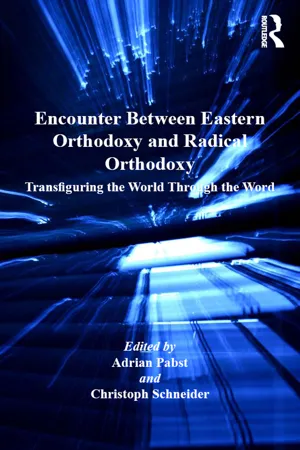
Encounter Between Eastern Orthodoxy and Radical Orthodoxy
Transfiguring the World Through the Word
- 314 pages
- English
- ePUB (mobile friendly)
- Available on iOS & Android
eBook - ePub
Encounter Between Eastern Orthodoxy and Radical Orthodoxy
Transfiguring the World Through the Word
About this book
This book presents the first debate between the contemporary movement Radical Orthodoxy and Eastern Orthodox theologians. Leading international scholars offer new insights and reflections on a wide range of contemporary issues from a specifically theological and philosophical perspective. The ancient notion of divine Wisdom (Sophia) serves as a common point of reference in this encounter. Both Radical and Eastern Orthodoxy agree that the transfiguration of the world through the Word is at the very centre of the Christian faith. The book explores how this process of transformation can be envisaged with regard to epistemological, ontological, aesthetical, ecclesiological and political questions. Contributors to this volume include Rowan Williams, John Milbank, Antoine Arjakovsky, Michael Northcott, Nicholas Loudovikos, Andrew Louth and Catherine Pickstock.
Information
PART I
Sophia, Theology and Philosophy
Chapter 1
Glorification of the Name and Grammar of Wisdom (Sergii Bulgakov and Jean-Marc Ferry)
Monde renversé je t’aime
J’aime à monde renversé1
Having read with much interest, or rather I should say with passion, the work of Archbishop Rowan Williams on Father Sergii Bulgakov, the works of John Milbank and Catherine Pickstock, as well as the presentation of Radical Orthodoxy in French by Adrian Pabst and Olivier-Thomas Venard, I share in the desire of Radical Orthodoxy to rediscover the living origins of orthodox Christianity and to promote an engagement between an intellectual movement, that of Radical Orthodoxy, and an ecclesiastical tradition, that of Eastern Orthodoxy. I do not believe that these terms are equivalent. But it seems to me that on both sides are those who have become aware of the end of an era, and of these modern times characterized in particular by assertion of denominational identity. However, at the origin of the ecumenical realization are found those whose lives have been radically changed by friendship – the friendship that was shared by Lord Halifax and Abbey Portal, and also that between Bishop Walter Frere and Father Sergii Bulgakov.
The transfiguration of the world by the Word is at the heart of The Philosophy of the Word and the Name by Sergii Bulgakov. His idea was that the worship of the Name of God was like the river of flowing water, shining like crystal, of the new Jerusalem, ‘The throne of God and of the Lamb shall be in it; and his servants shall serve him / And they shall see his face; and his name shall be on their foreheads’ (Rev 22:3–4). After briefly introducing The Philosophy of the Word and the Name by Sergii Bulgakov, I will then compare it with the communicational philosophy of the French thinker Jean-Marc Ferry, a professor at the Free University of Brussels and a close friend of Jürgen Habermas. My aim, in fact, is to demonstrate that from our ultra-modernity comes an idea that suggests the secret presence of the Logos at the heart of human intelligence. However, this philosophy still hesitates to pronounce the Name of God, perhaps because Christians themselves still owe a clear answer to the following question: is God’s name God himself?
The Philosophy of the Word and the Name
Sergii Bulgakov, dean of the St Serge Institute in Paris in the 1930s, drafted in the Crimea at the beginning of the 1920s two works that took him the rest of his life to complete. The first is called The Tragedy of Philosophy and the second The Philosophy of the Word and the Name. During his lifetime, only the first work and one chapter of the second What is the Word? were translated in 1927 and 1930 respectively, both into German. In these two papers, Bulgakov’s aim was above all to give an argued response to the debate before the First World War in Russia on the subject of the glorification of the Name of God.
It all started in 1907 with the publication of a book entitled In the Caucasus Mountains by a monk called Ilarion. In Moscow the book was supported by another monk, Antoni Boulatovitch, but it divided the Russian monasteries of Mount Athos on the subject of whether or not God’s name is God himself, to the point that the Archbishop of Constantinople Joachim III was forced to intervene on 12 September 1912 to condemn Ilarion’s book. The monks worshipping the Name of God did not back down and on 30 March 1913, the new Archbishop Germain V also strongly condemned those who he considered to be heretics, with the support of teachers from the Halki seminary. Finally, on 18 May 1913, the Holy Synod of Petrograd sent Bishop Nikon to dislodge about 600 rebel monks by force, a sign of the growing tensions between Moscow and Constantinople on the eve of the First World War. Numerous intellectuals moved in favour of the Onomatodox monks, among them Nicolai Berdyaev and Pavel Florensky. The latter explained that the Name of God, like the image of the icon, represents the divinity present in its energy – not in a substantialist sense but in ‘its flow of meaning’. The meaning of this was not generally understood and the outbreak of the war in 1914 temporarily closed the debate. During the Council of the Russian Church in 1917, Archbishop Tikhon joined in celebration with the Onomatodox monks as a gesture of reconciliation. However, the conciliatory commission, in which Sergii Bulgakov participated in the role of speaker, did not have time to make the assembly adopt any resolution relating to the decision of 1913. Since then, no decision has been made in the Orthodox Church on the subject of the veneration of the Name of God.
In his two treatises, Bulgakov sought to deepen the thinking on this question which had so far been confined to a simple opposition between the Onomatomdox – the enemies of the veneration of the Name – and the Palamite apophatic teaching on the distinction between essence and energies. Bulgakov saw, first of all, that only the symbolic philosophy of the world was able better to understand the foundations of the Name veneration. Thus, from this point of view, words are not conventional signs, but living and symbolic realities. Bulgakov even agreed with the Cabbalists for whom speech and hearing exist not because of themselves but because sounds exist. The word speaks within us. The word belongs to conscience but also to being. This is contrary to the nominalism of modernity for which words are only signatures of things, which lead to the divorce between things and words, as shown by Michel Foucault. Bulgakov’s view was that words are ‘things as much as they are meaning’. For him, people do not speak ‘with words’ but they are the theatre and the leading player: ‘from the birth of these by symbolisation of meanings, as much as for particular words as for speech in general’.2
This is why Bulgakov drafted a grammatical philosophy in which he distinguished three elements within the word: the phonetic aspect (phonème), the ‘envelope’ (morphème) and finally the meaning (synème). For Bulgakov, knowledge as ‘denomination-judgement’ is an artificial process by which a link is established between an object (a noun) and an idea (a predicate).3 This symbolic philosophy constitutes Bulgakov’s ‘linguistic turn’. Thus, if reason is inseparable from the verbal expression of a person, if language is energy, and if the essential purpose of language is to give a name, that is to say, to distinguish the field of the subject from that of the predicate, then human judgement itself must be learned in the same way as grammar. It is at this point that Bulgakov discovered in the fundamental structure of the subject-verb-object clause, the ‘tri-hypostatic dimension of the being’. This can be formulated as follows: the subject and the object are characterized, first, by the predication of one by the other, secondly, by the transformation of the object by the word of the subject, and thirdly, by the recognition of this transformation in terms of the verb ‘to be’ – as a result of which the subject and the object are recognized as the same. Grammatically, this means that the sole subject exists as itself in the noun, through itself in the object, and as and through itself in the verb ‘to be’. In other words, the subject is the pure hypostasis, the object is the nature of the hypostasis revealed in itself and before itself, so that the verb is the act of self-realization in its own nature.
Bulgakov went a step further in affirming in La tragédie de la philosophie that the whole history of modern philosophy and its derivations can be explained by this method of judgement. Indeed for him, the grammatical subject-verb-object clause is the foundation of the consciousness of the self. The mind is a living clause that constantly realizes itself. This means that, for Bulgakov, hypostasis is primary to ousia. Modern philosophy however, in equating ousia with nature, understands substance as a non-hypostatic nature and thus deprives it of all personal life. For Kant, substance is an abstract hypostasis for which only the subject exists. For Hegel, substance is the thought which self-generates, a philosophical version of Sabellianism. For Schelling, substance is identical with being, but in itself is no more than a relational function.
The overshadowing of nominalism by personalist ontologism thus allows Bulgakov to answer the questions of the Onomatodox. Bulgakov drew a parallel between the Name and the icon: ‘the phonème corresponds to the colours and the form of an icon, the morphème to the hieroglyphic character of the “original” that provides the design for the representation. The synème is the name itself, the energy of the representation’.4 According to Bulgakov, the only basis which allows the resolution of the question of icon worship is thus that of the nature of the Name of God: ‘The doctrine of divine energy and of the incarnation of the word-noun, justified by the image and the resemblance of God to mankind.’5
The Onomatodox denied the worship of the name of Jesus because of its variation according to language (Issus, Jesus, Ieshoua). The differentiation between the phonème and the synème (which relates to the speaker) resolves this problem. Moreover, the Onomatodox did not agree that God could freely reveal himself to men solely by the invocation of his name, and they considered that the power of the Name depended solely on the fervour of the prayer. Bulgakov’s response was thus:
They believe that the virtue of God’s name is conveyed accordingly to whether or not the prayer is heard, as if the Lord has to be convinced. God hears whoever calls him, but those who call him do not all do so from their hearts, and neither do they always hear God listening to them. Just as the Eucharist is everlastingly the Body and the Blood of Christ, whether it be in ‘salvation’ for some or ‘judgement and condemnation’ for others, so the Name of God is a divine energy, regardless of whether our attitude towards it is pious or sacrilegious. Given that the Name of God contains divine energy and that it offers the presence of God, it can be said that from the point of view of practice, energetics, even though it may be very imprecise, that God’s name is God himself. More precisely, that the divine power which is present in the Name, and which is indivisible from the Divine Being is, in this sense, God himself.6
Possible Comparisons with the Philosophy of Jean-Marc Ferry
I would like to interrupt my presentation of Bulgakov’s grammatical philosophy here, in order to highlight some similarities with ideas in contemporary philosophy, despite the fact that, for reasons that I have shown, very few contemporary philosophers or linguists are familiar with Sergii Bulgakov.7 I will concentrate on the work of Jean-Marc Ferry entitled Les grammaires de l’intelligence, published in 2004. Less well known than his brother Luc Ferry who was Minister for Education in the government of the former Prime Minister Jean-Pierre Raffarin, Jean-Marc Ferry is nevertheless regarded by thinkers, among them the late Paul Ricœur, as one of the most shining contemporary French philosophers.
Although Jean-Marc Ferry seems not to have heard of Bulgakov, a similar strand of thinking can be noted between him and the Russian philosopher. First, Ferry rejects, like Bulgakov, modern philosophies of representation. He prefers a communicative ontology, in the same way that Bulgakov advocates sobornost (‘conciliarity’) as the basis of knowledge. Ferry writes that
It is not from the substance of my own representation that I can conclude my own existence, it is rather by reducing my own representation to an act. What I recognize is thus an ‘I’, which can be understood as the representation of the self. ‘I am’ is the product of a positioning, which places me as an opposite.8
The same is true for Bulgakov, for whom the revelation of God’s name to Moses, ‘I am who I am’ (Ex 3:14), testifies to a supreme freedom. At this point, Ferry, like Bulgakov, gives precedence to the ideas of self-position and self-revelation above those of adequacy and conformity. This is because in the self-referential as well as in the communicational relationship, the interrogator is also the interrogated.
This means that Ferry, to the same degree as Bulgakov, contradicts the philosophy of Kant. For Kant, the explanation of comprehension, like the relationship between the image, which is viewed, and the concept which it represents, is seen as too theoretical. For Ferry, this idea is fundamentally flawed because of the reality that, in practice, the object is recognized even before the introduction of the idea. For Ferry, philosophy must thus be symbolic and rely on, as with Bulgakov, clauses and judgements: ‘The Grammar of propositions only consecrates the power of the symbol by integrating the moment of the icon and the index. It consecrates above all the power of the verb, the conjugated verb which involves in particular the tenses, the pronouns and the modes.’9 Thus in Les grammaires de l’intelligence can be found the same inversion as in La tragédie de la philosophie: ‘The transcendent rules become grammatical rules. This is the human discourse, it consists of a reference to something, an address to a person and the engagement of the self, which allows not the command of, but the participation in the realities of the world.’
However, Jean-Marc Ferry does not ignore modern linguistic theories in his work. For him...
Table of contents
- Cover Page
- Half Title Page
- Title Page
- Copyright Page
- Contents
- Acknowledgements
- List of Contributors
- Transfiguring the World through the Word
- Sophia, Theology and Philosophy
- Glorification of the Name and Grammar of Wisdom (Sergii Bulgakov and Jean-Marc Ferry)
- Commentary
- Sophiology and Theurgy: The New Theological Horizon
- Commentary
- Sophia, Politics and Ecclesiology
- The Metaphysics of Hope and the Transfiguration of Making in the Market Empire
- Wisdom and the Art of Politics
- Ontology, East and West
- Ontology Celebrated: Remarks of an Orthodox on Radical Orthodoxy
- Commentary Ecumenical Orthodoxy – A Response to Nicholas Loudovikos
- Kenosis, Poiesis and Genesis: Or the Theological Aesthetics of Suffering
- Commentary Silence, Intellect and Discourse in the Quest for the True Teaching – Reflections on Hermes Trismegistos' ‘Definitions'22
- The Beatific Vision of St Thomas Aquinas1
- Orthodoxy and Transfiguration
- Space, Time and the Liturgy
- Commentary Liturgical Twilight – A Footnote to Andrew Louth
- Wisdom in the Fathers: An (Eastern) Orthodox Perspective
- The Theologico-Political Constitution of Monastic Liturgy
- The Transformation of Eros: Reflections on Desire in Jacques Lacan
- Index
Trusted by 375,005 students
Access to over 1.5 million titles for a fair monthly price.
Study more efficiently using our study tools.
Frequently asked questions
Yes, you can cancel anytime from the Subscription tab in your account settings on the Perlego website. Your subscription will stay active until the end of your current billing period. Learn how to cancel your subscription
No, books cannot be downloaded as external files, such as PDFs, for use outside of Perlego. However, you can download books within the Perlego app for offline reading on mobile or tablet. Learn how to download books offline
Perlego offers two plans: Essential and Complete
- Essential is ideal for learners and professionals who enjoy exploring a wide range of subjects. Access the Essential Library with 800,000+ trusted titles and best-sellers across business, personal growth, and the humanities. Includes unlimited reading time and Standard Read Aloud voice.
- Complete: Perfect for advanced learners and researchers needing full, unrestricted access. Unlock 1.5M+ books across hundreds of subjects, including academic and specialized titles. The Complete Plan also includes advanced features like Premium Read Aloud and Research Assistant.
We are an online textbook subscription service, where you can get access to an entire online library for less than the price of a single book per month. With over 1.5 million books across 990+ topics, we’ve got you covered! Learn about our mission
Look out for the read-aloud symbol on your next book to see if you can listen to it. The read-aloud tool reads text aloud for you, highlighting the text as it is being read. You can pause it, speed it up and slow it down. Learn more about Read Aloud
Yes! You can use the Perlego app on both iOS and Android devices to read anytime, anywhere — even offline. Perfect for commutes or when you’re on the go.
Please note we cannot support devices running on iOS 13 and Android 7 or earlier. Learn more about using the app
Please note we cannot support devices running on iOS 13 and Android 7 or earlier. Learn more about using the app
Yes, you can access Encounter Between Eastern Orthodoxy and Radical Orthodoxy by Christoph Schneider, Adrian Pabst in PDF and/or ePUB format, as well as other popular books in Theology & Religion & Religion. We have over 1.5 million books available in our catalogue for you to explore.