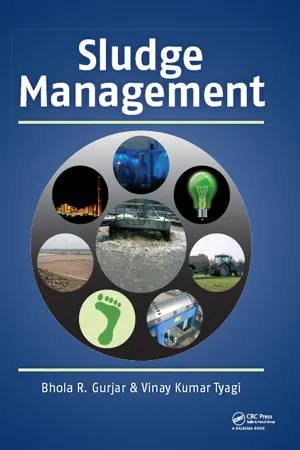
Sludge Management provides up-to-date information on sludge treatment, reuse and disposal. A comprehensive coverage of all issues related to sludge management is included with local through global coverage of all sludge management practices. Conventional to advanced technologies for sludge management with available case studies from both developing and developed countries are covered in this book. Given the responsibility of engineers to develop the technological tools to meet the increasingly stricter standards for sludge treatment and disposal, the main attraction of the book principally relies on its technical content that reviews all the points to be considered in sludge management from engineering and technological perspectives. Sludge Management can be used for planning, designing, and implementing waste sludge management projects. Moreover, this book can be used as a standard textbook in Universities for Master and Doctoral students. Also, academics, researchers, scientists, and practicing engineers working in the field of sludge management would find the book very informative and a source of interesting case studies.
- 304 pages
- English
- ePUB (mobile friendly)
- Available on iOS & Android
eBook - ePub
Sludge Management
About this book
Information
Chapter 1
Sludge: An overview
1.1 INTRODUCTION
Sludge is universally considered as waste, something to be disposed of out of sight and out of mind. As a result, the word “sludge” is usually associated with pollution, contamination and disease. Nobody wants it in their backyard, and everybody thinks it should be somewhere else.
Sludge can be defined as a soft mud or mire, a slimy precipitate produced during the treatment of waste water. As far as an environmental engineer is concerned, sludge is a byproduct of several processes (Bowen et al., 1990; Fleming, 1986):
• Water treatment plants
• Sewage treatment plants
• Dredging of rivers and harbours
• Coal and sand washeries
• Industrial manufacturing
• Agriculture.
Sludge can be regarded as consisting of particles aggregated into flocs that act hydrodynamically as single particles. These flocs can be in suspension, separated from other flocs (e.g. alum floc in water treatment prior to settling), or in a solid matrix where individual flocs cannot be identified and the sludge mass forms a continuum (e.g. waste-activated sludge).
In terms of the quantity of sludge, overall sludge production is dependent on influent loading, type of treatment, treatment performance, type of sludge-handling facilities, and effluent treatment requirements. In general, sludge production is expected to be directly related to the average dry-weather flow rate through the plant, assuming no changes in influent unit loading or the treatment process.
1.2 SOURCES OF SLUDGE
(Balmer & Frost, 1990; Girovich, 1990; Martin & Bhattarai, 1991; Supernant et al., 1990; Topping, 1986)
Sludge has several sources, namely, water treatment plants, municipal waste water treatment plants and industrial effluent treatment plants. Is sludge purely a waste? Can it serve as a resource? These questions require closely considered definitions of the terms “waste” and “resource”. Obviously, waste can be defined as something which is lying unused, unproductive, uncultivated, superfluous, or which is in disadvantageous (useless) condition. On the other hand, a resource is a means of generating wealth or money, that is, something that can be used in one or more ways, a thing from which some useful byproduct can be extracted, or something that helps in the manufacture of some advantageous product/item. Clearly, from such general definitions, any form of sludge that is put to use is not waste, but those sludges that are just dumped most certainly are.
1.2.1 Water treatment plants
In the case of water treatment plants, sludge comprises either settled particulate matter in sedimentation tanks, flocculated and precipitated material resulting from chemical coagulation, or the residue of excess chemical dosage, plankton, etc. In such cases, for continuous sludge removal, the feasibility of discharging sludge to existing sewers nearby is normally considered. For lime-softening plant sludge, reclamation by calcination and reuse can be explored.
Sludge from clarification units using iron and aluminium coagulants can be dewatered to a cake by vacuum filtration, using lime as a conditioner, and can conveniently be trucked to landfill. Recovery of alum from sludge by treatment with sulphuric acid offers possibilities for reduction in the quantities of sludge to be handled. Sand drying beds are an acceptable method for dewatering certain types of sludge from settling tanks or clarifiers for subsequent disposal to landfill. Simple lagooning of sludge can also bring about a reduction in the bulk of sludge to be handled, followed by disposal to landfill. However, acceptable rates of application of water treatment sludges to various soil types are related to the phosphorus-fixing capacity of the sludge.
1.2.2 Sewage treatment plants
Sewage sludge is slurry with a water content usually in excess of 95%. The solid phase consists principally of organic matter, derived from human, animal and food wastes. Other constituents are trace contaminants (metals and persistent organic compounds), mainly from industrial effluents and bacteria, some of which may be pathogenic.
Girovich (1990) describes the sewage sludge in its initial form as a liquid with 2–6% total solids (TS). On a dry basis, sludge contains 35–65% of organic matter, with the remainder being non-combustible mineral ash. Nutrients like nitrogen, phosphorus, potassium and some trace metals are present in sludge and it can be used as an effective fertiliser. However, the sludge also contains pathogens and, in some cases, constituents such as heavy metals and hazardous organics.
1.2.3 Industrial effluent treatment plants
Industrial waste water treatment facilities generate different types of sludge, which can be generally classified as either organic or inorganic, and both may contain toxic materials, mainly heavy metals. The presence of toxic compounds (e.g. from pharmaceutical and metal industries) contam...
Table of contents
- Cover
- Half Title
- Title Page
- Copyright Page
- Table of Contents
- Foreword
- Preface
- Acknowledgements
- Introduction
- 1 Sludge: An overview
- 2 Pumping of sludge
- 3 Treatment of sludge
- 4 Thickening of sludge
- 5 Sludge conditioning
- 6 Sludge dewatering
- 7 Biological stabilisation of sludge
- 8 Non-biological sludge stabilisation
- 9 Sludge stabilisation at small works
- 10 Sludge minimisation technologies
- 11 Sludge disinfection and thermal drying processes
- 12 Thermal treatment and sludge disposal
- 13 Sludge disposal methods, problems and solutions
- 14 Energy and resource recovery from sludge
- Problems
- Concluding remarks
- References
- Subject index
Trusted by 375,005 students
Access to over 1.5 million titles for a fair monthly price.
Study more efficiently using our study tools.
Frequently asked questions
Yes, you can cancel anytime from the Subscription tab in your account settings on the Perlego website. Your subscription will stay active until the end of your current billing period. Learn how to cancel your subscription
No, books cannot be downloaded as external files, such as PDFs, for use outside of Perlego. However, you can download books within the Perlego app for offline reading on mobile or tablet. Learn how to download books offline
Perlego offers two plans: Essential and Complete
- Essential is ideal for learners and professionals who enjoy exploring a wide range of subjects. Access the Essential Library with 800,000+ trusted titles and best-sellers across business, personal growth, and the humanities. Includes unlimited reading time and Standard Read Aloud voice.
- Complete: Perfect for advanced learners and researchers needing full, unrestricted access. Unlock 1.5M+ books across hundreds of subjects, including academic and specialized titles. The Complete Plan also includes advanced features like Premium Read Aloud and Research Assistant.
We are an online textbook subscription service, where you can get access to an entire online library for less than the price of a single book per month. With over 1.5 million books across 990+ topics, we’ve got you covered! Learn about our mission
Look out for the read-aloud symbol on your next book to see if you can listen to it. The read-aloud tool reads text aloud for you, highlighting the text as it is being read. You can pause it, speed it up and slow it down. Learn more about Read Aloud
Yes! You can use the Perlego app on both iOS and Android devices to read anytime, anywhere — even offline. Perfect for commutes or when you’re on the go.
Please note we cannot support devices running on iOS 13 and Android 7 or earlier. Learn more about using the app
Please note we cannot support devices running on iOS 13 and Android 7 or earlier. Learn more about using the app
Yes, you can access Sludge Management by Bhola Gurjar,Vinay Kumar Tyagi,Bhola R. Gurjar in PDF and/or ePUB format, as well as other popular books in Technology & Engineering & Civil Engineering. We have over 1.5 million books available in our catalogue for you to explore.