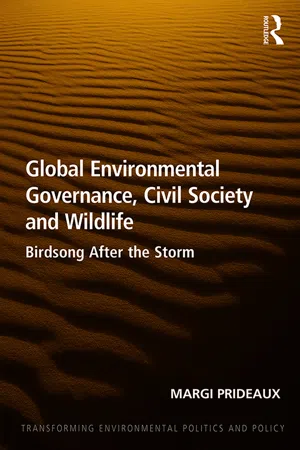
The world is entering a period of unprecedented environmental and political change. By mid-century, climate change will cause dramatic ecosystem shifts. Hundreds, if not thousands, of species will disappear from the earth including icons like polar bears, gorillas, Asiatic lions and bluefin tuna. For many cultures 'species' are 'place'. As our cultivated global community erodes, international triage decisions about species and local ecosystems will commence and if we are not alert, these decisions will be made on our collective behalf, without local perspective or accountability. Global Environmental Governance, Civil Society and Wildlife illuminates a clear pathway for the environmental, non-governmental community to transition into a co-governance role. Many NGO diplomats have deeper experience and more technical knowledge about policy discussions than their government counterparts and are unburdened by sovereign constraints. The book puts forward the perspectives of developing world civil society and the case that it must play a more significant role in future decision making. Civil society from around the world must be welcomed by governments at the global environmental governance table if we are to hear birdsong after the storm.
eBook - ePub
Global Environmental Governance, Civil Society and Wildlife
Birdsong After the Storm
- 168 pages
- English
- ePUB (mobile friendly)
- Available on iOS & Android
eBook - ePub
About this book
Information
1 The barometer is rising
A storm is coming
A storm is coming; a maelstrom like we have never experienced before. The combined forces of climate change and political upheaval will play out with more of us aware than at any other time in human history.
Global warming is not hypothetical. It is happening now. Wave after wave of data confirms it. Each of the past several decades has been significantly warmer than the previous ones. The period 2011–2015 was the hottest on record, as was the year 2015 – with an extra boost from a powerful El Niño. The record-breaking trend continued in 2016. Climate change is increasing the frequency and intensity of extreme events like heat waves, droughts and heavy rainfall.[1] The World Meteorological Organization Hurricane Committee reported that the Eastern North Pacific experienced nine major hurricanes (above Category 3) in 2015 – the most since reliable records began in 1971. The Accumulated Cyclone Energy, which measures the combined strength and duration of tropical storms and hurricanes, was about 63 per cent higher than the 1981–2010 average.[2] India and Pakistan suffered the traumatic and devastating effects of heat waves right through 2015. Thousands of lives were lost. The India Meteorological Department has warned of heat-wave conditions still to come.[3] Global average sea level has risen by about 17 cm between 1900 and 2005 at a much faster rate than in the previous 3,000 years.[4] Record rainfall led to flooding that impacted on tens of thousands of people across South America, West Africa and Europe. At the same time, unseasonal dry conditions in southern Africa and Brazil exacerbated multi-year droughts. The global average near-surface temperature for 2015, when the core of this book was written, was the warmest on record by a clear margin.[4]
The first dangerous milestone was crossed in 2013 when Hawaii’s Mauna Loa Observatory, a key scientific facility run by the University of California, measured a carbon dioxide (CO2) concentration in the atmosphere at over 400 parts per million – around 40 per cent higher than before the Industrial Revolution and higher than at any time in human history. That milestone was the trigger for me to begin thinking about this book. The year 2015 was the impetus to start writing. As I write, news has been released that atmospheric CO2 concentration of the entire southern hemisphere is now at or above 400 parts per million, much earlier than the experts had predicted. Casey Station on Antarctica exceed 400 parts per million on 10 May 2016.[5] The last time CO2 levels were this high, some three to five million years ago, the mean global temperature was around 3°C higher than the pre-Industrial average, the sea level was up to 40 metres higher, and the Greenland ice sheet was impermanent. A changing climate has both fast and slow pulses, so temperature shifts and sea-level rise will build momentum in the coming few decades. Our lives and our livelihoods are already changing.
We have absorbed the news of the looming impact of climate change for some time now – like watching a disaster unfold in slow motion. So slow at times that our daily lives continue between the scenes. We are aware of it nonetheless, and for some of us these impacts are already tangible.
On our farm in Australia we now live between two extremes; less rainfall and more very hot days. As I began this book we had just come out of the driest winter in living memory. Without winter rain our reservoirs were dry throughout the summer. There was less green vegetation to sustain the farm. Through spring and summer we anxiously watched the skies for lightning storms on the horizon. When I was a child lightning was exciting. With the long stretches of hot dry days, lightning now means wildfires.
Elsewhere the signs are far worse. Climate change has impacted all continents and all oceans. Arctic sea ice is retreating at a visible rate. Melting around Antarctica is causing sea ice changes which are still not well understood.[6–8] After lifetimes in harmony with the ocean, people of the Pacific and the Indian Oceans already look across the waves to a bleak future. The homes of their ancestors will soon disappear; the sea engulfing their history. Europe’s glaciers are retreating. The United Kingdom has been flooding. The Sahara Desert is encroaching on farmland on the African continent, forests are disappearing from Congo to Madagascar and rising sea levels are swallowing homes in West African river deltas. North America faces severe heat, heavy rain and declining snowpack.[6, 9–12] Thirty per cent of the fertile land in the world has vanished in the past 30 years.
Climate change is happening now.
Impacts in the future won’t discriminate. Large cities, isolated from the natural world, will be just as susceptible as the ancient Amazon rainforest.[13–16] In the 1970s there were 660 reported disasters around the world including droughts, floods, extreme temperatures events, wildfires and storms. In the 2000s there were 3,322. This is a fivefold increase in just over 30 years.[17] We can expect more climate-related extremes: more heat waves, droughts, floods, cyclones, and wildfires. Competition for water will be intense. In many regions our staple crops and fisheries will diminish.[18] Climate change is expected to reshape the global economy by substantially reducing economic output, reducing average global incomes by roughly 23 per cent by 2100.[19] There will be serious food and water security issues. Violent conflicts, amplified by poverty, will become more common.[6]
While we feel the human impacts, the natural world will also be lurching. The current rates of species extinction are already one thousand times the rate that would be expected if humans were not a factor. In the near future, rapid shifts, caused by climate change, will exceed the ability of many species to migrate or adjust.[6, 20–23] A quarter of the Earth’s species could be extinct by midcentury.[24] It is perhaps a sad coincidence that extinction rates will be greatest where the power of people is the least – Latin America, Africa, Oceania.[25] If we continue as we now are, the dawn of the next century will grieve the loss of icons – gorillas, polar bears, lions, tuna, sandpipers and warblers.
The longer the world community dithers, the stronger the likelihood of ‘severe, pervasive and irreversible impacts for people and ecosystems’.[18]
The Intergovernmental Panel on Climate Change (IPCC) is the pre-eminent scientific body for climate change. It was established by the United Nations in 1988, at the request of member governments. Its role is to track and advise on matters relating to climate change. There is no higher or more rigorous scientific authority. Their meetings are no side event, nor are they informal gatherings of left-leaning trouble-makers – as the climate sceptics would have you believe.
Every few years ‘the best and the brightest’ are nominated – by governments – to participate in the IPCC review of the most recent scientific, technical and socio-economic information about the biosphere and to assess what is likely to happen in the decades to come.[26] The scientists involved are all respected, published, acknowledged experts in their fields and their main task is to merge this information into a series of reports for governments to consider. Their reports have always been sobering reading and the fifth formal report does not break the trend.[18]
With the input of thousands of scientists, their message is clear and as solid as science ever gets. Warming of the climate system is unequivocal. Human influence on the climate system is clear, and emissions of greenhouse gases are the highest in history. The atmosphere and ocean have warmed, snow and ice have diminished, and the sea level has risen.[18]
In 2015 the world’s governments collectively, finally, agreed that the IPCC is right. The freshly minted Paris Agreement turned a corner on decades of political disregard. Countries agreed to limit emissions, and to continually review and strengthen actions every five years, beginning in 2018. They have set an aspirational goal of 1.5°C that most closely aligns to the scientific recommendations of the IPCC, with a politically expedient target of 2°C, but their pledges (formally called the Intended Nationally Determined Contributions or INDCs) still have the world on a road to between 2.7°C and 3.7°C of warming compared with pre-industrial levels. It is true, this is better than the 4.5°C trajectory before the Paris Summit, but it is significantly short of where we need to be.[27] They won’t revisit this figure again until 2020 when their ‘five year meeting’ to present updated plans on raising their emission cuts begins. Starting in 2023, they will have to update the public on their progress.
The new agreement doesn’t take effect until 2020. The window to achieve the 1.5°C goal will have already gone, unless all of the world’s largest economies dramatically change course. Emissions levels in 2025 and 2030 will have significant consequences for our ability to limit warming to 2°C. The higher the emissions in the near term, the greater the emissions reduction will be required in later decades.[27, 28]
I have worked in international environmental negations for 25 years. I know that all governments need to do to meet their obligations under the Paris Agreement is to come back in 2023 (and every five years after that) and say they’ll do a little more.[28, 29] So long as they do that their peers (i.e., other governments) won’t shame them. There is no new money promised to address climate change in developing countries, and discussing loss and damage now or in the future is off limits in order to appease wealthy countries responsible for hundreds of years of emissions that have brought us to this point. The very industries that need to change are absent from the Agreement. Oil, gas, or coal producers have not been told to leave fossil fuels in the ground, and carbon pollution from international shipping and flights don’t count as greenhouse gas emissions.[29] The two issues that matter the most – actual emission reductions and financial investment – have no explicit numerical targets for individual countries and no meaningful mechanisms for ensuring accountability.[28]
As part of the Paris deal, governments have put dangerous trust in future technologies – on physically removing huge quantities of carbon dioxide from the atmosphere many decades from today.
It is easy to be swept away in the euphoria of governments achieving even a small level of harmony in Paris. But objective assessment soon dents that high. In the days directly after the Paris Summit, Kevin Anderson wrote:
If the global community is to maintain emissions with the 2°C carbon budget, there needs to be much greater recognition of the profound and immediate challenges we face. The scale of emission reductions will not be delivered through eloquent speeches, win-win rhetoric and green-growth spin. Zero carbon energy technologies are a prerequisite...
Table of contents
- Cover
- Half Title
- Title Page
- Copyright Page
- Table of Contents
- Acronyms
- Species names and IUCN status
- Acknowledgments
- Preface
- 1. The barometer is rising
- 2. Storm on the horizon
- 3. Lightning cracks
- 4. Thunder rumbles
- 5. Rain pours
- 6. Through the storm
- 7. Birdsong after the storm
- Index
Trusted by 375,005 students
Access to over 1.5 million titles for a fair monthly price.
Study more efficiently using our study tools.
Frequently asked questions
Yes, you can cancel anytime from the Subscription tab in your account settings on the Perlego website. Your subscription will stay active until the end of your current billing period. Learn how to cancel your subscription
No, books cannot be downloaded as external files, such as PDFs, for use outside of Perlego. However, you can download books within the Perlego app for offline reading on mobile or tablet. Learn how to download books offline
Perlego offers two plans: Essential and Complete
- Essential is ideal for learners and professionals who enjoy exploring a wide range of subjects. Access the Essential Library with 800,000+ trusted titles and best-sellers across business, personal growth, and the humanities. Includes unlimited reading time and Standard Read Aloud voice.
- Complete: Perfect for advanced learners and researchers needing full, unrestricted access. Unlock 1.5M+ books across hundreds of subjects, including academic and specialized titles. The Complete Plan also includes advanced features like Premium Read Aloud and Research Assistant.
We are an online textbook subscription service, where you can get access to an entire online library for less than the price of a single book per month. With over 1.5 million books across 990+ topics, we’ve got you covered! Learn about our mission
Look out for the read-aloud symbol on your next book to see if you can listen to it. The read-aloud tool reads text aloud for you, highlighting the text as it is being read. You can pause it, speed it up and slow it down. Learn more about Read Aloud
Yes! You can use the Perlego app on both iOS and Android devices to read anytime, anywhere — even offline. Perfect for commutes or when you’re on the go.
Please note we cannot support devices running on iOS 13 and Android 7 or earlier. Learn more about using the app
Please note we cannot support devices running on iOS 13 and Android 7 or earlier. Learn more about using the app
Yes, you can access Global Environmental Governance, Civil Society and Wildlife by Margi Prideaux in PDF and/or ePUB format, as well as other popular books in Politica e relazioni internazionali & Politica. We have over 1.5 million books available in our catalogue for you to explore.