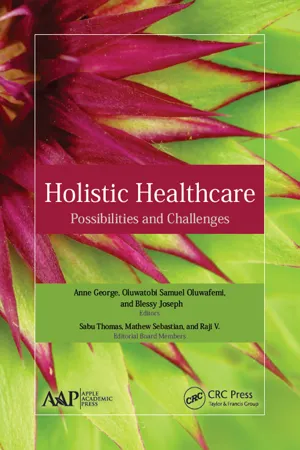
This new book focuses on recent trends in holistic medicine, the art of maintaining proper balance between one's physical health and mental well-being. The books highlights the importance of maintaining a healthy life style for physical well-being and examines the advantages of using traditional medicine to combat multi-drug-resistance problems caused by modern-day antibiotics. It details the advantages of using holistic approaches to treat infectious diseases with relevant clinical data.
eBook - ePub
Holistic Healthcare
Possibilities and Challenges
- 276 pages
- English
- ePUB (mobile friendly)
- Available on iOS & Android
eBook - ePub
Holistic Healthcare
Possibilities and Challenges
About this book
Information
Topic
MedicineCHAPTER 1
A TOUR AROUND THE WORLD’S MEDICAL SYSTEMS USING EVIDENCE-BASED MEDICINE TO POINT OUT WHAT IS THE BEST MEDICINE: HOLISTIC MIND–BODY MEDICINE IS SAFEST AND MOST EFFECTIVE FOR MOST CLINICAL CONDITIONS
SØREN VENTEGODT*
Quality of Life Research Center, Copenhagen, Denmark Research Clinic for Holistic Medicine, Copenhagen, Denmark Nordic School of Holistic Medicine, Copenhagen, Denmark
*E-mail: [email protected]
CONTENTS
Abstract
1.1 What Is Evidence-Based Medicine?
1.2 Two Major Components of Good Scientific Medicine: Good Theory and Good Clinical Documentation
1.3 Advices to the Person Who Wants to Seek Holistic Medicine/Therapy
1.4 Holistic Medicine Around the World
1.5 Comparative Analysis of Cost-Benefit and Cost-Effectiveness of All Types of Evidence-Based Medicine for All Clinical Conditions
1.6 Methods
1.7 Results
1.8 Discussion
1.9 Conclusion
Acknowledgments
Keywords
References
ABSTRACT
Aim: To examine the conditions for good medical science and to compare cost-benefit and cost-effectiveness of all types of evidences-based medicine, both pharmaceuticals and non-drug complementary and alternative medicine (CAM) for all clinical conditions.
Method: Calculating therapeutic value (TV = Total number needed to harm (NNHtotal)/Number needed to treat (NNT)) and cost per cured patient (year 1–50) for 10 different types of evidence-based medicine. Cost is presented as EURO (€) per cured patient, EURO per quality-adjusted life year (QALY), EURO per health-adjusted life year (HALY), and number of harmed patients per cured patient. The cost of one year of treatment was set to €2000 and the difference between healthy to 20% (quality of life (QOL), self-rated health).
Results: We found the most effective CAM-types (mind–body medicine, holistic medicine, Shamanism) to be 100 times as cost-effective and 10,000 times less harmful compared to pharmaceuticals. The 50 years’ estimated cost for one patient cured was for drugs €1,000,000; physical therapy €100,000; psychotherapy €100,000; mind — body medicine €50,000; holistic mind–body medicine €20,000; and one-session shamanistic healing with hallucinogenic drugs €2000. CAM is more efficient than drugs and has no side effects and adverse events, whereas treatment with drugs always has adverse effects and events.
Interpretation: To be useful, medicine must have significant therapeutic value (good benefit-to-harm ratio: TV ≥ 1) and documented longterm effect and safety. Holistic mind–body medicine seems to be the safest and most effective of all types of medicine for almost all clinical conditions. The shift from drugs to non-drug CAM would improve health and quality of life radically in society and reduce harm to patients and the cost of healthcare to a small fraction. Strict laws should be introduced immediately in all countries to stop the pharmaceutical industry from promoting drugs without therapeutic value, and from repressing CAM.
1.1 WHAT IS EVIDENCE-BASED MEDICINE?
Evidence-based medicine is medicine based on scientific evidence of high quality. Medicine is everything that is intended for healing or prevention of physical and mental disease, discomfort, suffering, pour sexual, social, work etc. functioning, general unhappiness or any other aspect of our “global quality of life.” What quality of life (QOL) truly is remains a deep mystery for science; countless efforts of reducing this concept to something more practical and measurable have failed miserably. Therefore, medicine at its core remains a mystery also: It is simply philosophically unclear what you intend to improve. In the end of the analyses you want to improve the human being him- or herself, which is basically impossible, unless we let go of our own personality and conditioning, all our properties, and all our bonds to the world, as recommended by the spiritual mystics and religious leaders like Krishna, Buddha, and Jesus.
Medicine of the mind and the body remains an interest of small souls; greater souls would address the health of the spirit; unfortunately, spiritual health and self-insight often comes from suffering, poverty, and physical and mental illnesses which therefore should not be alleviated.
Medicine comes as magical rites, behavioral advices, magical amulets or potions, chemical drugs, physical interventions, like surgery or radiation therapy, physical therapy like massage and acupressure, and many different kinds of talk therapy. Even religious interventions like prayers, healings, meditation, and religious and philosophical teachings must be classified as medicine in the broadest meaning of this word.
The root of all these problems is of course that we do not, in scientific terms, understand consciousness itself, which gives rise to all our experiences, good and bad.
Table 1.1 gives a classification of medicines (including complementary and alternative medicine (CAM) and biomedicine) into 10 principal classes.
TABLE 1.1 Classification of Medicine (Including CAM and Biomedicine) into 10 Principal Classes: Classes 1 and 2 are Chemical Medicines; 3–10 are Informational Medicines.
1. Chemical medicine (biomedicine with bioactive molecules).
2. Chemical CAM (flower medicine, herbal medicine, diets, minerals, vitamins etc.).
3. Body-medicine (low-energy types: massage, reflexology, physical therapy, physiotherapy, spa, sauna etc.; high-energy types: chiropractics etc.).
4. Mind-medicine (psychotherapy—psychodynamic, cognitive, gestalt etc.—psychoanalysis, meditation, no-touch sexology, couching, healing music etc.).
5. Spirit-medicine (philosophical interventions, energy medicine, prayers, spiritual healing (i.e., Reichi), Shamanism, spiritual CAM (i.e., crystal healing) etc.).
6. Mind–body medicine (acupuncture, acupressure, homeopathy, manual sexology, body-psychotherapy, Reichian bodywork, Rosen therapy, ergo therapy etc.).
7. Body–spirit medicine (prayer involving physical activity like in Tibetan Buddhist-style meditation, pilgrimage etc.).
8. Holistic body-mind-spirit medicine—including existential therapy (holistic medicine, clinical medicine, clinical holistic medicine, holistic body-psychotherapy, holistic bodywork, the sexological examination, holistic mind–body medicine, biodynamic body-psychotherapy, tantric bodywork and massage, holistic sexology, Native American rituals).
9. Chemical body-mind-spirit medicine (Shamanism with peyote, Ayahuasca, magic mushrooms, Grof’s LSD psychotherapy etc.)
10. Social and environmental medicine (coaching, work-related personal development programs, stress management, leadership training, gardening, aesthetic architecture, Feng Shui etc.)
The next important question is “what scientific evidence is?” It is almost as difficult to answer as to the question about what medicine is. All sciences use axioms which cannot be proven. Therefore, all sciences are basically religion. That is even the case with pure mathematics, and much more the case with chemistry and physics, and even more with life sciences like biology and medicine, where life, consciousness, and happiness becomes core issues in spite of our almost total lack of scientific understanding of these subjects.
In science, the concept of true and false is essential, but how can any statement based on mind be absolutely true? It can only be relatively true, so the art of science is to make it simple and so, related to reality that we can be somewhat happy that our statement is at least true in a relative sense.
If consider a medicine and ask if a cure is helpful to a clinical condition, we need to test the cure on patients, and see if their condition improves. This is lovely simple. If you have a simple measure like pain, we can make the patient rate his pain before and after treatment and we can immediately see if we help the patients. If we test the cure on 20 patients with comparable pains, we can even calculate a mean for the improvement and say that our cure is so and so helpful for his kind of pain.
So, simple before-and-after studies using simple measures for simple and well-defined states of illness and suffering gives us relatively true measures for effectivity and safety of medicine.
But, the methods used for testing medicines today are not like that. They are highly complex procedures where many things can be adjusted until the wished-for results are created. The famous randomized clinical trial (RCT) is an example of such a method, which is not even relatively true. According the many critiques, it is nowadays only used by pharmacological companies to market poisonous chemicals as effective and safe medicine.1
In general, the more complex a thing is made, the less transparent it is, and the less it has to do with reality, the less true it is.
1.2 TWO MAJOR COMPONENTS OF GOOD SCIENTIFIC MEDICINE: GOOD THEORY AND GOOD CLINICAL DOCUMENTATION
Human beings are bio-psycho-social beings2; while science is quite clear and simple when it comes to chemistry, physics, and biology, it gets quite unclear and flimsy when it comes to psychology, and really messy when it comes to the social dimensions of man.
Good medicine theory is of course interdisciplinary; it describes man as a bio-psycho-social being and disease as a disturbance in the wholeness, not in one of its parts. When you get sick, the symptoms are often in your body, but the cause is in your psyche; and if you explore your mental dimension you will find that it is highly dependent on you social reality.
If you look at the immune system, its immunological defense power comes from the inner balance of the organism3; but this balance is hard to describe in scientific terms. We know that staying healthy is closely related to quality of life and happiness; you can say that happiness is the best medicine.
The biological and cellular order is highly sensitive to the state of mind of the person; but happiness goes even deeper: happiness goes to the roots of you being and stretches out to you most remote of your relationships. Your happiness vibrates though you whole existence. Happiness is a mystery in itself; there is no...
Table of contents
- Cover
- Half Title
- Title Page
- Copyright Page
- About the Editors
- Editorial Board Members
- Table of Contents
- List of Contributors
- List of Abbreviations
- Preface
- 1. A Tour Around the World’s Medical Systems Using Evidence-Based Medicine to Point Out What Is the Best Medicine: Holistic Mind–Body Medicine Is Safest and Most Effective for Most Clinical Conditions
- 2. African Traditional and Alternative Medicine Implementation into Primary Healthcare Systems in Africa: Bottlenecks and Prospects
- 3. Postures
- 4. Integrative Pharmacology–Interconnecting the World of Ayurveda (Traditional Indian Medicine–TIM), Traditional Chinese Medicine (TCM), and Conventional Medicine (CM)
- 5. Concept and Principles of Yoga
- 6. The Potential Bactericidal Properties of Some Plants Commonly Used in Ayurvedic Medicinal Practices of South India
- 7. Antibacterial Effect of Green Tea and Black Tea Extract Against Selected Genera of Bacteria
- 8. In vitro Anti-Platelet Aggregation Property of Heracleum candolleanum (Wight et Arn.) Gamble, A Promising Tribal Medicinal Plant from Western Ghats
- 9. Role of Medicinal Plants in Targeting Important Signaling Pathways in Cervical Cancer
- 10. Audio Visual Entrainment and Acupressure Therapy for Insomnia
- 11. A Review on Medicinal Plants Used in Cardioprotective Remedies in Traditional Medicine
- 12. Scope of Non-Invasive Surgery of Shushrut in the Present Era with Special Reference to Keloids
- 13. Complex Issues Related to Human Reproduction in Modern Society
- Index
Trusted by 375,005 students
Access to over 1.5 million titles for a fair monthly price.
Study more efficiently using our study tools.
Frequently asked questions
Yes, you can cancel anytime from the Subscription tab in your account settings on the Perlego website. Your subscription will stay active until the end of your current billing period. Learn how to cancel your subscription
No, books cannot be downloaded as external files, such as PDFs, for use outside of Perlego. However, you can download books within the Perlego app for offline reading on mobile or tablet. Learn how to download books offline
Perlego offers two plans: Essential and Complete
- Essential is ideal for learners and professionals who enjoy exploring a wide range of subjects. Access the Essential Library with 800,000+ trusted titles and best-sellers across business, personal growth, and the humanities. Includes unlimited reading time and Standard Read Aloud voice.
- Complete: Perfect for advanced learners and researchers needing full, unrestricted access. Unlock 1.5M+ books across hundreds of subjects, including academic and specialized titles. The Complete Plan also includes advanced features like Premium Read Aloud and Research Assistant.
We are an online textbook subscription service, where you can get access to an entire online library for less than the price of a single book per month. With over 1.5 million books across 990+ topics, we’ve got you covered! Learn about our mission
Look out for the read-aloud symbol on your next book to see if you can listen to it. The read-aloud tool reads text aloud for you, highlighting the text as it is being read. You can pause it, speed it up and slow it down. Learn more about Read Aloud
Yes! You can use the Perlego app on both iOS and Android devices to read anytime, anywhere — even offline. Perfect for commutes or when you’re on the go.
Please note we cannot support devices running on iOS 13 and Android 7 or earlier. Learn more about using the app
Please note we cannot support devices running on iOS 13 and Android 7 or earlier. Learn more about using the app
Yes, you can access Holistic Healthcare by Anne George, Oluwafemi Samuel Oluwatobi, Blessy Joseph, Anne George,Oluwafemi Samuel Oluwatobi,Blessy Joseph in PDF and/or ePUB format, as well as other popular books in Medicine & Alternative & Complementary Medicine. We have over 1.5 million books available in our catalogue for you to explore.