This chapter outlines briefly the historical development, emergence, and merging of the fundamental digital communication and optical communication techniques to fully exploit and respond to the challenges of the availability of ultra-high frequency and ultra-wideband in the optical spectra of optical fiber communications technology. The organization of rest of the chapters of the book is outlined in this chapter.
1.1 Digital Optical Communications and Transmission Systems: Challenging Issues
Starting from the proposed dielectric waveguides by Kao and Hockham [1,2] in 1966, the first research phase attracted intensive interest around the early 1970s in the demonstration of fiber optics, and optical communications has greatly progressed over the past three decades. The first-generation lightwave systems were commercially deployed in 1983 and operated in the first wavelength window of 800 nm over multimode optical fiber (MMF) at transmission bit rates of up to 45 Mbps [1, 2 and 3]. After the introduction of ITU-G652 standard single-mode fiber (SSMF) in the late 1970s [3,4], the second generation of lightwave transmission systems became available in the early 1980s [5,6]. The operating wavelengths were shifted to the second window of 1300 nm, which offers much lower attenuation for silica-based optical fiber as compared to the previous 800 nm region. In particular the chromatic dispersion (CD) factor is close zero. This spectral window is current attracting lots of interests for optical interconnections for data centers. These second-generation systems could operate at bit rates of up to 1.7 Gbps and have a repeaterless transmission distance of about 50 km [7]. Further research and engineering efforts were also devoted to the improvement of the receiver sensitivity by coherent detection techniques, and the repeaterless distance reached 60 km in installed systems with a bit rate of 2.5 Gbps. Optical fiber communications then evolved to third-generation transmission systems that utilized the lowest-attenuation 1550 nm wavelength window and operated up to a bit rate of 2.5 Gbps [7,8]. These systems were commercially available in 1990 with a repeater spacing of around 60–70 km [7,9]. At this stage, the generation of optical signals was based on direct modulation of the semiconductor laser source and either direct detection. Since the invention of erbium-doped fiber amplifiers (EDFAs) in the early 1990s [10, 11 and 12], lightwave systems have rapidly evolved to wavelength division multiplexing (WDM) and shortly after that to dense WDM (DWDM) optically amplified transmission systems that are capable of transmitting multiple 10 Gbps channels. This is because the loss is no longer a major issue for external optical modulators, which normally suffer an insertion loss of at least 3 dB. These modulators allow the preservation of the narrow linewidth of distributed feedback lasers (DFBs). These high-speed and high-capacity systems extensively exploited the external modulation in their optical transmitters. The present optical transmission systems are considered as the fifth generation, having a transmission capacity of a few terabits per second [7].
Coherent detection, homodyne or heterodyne, was the focus of extensive research and development during the 1980s and early 1990s [13, 14, 15, 16, 17 and 18] and was the main detection technique used in the first three generations of lightwave transmission systems. At that time, the main motivation for the development of coherent optical systems was to improve the receiver sensitivity, commonly by 3-6 dB [14,17]. Thus, the repeaterless transmission distance could be extended to more than 60 km of SSMF (with a 0.2 dB/km attenuation factor). However, coherent optical systems suffer severe performance degradation due to fiber dispersion impairments. In addition, the phase coherence for lightwave carriers of the laser source and the local laser oscillator were very difficult to maintain. On the contrary, the incoherent detection technique minimizes the linewidth obstacles of the laser source as well as the local laser oscillator, and thus relaxes the requirement of the phase coherence. Moreover, incoherent detection mitigates the problem of polarization control in the mixing of transmitted lightwaves and the local laser oscillator in the multiterahertz optical frequency range. The invention of EDFAs, which are capable of producing optical gains of 20 dB and above, has also greatly contributed to the progress of incoherent digital photonic transmission systems up to now.
Recent years have witnessed a huge increase in demand for broadband communications driven mainly by the rapid growth of multimedia services, peer-to-peer networks, and IP streaming services, in particular IP TV. It is most likely that such tremendous growth will continue in the coming years. This is the main driving force for local and global telecommunications service carriers to develop high-performance and high-capacity next-generation optical networks. The overall capacity of WDM or DWDM optical systems can be boosted either by increasing the base transmission bit rate of each optical channel, multiplexing more channels in a DWDM system or, preferably, by combining both of these schemes. However, while implementing these schemes, optical transmission systems encounter a number of challenging issues, which are outlined in the following paragraphs Figure 1.1.
Current 10 Gbps transmission systems employ intensity modulation (IM), also known as on–off keying (OOK), and utilize non-return-to-zero (NRZ) pulse shapes. The term OOK can also be used interchangeably with amplitude shift keying (ASK) [1,2].* For high-bit-rate transmission such as 40 Gbps, the performance of OOK photonic transmission systems is severely degraded owing to fiber impairments, including fiber dispersion and fiber nonlinearities. The fiber dispersion is classified as CD and polarization-mode dispersion (PMD), causing the intersymbol interference (ISI) problem. On the contrary, severe deterioration in the system performance due to fiber nonlinearities result from high-power spectral components at the carrier and signal frequencies of OOK-modulated optical signals. It is also of concern that existing transmission networks comprise millions of kilometers of SSMF, which have been installed for approximately two decades. These fibers do not have as advanced properties as the state-of-the-art fibers used in recent laboratory “hero” experiments, and they have degraded after many years of use.
The total transmission capacity can be enhanced by increasing the number of multiplexed DWDM optical channels. This can be carried out by reducing the frequency spacing between these optical channels, for example, from 100 GHz down to 50 GHz, or even 25 GHz and 12.5 GHz [19,20]. The reduction in the channel spacing also results in narrower bandwidths for the optical multiplexers (mux) and demultiplexers (demux). On passing through these narrowband optical filters, signal waveforms are distorted and optical channels suffer the problem of interchannel crosstalk. The narrowband filtering problems are becoming more severe at high data bit rates, for example, 40 Gbps, thus degrading the system performance significantly.
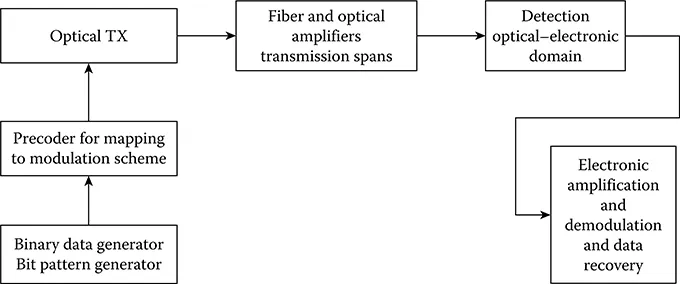
FIGURE 1.1 Schematic diagram of the modulation and the electronic detection and demodulation of an advanced modulation format optical communications system.
Together with the demand for boosting the total system capacity, another challenge for the service carriers is to find cost-effective solutions for the upgrading process. These cost-effective solutions should require minimum renovation of the existing photonic and electronic subsystems; that is, the upgrading should only take place at the transmitter and receiver ends of an optical transmission link. Another possible cost-effective solution is to extend significantly the uncompensated reach of optical transmission links, that is, without using dispersion compensation fibers (DCFs), thus considerably reducing the number of required in-line EDFAs. This network configuration has recently attracted the interest of both the photonic research community as well as service carriers.
Over the past few years, extensive research and development has proved that coherent reception incorporating digital signal processing (DSP) can push the bit rates per wavelength channel to 100 Gbps by employing 25 GBaud polarization multiplexing and QPSK (two bits/symbol) and/ or M-ary quadrature amplitude modulation (M-QAM) to aggregate to 200 Gbps or 400 Gbps. Furthermore, the channels can be made pulse shaped by using digital-to-analog converter (DAC) to pack the channels into superchannels to generate terabits per second (Tbps) per channel with subcarriers. The advances of ultra-high sampling rate analog-to-digital converters (ADCs) and DACs at 64 GSa/s allow the DSP to recover the clock, and hence the sampling rate and time, combating the linear and nonlinear impairments due to CD, PMD, self-phase modulation (SPM), cross-phase modulation (XPM), and other effects. The transmission for 100 Gbps would reach 3500 km in field trials and 1750 km for 200 Gbps over optically amplified and non-DCF fiber span transmission distances.
Therefore, the principal motivations of this book are to describe the employment of digital communications in modern optical communications. The fundamental principles of digital communications, both coherent and incoherent transmission and detection techniqu...