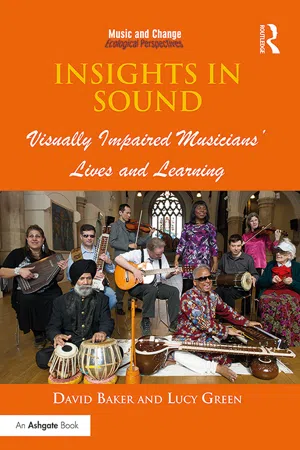
Music has long been a way in which visually impaired people could gain financial independence, excel at a highly-valued skill, or simply enjoy musical participation. Existing literature on visual impairment and music includes perspectives from the social history of music, ethnomusicology, child development and areas of music psychology, music therapy, special educational needs, and music education, as well as more popular biographical texts on famous musicians. But there has been relatively little sociological research bringing together the views and experiences of visually impaired musicians themselves across the life course. Insights in Sound: Visually Impaired Musicians' Lives and Learning aims to increase knowledge and understanding both within and beyond this multifaceted group. Through an international survey combined with life-history interviews, a vivid picture is drawn of how visually impaired musicians approach and conceive their musical activities, with detailed illustrations of the particular opportunities and challenges faced by a variety of individuals. Baker and Green look beyond affiliation with particular musical styles, genres, instruments or practices. All 'levels' are included: from adult beginners to those who have returned to music-making after a gap; and from 'regular' amateur and professional musicians, to some who are extraordinarily 'elite' or 'successful'. Themes surrounding education, training, and informal learning; notation and ear playing; digital technologies; and issues around disability, identity, opportunity, marginality, discrimination, despair, fulfilment, and joy surfaced, as the authors set out to discover, analyse, and share insights into the worlds of these musicians.
- 272 pages
- English
- ePUB (mobile friendly)
- Available on iOS & Android
eBook - ePub
About this book
Information
1 Background, aims, and context
Chapter contents:
• Studies of visual impairment and musical participation
• The aims of the book
• What do we mean by “visually impaired”, and what kinds of visual impairment among musicians are included in our study?
• The terms “impairment”, “disability”, “handicap”, and the deficit model
• What do we mean by “musician”, and what kinds of musician are included in our study?
• How we came to this research
• Research methods, participant sample, and communicating with our participants
• Methods and sample
• Communicating with our participants: digital technologies, Braille, and the telephone
• Limitations
• Overview of the book
• Reflections
(End of chapter contents)
(Joe Buck, film and television composer, partially sighted; interview, USA)You almost have an edge when you lose your sight because you hear so much better. So it’s a love–hate relationship with my blindness.(Cara Tivey, Lecturer in Performing Arts, Royal National College for the Blind, sighted; interview, UK)I think visually impaired people’s ability to work by ear is so much better, so superior to their sighted counterparts …(Mark Miller, piano teacher, sighted; interview, USA)If one sense is lowered, the other one is heightened, right, so visually impaired musicians have good ears.(Norman Waddington, pianist and guitarist, blind; interview, UK)A lot of people would assume that, because you are a blind person, you would be good in music, which doesn’t follow at all. You know, there is this stereotype that says “All blind people are good at music”, which they are not necessarily, you know. It’s a bit like saying “All sighted people can be good drivers”, but they are not.(End of quotes)
Straus (2011, p. 170) comments: “in popular imagination, blind people are compensated for their disability with preternaturally acute hearing as well as prodigious musical gifts”. Durant (1984, p. 86) traces a line of blind musicians in early jazz through to the rock and soul of the 1980s, describing “a mythology of special attentions to sound in the absence of light”. Stories of famous, even legendary blind musicians of many kinds, past and present, abound, and the sighted layperson and sighted musician alike are prone to be astonished at how such composers, instrumentalists, singers, and others acquire their musical skills, sometimes with truly amazing success. There have also been legions of less well-known professional as well as amateur visually impaired musicians across vernacular and classical musics, around the world and through the ages.
But what is the nature of visually impaired people’s musical experiences across the life-course? How do they acquire their musical skills, rehearse, perform, compose, and produce music? What musical choices do they make, and to what extent are those choices related to their visual impairment? What challenges and opportunities do they encounter? Many sighted musicians – performers, composers, musical directors, teachers, researchers, and others – will admit they know little of the answers to such questions. Even many visually impaired musicians themselves, while knowing how they personally experience their musical world and how they participate in musical life, do not necessarily know a great deal about the experiences of others.
Studies of visual impairment and musical participation1
For centuries in Europe, the Middle East, and Asia, says Meeker (2006, p. 3), “music has historically been one way that visually impaired people could earn their living”. Music-making was able to offer opportunities for financial independence, either alongside or instead of other work, or in the face of difficulties in conducting or obtaining paid employment in a largely sighted world. Several studies within the social history of music and ethnomusicology have focused on what might be called “closed” or specialist socio-musical groups made up mainly or entirely of visually impaired musicians, past and present. Many of the itinerant traditions in the middle ages and beyond have included visually impaired performers, some of whom have risen to fame such as Takahashi Chikuzan (1910–98), a shamisen2 player and member of the Tsugaru-jamisen tradition from Northern Japan, whose life was portrayed in a 1977 film, Life of Chikuzan (Groemer, 2012; see also Isaki, 1987 who provides a history of blind performers in Japanese music). There are blind musical traditions in Sierra Leone, among which Ottenberg (1996) explores the life histories of three musicians who play the kututeng,3 elucidating “their problems in coping with the world as sightless, wifeless, and childless men who are poor and largely dependent on relatives for survival” (p. 4). He looks at the rituals and musical performances of the Wara Wara Bafodea people (living in a chiefdom of Northern Sierra Leone), and at marriage and work as viewed by the three men. In relation to the Ukraine, Kononenko (1998) calls the period 1850–1930 a “zenith” of blind minstrelsy, noting that minstrelsy was “a solution to disability. It existed to provide for the blind, not to foster art … Because music was a way to support those who could not do normal work, a far greater range of musical ability was tolerated and financially rewarded” (p. 65). As Silvers et al. (1998, p. 53) state “cultures commonly create social roles that are imagined to be especially suited to people with a particular impairment”; and they go on to describe guilds of blind musicians and fortune tellers who survived for many centuries in China. As a contemporary example, during the research for this book we were approached by Sister Christine Ntibarutaye who e-mailed us from Dublin, putting us in touch with Jean-Bosco Ntunzwenimana, President of the Union of Visually Handicapped Persons of Burundi, Central Africa, “Sois notre lumière”. Jean-Bosco’s organization was ratified by the government on 17 April 2011, and comprises a group of seven blind musicians who come together with the aim of gaining economic self-reliance through music, as well as agricultural activities and making and selling table cloths, mats and handbags.
Literature has also examined lengthy global traditions stretching back to ancient times, where blind musicianship is linked to mythology about other compensatory abilities such as wisdom or spiritual powers. From medieval times, there was for example, an ancient custom of blind Japanese singers who accompanied themselves on the biwa, a short-necked lute used for storytelling. It is associated with Benten, a Shinto goddess of music, poetry, and education (De Ferranti, 2009). Lubet (2011) observes of the Japanese biwa hōshi tradition, “it is widely believed that, like other disabilities, blindness has, or leads to, ‘compensations.’ One such compensation is wisdom … Blind people’s capacity for special insight … has been a Japanese belief as well” (p. 70). In Kononenko’s study of the Ukrainian musicians mentioned above, she also notes they “were repositories of tradition and culture … They were disseminators of the word of God and the major source of folk historical and religious information” (Kononenko 1998, p. 3).
There has been particular attention to visual impairment in early gospel, blues, and jazz idioms. Rowden (2009) looks at the lives of musicians like the nineteenth-century prodigy Tom Bethune (1849–1908, a.k.a. Thomas “Blind Tom” Wiggins); the blues performer “Blind” Lemon Jefferson (1893–1929); gospel musicians such as “The Blind Boys of Alabama” (Jimmy Carter, Ben Moore and Eric McKinnie); and there are biographies of other early blues musicians such as “Blind Willie McTell” (Gray, 2008) and the jazz musician Rahsaan Roland Kirk (1935–77). Attention is paid to the dual adversity of racial discrimination and disability, in order to understand the socio-musical history of such musicians. Rowden (2009) argues that their lives mirrored the social positioning of the African-American people in nineteenth- to twentieth-century USA. Southall (1999) uses Bethune’s life to address questions about stigmatization due to a combination of racism and prejudice towards physical disability. Fuqua (2011) describes the Blind Boys of Alabama, formed in 1939, as “one of the most enduring acts in gospel music, now entering its seventh decade” (p. 48). They originated from the Alabama Institute for Deaf and Blind, and in the late 1940s began touring with a group of blind singers called Jackson Harmony, who were renamed by promoters as the Blind Boys of Mississippi for added hype (Fuqua, 2011). Batterson (1998) and Harrah (2004) both explore the life of the ragtime musician and composer, John William “Blind” Boone (1864–1927). Batterson states: “His own troubled beginnings and overcoming hardships are symbolic of the times” (p. 20).
In more recent jazz and popular music, biographies of visually impaired musicians include those on George Shearing (Shearing and Shipton, 2005), Art Tatum (Lester, 1994), Ray Charles (Charles and Ritz, 1978; Evans, 2005) and Stevie Wonder (Williams, 2002; Ribowsky, 2010). There have been intriguing, eccentric characters, too, like the iconic American poet and musician, “Moondog” (Louis Thomas Hardin, 1916–99), who lost his sight due to an accident at age 17 years. “Moondog” (also known as “The Viking of Sixth Avenue”) could be found from the 1940s to 1970s in New York, where he composed, performed, and sold his music on a street corner dressed in a horned helmet. He was linked with people such as the jazz musicians Benny Goodman (1909–86) and Charlie Parker (1920–55), British pop musician Elvis Costello (b. 1954), and US singer Janis Joplin (1943–70) (see <http://www.moondogscorner.de> [accessed 28 August 2014]). Among visually impaired popular music producers too there is, for example, the acclaimed Robin Millar, “one of the world’s most successful ever record producers with over 150 gold, silver and platinum discs and 55 million record sales to his credit” (see <http://en.wikipedia.org/wiki/Robin_Millar> [accessed 27 March 2016]).
Numerous biographies and autobiographies have documented the life histories of acclaimed visually impaired classical musicians as well. Texts include, for instance those on the opera singer Andrea Bocelli (Bocelli and Pugliese, 2002); the composer Frances McCollin (DiMedio, 1990); the flautist James Galway (Galway, 1979); and there are many books on the Japanese concert pianist, Nobuyuki Tsujii (b. 1988), all in Japanese to date (see <https://sites.google.com/site/nobufans/nobuyuki-books> [accessed 27 March 2016]). There are countless other highly successful visually impaired classical musicians about whom information is available on the internet and elsewhere, such as the composer Michael Stimpson (<www.michaelstimpson.co.uk> [accessed 30 March 2016]) or the composer and concert organist David Liddle, (see <davidliddle.org> [accessed 27 March 2016]). The latter represents a strong tradition of visually impaired church organists, in London, Paris and elsewhere for centuries (see e.g. Farlow 1956).
As well as such work in music history, biography, autobiography, sociology, ethnomusicology and related fields, there is a body of scholarship on music and visual impairment in the psychology of music, special needs education, music therapy, and music education.4 Ockelford provides a summary of findings drawn from three studies involving 32 children with septo-optic dysplasia, 37 with retinopathy of prematurity, 66 with Leber’s congenital amaurosis (see Appendix 1 for a glossary of these terms), and a comparison group of 32 sighted children. On this, he writes:
First, children with visual impairment were more likely than their fully-sighted peers to show a particular interest in everyday sounds and music, and to evince relatively advanced musical skills. Here, it was children’s level of vision rather than their medical condition that appeared to exert the greater effect. Second, there was a substantial difference in the prevalence of absolute pitch (AP) among the children who were visually impaired and those who were fully sighted. The data suggested that both level of vision and medical condition might affect the incidence of AP. However, having AP was neither a necessary nor a sufficient factor in the development of exceptional musical interest or achievement. Third, the studies provided evidence that learning difficulties need not impede a child’s evolving musicality. Here, however, the possession of AP appeared to be a necessary element in the development of exceptional skills. Fourth, it appears that blind children’s learning styles in music may be very different from those of their partially- and fully-sighted peers. Young blind children frequently teach themselves to play by ear (particularly the keyboard), for example, whereas children without visual impairment typically learn informally at a later stage through emulating what their friends do (largely visually, anecdotal evidence suggests) or, more formally, by taking instruction from a teacher, who will usually use music notation as the main route to learning. Fifth, it may be that some teachers’ perceptions of the impact of sight loss – especially in combination with other disabilities – may cause them to think, erroneously, that they lack the capacity to teach visually impaired pupils. Sixth, the young people who were reported to be learning Braille music were in their teens – although there is no pedagogical reason why music notation should not have been tackled earlier. Seventh, it was shown that neither visual impairment nor learning difficulties need be a barrier to musical accomplishment and, ultimately, to achievement at the highest level (Ockelford, 2014, conference abstract, n.p.n.).(End of quote)
(In an aside to an aside, but nonetheless related to a point of relevance to this book: we would not concur that informal learning takes place largely visually among sighted children [see pp. 133–4 for a distinction between aural and visual stimuli in ear-playing], or indeed that evidence in this field is anecdotal [see e.g. Bennett, 1980; Berliner, 1994; Monson, 1996; Green 2001]. Learning by ear through copying an audio recording, with no visual stimulus, has been the mainstay of informal learning particularly among young popular musicians since the beginnings of the recording industry. Chapters 6 and 7 include discussions of this practice as part of both formal education and informal learning among visually impaired people.)
What, then, of the notion that visually impaired people have a special gift for music? Melcher and Zampini (2011, p. 270) explain the phenomenon thus:
Brain regions that are normally involved in processing visual information in sighted people can be “recruited” by the blind to aid their auditory performance. By contrast, sighted people cannot rely on additional brain areas but are dependent only on auditory areas. In other words, if one sense is absent, another sense can take over and involve the neurons in those areas associated with the non-functioning sensory modality. This cortical plasticity may help to explain why blind people have increased auditory (but also tactile) abilities when compared to sighted people. It is tempting to speculate on whether the special sensitivity of the blind towards music might partially explain the long tradition, across many cultures, of blind musicians (and in Western Europe, blind piano tuners). It is interesting to note the large number of blind musicians who have played an important role in the development of jazz, country and blues music.(End of quote)
It is possible, too, that there may be a connection between an exceptional “musical ear” and, somewhat paradoxically, finding notation difficult. Many teachers of sighted children will tell us that those with “good ears” naturally rely on them and, possibly because of that, are often slower to learn to read notation. Remarks about people having a superb “musical ear” might be misconstrued to suggest the possession of some kind of inborn ability; yet, equally, any heightened sense could be the result of learning and necessity. As we know, many sighted musicians who learn primarily or entirely by ear can also develop fine aural capacities (see e.g. Berliner 1994; Monson, 1996; Green, 2001); and while many of the specialist teachers (both visually impaired and sighted) who we interviewed for this study did believe that visually impaired learners often had extraordinary hearing capabilities, they regarded it as mainly due to the need to rely more on their hearing in general ways, which expedited learning music aurally. This issue crops up many times during subsequent discussions within these pages.
The existing literature on visual impairment and music, then, includes research on individuals, guilds and other groups within the history and social history of music and within ethnomusicology; biographies of famous musicians; and investigations in the psychology of music, music therapy, special educational needs and music education. But there has been relatively little sociological research looking into the perspectives and practices of adult visually impaired musicians, broadly defined as a socio-musical group, cutting across a range of national and international contexts, musical styles, and musical practices.
The aims of the book
Insights in Sound: Visually Impaired Musicians’ Lives and Learning hopes to increase knowledge and understanding within and beyond this multifaceted group. Our aim is to draw a broad picture of the different ways in which various visually impaired musicians approach and conceive of their musical activities; to offer illustr...
Table of contents
- Cover
- Half Title
- Title Page
- Copyright Page
- Table of Contents
- List of illustrations
- Acknowledgements
- Note on the text
- 1. Background, aims, and context
- 2. Musical starting points and reasons for involvement
- 3. Learning at school
- 4. Teachers’ knowledge and skills; students’ confidence and autonomy
- 5. Light, gesture, language, and touch in music teaching and learning
- 6. Learning and participation beyond the school
- 7. Visual, tactile, and aural media: stave notation, Braille music, and the ear
- 8. Being a “musician” or being a “disabled musician”
- 9. Digital music technologies: the changing landscape
- 10. Digital music technologies, access, and the music industry
- 11. Aspirations and the search for fulfilment as a musician
- Appendix 1: Glossary of eye conditions and terms used in the medical profession
- Appendix 2: Other technical and non-technical terms
- Appendix 3: Research methods and demographics of the research sample
- Appendix 4: Literary Braille, digital assistive technologies, and communication
- Appendix 5: Respondents from whom we cited interview text or accounts provided through e-mail exchanges
- References
- Index
Trusted by 375,005 students
Access to over 1.5 million titles for a fair monthly price.
Study more efficiently using our study tools.
Frequently asked questions
Yes, you can cancel anytime from the Subscription tab in your account settings on the Perlego website. Your subscription will stay active until the end of your current billing period. Learn how to cancel your subscription
No, books cannot be downloaded as external files, such as PDFs, for use outside of Perlego. However, you can download books within the Perlego app for offline reading on mobile or tablet. Learn how to download books offline
Perlego offers two plans: Essential and Complete
- Essential is ideal for learners and professionals who enjoy exploring a wide range of subjects. Access the Essential Library with 800,000+ trusted titles and best-sellers across business, personal growth, and the humanities. Includes unlimited reading time and Standard Read Aloud voice.
- Complete: Perfect for advanced learners and researchers needing full, unrestricted access. Unlock 1.5M+ books across hundreds of subjects, including academic and specialized titles. The Complete Plan also includes advanced features like Premium Read Aloud and Research Assistant.
We are an online textbook subscription service, where you can get access to an entire online library for less than the price of a single book per month. With over 1.5 million books across 990+ topics, we’ve got you covered! Learn about our mission
Look out for the read-aloud symbol on your next book to see if you can listen to it. The read-aloud tool reads text aloud for you, highlighting the text as it is being read. You can pause it, speed it up and slow it down. Learn more about Read Aloud
Yes! You can use the Perlego app on both iOS and Android devices to read anytime, anywhere — even offline. Perfect for commutes or when you’re on the go.
Please note we cannot support devices running on iOS 13 and Android 7 or earlier. Learn more about using the app
Please note we cannot support devices running on iOS 13 and Android 7 or earlier. Learn more about using the app
Yes, you can access Insights in Sound by David Baker,Lucy Green in PDF and/or ePUB format, as well as other popular books in Media & Performing Arts & Music. We have over 1.5 million books available in our catalogue for you to explore.