Reading the Runes in Old English and Old Norse Poetry is the first book-length study to compare responses to runic heritage in the literature of Anglo-Saxon England and medieval Iceland. The Anglo-Saxon runic script had already become the preserve of antiquarians at the time the majority of Old English poetry was written down, and the Icelanders recording the mythology associated with the script were at some remove from the centres of runic practice in medieval Scandinavia. Both literary cultures thus inherited knowledge of the runic system and the traditions associated with it, but viewed this literate past from the vantage point of a developed manuscript culture. There has, as yet, been no comprehensive study of poetic responses to this scriptural heritage, which include episodes in such canonical texts as Beowulf, the Old English riddles and the poems of the Poetic Edda. By analysing the inflection of the script through shared literary traditions, this study enhances our understanding of the burgeoning of literary self-awareness in early medieval vernacular poetry and the construction of cultural memory, and furthers our understanding of the relationship between Anglo-Saxon and Norse textual cultures. The introduction sets out in detail the rationale for examining runes in poetry as a literary motif and surveys the relevant critical debates. The body of the volume is comprised of five linked case studies of runes in poetry, viewing these representations through the paradigm of scriptural reconstruction and the validation of contemporary literary, historical and religious sensibilities.
- 214 pages
- English
- ePUB (mobile friendly)
- Available on iOS & Android
eBook - ePub
Reading the Runes in Old English and Old Norse Poetry
About this book
Information
1
The writing’s on the wall
Inscription and inheritance in Old English poetry
There is little evidence from the corpus of Anglo-Saxon runic inscriptions to suggest that runes – the written characters known to the Germanic tribes who migrated to Britain from the Continent – were associated with pre-Christian religious practice in England,1 and it is therefore hardly surprising that this alphabetic script was swiftly assimilated into the rich and capacious textual culture of the early Anglo-Saxon Church. The characters þorn and wyn (n) were co-opted from the fuþorc to serve as additional letters in the insular alphabet, and runes had a clear practical value as an alternative script particularly suited to epigraphy. The status that runes came to hold in Northumbria in particular is demonstrated by the use of the script on such significant monuments as the Ruthwell and Bewcastle crosses and St Cuthbert’s Coffin, whilst recent finds such as the eighth-century page turner discovered in Baconsthorpe in Norfolk suggest that runes may have fulfilled a more important textual niche within the Anglo-Saxon Church than has previously been recognised.2
Whilst Anglo-Saxon ecclesiasts saw no contradiction in using runes alongside the roman alphabet – indeed, the runic tradition seems to have gained a new lease on life within religious communities in the seventh and eighth centuries – Lendinara reminds us that the script also came to ‘represent an important feature of the Germanic inheritance in England’ which lent runes a special place in Anglo-Saxon literary history.3 Indeed, although the epi-graphical tradition had all but died out in late Anglo-Saxon England, it is clear that the cultural memory of the script had not. Runes continued to be recorded in manuscripts and, at least in some quarters, to be closely associated with Anglo-Saxon heritage: as late as the eleventh century an innocuous reference to ‘ure stafas’ (‘our letters’) in a manuscript of the OE Bede seems to have inspired a scribe to pen a runic abcd directly beneath it.4 If the fuþorc itself needed little adaptation to serve the needs of a newly Christian community,5 the cultural narrative of the runic script must, like other features of a Germanic inheritance, have altered in the process of adoption by the Church. The origins of the fuþorc had to be understood within a Christian paradigm for history and salvation, and its relationship with the ascendant culture of Latin letters negotiated.
It is easy to forget that scripts represent cultural signifiers as well as practical technologies, and that Christianity developed its own mythology of writing, underpinned by the authority of the revealed word of God and the reliance on scripture to promulgate the faith. Indeed, early Christian theologians such as Isidore of Seville inculcated a narrative of scriptural development that fluently blended pseudo-scientific enquiry with religious superstition, his Etymologiae giving voice to a learned belief that all scripts ultimately derive from God’s gift to Moses and the Israelites. Isidore, one of the most important scholars of the late Antique world, whose writings had already ‘won a rapid and widespread popularity in Britain in the seventh century’,6 was concerned to define writing as a practical technology of literacy, stating that ‘letters are tokens of things, the signs of words’.7 Yet he also clearly fetishises this divine endowment, identifying mystical letters amongst the Greek alphabet including T as ‘the figure of the cross of the Lord’.8 What is more, whilst his account of scriptural development reiterates the orthodox notion that Latin and Greek were the direct descendants of the sacred script Hebrew (and that Chaldean and Syriac scripts were invented by Abraham), he also integrates extra-biblical narratives into this syncretic paradigm, including the notion that Latin was first brought to the Italians by the nymph Carmentis.9 If the Augustinian take on universal history provided Anglo-Saxon ecclesiasts with a theological roadmap for the rehabilitation of the pagan past, it is Isidore’s brief history of the genealogy of scripts that would have served as the authorised paradigm through which to understand the particular inheritance of the runic writing system.
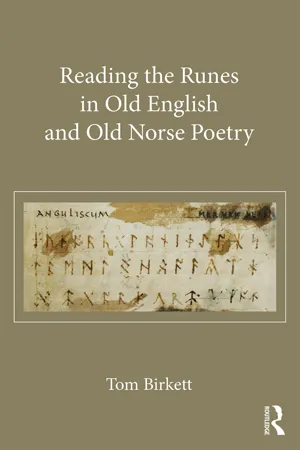
The runic alphabet lay well outside Isidore’s Mediterranean sphere of interest, and his Etymologiae leaves the question of runic origins open to interpretation. There is, however, some evidence that Anglo-Saxon ecclesiasts did attempt to situate runes within this Christian model of scriptural development, if not through design then perhaps through general ignorance of the writing systems to which Isidore refers. For example, certain manuscripts of an Anglo-Saxon provenance answer both the need for a separate Chaldaeo-Assyrian alphabet and the lack of a theory of runic origins in Isidore’s scriptural history simply by labelling various runic alphabets as Chaldean or Assyrian, suggesting, perhaps, a conflation of traditions.10 Of greater interest, however, is the short De inventione litterarum tract compiled in the first half of the ninth century, most probably in a German centre with strong Anglo-Saxon connections.11 This tract draws on Isidore’s Etymologiae in discussing the origins of the Hebrew, Greek and Latin alphabets, and usually includes a discussion of the runic script (as well as Aethicus Ister’s invented alphabet) alongside these sacred writing systems. As Derolez points out in his comprehensive study of the De inventione tradition, it is in this particular context that ‘runes are really integrated into the system of Mediaeval learning’: one which understood the development of all writing systems in direct relation to universal history.12 One important mid-ninth-century manuscript (St Gall, Stiftsbibliothek, MS 878) even contains what may represent a ‘preliminary state’ for the compilation of this De inventione tract, containing (along with the Abecedarium Nordmannicum poem) Hebrew, Greek and runic alphabets (see Cover Image) as well as extracts from Isidore’s Etymologiae.13 We can thus say with some confidence that an attempt to (more or less formally) align a runic inheritance with an authorised pseudo-history of scriptural origins did take place, and that the question of scriptural heritage was of interest within the communities in which runic material and exotic alphabets circulated. It is also clear that scholarly engagement with the origins of the script was limited, and that certain literate communities in Anglo-Saxon England may have been unaware of the distinction between scripts; relied exclusively on oral traditions about runes; or have simply regarded the runic script as a universal writing system of the ancient world, one used by both their Germanic ancestors and the biblical patriarchs.
Cautious interpretation of the literary sources can perhaps help us to understand the limits of this integrative narrative and to assess the degree to which scholarly attempts to incorporate runes in a universal history of scripts are reflected in the imaginative realm of poetry. The four texts that form the focus of this chapter – the poems Daniel, Beowulf and Andreas and the runic legends of the Franks Casket – represent some of the earliest texts in the Old English corpus, and all point in their own ways to an underlying rapprochement of a Germanic inheritance with universal history, and to the placement of runes within a biblical paradigm for scriptural development. In particular, they suggest that the native fuþorc had been re-imagined as a script of Old Testament pedigree with clear prophetic import, seeding Christian potentiality within a Germanic textual inheritance. Whether through the runic writing on the wall in Daniel, or the narrative of the flood engraved on the runic sword hilt in Beowulf, these poems give voice to an understanding of the Anglo-Saxon runic inheritance as a symbol of Divine Providence.
The Franks Casket
If there is one text-object that illustrates the complexities of cultural heritage in Anglo-Saxon England, it is the small whale-bone casket donated to the British Museum by the antiquarian Augustus Wollaston Franks. The iconography of the Franks Casket and its accompanying runic text have been the subject of countless critical examinations, with the more ambitious of these studies aimed at reading the various scenes of the Casket as a thematically unified whole.14 This is a particularly challenging undertaking due to the Casket’s blending of obscure episodes from Germanic legend with Roman and Jewish history and biblical narratives, including a famous diptych on the front panel featuring both Weland the Smith and the Adoration of the Magi (see Figure 1.1). An important component in this complex of cultural inheritance is the runic script itself, which accompanies the images on the four side panels and lid of the Casket.
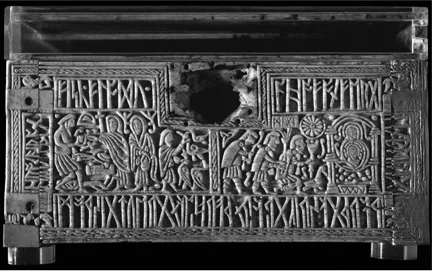
Figure 1.1 The Franks Casket, front panel
Source: © The Trustees of the British Museum.
The four main runic legends on the Casket are all carved in relief around a central image, and in a remarkable demonstration of runic erudition, sections of these legends are variously carved upside-down and in retrograde fashion (compare the lower legend in Figure 1.1 and Figure 1.2), whilst bind runes and several cryptic runes are employed on the left panel (Figure 1.2). There is even some indication that the layout was carefully planned to allow for 72 characters in each legend.15 Whilst this display of epigraphical virtuosity perhaps represents the apogee of the runic tradition in England, the influence of the scriptorium and a developed manuscript culture is also clearly in evidence. The artificer not only shifts to Latin in the relation of the flight of the Jews from Jerusalem in the first Jewish-Roman War, but appears to deliberately mimic a book script in the carving of this Latin titulus.16 What is more, the use of cryptic runes may itself ultimately derive from a predilection for such arcana in the scriptorium, including the notae Bonifatii in which vowels are replaced by a system of dots.17 The Casket is without doubt the product of a dynamic ecclesiastical centre – most probably produced by a Northumbrian monastic community for a royal patron18 – and presents an explicit intellectual challenge to the reader: to integrate the narratives and make sense of the relationship between text and image, which arise from an ‘ostentatiously erudite’ blend of different sources of eighth-century learning and culture.19
Runes had what we might call an ongoing ‘epigraphical currency’ in the eighth century, and it is hardly surprising that they should be used to render the legends on the Casket, that they added certain ‘elements of crypticism and decoration’ perhaps offering a secondary appeal.20 However, the fact that the Casket so clearly acts as an interface between Germanic and Mediterranean traditions should perhaps lead us to reconsider the role of the runes within this integrative scheme, and to understand the script as a meaningful element in the Casket’s syncretic symbolism. The legend on the rear panel is perhaps the most informative when it comes to understanding the script’s positioning in relation to the roman alphabet. This panel depicts the first war between the Romans and the Jews in AD 70, with the inscription relating directly to the scene, and telling us specifically that ‘Here Titus and a Jew fight’. The upper segment of the scene depicts the Romans led by Titus on the one side, and the fleeing Jews on the other side, the two segments connected by an arched structure usually interpreted as the Temple of Jerusalem. To the left of this ...
Table of contents
- Cover
- Title
- Copyright
- Contents
- List of figures
- List of abbreviations
- Acknowledgements
- Introduction: script and sensibility
- 1 The writing’s on the wall: inscription and inheritance in Old English poetry
- 2 Releasing runes: riddles and revelation in the Exeter Book
- 3 Palm-twigs and runic glyphs: the ornamental textuality of runes
- 4 Re-scripting the past in Old Norse heroic poetry
- 5 Sacred script: myths of writing in the Poetic Edda
- Conclusion: the shape of things to come
- Bibliography
- Index
Trusted by 375,005 students
Access to over 1.5 million titles for a fair monthly price.
Study more efficiently using our study tools.
Frequently asked questions
Yes, you can cancel anytime from the Subscription tab in your account settings on the Perlego website. Your subscription will stay active until the end of your current billing period. Learn how to cancel your subscription
No, books cannot be downloaded as external files, such as PDFs, for use outside of Perlego. However, you can download books within the Perlego app for offline reading on mobile or tablet. Learn how to download books offline
Perlego offers two plans: Essential and Complete
- Essential is ideal for learners and professionals who enjoy exploring a wide range of subjects. Access the Essential Library with 800,000+ trusted titles and best-sellers across business, personal growth, and the humanities. Includes unlimited reading time and Standard Read Aloud voice.
- Complete: Perfect for advanced learners and researchers needing full, unrestricted access. Unlock 1.5M+ books across hundreds of subjects, including academic and specialized titles. The Complete Plan also includes advanced features like Premium Read Aloud and Research Assistant.
We are an online textbook subscription service, where you can get access to an entire online library for less than the price of a single book per month. With over 1.5 million books across 990+ topics, we’ve got you covered! Learn about our mission
Look out for the read-aloud symbol on your next book to see if you can listen to it. The read-aloud tool reads text aloud for you, highlighting the text as it is being read. You can pause it, speed it up and slow it down. Learn more about Read Aloud
Yes! You can use the Perlego app on both iOS and Android devices to read anytime, anywhere — even offline. Perfect for commutes or when you’re on the go.
Please note we cannot support devices running on iOS 13 and Android 7 or earlier. Learn more about using the app
Please note we cannot support devices running on iOS 13 and Android 7 or earlier. Learn more about using the app
Yes, you can access Reading the Runes in Old English and Old Norse Poetry by Thomas Birkett in PDF and/or ePUB format, as well as other popular books in Literatura & Crítica literaria. We have over 1.5 million books available in our catalogue for you to explore.