The purpose of this book, first published in 1982, is to probe the nature of the state in India and the role played by it in the evolution of the social economy, particularly in the growth of industry. In fact, the problematic of the state and its relationship with socio-economic progression or regression is a dialectic process. What this book does is attempt to unravel this dialectic, by following the theory and method of Maxism.
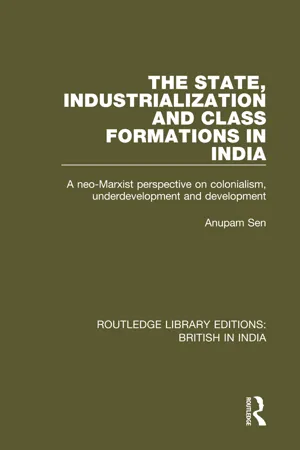
eBook - ePub
The State, Industrialization and Class Formations in India
A Neo-Marxist Perspective on Colonialism, Underdevelopment and Development
- 300 pages
- English
- ePUB (mobile friendly)
- Available on iOS & Android
eBook - ePub
The State, Industrialization and Class Formations in India
A Neo-Marxist Perspective on Colonialism, Underdevelopment and Development
1
Introduction
Purpose and method of the study and relevant literature
The purpose of this book is to probe the nature of the state in India and the role played by it in the evolution of the social economy, particularly in the growth of industry. In fact, the problematic of the state and its relationship with socio-economic progression or regression is a dialectic process. What we will attempt here is to unravel this dialectic – by following the theory and method of Marxism. The Marxian dialectic views the state not as an embodiment of some abstract idea of political will or sovereignty but as a reflection of the social dynamics resulting from either the constant change or relative stability of a mode or modes of production and the resultant class configurations. How far the development of a mode or modes of production contributes towards social formations and classes depends on the level of development of the forces and relations of production. As these vary from society to society, depending on various natural (as well as human) factors – such as aridity of land, which is an object of production – the character and form of the state and its role also vary from society to society. The singularity and uniqueness of the Marxian analysis of the state thus rest on the fact that it is not only a political but also a social analysis – and includes a concrete study of social formations. Henri Lefebvre says:
the critical analysis of the state in any Marxian sense must be based on specific studies of every known mode of production, every historical phase, every country. And this in terms of both the structural aspect (classes) and the conjunctural aspect (conquests, domination, characteristics of the conquerors and their armies, etc.). Governments reveal the particularities of the society they administer and set themselves above; they sum up … its struggles and conflicts. Conversely, specific sociological and historical studies help us understand governments by taking into account the multiple conditions under which one or another state was formed. For Marx, just as for Hegel, truth is always concrete, specific, particular (and yet has its place within the whole or totality). However, in this connection as in other, Marx put the Hegelian formulations ‘back on their feet.’ The concrete is social, not political.1
Our analysis of the state in India will, therefore, deal with the nature of the modes of production and their transformation, which have historically provided the base for the state in India. In this process, as we will endeavour to show, the classes had and have been playing either an active or a relatively passive role, depending on the conjuncture of the social formation and its constituent mode or modes of production. The state, in Marxian analysis, is an object of class conflict. But what form the state would take in the process, reflecting the class formations and their struggles, depends on the mode of production. However, the process is not always one-way. Once the state takes a definite form, it reacts on the evolution of a mode of production and, in turn, is determined by its changing nature. Engels comes to grips with the interaction between the state and the economy thus:
Society gives rise to certain functions which it cannot dispense with. The persons selected for these functions form a new branch of the division of labour within society. This gives them particular interests, distinct too from the interests of those who gave them their office; they make themselves independent of the latter and – the state is in being. And now the development as it was with commodity trade and later with money trade; the new independent power, while having in the main to follow the movement of production, also, owing to its inward independence (the relative independence originally transferred to it and gradually further developed) reacts in its turn upon the conditions and course of production. It is the interaction of two unequal forces: on one hand the economic movement, on the other the new political power, which strives for as much independence [emphasis added] as possible, and which, having once been established, is also endowed with a movement of its own…. The reaction of the state power upon economic development can be one of three kinds: it can run in the same direction, and then development is more rapid; it can oppose the line of development in which case nowadays state power in every great nation will go to pieces in the long run; or it can cut off the economic development from certain paths, and impose on it certain others. This case ultimately reduces itself to one of the two previous ones. But it is obvious that in cases two and three the political power can do great damage to the economic development and result in the squandering of great masses of energy and material.2
Thus, according to Engels, because of the division of labour within society, the functionaries of the state3 develop distinct interests which do not always and necessarily correspond to the interests of those who entrust them with state power. Their particular interests are distinct from the general interests of society or the class they represent. One of these interests is the state’s autonomous power that comes into being in the very moment of its formation. It is, therefore, in their own particular interests that the state functionaries strive for as much independence as possible for the state power, because it reflects their own power.
Normally, economic movement determines the course of action of the political power of the state. That is, if state power does not operate in the interests of the gradual unfolding of the dominant forces and relations of production, state power jeopardizes its own existence. For example – as Marx pointed out – the Tories or the party of aristocrats in England were compelled to rule in the interests of the bourgeoisie because they could not, or dared not, go against the tide of capitalism. Marx says, ‘In a word, the whole artistocracy is convinced of the need to govern in the interests of the bourgeoisie; but at the same time it is determined not to allow the latter to take charge of the matter itself.’4 Thus, although there is a disjunction between political and economic powers, political power follows economic movement. By going against the rising tide of the forces and relations of production of capitalism, the state functionaries – in this case the aristocrats – would have endangered their own future as well as possibly damaging the normal process of growth of the economy.
Two things are to be noted in Engels’s formulation of the relationship between the state and the social economy. First, the state (i.e. its functionaries) always endeavours to acquire as much independence as possible. The source of this striving is the relative independence with which the state is first endowed at its inception. But this relative independence or autonomy may result in more independence or autonomy from society or the social classes, depending on the development of the latter and the mode or modes of production – in short, depending on the conjuncture of the social formation. Marx and Engels have repeatedly pointed out in their concrete political studies such as ‘The Eighteenth Brumaire’, The Peasants’ War in Germany, The Class Struggle in France, The Constitutional Question in Germany, The Prussian Constitution, etc., as well as in their writings on the countries of Asia, how the apparatus of the state could acquire ‘complete independence’5 from the control of the social classes. The state attains this superior position over the social classes under certain favourable circumstances, such as when contending classes balance one another’s power in a particular social formation; or when the generation of social classes is weak as a result of the characteristic development of a particular mode of production; or even because of military conquest. Second, the resulting independence of the state may lead the state functionaries to pursue economic policies that are not in consonance with the economic movement, which may be a gradually unfolding mode of production attempting to regulate other modes in the social formation for its own reproduction. A good example, as we will explain below, is the endeavour of the merchant capitalists in India in the seventeenth and early eighteenth centuries – a section of whom metamorphosed themselves into industrial capitalists – to transform urban artisan industries in the service of the court into manufacturing industries that could cater to the world market. This attempt was accompanied by a simultaneous attempt to weaken the central power of the state. But even in decline, as we will see, the autonomous state power in India operated as a fetter on the growth of the capitalist class, thus resisting the unfolding of the incipient capitalist mode of production which – deriving impetus from the demand of Indian goods in the world market – was gradually undermining the existing Asiatic mode of production. This failure of the state in India to follow the economic movement not only obstructed the growth of the capitalist mode of production but also ushered in its own disintegration and defeat at the hands of the colonizing countries.
These two instances indicate how the state can facilitate or obstruct economic movement or the growth of a mode of production. In England, the state facilitated the growth of the capitalist mode of production; in India, it was a positive hindrance to such development.
It is noteworthy, in this connection, that the state’s ability to obstruct the development of an unfolding mode depends largely on the relative strength of the pre-existing mode which is being superseded, and on the power of the classes that come into being with the emerging mode. The relations of production are shattered and a revolution occurs which replaces the existing state structure, as Marx and Engels have observed, only after the forces of production of the new mode mature to such an extent that the new class configuration makes it impossible to let the existing state structure continue. However, a situation can occur when no mode of production is in a position to establish its sway in the social formation, and, as a result, the class conflict may lead to ‘the common ruin of the contending classes’ and society.6 This was the case – as Marx has argued in Capital, vol. Ill – when the slave mode of production began to dissolve in Roman society, but no new mode replaced it and, as a consequence, the class struggle between the patricians and plebeians, and also among the various factions of the patricians, brought in the ‘common ruin of the contending classes’ and the Roman state.7 Whether the class conflict would lead to the victory of a particular class and the reconstitution of society at large – i.e. the victory of a particular mode of production in the social formation – is, to a considerable extent, dependent upon the nature of the dissolution of the old mode and its succession by a new one which, in turn, is determined by the character of the class struggle.
Thus, in Marxian analysis, what form the state will take – its autonomy or independence, and its interrelationship with the economy – does not follow a unilinear or monocausal path, as is commonly believed. The Marxian analysis of the state and its relationship with the economy is multidimensional and dialectical. It can only be based on a concrete study of a social formation, and the social classes that emerge within it, their strengths and weaknesses, and the nature of the struggle they wage to take control of the state to use it in their own interests.
It should also to be noted that, in Marxian analysis, political power is not just an appendage to economic power, as is popularly believed. How the economy will evolve depends, to a great extent, on political power. That is why in Marxism political power or the state is the object of class conflict. As it is necessary for the bourgeoisie to capture state power to maintain its economic domination, so it is necessary for the proletariat to conquer this power to mould the economy in its own interests. The state, moreover, as we have already noted, endeavours to obtain as much independence as possible, so that it does not have to be subservient to any class. This point was repeatedly emphasised by Marx and Engels in their political studies. To preserve its independence – the particular interest of the functionaries of the state as distinct from the general interests of the society or its dominant or contending classes – the state would often pursue policies that would make it difficult for any class to become dominant enough to subordinate the state under its own hegemony. These policies in a historical conjuncture, depending on the forces of production and class formation, may foster or undermine economic development in many ways.
Our study of the state in India and its relationship with the social economy has shown that the state which emerged on the basis of the Asiatic mode of production later became an obstacle in the path of the bourgeoisie – which grew rapidly in the seventeenth and early eighteenth centuries – towards gaining hegemony. The weakness of the social classes vis-à-vis the state resulted not only in the colonization of India, to which we have already referred, but also had (and still has) other far-reaching effects on India’s economy: these we will examine later.
Briefly our thesis is this: the state in India, conditioned by the nature of its social formation, was and still is autonomous, and this autonomy has had and still has a positive impact on the character of the economic development or underdevelopment of India during the pre-British, British and post-Independence periods.
On the basis of our study of the social conjunctures of these three periods of Indian history, an analysis can be presented in the form of three theses. First, the autonomy of the state which resulted from the Asiatic mode of production obstructed India’s transition to capitalism and thus undermined her economic development and led to her colonization. Second, the continuation of the state’s autonomy vis-à-vis the indigenous social classes during the colonial period – due to a social formation which was partly Asiatic, partly feudal, and partly capitalist, and to the colonial state’s subservience to the metropolitan bourgeoisie – enabled the state to transfer colossal resource from India to the metropolitan centres, and led to India’s underdevelopment and low productivity of labour. Third – and the major concern of this study – the attempt by the post-independent state in India to maintain its autonomy, which is derived more or less from the same social formation inherited from the colonial period, has resulted in extensive state control of the private corporate sector, the concentration of basic industries in the state sector, the support and encouragement of the artisan and petty industries as a counterpoise to the private corporate industries, and the failure of the bourgeoisie to transform agriculture into a capitalist undertaking. These measures, in turn, have led to a lop-sided development of the economy in which the condition of the masses and the direct producers has gradually deteriorated and an uncertain future threatens.
It may not be out of place to mention here that to the author’s knowledge there has been no work, since the classical studies of Marx, Engels and Lenin, in which a systematic analysis of the state and its relationship with the social economy – in particular, the process of industrialization – has been attempted: moreover one which specifically relates to the social formation (composed of a mode or modes of production) and class configurations. In fact there have been very few works, since those of Marx, Engels and Lenin, which have attempted to analyse the problematic of the state with reference to a concrete social formation. James O’Connor has tried to underline the nature of the state’s participation in the capital accumulation of the capitalist class in the U.S.A.8, but his study does not analyse the historically determined relationship between the state and the social formation.
Ralph Miliband and Nicos Poulantzas have explained at a general level the state’s role in economic development as the guardian of the interests of the capitalist class.9 For Miliband, the modern state is primarily a coercive/ideological instrument of class rule. The state is embodied in its various ‘apparatuses’ – the bureaucracy, the police, the judiciary, the military, etc. – and all these organs of government in this instrumentalist view are recruited from, and subordinate to (hence, have no autonomy from) private capital. In contrast, Poulantzas thinks that the main function of the state is to preserve and strengthen the capitalist mode of production and in so doing the state secures the rule of the economically dominant classes. Paradoxically, to perform this function adequately the state, Poulantzas contends, needs a relative autonomy from the dominant classes. The argument runs like this: the capitalist class is not a homogeneous class; it is divided into various factions and sectors (finance capital, industrial capital, commercial capital, etc.) whose economic, political, and ideological interests are not always identical. To preserve the unity and cohesion of the capitalist class, in a word, to safeguard the general interests of the bourgeoisie as a whole, it becomes necessary for the state to acquire freedom of action or functional autonomy with regard to the fractions of capital, so that it does not endanger the common interests of the capitalist class by promoting particular interests. The common affairs of the whole bourgeoisie, according to Poulantzas, can only be managed by advancing the unity of the capitalist social formation. To do so it sometimes becomes necessary for the state to make some political and economic concessions to the dominated classes at the cost of the immediate interests of the ruling classes. Thus, the rule of the internally fragmented capitalist class does not depend on the condition of its direct governing, nor even on its physical presence in the government, but on the capability of the state to maintain its autonomy vis-à-vis particular interests so that it can secure the general interests of the capitalist class and its hegemony over th...
Table of contents
- Cover
- Half Title
- Title
- Copyright
- Original Title
- Original Copyright
- Contents
- Tables
- Acknowledgments
- Foreword
- 1 Introduction
- 2 The mode of production and social formation in pre-British India
- 3 The victory of the British and its impact on the evolution of social classes in India
- 4 Socialism in India: an ideology of state hegemony
- 5 The artisan and small-scale industries in India’s social economy and their relationship with the state
- 6 The state and the growth of the public and private sectors
- 7 The social economy of Indian agriculture and its effect on industrialization and the state
- 8 Conclusion
- Notes
- Bibliography
- Index
Trusted by 375,005 students
Access to over 1.5 million titles for a fair monthly price.
Study more efficiently using our study tools.
Frequently asked questions
Yes, you can cancel anytime from the Subscription tab in your account settings on the Perlego website. Your subscription will stay active until the end of your current billing period. Learn how to cancel your subscription
No, books cannot be downloaded as external files, such as PDFs, for use outside of Perlego. However, you can download books within the Perlego app for offline reading on mobile or tablet. Learn how to download books offline
Perlego offers two plans: Essential and Complete
- Essential is ideal for learners and professionals who enjoy exploring a wide range of subjects. Access the Essential Library with 800,000+ trusted titles and best-sellers across business, personal growth, and the humanities. Includes unlimited reading time and Standard Read Aloud voice.
- Complete: Perfect for advanced learners and researchers needing full, unrestricted access. Unlock 1.5M+ books across hundreds of subjects, including academic and specialized titles. The Complete Plan also includes advanced features like Premium Read Aloud and Research Assistant.
We are an online textbook subscription service, where you can get access to an entire online library for less than the price of a single book per month. With over 1.5 million books across 990+ topics, we’ve got you covered! Learn about our mission
Look out for the read-aloud symbol on your next book to see if you can listen to it. The read-aloud tool reads text aloud for you, highlighting the text as it is being read. You can pause it, speed it up and slow it down. Learn more about Read Aloud
Yes! You can use the Perlego app on both iOS and Android devices to read anytime, anywhere — even offline. Perfect for commutes or when you’re on the go.
Please note we cannot support devices running on iOS 13 and Android 7 or earlier. Learn more about using the app
Please note we cannot support devices running on iOS 13 and Android 7 or earlier. Learn more about using the app
Yes, you can access The State, Industrialization and Class Formations in India by Anupam Sen in PDF and/or ePUB format, as well as other popular books in History & World History. We have over 1.5 million books available in our catalogue for you to explore.