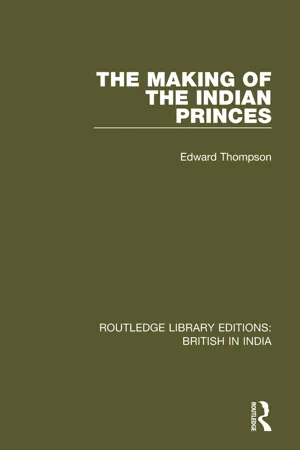
This book, first published in 1943, sets forth the history of the rise and development of the states of princely India from the end of the eighteenth century until the beginning of nineteenth. This was also the formative period for the East India Company and thus for India itself. It describes the processes, military and political, whereby modern India was formed.
- 316 pages
- English
- ePUB (mobile friendly)
- Available on iOS & Android
eBook - ePub
The Making of the Indian Princes
Contents
- PART I. THE EMERGENCE OF THE PRINCES
- I. INDIA AT THEEND OF THEEIGHTEENTHCENTURY
- II. THEMARATHAS
- III. DECLINE OFMARATHAPOWER
- IV. LORDWELLESLEY AND THEPESHWA
- V. BRITISH ANDMARATHADIPLOMACY
- VI. THEDEATH OFNANAFARNAVIS
- VII. THEBATTLE OFPOONA
- VIII. THETREATY OFBASSEIN
- IX. COLLINS ANDMETCALFE ATPOONA
- X. OUTBREAK OF THESECONDANGLO-MARATHAWAR
- XI. BRITISH ANDMARATHAMILITARYTACTICS
- XII. LAKEOPENS HISCAMPAIGN
- XIII. THEBATTLE OFDELHI AND THEFALL OFAGRA
- XIV. THEBATTLE OFLASWARI
- XV. GENERALWELLESLEY'SVICTORIES
- XVI. THEMAKING OF THETREATIES
- XVII. DIFFICULTIESFOLLOWING THECONCLUSION OFPEACE
- XVIII. YESWANTRAOHOLKAR
- XIX. FIRSTSTAGES OF THEWAR WITHHOLKAR
- XX. THESIEGE OFBHARATPUR
- XXI. BHARATPUR ANDINDIAN ANDBRITISHREACTIONS
- XXII. ARRIVAL OFLORDCORNWALLIS
- XXIII. CONSIDERATIONS OF THEPEACE
- XXIV. THEWAR'SRESULTS
- XXV. THEPSYCHOLOGICALCHANGE IN THECONQUERORS
- PART II. BRITISH PARAMOUNTCY
- XXVI. MUTINIES. THECHAOS OFCENTRALINDIA
- XXVII. THECOMPANY'SEMBASSIES
- XXVIII. DOMESTICTROUBLES ANDCOLONIALEXPEDITIONS
- XXIX. THEMOGULEMPEROR ANDDELHI
- XXX. METCALFE ANDCENTRALINDIA
- XXXI. THECOMPANY'SSATRAPS
- XXXII. THEGURKHAWAR
- XXXIII. THEPESHWA ANDGANGADHARSASTRI'SMURDER
- XXXIV. THEPINDARIS AND THECHAOS OFCENTRALINDIA
- XXXV. PRELIMINARIES OF THEPINDARICAMPAIGN
- XXXVI. ELPHINSTONE AND THEPESHWA
- XXXVII. AMIRKHAN. THERAJPUTSTATES
- XXXVIII. THEPESHWA'SOUTBREAK
- XXXIX. THENAGPUROUTBREAK
- XL. THECAMPAIGN AGAINSTHOLKAR
- XLI. SURRENDER OF THEPESHWA
- XLII. THEBRITISHLEADERS AND THECOMMONSOLDIER
- XLIII. REFLECTIONS: POLITICAL
- XLIV. STATUS OF THEPRINCES. THEKING OFDELHI
- XLV. THEDOCTRINE OFPARAMOUNTCY
- BIBLIOGRAPHY
- INDEX
Part I
The Emergence of the Princes
I. India at the end of the Eighteenth Century
The Marattahs possess, alone of all the people of Hindostan and Decan, a principle of national attachment, which is strongly impressed on the minds of all individuals of the nation, and would probably unite their chiefs, as in one common cause, if any great danger were to threaten the general state.—
Warren Hastings, in 1784.
India contains no more than two great powers, British and Mahratta, and every other state acknowledges the influence of one or the other. Every inch that we recede will be occupied by them.—
Charles Metcalfe, in 1806.
WARREN HASTINGS left India in 1784. On his voyage home he drew up an analysis of its political condition.1
The list of Powers which might be considered independent had shrunk from one cause or another, the East India Company having been the most effective dissolvent: 'it seems to have been the fixed policy of our nation in India to enfeeble every power in connection with it'. The Mogul Emperor, though hardly worthy to be reckoned among Powers of any sort or kind, he mentions because of the prestige attaching to his ancestors and in some degree to his person. The Nawabs of Oudh and the Carnatic, nominally servants of the Emperor, he notes as entirely dependent on the Company. Another nominal officer of the Emperor, the Nizam of Hyderabad, he sees in the position of a star destined to become a satellite but now the object of contention between rival heavenly bodies:
'His dominions are of small extent and scanty revenue; his military strength is represented to be most contemptible; nor was he at any period of his life distinguished for personal courage or the spirit of enterprise. On the contrary, it seems to have been his constant and ruling maxim to foment the incentives of war among his neighbours, to profit by their weakness and embarrassments, but to avoid being a party himself in any of their contests, and to submit even to humiliating sacrifices rather than subject himself to the chances of war.'2
There were also a number of small principalities, whose safety was in lying quietly under the shadow of some greater Power. Some of these, notably the Rajput states, all nominally dependents of the Emperor though actually fallen within the orbit of the Maratha chieftain Sindhia, were respectable from their antiquity. They still survive, almost the only states with a title older than that of the British Government or with one not originally derived from an office under the Mogul Emperor.
The Punjab was unsettled. The Sikhs (as Hastings notes, a sect rather than a nation) were there struggling with Mussulman invaders and adventurers. Apart from this and other districts beyond the Company's present purview—such as Nepal, Sind, and Kutch —in India Hastings saw only two genuinely independent Powers, Tipu Sultan in the Mysore, and the Maratha Confederacy straddling across Central India and now reaching far into the north, controlling Delhi itself. It was certain that sooner or later war would come between these two Powers and the British.1
The Destruction of Tipu Sultan
The first of the wars which Hastings foresaw began when Tipu (29 December 1789) attacked the Company's ally, the Raja of Travancore. 'That mad barbarian Tippoo has forced us into a war with him.'2 It ended, 1792, in Tipu's utter defeat. But the peace which followed this Third Mysore War was to be merely an armistice.
In the decade that ended the century, Tipu was in fitful communication with the French. Raging from his loss of a huge indemnity and of half his dominions, he felt blindly for allies, inside and outside India. This restlessness in no way differed from the normal behaviour, then or since, of warring or threatened States, but it was reprobated as proof of his ingrained faithlessness. His quarrel with the British was one of deep mutual hatred; the stories of his treatment of captives had rung through England.
Three wars only—the two World Wars and that against Napoleon—have been waged by the British with a conviction that defeat meant submergence. During the Napoleonic War the ruling oligarchy knew that the commerce which brought it wealth and financed the political arrangement which secured enjoyment of that wealth was threatened. When the Earl of Mornington reached India as Governor-General, May 1798, his class had worked itself into a frenzy of patriotism and exasperation against Jacobinism (a term used as widely and loosely as such terms as 'Red', 'Left', and 'Communism' in recent years) and against Buonaparte. The latter was entangled in his Egyptian and Syrian adventure, which in retrospect appears a mere escapade but at the time was accepted as a serious attempt to break through to the growing British Empire in the East. Such a break-through was, as a matter of fact, part of Napoleon's larger hope. The new Governor-General came resolute to end the Company's quarrel with Mysore once for all. He regarded this as his contribution to Buonaparte's defeat.
Madras, long sunk in selfishness and corruption, and Bombay, an isolated and fragmentary property overshadowed by the power of the Marathas, he found hard to stir. But he infused his own excitement and enthusiasm into the British of Bengal. Calcutta subscribed and sent home, July 1798, £130,785 3s. I½d., a sum which included a small contribution by Indians.1 There was immense, if passing, zeal to enrol as volunteers against invasion by the Corsican ogre, and plans were drawn up for the defence of the capital. Gentlemen turned out on Calcutta maidan,2 complete with sidearms and musket, and attended by native servants carrying umbrellas, and bricks to put beneath Master's feet if Master had to drill in squashy places. The season was the monsoon, when the maidan, even now, can be very wet.
Tipu could hardly have escaped destruction by even the most circumspect humility. He gave a casus belli by inept negotiations with the French Governor of Mauritius,3 which the latter boastfully published. These intrigues, with a not very important official, furnished an excuse for the war which Lord Mornington would have made in any case. It began in February 1799, and was over in three months. Seringapatam was stormed (May 4), and the Sultan's body was found in a pile of about five hundred crowded into a small space. The Governor-General's brother, Arthur Wellesley, as unshakably phlegmatic as Lord Mornington was excitable, standing in torchlight felt heart and pulse, and reported Tipu to be lifeless. His conquerors buried him with military honours, in which the elements joined, sweeping the island with a tempest of thunder and rain such as was hardly remembered in even that storm-ravaged region.4
A shrunken Mysore was placed under a Prince of the Hindu dynasty which Tipu's father, Haidar, had dislodged. The new Maharaja, a child,1 showed a 'highly proper' decorum during the ceremony of his enthronement. His family, who had been discovered in abject poverty, behaved equally well, and acknowledged their grateful sense of dependence. 'We shall at all times', the two ladies of highest distinction told the Commissioners for the settlement, 'consider ourselves as under your protection and orders. . . . Our offspring can never forget an attachment to your government, on whose support we shall depend.' This language was rather more than the flowery recognition of favours received, which etiquette and custom prescribed. It underlined what was obvious; Mysore had become a puppet state. Its pacification was undertaken by a group of able soldiers, who afterwards left administration in the hands of Purnayya, a veteran Brahman politician, who governed it as Dewan.2
The French, all but ejected from India, had long watched despairingly from Pon...
Table of contents
- Cover
- Half Title
- Title
- Copyright
- Original Title
- Original Copyright
- Contents
- BIBLIOGRAPHY
- INDEX
Trusted by 375,005 students
Access to over 1.5 million titles for a fair monthly price.
Study more efficiently using our study tools.
Frequently asked questions
Yes, you can cancel anytime from the Subscription tab in your account settings on the Perlego website. Your subscription will stay active until the end of your current billing period. Learn how to cancel your subscription
No, books cannot be downloaded as external files, such as PDFs, for use outside of Perlego. However, you can download books within the Perlego app for offline reading on mobile or tablet. Learn how to download books offline
Perlego offers two plans: Essential and Complete
- Essential is ideal for learners and professionals who enjoy exploring a wide range of subjects. Access the Essential Library with 800,000+ trusted titles and best-sellers across business, personal growth, and the humanities. Includes unlimited reading time and Standard Read Aloud voice.
- Complete: Perfect for advanced learners and researchers needing full, unrestricted access. Unlock 1.5M+ books across hundreds of subjects, including academic and specialized titles. The Complete Plan also includes advanced features like Premium Read Aloud and Research Assistant.
We are an online textbook subscription service, where you can get access to an entire online library for less than the price of a single book per month. With over 1.5 million books across 990+ topics, we’ve got you covered! Learn about our mission
Look out for the read-aloud symbol on your next book to see if you can listen to it. The read-aloud tool reads text aloud for you, highlighting the text as it is being read. You can pause it, speed it up and slow it down. Learn more about Read Aloud
Yes! You can use the Perlego app on both iOS and Android devices to read anytime, anywhere — even offline. Perfect for commutes or when you’re on the go.
Please note we cannot support devices running on iOS 13 and Android 7 or earlier. Learn more about using the app
Please note we cannot support devices running on iOS 13 and Android 7 or earlier. Learn more about using the app
Yes, you can access The Making of the Indian Princes by Edward Thompson in PDF and/or ePUB format, as well as other popular books in History & World History. We have over 1.5 million books available in our catalogue for you to explore.