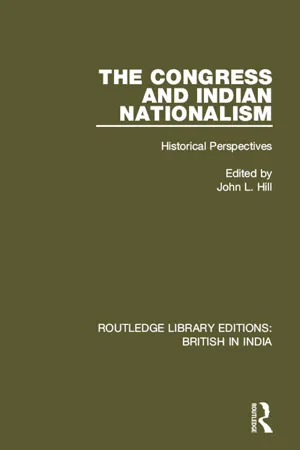
The celebration of the centenary of the Indian National Congress prompted a scholarly re-examination of that organization in the midst of an active international discussion about the nature of Indian society in the nineteenth and twentieth centuries. Any group of historians who come together to give fresh consideration to the Congress – its organization, leadership, ideology and support – also join in the wider debate going on in Indian history. This volume, first published in 1991, reflects such an engagement with the full range of contemporary discussion, representing not just scholarship in five different countries but also quite distinct historiographical traditions. It surveys the origins and development of the Congress from its inception to its development up to Independence.
- 360 pages
- English
- ePUB (mobile friendly)
- Available on iOS & Android
eBook - ePub
THE EARLY CONGRESS AND THE IDEA OF REPRESENTATIVE AND SELF-GOVERNING INSTITUTIONS ON THE COLONIAL CANADIAN MODEL
Scholars familiar with the early development of modern nationalism in the Indian subcontinent, including the formative stages of the prime agency of nationalist mobilization, the Indian National Congress, will be aware that at times considerable attention was given to the British white-settler model of constitutional evolution, and especially that of Canada, as an appropriate one for India. However, except for S.R. Mehrotra, who gives some coverage to this issue in a couple of his studies, the subject has received little attention.1 The purpose of this paper is to explore this neglected subject; to examine the extent to which early nationalists, and particularly the purposeful first general secretary of the Congress, Allan O. Hume, believed and argued that the most advanced model of white colonial constitutional development should apply to India. The paper begins with brief comments on the socio-political circumstances of British India which explain how and why the emerging nationalist leadership there became conscious of the constitutional evolution of Canada and other major British colonies. This leads into the main body of the paper which focuses on the three areas of the Canadian constitutional model which were of prime interest to the Indian nationalist élite – namely, representative and responsible government, indigenous control of the civil service and the military, and government autonomy in tariff and general financial policy. The paper argues that Hume, the British radical organizer of the Congress, was a major proponent of the relevance of the Canadian constitutional model but that his views were widely shared by the Indian leadership of the early Congress. The reasons why India’s progressive realization of domestic self-government remained largely illusory for the first twenty years of Congress existence are briefly examined in the concluding section of the paper. It is suggested, in conclusion, that this failure helped to undermine the credibility of the Congress founders and paved the way for the growth of a new militant nationalism.
Modern political associations began on a regional basis in the thriving new port-cities of British India, notably Calcutta and Bombay, around the middle of the nineteenth century. By the early 1880s a relatively impressive growth in higher English education, and in newspapers and other print media, together with the completion of main-line railway networks across the country, made it possible for the modern intelligentsia, who led the regional political associations, to think in all-India terms for the first time.2 Then, a combination of harsh and repressive policies under the Conservative viceregal regime of Lord Lytton in the late 1870s, and the failure of liberalizing initiatives by his Gladstonian successor, Lord Ripon, in the early 1880s, induced leaders of India’s modernized, urban, political élite, with considerable organizing assistance from Hume, to assemble in Bombay in December 1885 to found the Indian National Congress.3
Given that India’s developing modern education system was modelled closely on that of Britain and that students were accordingly well versed in British political and constitutional history, it was hardly surprising that the new intellectual élite were relatively familiar with the progress of constitutional government in the major white-settler colonies of the Empire. Knowledge through formal education was supplemented by the flow within imperial channels of newspaper and journalistic communications. As a result India’s English language press in particular frequently carried news and occasionally lengthy articles on political developments in other British colonies.
It is noteworthy that as early as 1852, only a few years after the momentous achievement of responsible government in most of the British North American colonies, the leading Indian political association in Bengal petitioned the British Parliament to place the legislature of British India ‘on the footing of those enjoyed by most of the Colonies of Her Majesty.’4 But that plea was ignored and in the constitutional shake-up following the Mutiny and Rebellion of 1857 nothing was done under the new system of direct crown rule to add a representative element to the councils, which were now appointed by the British government instead of the former East India Company. At the same time the Rebellion had demonstrated the obvious dangers of ruling India without any formal procedures for public input in the governing system. Accordingly, in 1861 the British Parliament adopted an Indian Councils Act which permitted appointment of two or three token Indians to the legislative councils of the central government and those of the three major provinces of Bengal, Bombay and Madras.5 The Indians selected by the British authorities for these few positions were invariably from the landed or princely aristocracy and the councils as a whole lacked any real autonomy. As a consequence, the new Indian intelligentsia never regarded the 1861 Act as more than an insignificant nod in the direction of representative government.
While it was not until a quarter of a century later that India’s new political élite organized nationally in the Congress to promote representative and responsible government, individual members of the intelligentsia had not been silent in the interim on the need for such reforms. Interestingly enough, the first carefully argued case for ‘Representative and Responsible Government for India’ was made in July 1867, by a young Bengali lawyer, W.C. Bonnerjee, later to become first president of Congress, in a speech to the East India Association of London.6 Bonnerjee’s timing was obviously influenced by the British Reform Bill of 1867, but possibly also by the adoption earlier that year of the British North America Act establishing the Canadian federation, which then consisted of four of the existing, domestically self-governing colonies. Bonnerjee was clearly familiar with the latter Act, for he referred in his speech to the need for a ‘senate’ as well as a representative assembly in India, and suggested ‘a power of veto to the governor-general, but under the same restriction as exists in America.’7 It is significant that other future founders of the Congress such as Dadabhai Naoroji, P.M. Mehta and Badruddin Tyabji were present at the meeting and spoke strongly in favour of Bonnerjee’s basic argument that ‘paternal despotism’ was no substitute for representative government, which could alone assure ‘the active confidence of the people.’ However, prominent representatives of the Raj who were present at the meeting threw cold water on the Indian demands for such advanced reforms and nothing immediate came of Bonnerjee’s initiative.
The Indian educated class did little further to advance this cause politically until 1876 when Bengali middle class élites, led by S.N. Banerjea, organized the Indian Association, a direct precursor of Congress. In the meantime, a number of progressive Bengali newspapers, led by the Amrita Bazar Patrika in 1870, had already lent their support to the idea of representative institutions.8 In an editorial of 1874 another Bengali, and one of India’s most prominent journalists, Kristodas Pal of the Hindoo Patriot, clearly cited the relevance of the Canadian constitution experience for India. He wrote:
Our attention should…be directed…to the introduction of constitutional Government for India. … If the Canadas could have a Parliament, if such small and little advanced Colonies as Prince Edward Island, [and] Newfoundland…could have elected Councils, surely British India has a fair claim to similar representation. If taxation and representation go hand in hand in all British Colonies, why should this principle be ignored in British India?…Home Rule for India ought to be our cry, and it ought to be based upon the same constitutional basis that is recognized in the Colonies.9
Before the end of that decade the premier political association in Bombay province, the Poona Sarvajanik Sabha, formally called for representative institutions, and between 1880 and 1885 the Bengal-based Indian Association, under Banerjea’s enthusiastic leadership, gave extensive attention to the issue of representative government.10
The matter of representative institutions for India was a top priority as well for many of the 72 ‘delegates’ who met at Bombay in 1885 to found the Congress. Certainly for key leaders such as Bonnerjee, Naoroji, Mehta and Hume, who were all thoroughly schooled in British constitutional history, representative government was a kind of talisman that promised to pave the way to India’s political, economic and social progress. This was especially true of Hume, who as the son of the long-time British Radical M.P., Joseph Hume, had grown to maturity in an atmosphere of reformism and advanced politics. Hume had been a member of the prestigious Indian Civil Service from 1849 to 1882, but retired early, primarily as a result of policy differences with his superiors during the unpopular Lytton regime.11 A keen student of history and personally familiar with British constitutional developments in the metropolis and overseas, Hume was to play a key role in dramatizing the appropriateness of the Canadian constitutional model as the Congress goal for India.
Hume undoubtedly had a decisive hand in the drafting of the March 1885 circular, which announced that a political Congress would be held in Western India in December, and asserted that it would ‘form the germ of a Native Parliament and…constitute in a few years an unanswerable reply to the assertion that India is wholly unfit for any form of representative institutions.’12 Three years later, after Congress had established itself as a going concern, Hume cogently articulated his deep philosophic convictions about the fundamental importance of representative government. Responding to criticisms of Congress for neglecting socio-cultural reform, Hume confessed that in a universal scheme of values he attached chief importance to the ‘elevation’ of moral and ethical values.13 Second in importance was the ‘diffusion’ of intellectual or cultural enlightenment. Hume continued:
Only third in importance to my mind is political enfranchisement, but I throw my energies into this latter, firstly, because I have read history … and I have come to see that neither moral elevation nor mental culture are nationally possible without some considerable political enfranchisement. There have been periods of intellectual culture as in the Augustan age, accompanied…by political serfdom, but that culture was but the fruit of seed sown…in an antecedent era of political freedom. You may create the grandest academies. You may found the purest religious sects, but without the infinitely varied inducements to mental exertion and moral restraint afforded by political freedom, your nature will never be either cultured or virtuous.
Hume, as this statement suggests, was a convinced democrat.
At the same time, and in contrast to most British observers, Hume believed that the idea of representative rule was in no way foreign to India. Obviously thinking of the village republics of Vedic India, he argued publicly in 1888 that representative institutions, ‘so far from…being alien to the genius of the nation…had…their origin in India.’14 Moreover, he continued, ‘they underlie the whole social structure of indigenous society, and are universally understood.’ During his first five years as general secretary of the new Congress, Hume played a leading role in the development of a systematic scheme of constitutional reform, including a significant enlargement of the membership and functions of legislative councils and public election of 50 per cent of council mem...
Table of contents
- Cover
- Half Title
- Title Page
- Copyright Page
- Table of Contents
- Acknowledgements
- Introduction
- DEBATE ON THE CONGRESS
- MOBILIZATION
- GOALS, METHODS, AND THE IMPACT OF GANDHI
Trusted by 375,005 students
Access to over 1.5 million titles for a fair monthly price.
Study more efficiently using our study tools.
Frequently asked questions
Yes, you can cancel anytime from the Subscription tab in your account settings on the Perlego website. Your subscription will stay active until the end of your current billing period. Learn how to cancel your subscription
No, books cannot be downloaded as external files, such as PDFs, for use outside of Perlego. However, you can download books within the Perlego app for offline reading on mobile or tablet. Learn how to download books offline
Perlego offers two plans: Essential and Complete
- Essential is ideal for learners and professionals who enjoy exploring a wide range of subjects. Access the Essential Library with 800,000+ trusted titles and best-sellers across business, personal growth, and the humanities. Includes unlimited reading time and Standard Read Aloud voice.
- Complete: Perfect for advanced learners and researchers needing full, unrestricted access. Unlock 1.5M+ books across hundreds of subjects, including academic and specialized titles. The Complete Plan also includes advanced features like Premium Read Aloud and Research Assistant.
We are an online textbook subscription service, where you can get access to an entire online library for less than the price of a single book per month. With over 1.5 million books across 990+ topics, we’ve got you covered! Learn about our mission
Look out for the read-aloud symbol on your next book to see if you can listen to it. The read-aloud tool reads text aloud for you, highlighting the text as it is being read. You can pause it, speed it up and slow it down. Learn more about Read Aloud
Yes! You can use the Perlego app on both iOS and Android devices to read anytime, anywhere — even offline. Perfect for commutes or when you’re on the go.
Please note we cannot support devices running on iOS 13 and Android 7 or earlier. Learn more about using the app
Please note we cannot support devices running on iOS 13 and Android 7 or earlier. Learn more about using the app
Yes, you can access The Congress and Indian Nationalism by John L. Hill in PDF and/or ePUB format, as well as other popular books in History & World History. We have over 1.5 million books available in our catalogue for you to explore.