Silicon Wet Bulk Micromachining for MEMS
eBook - ePub

Silicon Wet Bulk Micromachining for MEMS

  1. 412 pages
  2. English
  3. ePUB (mobile friendly)
  4. Available on iOS & Android
eBook - ePub

Silicon Wet Bulk Micromachining for MEMS

About this book

Microelectromechanical systems (MEMS)-based sensors and actuators have become remarkably popular in the past few decades. Rapid advances have taken place in terms of both technologies and techniques of fabrication of MEMS structures. Wet chemical–based silicon bulk micromachining continues to be a widely used technique for the fabrication of microstructures used in MEMS devices. Researchers all over the world have contributed significantly to the advancement of wet chemical–based micromachining, from understanding the etching mechanism to exploring its application to the fabrication of simple to complex MEMS structures. In addition to its various benefits, one of the unique features of wet chemical–based bulk micromachining is the ability to fabricate slanted sidewalls, such as 45° walls as micromirrors, as well as freestanding structures, such as cantilevers and diaphragms. This makes wet bulk micromachining necessary for the fabrication of structures for myriad applications.

This book provides a comprehensive understating of wet bulk micromachining for the fabrication of simple to advanced microstructures for various applications in MEMS. It includes introductory to advanced concepts and covers research on basic and advanced topics on wet chemical–based silicon bulk micromachining. The book thus serves as an introductory textbook for undergraduate- and graduate-level students of physics, chemistry, electrical and electronic engineering, materials science, and engineering, as well as a comprehensive reference for researchers working or aspiring to work in the area of MEMS and for engineers working in microfabrication technology.

Frequently asked questions

Yes, you can cancel anytime from the Subscription tab in your account settings on the Perlego website. Your subscription will stay active until the end of your current billing period. Learn how to cancel your subscription.
At the moment all of our mobile-responsive ePub books are available to download via the app. Most of our PDFs are also available to download and we're working on making the final remaining ones downloadable now. Learn more here.
Perlego offers two plans: Essential and Complete
  • Essential is ideal for learners and professionals who enjoy exploring a wide range of subjects. Access the Essential Library with 800,000+ trusted titles and best-sellers across business, personal growth, and the humanities. Includes unlimited reading time and Standard Read Aloud voice.
  • Complete: Perfect for advanced learners and researchers needing full, unrestricted access. Unlock 1.4M+ books across hundreds of subjects, including academic and specialized titles. The Complete Plan also includes advanced features like Premium Read Aloud and Research Assistant.
Both plans are available with monthly, semester, or annual billing cycles.
We are an online textbook subscription service, where you can get access to an entire online library for less than the price of a single book per month. With over 1 million books across 1000+ topics, we’ve got you covered! Learn more here.
Look out for the read-aloud symbol on your next book to see if you can listen to it. The read-aloud tool reads text aloud for you, highlighting the text as it is being read. You can pause it, speed it up and slow it down. Learn more here.
Yes! You can use the Perlego app on both iOS or Android devices to read anytime, anywhere — even offline. Perfect for commutes or when you’re on the go.
Please note we cannot support devices running on iOS 13 and Android 7 or earlier. Learn more about using the app.
Yes, you can access Silicon Wet Bulk Micromachining for MEMS by Prem Pal, Kazuo Sato, Prem Pal,Kazuo Sato in PDF and/or ePUB format, as well as other popular books in Physical Sciences & Biology. We have over one million books available in our catalogue for you to explore.

Information

Chapter 1
A Brief Introduction of the Crystal Structure
1.1 Introduction
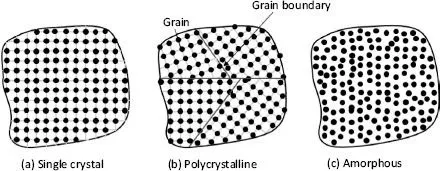
All of the solids, liquids, and gases that we encounter in our daily life are classified as a common type of matter. In solids and liquids the distance between neighboring atoms is of the order of a few angstroms. In the case of the gases, an average distance between molecules is approximately 30 Å at room temperature under 1 atm. Solids are one of the major states of matter. On the basis of the atomic arrangement, solids are classified into three categories: crystalline, polycrystalline, and amorphous [15]. In the crystalline structure (or single crystal or monocrystalline), the periodicity of atoms (or molecules) extends throughout the material (e.g., diamond, quartz, etc.). The opposite of a single crystal is an amorphous structure where the atomic position is completely random. In between the two extremes exist polycrystalline structures, which are made up of a number of small crystals known as crystallites. The crystallites in polycrystalline structures are randomly oriented. The small crystallites are known as grains and the boundaries separating them as grain boundaries. The crystalline, polycrystalline, and amorphous structures are schematically illustrated in Fig. 1.1.
Image
Figure 1.1 Schematic illustration of three types of solids: (a) crystalline, (b) polycrystalline, and (c) amorphous.
1.2 Crystal Structure
To understand the crystal structure, one must know the answer of following questions:
• What is a space lattice?
• What are the lattice translation vectors?
• What is the basis?
A space lattice is a regular periodic array of infinite number of imaginary points in three-dimensional space [15]. It can be defined in three dimensions by three fundamental translational vectors a, b, and c such that the atomic arrangement looks exactly the same in every respect when viewed from the point r as when viewed from the point r′, where
r=r+u1a+u2b+u3c
(1.1)
where u1, u2, and u3 are arbitrary integers. The set of points r′ defined by Eq. 1.1 for all u1, u2, and u3 defines a lattice. We can say that a lattice is a mathematically concept. The aforementioned periodic arrays of the infinite number of imaginary points in one dimension and two dimensions are called line lattice and plane lattice, respectively.
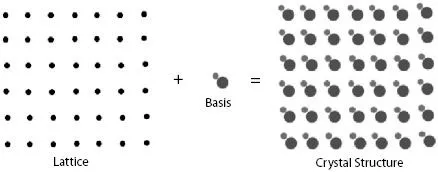
The crystal structure is always described in terms of atoms rather than point. Hence, to achieve a crystal structure, an atom or a group of atoms (i.e., molecule) must be placed on each lattice point in a regular fashion. Such an atom or a group of atoms is called the basis and acts as a building unit or a structural unit for the complete crystal structure. The crystal structure is formed when a basis of atoms is attached identical to every lattice points. Every basis should be identical in composition, arrangement, and orientation. Consequently, the crystal looks the same when viewed from any equivalent lattice point (Fig. 1.2). Mathematically, it is expressed as
Space lattice + Basis = Crystal structure.
Image
Figure 1.2 Schematic representation of the formation of a crystal structure by the addition of the basis to every lattice points of the lattice.
A lattice translation operation T is defined as the displacement of a crystal by a crystal translation vector
T=u1a+u2b+u3c
(1.2)
From Eqs. 1.1 and 1.2
r=r+T
(1.3)
It indicates that r can be obtained from r by the application of Eq. 1.2.
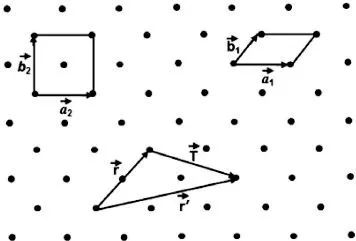
A lattice translation vector (r) with translation operation (T) for a two-dimensional arrangement of the lattice points is shown in Fig. 1.3.
The lattice and the translation vectors a, b, and c are said to be primitive if any two points r, r’ from where the atomic arrangement looks the same always satisfy Eq. 1.1 with a suitable choice of the integers u1, u2, u3. With this definition of the primitive translation vectors, there is no cell of smaller volume than a(b×c) that can serve as a building block for the crystal structure.
Image
Figure 1.3 A two-dimensional lattice. The atomic arrangement at r and r looks the same to observers at these points, since T is an integer number of the primitive translation vectors a1 and b1(T=2 a1b1).. a2 and b2 are the nonprimitive translatio...

Table of contents

  1. Cover
  2. Half Title
  3. Title Page
  4. Copyright Page
  5. Table of Contents
  6. Preface
  7. 1. A Brief Introduction of the Crystal Structure
  8. 2. Brief Overview of Silicon Wafer Manufacturing and Microfabrication Techniques
  9. 3. Isotropic Etching of Silicon and Related Materials
  10. 4. KOH-Based Anisotropic Etching
  11. 5. TMAH-Based Anisotropic Etching
  12. 6. Convex and Concave Corners in Silicon Wet Bulk Micromachining
  13. 7. Alignment of Mask Patterns to Crystallographic Directions
  14. 8. Simple to Complex Structures Using Wet Bulk Micromachining
  15. Index