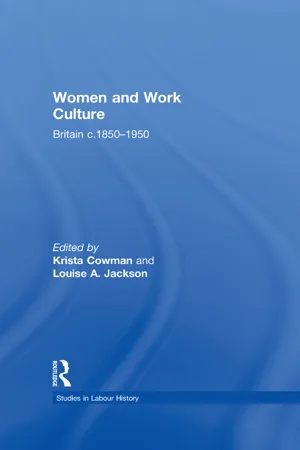
- 264 pages
- English
- ePUB (mobile friendly)
- Available on iOS & Android
eBook - ePub
About this book
Women's work has proved to be an important and lively subject of debate for historians. An earlier focus on the pay, conditions and occupational opportunities of predominantly blue-collar working-class women has now been joined by an interest in other social groups (white-collar workers, clerical workers and professionals) as well as in the cultural practices of the work place, reflecting in part the recent 'cultural turn' in historical methodology. Although the term 'culture' is debated and contested, this volume reflects this diversity, addressing a variety of interpretations. The individual essays address such issues as how women have created occupational and professional identities, negotiated masculine working practices (cultural, legal and institutional) and created their own 'feminine' environments. They also examine the integration of paid work with domestic responsibilities, the concept of 'career' for women, and the construction and representation of women's work within the wider cultural landscape.' By focusing on the experiences of British women between c.1850 and 1950, the collection vividly demonstrates that the association of 'work' with paid labour is problematic and that the categories of 'work', 'leisure' and 'consumption' must be viewed as overlapping and inter-linked rather than as separate entities. Furthermore, it highlights the ways in which the concept of gender operated as an organising principle in the construction and negotiation of identities and practices in British society.
PART I
WHAT DO WE MEAN BY WORK?
Chapter 1
Victorian Liberal Feminism and the ‘Idea’ of Work
The demand for expanded opportunities for work was a key concern of the women’s movement in Victorian England.1 Barbara Leigh Smith’s Women and Work, which appeared in 1857, was one of many mid-Victorian tracts to address the problem. Like many period pieces, the essay is a somewhat disconcerting collage of religious pronouncements and highly practical material concerns. In one breath, readers are admonished to ‘think seriously over my words: and if they have truth in them, it is a matter between God and your own souls that you act on them’. In the next, new employment opportunities for women are mooted and advice is given about suitable clothing for working women; cork-lined boots, waterproof cloaks, and skirts between the ankle and the knee are recommended.2
Smith’s essay is prefaced by two quotes. The first, from St Paul, summons a Christian vision of a community bound by a common faith that transcends all differences, including those of sex.3 The second, from Elizabeth Barrett Browning’s Aurora Leigh, associates work with the value of self-dependence. Asserting that all honest work promotes God’s purposes in the world, it proclaims that without work women are doomed to serfdom.4 Subsequently, Smith informs her readers that God’s purposes for the world encompass individual self-development: ‘Think of the noble capacities of a human being. Look at your daughters, your sisters, and ask if they are what they might be if their faculties had been drawn forth, if they had liberty … to become what God means them to be’.5
This complex of associations, identifying work with religious aspirations as well as practical material concerns and with hopes for communal integration as well as individual freedom and self-development, was characteristic of women and men who were active in women’s rights causes in the mid- Victorian years. However, the linkage between these various dimensions of work – between the metaphysical and the material and the communal and the self-promotional – is not obvious. The following discussion seeks to understand this ‘idea’ of work, its logic and its attractions for Victorian feminists.
Far from viewing work as a regrettable necessity, feminists of this generation saw work as a desideratum for all individuals regardless of sex and invested work with existential hopes that were both religious and secular in character. They recognised that for many women work was a matter of urgent material need. They wanted women who engaged in waged work to be adequately remunerated and wished a greater range of paid employments to be opened to women. However, their ‘idea’ of work – particularly for individuals like themselves – was not that of a relationship dictated by economic imperatives. Rather, it was rooted in a non-materialist worldview that aligned Protestant religious convictions with a contemporary strand of liberal thought. The former associated work with a sense of moral/spiritual agency, transcendent purpose, and an understanding of community as a community of believers united by faith in a common cause. The latter assumed that self-interested individual striving would ultimately promote the common good but identified the higher self-interest with altruistic orientations. Blurring the distinction between waged and unwaged work and domestic and public employments, this ‘idea’ of work, while not necessarily gendered, included elements that were compatible with conventional ideals of middle-class womanhood and thus could carry gendered overtones.
In practice this ‘existential’ view of work had class implications, assuming a freedom of choice that was largely limited to the privileged few. More particularly, it was closely attuned to emergent professional ideals, which assumed a measure of independence from immediate market constraints and were oriented to an ethic of public service rather than a direct pursuit of private gain. However, its early proponents did not understand this ‘idea’ of work as being class-specific. On the contrary, they assumed it to be potentially accessible to all and as promoting bonding across lines of class and sex. By the late nineteenth and early twentieth century, when class-related issues (including working-class conditions of employment) were acquiring greater salience, this vision of work as a secular calling was becoming increasingly class-specific, feeding into the formation of professional identities and the concept of a career.
* * *
For most mid-Victorian feminists the ‘idea’ of work remained heavily freighted with religious associations: with a quest for transcendental meaning, a hope (however faint) of immortality, a view of life as a pilgrim’s progress towards spiritual/moral enlightenment, and a search for spiritual fellowship. Work was often projected as a religious imperative incumbent on all human beings. In Barbara Leigh Smith’s words:
God sent all human beings into the world for the purpose of forwarding … the progress of the world. We must each leave the world a little better than we found it… To do God’s work in the world is the duty of all, rich and poor, of all nations, of both sexes.6
Her views were echoed by Josephine Butler, who also believed that it was against God’s will that any be ‘cumberers of the ground’.7 This religious vision of work dovetailed with a strain of contemporary liberal thought, associated especially with the later works of John Stuart Mill, that envisaged a meritocratic society in which individuals were rewarded for their works but at the same time recognised their responsibilities for promoting the larger, public good. As Mill related, he and his wife Harriet Taylor Mill:
… looked forward to a time when society will no longer be divided into the idle and the industrious; when the rule that they who do not work shall not eat will be applied … impartially to all … and when it will no longer either be, or be thought to be, impossible for human beings to exert themselves strenuously in procuring benefits which are not to be exclusively their own, but to be shared with the society they belong to.8
The ‘idea’ of worldly work as a Godly calling of course had roots reaching far back in the Protestant tradition. While work retained religious associations for many individuals of this generation, it was but loosely attached to any particular doctrinal or denominational moorings. Although their religious sensibilities differed, Barbara Leigh Smith, a Deist from a radical Unitarian family, and Josephine Butler, an Evangelical, vested similar hopes in the ‘idea’ of work,9 and their hopes were broadly shared by many earnest doubters, including Mill. Eliding moral and spiritual values, Mill considered that individuals might find something at least akin to religious satisfactions in labouring to realise the new moral order that he believed destined to prevail:
A battle is constantly going on, in which the humblest human creature is not incapable of taking some part, between the powers of good and those of evil … even the smallest help on the right side has its value in promoting the very slow … progress by which good is gradually gaining ground from evil, yet gaining it so visibly at considerable intervals as to promise the very distant but not uncertain final victory of Good. To do something during life … towards bringing this consummation ever so little nearer, is the most … invigorating thought which can inspire a human creature; and that it is destined, with or without supernatural sanctions, to be the religion of the Future I cannot entertain a doubt.10
In working for the good of humankind, Mill noted, noble-minded individuals might hope to achieve a form of immortality in being honoured forever in the memory of their fellow human beings.
For many thoughtful individuals of this generation who struggled with religious doubts, however they resolved them, the quest for work assumed a special urgency. Whether or not they were believers they were determined to find a sense of transcendent purpose in this life and some way of leaving their footprints in the sand. Jane Rendall has provided a moving account of the young Barbara Leigh Smith’s and her good friend Bessie Rayner Parkes’s quest for work that would provide a sense of purpose in their lives. Writing to her friend about ‘work & life’ and urging the necessity of ‘fixing early on a train of action’, Barbara reflected ‘what is so sad so utterly black as a wasted life …. I believe there are thousands & tens of thousands who like you & I … intend working but live & die, only intending’.11 Also familiar is Florence Nightingale’s heartfelt cry for work, and her outrage at what seemed to her the appalling waste of life that conformity to the small rituals of private social concourse entailed. ‘[I]s it a wonder’, she demanded, ‘that all individual life is extinguished [in this context]’?12 Millicent Fawcett, a perfunctory Anglican, devoted much of her later life to working for the cause of women’s suffrage. As her sister wrote to her: ‘I felt… that the cause is to you what religion was to dear mother’.13
These feminists’ ‘idea’ of work was comprehensive. It included both waged and unwaged labour and might include women’s domestic responsibilities as well. Bessie Parkes, who edited the English Woman’s Journal from 1858-63, intended it to be a ‘Working Woman’s Journal’. She included in the ranks of ‘working woman’:
[A]ll women who are actively engaged in any labours of brain or hand, whether they be the wives and daughters of landed proprietors, devoted to the well¬being of their tenantry, or … other labourers in the broad field of philanthropy … teachers … professional artists; or are engaged in any of those manual occupations by which multitudes … gain their daily bread.14
Insisting on the equivalency of women’s domestic work and other forms of work, Barbara Leigh Smith explained:
Women who act as housekeepers, nurses, and instructors of their children, often do as much for the support of the household as their husbands; and it is very unfair for men to speak of supporting a wife and children when such is the case. When a woman gives up a profitable employment to be a governess to her own family, she earns her right to live. We war against idleness, whether of man or woman, and every one is idle who is not making the best use of the faculties nature has given them.15
For Smith, then, it was the nature of the work, not the setting or its remuneration, that were of crucial interest.
However comprehensive their definition of work, these individuals did not consider all forms of labour equally valuable. Consistent with their Protestant origins, they insisted on the importance of inner motivation in determining the ethical value of work. In their view, ideally work was undertaken in a disinterested, altruistic spirit, whether or not the work was waged and whatever the benefits that accrued incidentally to the individual worker. The ideal life’, Florence Nightingale explained, ‘is passed in noble schemes of good consecutively followed up, of devotion to a great object, of sympathy given and received for high ideas and generous feelings’.16 Frances Power Cobbe took a similar view: ‘[A]ll faithful work – be it in the fields of art or science, or disinterested labour of any kind – is as truly work for God as the toil of the most devoted philanthropists’.17
These individuals’ claims for work for women were tailored to a worldview in which claims to esteem and power were based on individuals’ moral and mental merit (they were inclin...
Table of contents
- Cover
- Half Title
- Title Page
- Copyright Page
- Table of Contents
- List of Figures and Table
- List of Contributors
- General Editor’s Preface
- Acknowledgements
- Introduction: Women’s Work, a Cultural History
- Part I: What Do We Mean by Work?
- Part II: Factory Labour
- Part III: Youth
- Part IV: Science and Medicine
- Part V: Women and War
- Index
Trusted by 375,005 students
Access to over 1.5 million titles for a fair monthly price.
Study more efficiently using our study tools.
Frequently asked questions
Yes, you can cancel anytime from the Subscription tab in your account settings on the Perlego website. Your subscription will stay active until the end of your current billing period. Learn how to cancel your subscription
No, books cannot be downloaded as external files, such as PDFs, for use outside of Perlego. However, you can download books within the Perlego app for offline reading on mobile or tablet. Learn how to download books offline
We are an online textbook subscription service, where you can get access to an entire online library for less than the price of a single book per month. With over 1.5 million books across 990+ topics, we’ve got you covered! Learn about our mission
Look out for the read-aloud symbol on your next book to see if you can listen to it. The read-aloud tool reads text aloud for you, highlighting the text as it is being read. You can pause it, speed it up and slow it down. Learn more about Read Aloud
Yes! You can use the Perlego app on both iOS and Android devices to read anytime, anywhere — even offline. Perfect for commutes or when you’re on the go.
Please note we cannot support devices running on iOS 13 and Android 7 or earlier. Learn more about using the app
Please note we cannot support devices running on iOS 13 and Android 7 or earlier. Learn more about using the app
Yes, you can access Women and Work Culture by Louise A. Jackson, Krista Cowman in PDF and/or ePUB format, as well as other popular books in History & World History. We have over 1.5 million books available in our catalogue for you to explore.