- 512 pages
- English
- ePUB (mobile friendly)
- Available on iOS & Android
eBook - ePub
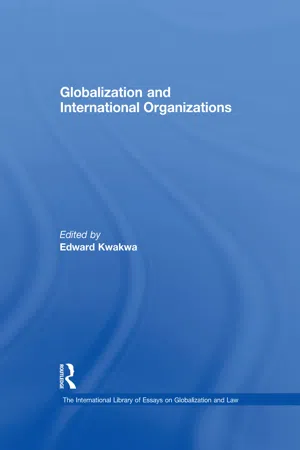
Globalization and International Organizations
About this book
The last few years have witnessed several significant developments in respect of international organizations, most of which are best encapsulated in the word "change". In particular, international organizations have moved from their traditional role of facilitator of the activities of their members, to that of director of their own activities. As a result, there is increased scrutiny over issues relating to the governance, control, accountability and the privileges and immunities of international organizations. These subjects are all the focus of this book. Edward Kwakwa has collected together the best published work by leading authorities in the field on subjects of crucial importance and relevance to international organizations, particularly in the context of today's ever-increasing globalization. This book is of interest to scholars and students of law, as well as government and non-government practitioners and international civil servants.
Information
Part I
General and Conceptual Issues
[1]
INTERNATIONAL ORGANIZATIONS: THEN AND NOW
International organizations (or IOs)—intergovernmental entities established by treaty, usually composed of permanent secretariats, plenary assemblies involving all member states, and executive organs with more limited participation—are a twentieth-century phenomenon having little in common with earlier forms of institutionalized cooperation, including those in the ancient world.1 The story of how, shortly after the turn of the last century, the Euro-American lawyers that dominated the field of international law sought to transcend the chaos of war by “moving to institutions” has been told elsewhere and needs no repeating here. David Kennedy, Martti Koskenniemi, and David Bederman, among others, have described the disparate individuals, separated by nationality, juridical philosophy, and competing “idealist”/”realist” schools of thought, who nevertheless shared a messianic, quasi-religious, and coherent “internationalist sensibility” that sought to institutionalize multilateral diplomacy with a view to promoting civilization and progress.2 Kennedy locates the move to international organization in turn-of-the-century reformist aspirations for parliamentary, administrative, and judicial mechanisms that, in the Victorian language of the day, would convert “passion into reason.”3 By the time this Journal was established, the Congress of Vienna’s concert system had provided a model for an incipient (albeit only periodic) pseudo-parliament; diverse public administrative unions and river commissions suggested the possibilities for international administration and even the interstate pooling of funds; and the Permanent Court of Arbitration presaged an international judiciary.4
The decisive move to institutionalize what heretofore had been only fitful attempts to codify discrete areas of international law, jointly administer the global commons (such as with respect to certain rivers and postal services), and peacefully settle interstate disputes, came, of course, in 1919, when the Covenant establishing the League of Nations was concluded. This was the break with prior practice that transformed ad hoc practice into more integrated institutions. The establishment of the League of Nations—a subject that understandably received considerable attention in this Journal—sought to make permanent the forms of great-power cooperation first seen in the course of World War I. It also sought to change, in rhetorical terms and in fact, the waging of war into the discourse of “dispute resolution.”5
As is clear from President Wilson’s address—published in the Journal—when he presented the draft League Covenant at a Paris conference on February 14, 1919, those who built the League presaged many contemporary dilemmas: how best to deploy law in the service of peace, how to further “democratic” representation in a body representing the “great body of the peoples of the world,” how to construct a constitutive instrument that would also be a “vehicle of life” suited to “changing circumstances,” how to ensure transparency in international relations, and how best to promote the development of the “helpless peoples of the world.”6 To a considerable extent, the post–World War II establishment of the United Nations and Bretton Woods systems was only a continuation, with midcourse corrections and embellishments (such as creating institutions to address problems of international finance and economy), of the (interrupted) hope to institutionalize the aspirations of the “international community.”7 The twentieth century’s “move to institutions,” as Kennedy describes it, constituted a move from utopian aspirations to institutional accomplishment; that is, a move to replace empire with institutions that would promote the economic development of the colonized, end war through international dispute settlement, affirm human rights and other “community” goals through discourse, advance “democratic” governance at both the national and the international levels, and codify and progressively develop, on the basis of “scientific principles,” international rules—all by turning to the construction of proceduralist rules, mechanisms for administrative regulation, and forums for institutionalized dispute settlement.8
Despite the collapse of the League of Nations, and revolutionary changes in foreign relations and technology, public international lawyers have today largely achieved their century-old dream to institutionalize. The nearly three hundred IOs—regional and global, presiding over both high-profile issues of war and peace and more prosaic “technocratic” matters—and nearly forty institutionalized international dispute settlers that now address virtually every field of human endeavor, including matters once regarded as exclusively subject to national law, reflect these lawyers’ faith in technocratic and legal elites, neutral forms of adjudication modeled on the independent judiciary of rule-of-law states, Western models of governance and free markets, and functionalist needs as the drivers of international cooperation.9 Although today’s IOs differ in relation to many variables—from degree of legalization10 to measurable real-world impact11—they are the unmistakable progeny of the “Grotian tradition” memorably described by Hersch Lauterpacht in 1946.12 The UN and Bretton Woods organizations, and other IOs that aspire to global participation, such as the World Trade Organization (WTO), institutionalize Lauterpacht’s eleven features of the “Grotian tradition.” They attempt to subject the totality of international relations to the rule of law; inspire conceptions of a new form of jus gentium; affirm the social nature of humankind; recognize that individual human beings (and not just states) are of direct concern to international law; seek to subject all states, including the most powerful, to the rule of law; reject the idea that the decision to wage a “just war” is ultimately the “supreme prerogative” of individual states; subject the privilege of remaining neutral to IO (e.g., Security Council) exception; rely on the binding force of treaty promises; affirm the foundational rights and freedoms of the individual; err on the side of pacifism; and reflect a tradition of “idealism and progress.”13
In large and small ways, IOs have accomplished more than their creators anticipated. As this Journal’s other centennial essays begin to suggest, they have transformed the sources of international obligations as well as their content, the principal lawmaking actors, and even our understanding of what “international law” is and what it means to “comply” with its rules.14
I. IOs AND THE RULES OF INTERNATIONAL LAW
Dinah Shelton’s examination of “normative hierarchy” suggests some of the changes in modern sources of international obligation that are at least partly attributable to institutionalization.15 Jus cogens and erga omnes obligations are products of the age of IOs precisely because they made real (or more real than ever before) the idea of a “community of states as a whole” on which such hierarchical concepts could be built. The articulation of jus cogens—in Article 53 of the Vienna Convention on the Law of Treaties16—resulted from the kind of “package deal” that characterizes treaty making in institutionalized global venues involving UN expert bodies (in this instance, the International Law Commission [ILC]) and UN-authorized treaty-making conferences; that is, it placated, as Shelton indicates, the Soviet bloc and newly independent states, and was part of a single package that stabilized treaty relations through codification, as sought by the West, in exchange for softening the rigor of some preexisting rules, as sought by others.17 Article 53 is also the k...
Table of contents
- Cover Page
- Title Page
- Copyright Page
- Contents
- Acknowledgements
- Series Preface
- Introduction
- PART I GENERAL AND CONCEPTUAL ISSUES
- 1 International Organizations: Then and Now
- 2 The Law of International Organizations: A Subject which needs Exploration and Analysis
- 3 International Institutions Today: An Imperial Global State in the Making
- PART II GOVERNANCE, CONSTITUTIONAL REFORM AND ACCOUNTABILITY
- 4 Governance and Accountability: The Regional Development Banks
- 5 Representation and Power in International Organization: The Operational Constitution and Its Critics
- 6 Constitutionalism Lite
- 7 The Bustani Case Before the ILOAT: Constitutionalism in Disguise?
- PART III PRIVILEGES AND IMMUNITIES
- 8 Privileges and Immunities of United Nations Officials
- 9 In the Shadow of Waite and Kennedy: The Jurisdictional Immunity of International Organizations, the Individual’s Right of Access to Courts and Administrative Tribunals as Alternative Means of Dispute Settlement
- PART IV NORM-MAKING
- 10 Law-making through the Operational Activities of International Organizations
- 11 Some Comments on Rulemaking at the World Intellectual Property Organization
- PART V DEVELOPMENT
- 12 The World Intellectual Property Organization and the Development Agenda
- 13 International Trade for Development: The WTO as a Development Institution?
- 14 The WTO, Global Governance and Development
- Name Index
Trusted by 375,005 students
Access to over 1.5 million titles for a fair monthly price.
Study more efficiently using our study tools.
Frequently asked questions
Yes, you can cancel anytime from the Subscription tab in your account settings on the Perlego website. Your subscription will stay active until the end of your current billing period. Learn how to cancel your subscription
No, books cannot be downloaded as external files, such as PDFs, for use outside of Perlego. However, you can download books within the Perlego app for offline reading on mobile or tablet. Learn how to download books offline
Perlego offers two plans: Essential and Complete
- Essential is ideal for learners and professionals who enjoy exploring a wide range of subjects. Access the Essential Library with 800,000+ trusted titles and best-sellers across business, personal growth, and the humanities. Includes unlimited reading time and Standard Read Aloud voice.
- Complete: Perfect for advanced learners and researchers needing full, unrestricted access. Unlock 1.5M+ books across hundreds of subjects, including academic and specialized titles. The Complete Plan also includes advanced features like Premium Read Aloud and Research Assistant.
We are an online textbook subscription service, where you can get access to an entire online library for less than the price of a single book per month. With over 1.5 million books across 990+ topics, we’ve got you covered! Learn about our mission
Look out for the read-aloud symbol on your next book to see if you can listen to it. The read-aloud tool reads text aloud for you, highlighting the text as it is being read. You can pause it, speed it up and slow it down. Learn more about Read Aloud
Yes! You can use the Perlego app on both iOS and Android devices to read anytime, anywhere — even offline. Perfect for commutes or when you’re on the go.
Please note we cannot support devices running on iOS 13 and Android 7 or earlier. Learn more about using the app
Please note we cannot support devices running on iOS 13 and Android 7 or earlier. Learn more about using the app
Yes, you can access Globalization and International Organizations by Edward Kwakwa in PDF and/or ePUB format, as well as other popular books in Politik & Internationale Beziehungen & Globalisierung. We have over 1.5 million books available in our catalogue for you to explore.