- 302 pages
- English
- ePUB (mobile friendly)
- Available on iOS & Android
eBook - ePub
About this book
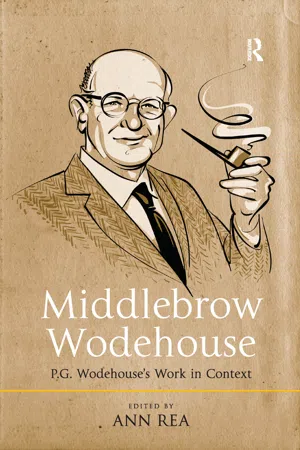
While he is best known for his Jeeves and Bertie Wooster stories, P.G. Wodehouse was a prolific writer who penned many other novels, stories, and musical comedy libretti, the latter of which played an enormous role in the development of American musical theater. This collection re-examines Wodehouse in the context of recent scholarship on the middlebrow, attending to his self-conscious relationship to the literary marketplace and his role in moving musical comedy away from vaudeville's lowbrow associations towards the sophistication of the Wodehouse style. The focus on the middlebrow creates a critical context for serious critical consideration of Wodehouse's linguistic playfulness and his depictions of social class within England. The contributors explore Wodehouse's fiction and libretti in reference to philosophy, depictions of masculinity, World War I Britain, the periodical market, ideas of Englishness, and cultural phenomena such as men's fashion, food culture, and popular songwriting. Taken together, the essays draw attention to the arbitrary divide between high- and middlebrow culture and make a case for Wodehouse as a writer whose games with language are in keeping with modernist experimentation with artistic expression.
Information
Chapter 1
Know Your Audience: Middlebrow Aesthetic and Literary Positioning in the Fiction of P.G. Wodehouse
Although praised exuberantly by Evelyn Waugh and Hilaire Belloc, translated into dozens of languages and avidly read worldwide, it appears that P.G. Wodehouse is everybody’s favourite comic author, but nobody’s canonical writer – except when seen as the centre of his own particular canon of Wodehouseiana. In his 1953 review of The Inimitable Jeeves, Julian Maclaren-Ross deplored that ‘in spite of the superlatives with which these [reviews] are studded, the reviewers seem content to pigeon-hole him conveniently as ideal light reading for beach, train, or week-end trip’ rather than probing further (351). This essay strives to explain Wodehouse’s status as a popular writer, whose work is read with enjoyment by academics, critics and the general reader alike, as resulting from his particular positioning within the literary field, scrutinizing his relationship to both popular commercial fiction and avant-garde literary output. Wodehouse as a writer of enduring popularity and yet non-canonical status fits in with a range of critical discourses of the middlebrow, both modern and contemporary. Like most writers, however, he inevitably puts his own stamp on the term ‘middlebrow’. But how middlebrow is Wodehouse, and how far does he subscribe to a middlebrow aesthetic? As Erica Brown and Mary Grover have recently reasserted, the middlebrow remains notoriously hard to define, and is more often than not approached purely in contrast to its avant-garde contemporaries (Brown and Grover 1–21). Despite the efforts of a whole range of recent critical studies, ‘middlebrow’ largely remains ‘a pejorative label, its dismissive effect designed to credit its users with superior powers of discrimination’ (Brown and Grover 1–2). The purpose of this essay is not to pin such a pejorative label on Wodehouse’s writing. Rather than take the term ‘middlebrow’ for granted, it will investigate precisely what qualities of Wodehouse’s writing can be termed middlebrow and why Wodehouse’s particular brand of the middlebrow can be seen as closely linked with J.B. Priestley’s original defence of the middlebrow – or ‘Broadbrow’ – as ‘an inclusive stance’, a ‘happy medium’ (Pollentier 46), part of a long tradition of such writing reaching back as far as Shakespeare. Like Priestley, the early champion of the middlebrow, Wodehouse reclaimed Shakespeare as a popular writer whom Robert Scholes has boldly identified as an early practitioner of ‘durable fluff’ (Scholes 144).
One of the core distinctions made between ‘literary’ and ‘middlebrow’ writers is that between the writer-as-artist and the writer-as-craftsman. The distinction between these two understandings of literary production largely hinges on the question of audiences and expectations: problematic though Bourdieu’s theorizing of middlebrow culture may be, his definition of middlebrow works of art as ‘entirely defined by their public’ (Bourdieu 125) holds at least a grain of truth. It is of course naive to assume that the writer-as-artist cares only about his or her own aesthetic practice and is contemptuous of attracting a wider readership. The desperate struggle on the part of many modernist writers to find such an audience and make a living disproves such notions of exclusivity, and conversely, ‘middlebrow’ writers can be highly reflective of their literary practice. However, it seems fair to argue that there is a difference between the two opposing poles of artistry and craftsmanship in terms of how these two elements are weighted and that middlebrow writers place far greater emphasis on meeting audience expectations.
Wodehouse in particular felt that it was a fundamental part of the ethos of the professional writer not to startle and challenge one’s readers, but to satisfy expectations once raised by maintaining a consistency of style and approach without, however, succumbing to tedious predictability. In Wodehouse’s opinion, ‘professional’ writing is first and foremost readable, pleasurable, and free from any moralizing or aim to challenge or educate readers. Although Wodehouse’s writing does not tally with what Bourdieu has described as l’art moyen, it can usefully be described with reference to Bourdieu’s different fields of cultural production, in that Wodehouse borrows freely from a whole range of both high and low cultural sources, all the while situating himself freely and unashamedly in the commercial mass market as an example of the ‘ordinary novelist, the straightforward, horny-handed dealer in narrative, who is perfectly content to turn out his two books a year’ (‘The Super-Novelists’ 49) – in short, a craftsman who is through Wodehouse’s very use of language linked to the physical exertion and productive handiwork associated with hard-working average citizens rather than the moneyed intelligentsia.
It is in the nature of Wodehouse’s demonstratively practical rather than intellectual approach to writing that his literary aesthetic was never articulated in the form of a manifesto or critical essay. In his defiance of highbrowism that occasionally borders on anti-intellectualism, Wodehouse is in many ways a perfect illustration of Nicola Humble’s concept of the camp middlebrow (Middlebrow Literary Cultures 220), with its refusal to take itself and the world around it seriously while still delivering what readers want to see. Where Priestley addressed the debate over the cultural validity of middlebrow writing in articles and broadcasts as well as fiction, Wodehouse does not get involved in public debates beyond the occasional flippant article in a popular magazine, and restricts his comments to comic portrayals of both highbrow writers and lowbrow readers. However, looking at his mostly casual but ample comments on writing, audiences and the creative process in letters, articles, fiction and non-fiction, it quickly becomes apparent that Wodehouse’s approach to literature was characterized by a sense of democracy in culture, and shaped by his middle-class background. Wodehouse began his career equipped with an excellent secondary education from Dulwich College, but was denied a university education on financial grounds. Negative evaluations of middlebrow writing ascribe to it a strong aspirational element, an air of pretence, of striving to be high culture and yet failing to deliver literary and aesthetic excellence. Having experienced, like many ‘middlebrow’ writers, the life of an unwilling clerk, Wodehouse’s main aspiration was not to be a ‘literary’ writer, but to make a living by his pen in a manner that he saw as both lucrative and enjoyable. As such, Wodehouse had no compunction about turning out what would sell, albeit with a keen eye on what he perceived as quality writing. Despite his lack of overt engagement in critical debates about authorship, Wodehouse shows a high degree of self-reflexivity on writing processes and the writer’s profession characteristic of middlebrow texts. As Brown and Grover note, ‘if there is one trope which pervades writing labelled middlebrow it is the representation of the act of writing itself’ (15). This reflects Wodehouse’s identity as a reader for pleasure as well as a writer: as we will see below, authorship and particularly a sense of craftsmanship are inscribed deeply in Wodehouse’s writing.
Wodehouse’s professional aesthetic, then, is based on three main tenets, all of which can be classed as middlebrow in one sense or another:
- It assumes a position in-between highbrow intellectualism (negatively characterized as impenetrable and elitist) and affectionately derided popular forms (ridiculed as overly contrived and predictable).
- It emphasizes the importance of readability, including the belief that reading pleasure can be repetitive and repeated without detriment to quality.
- It refuses to take itself and the process and profession of writing entirely seriously, and is suspicious of ‘literary’ writers on the grounds of their perceived unmitigated seriousness about their own output.
Wodehouse, especially during the early decades of his career, was writing in a climate in which the literary celebrity had become a common phenomenon. Popular and ‘middlebrow’ writers of various calibres, such as Arnold Bennett, John Galsworthy, Marie Corelli, W.J. Locke, E. Phillips Oppenheim, Baroness Orczy or Edgar Wallace, were well known to vast audiences, not simply for their books, but through interviews and feature articles in popular papers and magazines (Bloom 181). The prospect of joining the ranks of such successful writers must have seemed eminently desirable to an aspiring young author like Wodehouse who, due to constraints upon his parents’ finances, found himself unable to attend university upon leaving school and had to rely on commercial success as a writer to escape from a monotonous existence as a lowly bank clerk. In comparison, the life of a perpetually cash-strapped avant-garde artist was less appealing to a young writer dependent on his pen, who had been raised not only on the classics, but also on popular Victorian novels and magazine fare. Besides studying Latin and Greek for university scholarship exams that he would never sit, the young Wodehouse read and enjoyed Shakespeare’s plays and Thackeray’s novels and was familiar with magazines such as the Captain, Pearson’s Weekly, Tit-Bits and the Strand – as evidenced in his early letters – cementing his enjoyment of competently written, entertaining prose. As Sophie Ratcliffe notes in her recent edited volume of Wodehouse’s letters, Wodehouse is one of those twentieth-century writers who, having experienced their fair share of modern upheaval and displacement in the wake of two world wars, ‘may have eschewed the techniques of modernism, but […] still provide stylistic paths through the same insecurity that the modernists exposed’ (4). Whereas formal experimentation and fragmentation served this purpose for the modernists, Wodehouse tackles the vagaries of the modern experience by moulding together old and new, the popular and the intellectually challenging in a satirical mix that treats the fears and insecurities of modern life lightly.
Wodehouse and the Academy
A recurring question in biographies and memorial volumes on Wodehouse is why there is so little serious criticism to counterbalance the enthusiastic eulogies of his admirers. Laura Mooneyham explains Wodehouse’s extra-canonical status by pointing to the fact that Wodehouse’s writing, both comic and popular, is diametrically opposed to the tenets of literary modernism that have come to inform academic critical practice. Mooneyham identifies a whole range of aspects in which Wodehouse’s writing runs counter to modernist ideas of what literature should be, such as his resolute indifference to notions of originality and innovation beyond a playful engagement with literary models; his extreme attachment to well-crafted, intricate plots and consequent rejection of ‘plotless’ fiction; and his belief in readability and closure as opposed to the fragmentation and openness that characterize so many modernist novels and short stories (Mooneyham 119–21). Wodehouse’s work can also be seen as defying serious treatment through its own refusal to take anything seriously, including itself, and by aiming explicitly for popular and not critical success. As Mooneyham observes, Wodehouse himself was the first to ‘[accept] his chosen conventionality’ and indeed to defiantly posit himself against serious critical appreciation (122). With characteristic hyperbole, Wodehouse diagnosed the underappreciated status of the comic writer more than once, such as in his 1966 ‘Note on Humour’:
Humorists are often rather gloomy men, and what makes them so is the sense they have of being apart from the herd, of being, as one might say, the eczema on the body politic. They are looked down on by the intelligentsia, patronized by the critics and generally regarded as outside the pale of literature. People are very serious today, and the writer who does not take them seriously is viewed with concern and suspicion. (‘A Note on Humour’ 316)
Albeit tongue-in-cheek, Wodehouse here perceptively addresses his own lack of canonicity and links it to the low reputation of comedy as a genre in a manner similar to Mooneyham’s.
Critical Reception
Literary critics appear to like Wodehouse despite the fact that they for the most part fail to dedicate serious research to him. His main selling points are his grasp of language and rendering of a variety of idioms, his literateness, and his deft use of generic conventions. In all respects, Wodehouse shows a keen awareness of the literary and critical scene(s) around him and uses calculated irreverence towards canonical authors and their critics to position himself on the fringes of highbrow culture and at the same time to reject its elitism. Wodehouse engages with high as well as popular culture sufficiently to appeal to the widest possible range of tastes, offsetting his exuberant ‘popular’ plots with a dose of high-cultural references. Between 1910 and the Wodehouse centenary in 1981, the Times Literary Supplement alone published in excess of 50 reviews of Wodehouse’s books, which at times express regret over a slight lapse in originality and verve, but time and again praise new peaks of Wodehouse’s comic talent and particularly his enduring stylistic prowess. H.O. Lee noted the comic potential of the ‘idealized music-hall English’ and ‘gift of heavenly jargon’ evidenced in Damsel in Distress as far back as 1919 (Lee 590), and other reviewers continued in the same vein, from Maurice Richardson’s verdict that ‘his similes are vivid and telling, while the use of literary clichés and mixed metaphors to secure comic effects is as adroit as ever’ (Richardson 449), to Richard Usborne’s praise of Wodehouse’s ‘Bertie’s burble’ prose as ‘always, and still, a wonder and a joy’ (Usborne, ‘Fair-Weather England’ 1455). A number of scholars, first and foremost Inge Leimberg and Laura Mooneyham White, have also noted this most conspicuous quality of Wodehouse’s style, coupled with his use of literary allusion and pastiche. Indeed, his use of a variety of different idioms can be seen as Wodehouse’s one area of innovation and variation, in that he is constantly moulding his language, similes and register to the subject matter he is addressing, from golfing to romance and from crossword puzzles to fishing.
Wodehouse’s literateness is similarly an aspect of his writing that has been noted by a range of critics and reviewers, who focus primarily on his affectionate irreverence towards the canonized great, first and foremost Shakespeare. Indeed, one of the most noticeable features of Wodehouse’s fiction is its remarkable intertextuality, both in terms of reusing his own material in new guises and in its comic use of literary allusion. Ratcliffe and others observe how widely and variedly Wodehouse read, from popular detective fiction to Balzac and Austen (Ratcliffe 5). His reading finds expression in innumerable comic uses of literary (mis)quotation, embedded in the text or as part of his characters’ dialogue. At the same time, Wodehouse also freely borrows from and refers to popular cultural products, from pulp fiction to musical theatre and film, drawing on his own extensive knowledge of the commercial entertainment market as a writer of magazine fiction, musical lyricist and erstwhile Hollywood scriptwriter.
John Hayward, praising ‘the inimitable verbal wit, the grotesquely distorted literary echoes and the pure fantasy of simile and metaphor that are Mr. Wodehouse’s chief claim to literary distinction’, claims that ‘it would be easy to show how almost every single novel of his contains passages that prove, explicitly or implicitly, his familiarity with the work not only of Shakespeare but of a large number of the best English writers from Chaucer onwards’ (Hayward 29). While Wodehouse was certainly a prolific reader as well as writer, with a solid education in the classics and a lifelong enjoyment of Shakespeare’s work, he himself freely tells us that not all his literary allusions stem from the inexhaustible store of his literary memory. In his semi-autobiography ‘with digressions’, Over Seventy, Wodehouse enthusiastically praises the usefulness of ‘Bartlett’s book of Familiar Quotations, that indispensable adjunct to literary success’, claiming in his characteristic self-deprecating manner, ‘I am not very bright and find it hard to think up anything really clever off my own bat, but give me my Bartlett and I will slay you’ (Over Seventy 39). Despite this demonstrative modesty, Wodehouse’s skilful use of literary allusion is the best proof of his knowledge beyond Bartlett, without which a mere dictionary of quotations would have been of very limited benefit. Ratcliffe’s edited letters show us a Wodehouse who capably argues with his novelist friend Denis Mackail over a reference to Keats’s ‘La Belle Dame Sans Merci’ in Wodehouse’s The Old Reliable (1951) which Mackail had flagged up as flawed, establishing at last that they were looking at different versions of the poem (Ratcliffe 442–3). He can also be seen to mockingly upbraid his biographer, Richard Usborne, for his failure to recognize a quotation as originating from Robert Browning’s poem ‘Incident of the French Camp’, although he himself admittedly misremembers the poem’s title (Ratcliffe 488).
Whether or not the plentiful ‘allusion, imitation, rewriting, parody and quotation’ (Säckel 137) that characterize Wodehouse’s work are the result of private study or intelligent gleaning, their effect is crucial to Wodehouse’s success. His multiform use of literary models, from classical literature to contemporary fiction, marks his writing as intelligent humour beyond mere slapstick and situation comedy. Wodehouse not only shows a degree of reliance on his readers’ knowledge of key canonical as well as popular texts (Säckel 140), but also appeals to more educated readers by allowing them the gratification of recognizing these passages. His casual use of high-cultural references is a fundamental part of what can be called Wodehouse’s specifically middlebrow aesthetic, in that he assumes readers’ familiarity with both popular and canonical writing, yet refuses to treat it either reverentially or disdainfully. As Scholes suggests,
P.G. Wodehouse assumes that his readers share Jeeves’s knowledge [of Shakespeare] rather than Bertie’s ignorance. […] This is a Light Modernism that insists on its connection with the canonical masters of English literature, and it has been written for an audience that knows the work of those masters and can appreciate the various montages, pastiches, and outright mis-appropriations of the elder writers by the authors and characters of these modern texts. (Scholes 183)
Shakespeare’s tragic heroes are invoked as regular means of comparison, such as in Wodehouse’s description of one of his temporarily jilted golfing lovers, ‘I should now reveal that he was as fiercely jealous a man as ever swung an aluminium putter. Othello might have had a slight edge on him in that respect, but it would have been a very near thing’ (‘Feet of Clay’ 85).
Wodehouse not only leans heavily on Shakespeare in terms of echoing and adapting the playwright’s work for his own comic purposes, he also ‘rereads the bard’s “high brow” works as popular entertainment in their own time’ (Säckel 143) and aligns himself with Shakespeare as a hard-pressed professional writer at the mercy of editors, theatre managers and deadlines (Over Seventy 60). Transferring his own experience of writing for the stage onto Shakespeare, Wodehouse effectively declares him a fellow middlebrow, and a writer who, as Scholes puts it, ‘had once been regarded as satisfying a thirst for...
Table of contents
- Cover
- Half Title
- Title Page
- Copyright Page
- Dedication
- Table of Contents
- Notes on Contributors
- List of Abbreviations
- Introduction to Middlebrow Wodehouse
- 1 Know Your Audience: Middlebrow Aesthetic and Literary Positioning in the Fiction of P.G. Wodehouse
- 2 Reading Up or Curling Up with a Book: Aspiring and Promiscuous Readers in P.G. Wodehouse’s Jeeves and Bertie Stories
- 3 Before Jeeves: Impudence in P.G. Wodehouse’s Novels, 1909–23
- 4 P.G. Wodehouse and the First World War
- 5 The Prison Camp as Public School: Wodehouse, School Stories and the Second World War
- 6 The Place of the Pig: Blandings, Barsetshire and Britain
- 7 P.G. Wodehouse and the American Musical Comedy: Innovations in Writing
- 8 Wooster the Musician
- 9 Philosophy with a Smile
- 10 ‘A Fairly Unclouded Life’: Upper-Class Masculinity in Crisis in the Early Jeeves and Wooster
- 11 The Queer Domesticity of Bertie and Jeeves
- 12 Problematic Menswear in P.G. Wodehouse and Dornford Yates
- 13 In the Soup: Food and Hospitality in Wartime Wodehouse
- Appendix: P.G. Wodehouse’s Contributions to the Musical Theatre Genre
- Bibliography
- Index
Trusted by 375,005 students
Access to over 1.5 million titles for a fair monthly price.
Study more efficiently using our study tools.
Frequently asked questions
Yes, you can cancel anytime from the Subscription tab in your account settings on the Perlego website. Your subscription will stay active until the end of your current billing period. Learn how to cancel your subscription
No, books cannot be downloaded as external files, such as PDFs, for use outside of Perlego. However, you can download books within the Perlego app for offline reading on mobile or tablet. Learn how to download books offline
Perlego offers two plans: Essential and Complete
- Essential is ideal for learners and professionals who enjoy exploring a wide range of subjects. Access the Essential Library with 800,000+ trusted titles and best-sellers across business, personal growth, and the humanities. Includes unlimited reading time and Standard Read Aloud voice.
- Complete: Perfect for advanced learners and researchers needing full, unrestricted access. Unlock 1.5M+ books across hundreds of subjects, including academic and specialized titles. The Complete Plan also includes advanced features like Premium Read Aloud and Research Assistant.
We are an online textbook subscription service, where you can get access to an entire online library for less than the price of a single book per month. With over 1.5 million books across 990+ topics, we’ve got you covered! Learn about our mission
Look out for the read-aloud symbol on your next book to see if you can listen to it. The read-aloud tool reads text aloud for you, highlighting the text as it is being read. You can pause it, speed it up and slow it down. Learn more about Read Aloud
Yes! You can use the Perlego app on both iOS and Android devices to read anytime, anywhere — even offline. Perfect for commutes or when you’re on the go.
Please note we cannot support devices running on iOS 13 and Android 7 or earlier. Learn more about using the app
Please note we cannot support devices running on iOS 13 and Android 7 or earlier. Learn more about using the app
Yes, you can access Middlebrow Wodehouse by Ann Rea in PDF and/or ePUB format, as well as other popular books in Literature & Gothic, Romance, & Horror Literary Criticism. We have over 1.5 million books available in our catalogue for you to explore.