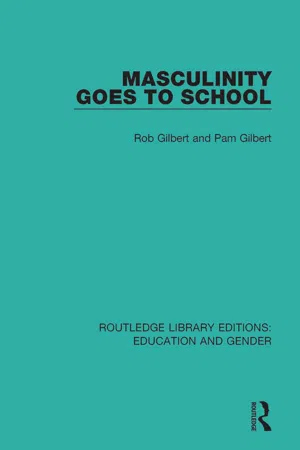
Originally published in 1998. This book offers a balanced overview of the issues surrounding boys and education. It looks beyond the often hysterical debate in the popular media to analyse what is happening with boys in the school system and how this can be understood. The authors argue that popular constructions of masculinity affect boys in all parts of their lives: in families, peer groups and work cultures – at home, at school, at work and at leisure. Offering insight into key issues such as literacy, sport, bad behaviour, sexuality, race and ethnicity, and popular culture, this book also looks at programs and approaches to working with boys which have been successful.
- 302 pages
- English
- ePUB (mobile friendly)
- Available on iOS & Android
eBook - ePub
Masculinity Goes to School
About this book
Information
PART I
Boys and tnasculinity: Current debates
1
What about the boys?
How do we begin a story about boys at school? For many parents, teachers, academics, education advisers and consultants, the issue of how well boys fare at school, and how well they are served by schools, is a highly contentious and emotional one, because the issue has so often been framed in terms of opposition and blame. Are boys doing less well at school, and if so, is anyone to blame? Do schools fail to provide for boys’ needs? And are these even the right questions to ask if we want to know more about boys and schooling?
The stories that boys tell about themselves at school will feature in later chapters of this book. Here we look at other stories that have been told about boys—stories from the popular press of opposition and blame; stories from statistical data about achievement and participation at school; stories from social surveys about boys’ health, crime, accident rates and death; and stories from teachers and female students about boys’ behaviour at school. We want to use the stories not only to build a multi-layered picture of the complexity of the issue this book confronts, but also to construct a framework for working with the question of boys and schooling in ways that are equitable, just, informed and productive.
POOR BOYS: STORIES FROM THE POPULAR PRESS
One of the most familiar and pervasive constructions of the boys and schooling issue is the one offered by the popular press. In many of the stories told by journalists, boys are represented as losing out in both educational and social contexts, as a new super-breed of girls and women takes control of school, of jobs, of relationships, and of their bodies. ‘The sex of success’ writes one Australian newspaper,1 or, as a 1995 magazine cover asserts:
Superior Sex
Women are smarter, healthier, more honest and live longer.
These days it’s the men who need help.2
In the United Kingdom, The Economist considers ‘The trouble with men’, and the New Scientist proclaims ‘Hard times for Britain’s lost boys’, as ‘Girls are racing ahead in Britain’s schools’.3 And in America, Men’s Health takes another typically alarmist stance about the scandal of boys in schools:
The War on Boys.
Wise up, America! Despite what you read in the papers, the nation’s schoolboys are in big trouble.4
Fuelling much of this concern are the results of competitive examinations, which are widely seen as evidence that boys as a group are falling behind girls. The media depict this through stories of a new poor underclass in the education system, and of the worrying impact of ‘the feminists’ on schooling.
But how seriously should we take these headlines? Are boys in trouble in schools, and if so, is their situation worse now than it has been before? Is there a sex bias in the education system—are girls advantaged to the detriment of boys? Have affirmative action programs for girls disadvantaged boys—and have there been no programs to support boys? Is there a recognisable and definable crisis for boys at school—and what sort of crisis is it?
The answers to questions like these cannot, unfortunately, be as easily answered as the popular press would have us believe.5 Undoubtedly many students are not served well by our current schooling structures or curricula, and nowhere has education been able to deliver on its promise of providing social equity and access for all children. However, the debates constructed in the popular press about boys and schooling seldom approach the topic from this angle. They are little interested in issues of educational and social inequality, more often choosing the easier option of constructing opposition and looking for parties to blame.
The usual media stories are those that treat boys (and girls) as single groups—and as opposing groups. The diversity and difference within and among groups of boys is seldom acknowledged or addressed, despite the fact that an impressive array of research literature indicates how schools serve some groups of boys significantly less well than they serve others. Across the three countries mentioned earlier, African-American, immigrant Caribbean and Aboriginal boys, boys living in poverty, boys who live in rural areas, and boys who do not have English as their first language at home, are significantly more at risk of being disadvantaged in our schools than are boys from white affluent areas. The research also suggests that while some boys may be disadvantaged at school and some ‘in trouble’, there are still many boys who are not, and for whom the competitive processes of schooling work very well indeed. The rewards for many of these boys become obvious in the post-schooling years, in terms of university access, employment and weekly earnings.6
News stories about boys’ school results seldom contextualise the problems of school assessment and achievement data within the broader picture of boys’ engagement and participation in school. Their reliance on indicators like the top scoring results in various state tertiary entrance rankings is particularly unhelpful in unravelling the problems of assessment, or the complexities of school disadvantage. Such indicators provide little information about how the vast majority of boys—or girls—fare at school. This is not their purpose. They were not designed to do so.
And, of course, it is both typical and yet disturbing for the press stories to construct female villains for their tales: to blame female students and teachers as the cause of boys’ educational ‘disadvantage’. Such an approach draws attention away from a consideration of boys, of boys’ cultures, and of schooling cultures, and encourages debates about education to be narrowly and irrelevantly linked to an ‘either-or’ attitude. If boys are to do well at school, is it to be at the expense of girls? If girls do well at school, is it at the expense of boys? Such an argument fails to advance understandings about educational equity and dangerously misinterprets the issue.
So what is going on in schools that promotes this view of boys and education? Is it all just a media beat-up, or are there serious issues to confront and redress? Should parents and teachers be concerned about how well schools are serving boys? How can we sort through the research and the stories to arrive at understandings of boys and schooling? This introductory chapter will offer a way through these questions. By looking more closely at the evidence in one of the contexts mentioned earlier, that of Australia, we will test the validity of the concerns about boys’ education. We will also identify important issues in the boys and schooling debate, and construct a lens through which to consider and evaluate the key questions.
‘WHO WINS AT SCHOOL?’: STORIES OF SUCCESS AND FAILURE
Who Wins at School? is the title of a recent report produced by Richard Teese and a research team from the University of Melbourne. It is, the Preface warns, a ‘reluctant’ title for a report on school achievement and participation.
School is sometimes celebrated as a race, and no more so than by the champions of yesteryear. But in an era of global dependence on success at school, there are better things to do with the curriculum than to run it as a race. Our choice of title recognises that there are winners and losers and that we must make a record of the race if we are to find ways of ending it.7
The study of ‘the race’ is comprehensive and rigorous, providing evidence on boys’ achievement not often available. The issues raised are important in addressing questions of boys’ education whatever the context.
School retention rates and subject selection
The report initially considers gender differences in an historical perspective, noting the shift in secondary education from ‘an elite system catering for a small minority of young people who prepared for university to a mass general system which now serves most young people, whatever their destinations’.8 The report argues that the traditional picture has changed, so that boys no longer rely upon successful completion of schooling more often than girls. It is now girls—the report argues—who depend upon school and who consistently complete more years of schooling than boys.
This shift is partly indicative of the changing composition of secondary schooling classrooms since the 1950s. The Teese report notes of Queensland data, for instance, that while there were twice as many boys as girls attending secondary school in Queensland in the 1950s, girls have now ‘increased their use of school over the post-war period at up to double the rate for boys’.9 Figures quoted in the Teese report show that by 1975 girls’ school retention rates were higher than boys, and that by the 1990s, the gender gap had widened to 10 percentage points.
In part this hints at boys’ resistance to school, and their unhappiness and unease in school cultures. However it is also quite clearly a response to vocational necessity. As the Teese report also notes, many traditional female occupations have required higher levels of schooling—and, unlike boys, girls have not had easy access to accredited vocational training in the workplace. However the figures indicate that boys are now making less use of senior schooling than are girls, and—significantly—the use they are making of schooling is narrow. Boys’ subject choices are a clear indicator of the vocational—and ‘masculinist’—lens through which many boys view schooling. Across all states, it is the subjects considered to have high vocational potential and ‘masculine’ status that attract boys. Boys stay away from subjects that are often historically cast as feminised. Languages, the arts, and the humanities, for instance, have poor male representation, and boys avoid language and literature subjects when given the choice.
This sexist stereotyping of subject selection was made obvious in a recent study of gender and school education led by Cherry Collins.10 The research group asked secondary students whether traditional gender associations of a subject still mattered when they chose subjects, and the results indicate that subject selection is still a central issue to address in terms of boys and schooling. The researchers concluded from their data that:
… boys shy away from subjects with a feminine past more than girls shy away from subjects with a masculine past. We can also conclude that the influence of the past is still surprisingly strong, at this point in history, in the consciousness of both sexes and that boys particularly try to put others off crossing gender boundaries …11
And it would seem as if schools have to accept more responsibility here if this narrowness of subject choice is to change. Within the Collins et al. study students claimed that they received little teacher support to take up non-traditional subjects, and that boys felt this more than girls did.
Forty-eight per cent [of the students in the study], less than half, affirmed that students got teacher support. And again, there was a highly significant difference between the sexes of 14 points, with only 39 per cent of male respondents compared with 53 per cent of female respondents perceiving teachers to give a lot of support.12
And as other educationists argue, there is no question that boys (and girls) lose from the curriculum imbalance that inevitably results.13
Personal development through the arts is in practice much less accessible to them as is language development through the study of modern languages. Their ability to communicate both with themselves, as individuals, and with others is handicapped. Their knowledge of ideas and institutions has fewer opportunities to grow through the active efforts that the discipline of a school subject imposes…. a potentially heavy price is paid by the highly vocational nature of boys’ subject selections.14
Some boys suffer more than others through this vocational narrowness. The clustering of boys into subjects like higher level mathematics and physics, for instance, means that those who do well are able to enjoy the benefits that high scores in these prestigious subjects still convey. And certainly more boys than girls are able to benefit from this success. However, not all boys do well in higher level mathematics and physics. Boys often occupy the extremes of the performance range in these subjects, producing a ‘saucer-shaped’ distribution of results which positions many of them as failures.15 And it is the boys caught at the lowest end of these distributions who are some of the losers in the schooling race. Having chosen subjects which are vested with high masculine status and power, but within which they are unable to succeed, these boys end up not only without high school qualifications, but also with a personal sense of failure within a male domain of achievement.
Differences between groups of boys
But are some groups of boys more likely than others to suffer failure of this kind, as well as a more generalised failure across the board at school? The intersections between socio-economic resources, geographical location, ethnicity and ‘race’ are critical here, as they demonstrate the groups of boys who are potentially more at risk of school failure. This is particularly noticeable in literacy results, where, although gender remains a key predictor of success, it is clearly affected by a range of other social and cultural factors.
In high migrant density working-class suburbs in western Melbourne, for instance, one in three boys could expect to fail university-accredited English if he chose to take it, compared with an anticipated failure rate for girls of one in five. And yet boys from the wealthy inner east suburbs do better than groups of girls from working-class and rural areas, their results being exceeded only by girls from similar socio-economic backgrounds.16 This pattern is repeated in other data, where boys from higher socio-economic areas enrol in English as frequently as girls, and, while not matching girls’ performance in this same region, are the only group of boys to outperform some groups of girls.17
These patterns can also be found in primary schools. Results on a s...
Table of contents
- Cover
- Half Title
- Title Page
- Copyright Page
- Table of Contents
- Acknowledgments
- Part I Boys and masculinity: Current debates
- Part II Boys and contemporary cultures
- Part III Boys and schooling
- Notes
- Bibliography
- Index
Trusted by 375,005 students
Access to over 1.5 million titles for a fair monthly price.
Study more efficiently using our study tools.
Frequently asked questions
Yes, you can cancel anytime from the Subscription tab in your account settings on the Perlego website. Your subscription will stay active until the end of your current billing period. Learn how to cancel your subscription
No, books cannot be downloaded as external files, such as PDFs, for use outside of Perlego. However, you can download books within the Perlego app for offline reading on mobile or tablet. Learn how to download books offline
Perlego offers two plans: Essential and Complete
- Essential is ideal for learners and professionals who enjoy exploring a wide range of subjects. Access the Essential Library with 800,000+ trusted titles and best-sellers across business, personal growth, and the humanities. Includes unlimited reading time and Standard Read Aloud voice.
- Complete: Perfect for advanced learners and researchers needing full, unrestricted access. Unlock 1.5M+ books across hundreds of subjects, including academic and specialized titles. The Complete Plan also includes advanced features like Premium Read Aloud and Research Assistant.
We are an online textbook subscription service, where you can get access to an entire online library for less than the price of a single book per month. With over 1.5 million books across 990+ topics, we’ve got you covered! Learn about our mission
Look out for the read-aloud symbol on your next book to see if you can listen to it. The read-aloud tool reads text aloud for you, highlighting the text as it is being read. You can pause it, speed it up and slow it down. Learn more about Read Aloud
Yes! You can use the Perlego app on both iOS and Android devices to read anytime, anywhere — even offline. Perfect for commutes or when you’re on the go.
Please note we cannot support devices running on iOS 13 and Android 7 or earlier. Learn more about using the app
Please note we cannot support devices running on iOS 13 and Android 7 or earlier. Learn more about using the app
Yes, you can access Masculinity Goes to School by Rob Gilbert,Pam Gilbert in PDF and/or ePUB format, as well as other popular books in Education & Education General. We have over 1.5 million books available in our catalogue for you to explore.