- 608 pages
- English
- ePUB (mobile friendly)
- Available on iOS & Android
eBook - ePub
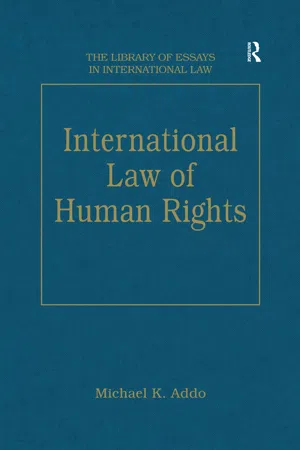
International Law of Human Rights
About this book
International law is a social construct crafted by human endeavour to achieve or at least contribute to the achievement of goals perceived to be valuable or necessary to effective social relations. In effect, international law is no more than a facilitative process and so cannot have answers and conclusions of its own other than what lies within the ambitions of those who define the limits of the process. The essays collected together here reveal how international law facilitates the achievement of the long standing ambition of turning human rights ideals and rhetoric into reality.
Part I
Nature
[1]
HUMAN RIGHTS GENEALOGY
INTRODUCTION
AS the century draws to an end, this Article explores the status and future directions of contemporary human rights theory. It begins with the puzzle that, despite its conceded normative force, con-temporary human rights theory is said to be fundamentally flawed, lacking a center, organizing structure, or unifying value. The puzzle is varyingly attributed to incoherence in international human rights theory and to irreconcilable dualisms pervading the theory.1 This Article critiques the prevailing understanding by elaborating on the implications of theorizing in these oppositional terms, proposing a genealogical perspective to human rights theory. Such a perspective explores international human rights theory’s historical and political legacies, its founding structures and rhetoric, with an eye toward a better understanding of the contemporary international human rights movement, its place in history, and its future potential. International human rights theory is reconsidered in light of its historical and political engendering circumstances. This Article will use “genealogy”2 in a number of senses: first, as the exploration of the organizing structures, logic, and language that comprehend the domain of contemporary human rights theory; second, as the historical and political circumstances of the international human rights movement; and third, as the connection between the relationship of international human rights theory and other philosophical, political, and legal rights theorizing.
The Article attempts to illuminate the status of prevailing international human rights theory by contributing a genealogical perspective to the contemporary theorizing. Part I examines the origins of the reigning theoretical framework by considering the historical and political circumstances that attended the development of the theory. Part II explains how a genealogical approach clarifies problems in the reigning paradigm. Part III explores further the dichotomies in the prevailing theory, thereby clarifying the puzzling status of contemporary human rights theory. Part IV examines the international human rights movement today, incorporating a genealogical perspective and clarifying the contemporary movement’s intimate and uneasy relation to its original historical and political circumstances. This part also proposes a more coherent view of the existing international human rights normative apparatus.
I. RIGHTS GENESIS
Consider international human rights theory and its engendering circumstances. The founding is said to go like this: Genesis of the human rights movement, by its own description, begins in postwar Europe. This point of departure for contemporary human rights theory is definitional—the international human rights movement is birthed in the war and the postwar experience. Told this way, international human rights creation, like the war itself, gave rise to a new, paradigmatic view of rights as extraordinary and discontinuous from prior expectations.
As a paradigm supported and engendered by the immediate circumstances of the postwar period, international human rights implies an utterly transformed model regarding individual/state responsibility and relations. International human rights, as both a postwar and posttotalitarian movement, was a radical departure from the prevailing rights theorizing assumptions about the state. A creature of postwar circumstances, the new paradigm was said to mean new rights and a departure from the contractarian tradition associated with pre-existing rights theorizing. International human rights drew their normative force, at the time, not necessarily from social consensus, but rather from the exercise of judicial power. This alternative normative vision is instantiated by the Nuremberg Tribunal, the extraordinary Allied justice brought to bear against human rights abusers.
Later, these norms were ratified in various international charters and conventions as merely the institutionalization of preexisting universal norms. The human rights movement, which blossomed in the war’s aftermath, was a phenomenon that largely developed within a newly created international legal system.3 The postwar construction of international human rights appeared in transnational form: initially, in the Nuremberg Charter, then in the United Nations Charter and other United Nations instruments, and in multilateral treaties and conventions.4 These alternative conceptions of human rights ultimately meant a new system of rights protection—inhering outside of social contract—vindicating a view of human rights within an adjudicatory model and an emerging international legal system. At Nuremberg, after the war, international human rights appeared to have ultimate normative power. Human rights seemingly were protectable, with or without the state, as the massive postwar codification projects made rights with normative force positive.
The postwar paradigm implied a reconceptualization of core rights concepts. First, rights were understood to be protected within a conception of rule of law which was largely conceived as legal accountability, indeed as criminal accountability. While this view of rule of law suffers from being ex post, it is best understood in its historical postwar context. After the grave atrocities of the war, the human rights project was largely the ascribing of individual responsibility. Next, and relatedly, the understanding of individual responsibility for rights protection under international law changed, particularly the balance between the individual and the state. These changed understandings implied changes in the content of human rights values. The postwar normative scheme that defined human rights in terms of political persecution was a response to the war and to totalitarianism. As such, postwar justice reflected its engendering circumstances.
The new arrangements forced a rethinking of the meaning of rights. This reconsideration included the extent to which these rights appertained to a corresponding system of duties. The change in the prior expectations, which were the legacy of social contract theory,5 transformed the human rights paradigm entirely. Whereas in earlier rights theory, individuals were entitled to the contractual rights that the state agreed to protect, these assumptions fell away in the postwar paradigm. Individual rights bore no particular relation to the state’s assumption of duties. Indeed, the previous formulation of rights appeared unavailable and the state instead a potential source of evil. Accordingly, rights protection moved to alternative sites and systems, to international human rights conventions, mechanics, and processes.
The human rights movement was nurtured by the concomitant development of a new international legal system, as well as by the parallel explosion of constitutionalism.6 The notion of rights as judicial in nature is supported by the postwar explosion of constitutionalism and judicial review. As time passed, the postwar paradigm and its ad hoc blend of laws of war and the laws of peace become normalized, despite the absence of political circumstances similar to those that attended its founding.7 Born at a time of unparalleled international cooperation, the human rights movement’s normative projects would later appear to have fostered unrealistic expectations about the human rights system’s potential.
These historical and political developments and contingencies engendered the postwar understanding of human rights. Genesis at Nuremberg and at Auschwitz expresses the paradigm shift’s sad paradoxical story of catastrophe and failure in the international order, which somehow nevertheless ends on a hopeful note. Through the international human rights movement and its lead in responding to wartime atrocities, justice becames a liberal means to a redemptive resolution.
II. RIGHTS GENERATION
The passage of time increased the distance from the engendering historical and political circumstances of the human rights movement. The distance led to questions about the continued viability of international human rights theory. Nevertheless, the international human rights movement is said to be in vital development and rights genesis considered an event capable of repetition. Consider rights “generation” in at least three senses. First, the language represents rights creation as a natural process. The rhetoric of “genesis” at once evokes the language of science and of nature. Scientific rhetoric imbues international human rights theory with legitimacy by implying that the theory follows the natural laws of the universe—as if human rights are just out there, existing as an autonomous and objective reality. Second, generation also conveys rights in a genetic sense.8 Put this way, rights generation casts the human rights story in terms of the broader human condition—of scientific, historical, and political generations. Third, the rhetoric of genesis and generation propounds the international human rights movement’s distinctive account of natural rights made positive.
The passage of time and the accompanying changes in circumstances put pressure on the prevailing rights narrative and the attempt to theorize in terms of a unitary international human rights apparatus. Every aspect of the Nuremberg legacy appeared vulnerable to normative incoherence.
The dominant paradigm, drawing largely from American constitutionalism, suggested that the proper response to human rights violations was individual accountability. The postwar paradigm instantiated at Nuremberg represented a radical shift in the understanding of prevailing international legal norms. Absolute sovereignty had been violated, seemingly challenging the border between the international and the national, as well as the individual and the collective. While there have been occasional national trials, such as Argentina’s military junta or those of unified Germany,9 there has never been the same sort of adjudication of rights violations as at Nuremberg. The historical and political circumstances surrounding Nuremburg, including the predicates for international sovereignty, and the force of occupation law, were missing from the later trials.
Considering rights theory in concert with localized historical and political knowledge clarifies the postwar precedent and doctrine. The very understanding of human rights and justice is entwined in the postwar paradigm’s engendering circumstances. International human rights’ historical and political contexts elucidate the theory’s putative incoherence. Acknowledging the extraordinary political circumstances of international human rights recognizes their parameters and their limits. As the postwar predicates of the international human rights model have not yet repeated themselves,10 the question has become: What, if any, is the ongoing vitality of the reigning theory’s generating structures and related norms?
This part has explored the human rights narrative that has long dominated our understanding. In addition, it contended that examining the reigning theory, in the light of its historical and political predicates, clarifies existing structures and perceived problems. The Article continues by explaining how a genealogically enriched perspective illuminates the problems said to pervade contemporary human rights theory.
III. RIGHTS-THEORETICAL DIVIDES
Consider the putative gap between human rights theory and practice: Prevailing human rights theory is generally conceded to lack full normative force because of a perceived gap between the theory and judicialized rights. These are commonly considered to signal incoherence in human rights theory. The absence of remedies is often considered fatal.11 The juxtaposition of rights theory to rights enforcement or rights practices also comprehends other theoretical dichotomies: international and national, universalism and particularism, positivism and natural law.12
The postwar story of Nuremberg justice inspires the reigning paradigmatic conception of international human rights as judicial. The post-war model of justice is the all powerful Military Tribunal and judicial righ...
Table of contents
- Cover Page
- Title Page
- Copyright Page
- Contents
- Acknowledgements
- Series Preface
- Introduction
- Part I Nature
- Part II Politics
- Part III Implementation
- Part IV Exceptions
- Part V Challenges
- Name Index
Trusted by 375,005 students
Access to over 1.5 million titles for a fair monthly price.
Study more efficiently using our study tools.
Frequently asked questions
Yes, you can cancel anytime from the Subscription tab in your account settings on the Perlego website. Your subscription will stay active until the end of your current billing period. Learn how to cancel your subscription
No, books cannot be downloaded as external files, such as PDFs, for use outside of Perlego. However, you can download books within the Perlego app for offline reading on mobile or tablet. Learn how to download books offline
Perlego offers two plans: Essential and Complete
- Essential is ideal for learners and professionals who enjoy exploring a wide range of subjects. Access the Essential Library with 800,000+ trusted titles and best-sellers across business, personal growth, and the humanities. Includes unlimited reading time and Standard Read Aloud voice.
- Complete: Perfect for advanced learners and researchers needing full, unrestricted access. Unlock 1.5M+ books across hundreds of subjects, including academic and specialized titles. The Complete Plan also includes advanced features like Premium Read Aloud and Research Assistant.
We are an online textbook subscription service, where you can get access to an entire online library for less than the price of a single book per month. With over 1.5 million books across 990+ topics, we’ve got you covered! Learn about our mission
Look out for the read-aloud symbol on your next book to see if you can listen to it. The read-aloud tool reads text aloud for you, highlighting the text as it is being read. You can pause it, speed it up and slow it down. Learn more about Read Aloud
Yes! You can use the Perlego app on both iOS and Android devices to read anytime, anywhere — even offline. Perfect for commutes or when you’re on the go.
Please note we cannot support devices running on iOS 13 and Android 7 or earlier. Learn more about using the app
Please note we cannot support devices running on iOS 13 and Android 7 or earlier. Learn more about using the app
Yes, you can access International Law of Human Rights by Michael K. Addo,MichaelK. Addo in PDF and/or ePUB format, as well as other popular books in Law & World History. We have over 1.5 million books available in our catalogue for you to explore.