eBook - ePub
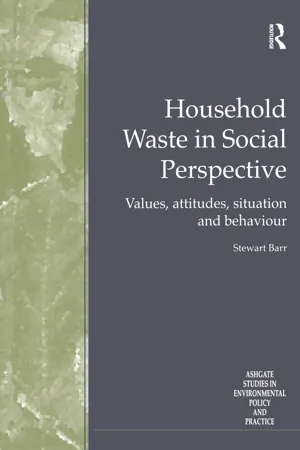
Household Waste in Social Perspective
Values, Attitudes, Situation and Behaviour
- 206 pages
- English
- ePUB (mobile friendly)
- Available on iOS & Android
eBook - ePub
About this book
The principal barrier to the introduction of more sustainable disposal methods has previously been thought to be the lack of both available knowledge and an awareness of the benefits and ease of these systems. Illustrated by an in-depth analysis of waste reduction, reuse and recycling behaviour in Exeter, Devon, this volume questions these assumptions. It not only provides a fresh examination of the previous (mainly US-focused) research into the underlying determinants of waste management behaviour from a geographical perspective, but also develops a new theoretical model based on the Theory of Reasoned Action. Linking three broad categories: environmental values, situational characteristics and psychological factors, the book provides a timely evaluation of research on household waste management, develops an original analytical model and demonstrates the utility and importance of focusing on individual attitudes.
Information
1 Introduction: the waste problem in social perspective
Introduction
This book focuses on the issue of household waste management and how understanding individual attitudes and behaviours can make a significant contribution to an appreciation of what factors shape behaviour and how these might be changed. Waste is, of course, only one environmental behaviour where this can be appreciated. As the forthcoming paragraphs demonstrate, the world faces a plethora of inter-related environmental problems. The programme that has been institutionalised at the highest governmental level globally is 'sustainable development'. This ambitious project, integrating environmental, social and economic goals, faces many challenges, from basic definition to practical implementation. Yet the underlying challenge facing academics and policy makers today is not necessarily an environmental or fiscal one, but social. Until the majority of people change their attitudes towards the environment and sustainability and, until their behaviours change as well, the search for a sustainable future for the earth will elude us. The prospect of using a social understanding of environmental problems is one that has the potential to make the realisation of environmental sustainability more tangible than ever before. First, however, sustainable development and its challenges must be fully placed in context.
The Environment, Sustainable Development and Citizens
One of the most important academic and social issues of the late twentieth century is the reluctance of humankind to respond decisively to growing evidence of resource depletion and environmental deterioration (Munton, 1997, p. 147).
This decisive statement on the state of human attitudes towards the environment is just one of many commentaries that have argued that unless hard choices about the environment are made now, the future of life on earth will be in doubt. Environmental problems are well documented in almost every sphere of the natural and human world. Global warming, ozone depletion, forest degradation, desertification, eutrophication, acidification, the litany continues. The consequences of these purely 'environmental' problems have significant social and economic impacts. As an example, global warming is already thought to have had serious effects worldwide, ranging from flooding due to enhanced rainfall (for example in Mozambique and India in 2000), to a particularly harsh El Nino in 1998-99 in Western America, to severe drought conditions in the Sudan in 2000. These 'natural' events, for example flooding, have familiar catastrophic results. Industrial shutdown, crop destruction, communications failure all result in economic disturbance as a consequence of flooding. Disease, starvation and in the long term increased poverty constitute some of the social costs of flooding. Just as the effects of global warming are diverse (flooding, storms and drought) so are the causes. Human activities produce greenhouse gases from numerous sources, including industrial plants, power stations, cars, aeroplanes, and landfilling of biodegradable waste.
The salient point to emphasise here is that environmental problems cannot be seen in isolation. They have human causes, human effects and are often the result of not merely of human economic mismanagement, but human poverty, leading to further degradation of the environment. Recognition of this fact has been late in reaching the governmental elite. However, the nations of the earth are now embarked on a programme that will hopefully begin to address these complex and acute problems. As outlined in the following sections this programme, called 'sustainable development', is now 'the message' for environmental protection, economic development and social progress.
In the following sections, the origins of sustainable development as a concept are examined initially, after which the conflicts regarding its definition are assessed, followed by an analysis of the practical working of sustainable development. Finally, an examination of the role of citizens within sustainable development is considered.
The Origins of ‘Sustainable Development’
O'Riordan (1993) reminds us that the notion of 'sustainability' is an historic 'ideal' that has existed for thousands of years. What may be termed more accurately as 'subsistence' or 'stewardship' is still a norm for a considerable number of the world's population in certain inhospitable areas. However, the processes of modernisation, enrichment and, more recently, car use has meant that the Western world has become very much the antipathy of sustainability (Gatersleben and Vlek, 1998). Stark realisation of this problem began in the 1960s with the doomsday scenarios of Carson (1962) and Meadow's et al. (1972) predicting environmental catastrophe. Although the spectres of immediate environmental catastrophe and definable natural limits to growth, which first came to the fore in the 1960s, have subsided, a more holistic approach to the environment has emerged. Several conferences have been held at a global level since the Stockholm meeting in the early 1970s which have sought to bring the environment to the world stage (e.g. World Commission on Environment and Development, 1987; United Nations Conference on Environment and Development, 1992). Throughout these fora and many more besides, the concept of sustainable development has been 'reborn' and is now seen as the way forward in global development.
Sustainable Development: Definition, Meaning and Conflict
In 1987 the Brundtland Commission (WCED, 1987, p.43) defined sustainable development as '...development that meets the needs of the present without compromising the ability of future generations to meet their own needs'. Such a broad statement might be seen as so ambiguous as to offer nothing to the plethora of problems facing both the environmental and social world today. Indeed, O'Riordan (1989, p.93) describes the concept as being the '...refuge of the environmentally perplexed'. Nevertheless, O'Riordan (1993, p.37) does have to concede that 'No public figure or private corporation can afford to speak any other language'. This, in essence, is the key point, as will be demonstrated below - namely that although the vagueness of the concept is a difficulty, the wide-ranging and all-encompassing nature of the concept allows the idea to be sold and marketed far more easily to a sceptical public. Thus Wilbanks (1994) has argued that this has been the success of sustainable development (SD), namely that ambiguity and integration are seen as key virtues, not barriers.
However, a reading of the extensive literature on sustainable development reveals a sharp contrast between the 'marketable' and 'nonmarketable' aspects of sustainable development. What Gibbs et al. (1998), among many more, have termed 'weak' and 'strong' sustainability presents the widest gap between the marketable and non-marketable approaches, respectively. There are many aspects to both of these approaches which cannot be detailed here, but those who support the weak approach are generally seen as technocentric (anthropocentric) and market-orientated whilst supporters of the strong position are usually ecocentric and intervention-orientated (Pearce, 1993; Gibbs et al., 1998). However, the principal division comes with regard to the concept of capital. Pearce et al. (1989) argue that proponents of the weak approach believe that as long as the same (or more) amount of capital is passed on to the next generation, then the goals of SD can said to have been met. The strong sustainability followers, however, would urge that certain 'critical' amounts of natural capital stock must be maintained for the next generation (e.g. Pearce et al., 1989; Pearce, 1993; Turner, 1998). What Turner has defined as a 'safety' level for such capital is vital for a number of reasons outlined by Pearce et al. (1989). Primarily, current use of non-renewable resources is such, that when they expire, there will be no viable resource base with which to meet current energy requirements (non-sustainability). Secondly, the presumption that new resources will always be found is not without doubt (uncertainty). Thirdly, following the path of only preserving capital stock which is economically viable means there is the risk of 'irreversibility'. Finally, degradation of natural capital means that the poor will be adversely affected, a point totally at odds with one of the key elements of SD - equity.
Of course it should not be forgotten that SD is not just about sustainability, although that is often held to be its rationale. 'Development' is a key aspect which is often forgotten. Pearce et al (1989) have argued that 'development' is a value-laden word which has many facets. In this context SD contains three principal elements. First, a value of the natural, cultural and built environment. Second, a time horizon of years, decades and centuries. Third, both an intergenerational and intragenerational component. Within this framework, various words are casually incorporated such as equity, equality, peace, etc. Yet the volume of literature surrounding the concept of sustainable development is so vast that difficulties of scope and definition arise frequently. Wilbanks (1994) acknowledges this problem and details several conflicts that SD has tried to resolve, but in reality will take more than warm words to settle. Primarily, the old problem of 'conservation vs. growth' still has relevance today. Many misunderstand that SD is about development, of which growth is a part. However, most people still perceive the two as indistinguishable. Although most proponents argue that development can occur with conservation, this is a vexed question. A further problem comes with the democratic process, i.e. who decides on SD policies, the people or the government. A considerable literature has emerged concerning the inclusivity of sustainable development and the incorporation of thus far marginalised interest groups. Yet the degree to which this is practically possible is strongly debated. On the one hand, Agenda 21 (UNCED, 1992) states that dialogue about local sustainability policies must be undertaken with all citizens, yet on the ground, decisions often have to be made that are unpopular. Indeed, can dialogue be maintained with people who are not interested? This leaves the vexed question of whether those who aren't interested are either forced to participate or left behind, which brings one back to an elitist position. This relates to a third issue of whether hard choices are going to be made or whether tinkering with the environment is sufficient. Most environmentalists and those in political opposition would opt for the former, whilst governments, for reasons of electoral viability, opt for the latter.
Sustainable Development in Practice
Implementing sustainable development in practice is a key difficulty for policy makers who are faced with the unenviable task of selling SD to a sceptical and apathetic public. Keeping the environment and sustainable development on the political agenda has thus proved rather a difficult task. In a rather over-zealous and optimistic discussion concerning the environment and sustainability, O'Riordan (1997a) celebrates the arrival of New Labour in 1997 and its new 'radicalism'. However, hope of such groundbreaking environmental reform was shattered, as the environment as an issue was pushed further down the legislative ladder. In a more depressing tone O'Riordan (1997b, p.2) a few months later, is left to criticise the lack of attention to sustainable development by New Labour and details the cabinet split on the environment, leading him to postulate that:
The overwhelming temptation will be to tinker with it, and trust that a few positive initiatives will keep the NGOs happy (O'Riordan, 1997b, p.2).
The situation 'on the ground' in local authority areas is little better. The fusing of the economic and environmental goals of sustainable development are critical if Local Agenda 21 (LA21) is to be successful. The problems are given full attention by a range of authors (e.g. Blowers, 1993; Evans, 1995; Gibbs et al., 1996; Gibbs et al., 1998, Rydin, 1998 Selman, 1996; Selman, 1998; Selman and Parker, 1997). Essentially, the underlying difficulty is that of 'change'. Local authorities have been reluctant to alter their practices for consulting and implementing environmental policy, as well as the way in which they treat issues in a holistic manner. There are a number of elements to this problem. First, different perceptions within and between local authorities about what constitutes sustainable development, lead to confused messages both within and emanating from local authorities. Second, there has been a tendency to place Local Agenda 21 officers in planning and environment departments, rather than economic development departments as well. Third, sustainable development policies tend to be in very traditional areas of governance such as waste recycling and land-use planning. Emphasis on economic development and social progress within a policy framework linked to environmental initiatives has achieved only grudging support. Fourth, the political unwillingness and apathy in local government for new initiatives, such as Local Agenda 21 (LA21), ensures that only in certain local authorities is the issue of sustainable development high on the agenda.
Citizens and Sustainability
Of course, although these problems appear severe, it must be borne in mind that this is still the early stage of LA21 and there is time to change, but this will depend on political will and more importantly, the will of the populace. Generating interest and action from individual people is probably the most important and difficult aspect of sustainable development on the ground. There is only now recognition that much of what was decided at Rio can only become reality if people, all people, change their attitudes and behaviours in many aspects of their life. Local Agenda 21 and its associated policies need support from citizens to make them work. The notion of 'Think Globally, Act Locally' posits that small actions for sustainable development will have significant impacts if everyone is involved. As Paul Selman has argued 'The active environmental citizen is pivotal to the process of sustainability' (Selman, 1998, p. 180). Yet why do some people act and others not, especially when both groups might state that they are equally concerned? Indeed, how can attitudes and behaviour be changed to achieve the goals of sustainability?
As will be outlined in more detail below, the search for a 'human' solution to some of our most pressing environmental concerns has been the focus of relatively few academics and researchers. The role of government in the process of regulation and exhortation in economic terms has been seen as the conventional and accepted method by which to resolve environmental issues. Yet many environmental problems are the result of what appear to be quite insignificant actions by individuals. The amount of carbon dioxide produced each year by private motor vehicles is a major contributor to the total greenhouse gas emissions which are widely blamed for the recent rises in global temperature. Yet, there are no easily definable polluters in this case. Anyone who drives a car makes a small, but in cumulative terms, significant contribution to carbon dioxide emissions. The classic response to this situation has been, for example, to raise duty on fuel in order to discourage drivers from using their cars as often. Yet, such measures are socially unacceptable, as was demonstrated by the widespread fuel protests throughout Europe in September 2000. What such a response from the public indicates is that attitudes towards car use are significantly at odds with the need to reduce car use and subsequent pollution. It is unlikely, as the fuel protests demonstrated, that higher taxes would lead to a change in behaviour in the short term. Thus, behaviour change is only likely to result from tangible shifts in attitudes towards the environment within the context of a clear programme for sustainable development.
Municipal Waste and Environmental Sustainability
One specific area of sustainable development and a key aspect of Local Agenda 21 is the issue of waste generation, especially household waste production. This section outlines the problems of waste management in the United Kingdom at present and what actions are being taken by the Government to alleviate the problem.
Waste management is a growing concern in both the developed and developing world. The growth in population and financial wealth results in increases in the products that are both consumed and more crucially here, disposed of after use. Chapter 17 of Agenda 21 sets out waste as a key problem in the search for sustainable development worldwide (United Nations, 1992). Continuing this theme, the European Fifth Environmental Action Programme (CEC, 1992) cites waste as a key arena for action. However, it is at the national and local levels that the waste problem is seen most vividly. In England and Wales, the amount of municipal waste that is produced per year is 28 million tonnes (DETR, 2000). This figure is currently rising at around 3% every year.
The problem of municipal waste is diverse. The term itself refers to '...household and other waste...' handled by local authorities in England and Wales (DETR, 1999a, p.13). In practice, the majority is from households and comprises both organic and non-organic material. The main sources of the former are kitchen and garden waste, whilst the latter comprises glass, paper, aluminium, steel, cardboard, plastics and so on. In the period 1998/1999, 25.1 million tonnes of waste arose from households. This represents 25 kilogrammes of waste per household produced each week, a rise of 1.5 kg on the period 1996/1997 (DETR, 2000).
Currently, the majority of this waste is landfilled (82%), with just 9,5% being recycled and the remainder being sent for incineration and energy recovery. These figures are variable across England and Wales, with some local authorities achieving over 40% recycling of household waste, whilst others as little as 1%. Indeed, the situational constraints placed upon the waste management industry mean that different forms of disposal are used in various parts of the country.
Key Players in the Waste System: Production to Disposal
Currently the nature of waste production can be seen as result of a linear process from the production of good...
Table of contents
- Cover
- Half Title
- Title
- Copyright
- Contents
- List of Figure
- List of Tables
- Preface
- Acknowledgements
- 1 Introduction: the waste problem in social perspective
- 2 The Social Psychological Perspective I: environmental values and attitudes
- 3 The Social Psychological Perspective II: structural and situational variables
- 4 The Social Psychological Perspective III: psychological factors
- 5 Social Psychological Models of Behaviour: conceptualising action
- 6 The Exeter Study I: planning, implementation and descriptive statistics
- 7 The Exeter Study II: multivariate analyses
- 8 A Framework for Advancing Theory and Policy?
- 9 Conclusion: household waste in social perspective
- Bibliography
- Index
Trusted by 375,005 students
Access to over 1.5 million titles for a fair monthly price.
Study more efficiently using our study tools.
Frequently asked questions
Yes, you can cancel anytime from the Subscription tab in your account settings on the Perlego website. Your subscription will stay active until the end of your current billing period. Learn how to cancel your subscription
No, books cannot be downloaded as external files, such as PDFs, for use outside of Perlego. However, you can download books within the Perlego app for offline reading on mobile or tablet. Learn how to download books offline
Perlego offers two plans: Essential and Complete
- Essential is ideal for learners and professionals who enjoy exploring a wide range of subjects. Access the Essential Library with 800,000+ trusted titles and best-sellers across business, personal growth, and the humanities. Includes unlimited reading time and Standard Read Aloud voice.
- Complete: Perfect for advanced learners and researchers needing full, unrestricted access. Unlock 1.5M+ books across hundreds of subjects, including academic and specialized titles. The Complete Plan also includes advanced features like Premium Read Aloud and Research Assistant.
We are an online textbook subscription service, where you can get access to an entire online library for less than the price of a single book per month. With over 1.5 million books across 990+ topics, we’ve got you covered! Learn about our mission
Look out for the read-aloud symbol on your next book to see if you can listen to it. The read-aloud tool reads text aloud for you, highlighting the text as it is being read. You can pause it, speed it up and slow it down. Learn more about Read Aloud
Yes! You can use the Perlego app on both iOS and Android devices to read anytime, anywhere — even offline. Perfect for commutes or when you’re on the go.
Please note we cannot support devices running on iOS 13 and Android 7 or earlier. Learn more about using the app
Please note we cannot support devices running on iOS 13 and Android 7 or earlier. Learn more about using the app
Yes, you can access Household Waste in Social Perspective by Stewart Barr in PDF and/or ePUB format, as well as other popular books in Scienze biologiche & Scienze ambientali. We have over 1.5 million books available in our catalogue for you to explore.