- 257 pages
- English
- ePUB (mobile friendly)
- Available on iOS & Android
eBook - ePub
About this book
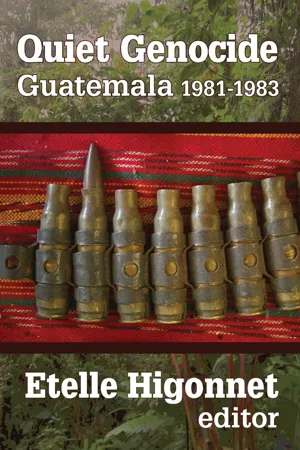
Quiet Genocide reviews the legal and historical case that genocide occurred in Guatemala in 1981-1983. It includes the full text of the genocide section of a United Nations sponsored Commission on Historical Clarification in Guatemala (CEH), brokered by the UN. In its final report, the CEH's rigorously reviewed abuses throughout the whole country. However, the memory of the Guatemalan dirty war, which predated the genocide and continued for over a decade of the heightened killing, has rapidly faded from international awareness. The book renders a historical picture of the 1948 Genocide Convention and its unique status in international law. It reminds readers of the difficulty of preventing and punishing genocide as illustrated by the ongoing tragedy of Darfur; anddiscusses the evolution of international and hybrid tribunals to prosecute genocide along with war crimes and crimes against humanity. Then, it sketches a brief history of Guatemala with a focus on genocide It explores how internal and global politics were an expression of structural violence, designed to ensure cheap, abundant, and quiescent Indian labor for coffee planters.a The volume provides the commission's general considerations, legal definitions, methodology, period of analysis, and victim groups, and finds that genocide had been perpetrated against five indigenous Guatemalan groups. By translating the genocide argument of the CEH into English and framing it in a lively, accessible way, this volume recovers the past, sets the record straight, and promotes accountability. This exploratory effort provides insight into the world of transitional justice and truth commissions, and valuable insights about how to engage with the question of genocide in the future. These findings shed light on a crucial and dark chapter of trans-American Cold War history, and will thus be of interest not only to scholars focused on Guatemala, but also on Central America and even more broadly, on the Cold War.
Information
Genocide
General Considerations and Legal Definitions
3198. As stated by the International Court of Justice, the Genocide Convention’s terms reflect fundamental judgments and the conscience of the international community, which have legal force independent of formal ratification. Guatemala ratified the Convention on January 13, 1950. Thus, the Convention was in force during the time of the armed conflict. The CEH adopted this international instrument as the legal reference in its investigation and analysis of the issue of genocide.
3199. Article II of the Convention defines the crime of genocide and its requirements in the following terms:
“In the present Convention, genocide means any of the following acts committed with intent to destroy, in whole or in part, a national, ethnical, racial or religious group, as such:(a) Killing members of the group;(b) Causing serious bodily harm or mental harm to members of the group;(c) Deliberately inflicting on the group conditions of life calculated to bring about its physical destruction in whole or in part;(d) Imposing measures intended to prevent births within that group;(e) Forcibly transferring children of that group to another group.”
3200. This description of acts of genocide has remained constant up until the present day. For example, the Statute of the International Criminal Court, adopted in an international conference in Rome on July 17, 1998, describes the crime of genocide in exactly the same terms.
3201. The Convention contemplates several objective elements of action described in Article II that constitute the crime of genocide, and a subjective element requiring that the action be carried out with “the intention to destroy in whole or in part.”
3202. Finally, the Convention establishes that the protected groups or potential victims of genocide must be national, ethnic, racial or religious groups, as such.
3203. The subjective element or the intent to destroy the group has been interpreted through international jurisprudence: “the intentionality that is particular to the crime of genocide does not need to be expressed clearly [and] can be inferred through a number of issues, such as ‘the general political doctrine’ that arises from the actions contemplated in Article 4 … the reiteration of destructive and discriminatory acts” (Interpretation of the International Criminal Tribunal for ex-Yugoslavia).
3204. It is very important to distinguish between “the intent to destroy a group in whole or in part” (that is, the positive determination to do so), and the motives behind such an intent. In order to determine genocide, it is only necessary to demonstrate that there exists an intent to destroy the group, regardless of motive. For example, if the motive to destroy an ethnic group is not pure racism but rather a military objective, the crime may nevertheless be understood to be genocide.
3205. An act falls into the category of genocide as defined by the Convention even if it forms part of a more extensive policy that was not strictly aimed at physical extermination. In this sense it is significant to distinguish between a genocidal policy and acts of genocide. A genocidal policy exists when the final objective of the actions is the extermination of a group, in whole or in part. Acts of genocide exist when the final objective is not the extermination of a group but rather alternate goals of a political, economic, military or other nature—but the means used to achieve these final goals involve the extermination of a group in whole or in part.
3206. These elements of jurisprudence, which are becoming doctrine and are also sources of law, have been helpful in the analysis that follows.
Methodology
3207. In order to determine if acts committed were indeed genocide, the CEH reviewed the legal basis of the Convention and previously cited jurisprudence, and analyzed the following:
– Analysis of the general policies of the state, particularly the Doctrine of National Security supporting the Guatemalan state’s counterinsurgency strategies, that helped shape the context and the intent behind actions.
– Diachronic analysis (relating time with acts and places) as well as synchronized analysis (relating acts and places with the perpetrators and victims). This analysis was modeled on sections “a,” “b,” “c,” “d,” and “e” of Article II of the Convention. The analysis was carried out chronologically, examining links between actions and the intent underlying those actions, and the Convention. The sequence of actions and their common characteristics were then examined, with the ultimate goal of establishing that the acts of violence committed by the State or its agents occurred in a repetitive manner, and were discriminatorily directed against a specific group or groups within the population.
– Analysis of acts that violate, or that the perpetrator considers to violate, the integrity of the group, occurring simultaneously with acts of physical destruction and arising from the same operation. This last form of analysis included acts indicating an attack on the integrity of the group such as rape and sexual mutilation, torture, public executions, the exhibition of cadavers, the destruction of material elements of culture, etc.
3208. The period of analysis is between 1981 and 1983, which is when most violence was recorded. Similarly the analysis focuses on set regions and certain ethnic groups. The CEH has verified that these groups and regions were located where the majority of human rights violations were concentrated. Based upon these criteria and available analytical methods, it has been possible to conduct an investigation of what took place among four selected ethnic groups, in four regions of the country:
– Maya Q’anjob’al and Maya Chuj, located in northern Huehuetenango in Barillas, Nenton, and San Mateo Ixtatan;
– Maya Ixil located in Nebaj, Cotzal and Chajul, in the department of Quiche;
– Maya K’iche’ in Zacualpa, department of Quiche;
– Maya Achi in Rabinal, Baja Verapaz
The selection criteria were the following:
– Intensity of violence (largest number of victims);
– Patterns of violence (indiscriminate violence);
– Composition of victims (identifiable groups)
– Quantity of information
3209. Of course, this investigation is limited by the circumstances in which the CEH operated. The CEH was only able to document a portion of the human rights violations that occurred during the internal armed conflict. This has made it necessary to correlate quantitative data regarding levels of destruction or extermination with other sources, such as the REMHI project and the database of the Alliance for Truth.
3210. To ensure the greatest accuracy for the sources, analysis, and statistical results, a system of control and fact-checking was created specially for these investigations. The system involved random checking of samples from the CEH database, using other databases as references to evaluate the CEH’s work.
3211. For quantitative analysis, the CEH database established the percentage of the human rights violations by comparing the intensity of violence in each region to its demographic base. At the same time, there was a comparative analysis of the violence against the indigenous and non-indigenous population in each region in order to establish if discrimination existed. Thus, the CEH explored if there was a substantial difference between the quality and severity of the human rights violations suffered by members of one group or another.
3212. The CEH analyzed its sources exhaustively. For each region there was a careful examination of presented and illustrative cases, indiv...
Table of contents
- Cover
- Half Title
- Title Page
- Copyright Page
- Table of Contents
- List of Abbreviations
- Glossary
- Editor’s Note
- Preface: Genocide in Guatemala
- Politics by Other Means: Guatemala’S Quiet Genocide
- English Translation of Sections of the Genocide Argument in the Final Report of the Guatemalan Commission for Historical Clarifi Cation, “Memory of Silence”
- Criminal Prosecutions for Genocide in Guatemala: Advances and Obstacles in Transnational and Domestic Cases
- Appendix I—Historical Clarifi cation Commission: Mandate and Investigative Procedures
- Appendix II—Guatemala: Memory of Silence Recommendations
- Works Cited
- Contributors
Trusted by 375,005 students
Access to over 1.5 million titles for a fair monthly price.
Study more efficiently using our study tools.
Frequently asked questions
Yes, you can cancel anytime from the Subscription tab in your account settings on the Perlego website. Your subscription will stay active until the end of your current billing period. Learn how to cancel your subscription
No, books cannot be downloaded as external files, such as PDFs, for use outside of Perlego. However, you can download books within the Perlego app for offline reading on mobile or tablet. Learn how to download books offline
Perlego offers two plans: Essential and Complete
- Essential is ideal for learners and professionals who enjoy exploring a wide range of subjects. Access the Essential Library with 800,000+ trusted titles and best-sellers across business, personal growth, and the humanities. Includes unlimited reading time and Standard Read Aloud voice.
- Complete: Perfect for advanced learners and researchers needing full, unrestricted access. Unlock 1.5M+ books across hundreds of subjects, including academic and specialized titles. The Complete Plan also includes advanced features like Premium Read Aloud and Research Assistant.
We are an online textbook subscription service, where you can get access to an entire online library for less than the price of a single book per month. With over 1.5 million books across 990+ topics, we’ve got you covered! Learn about our mission
Look out for the read-aloud symbol on your next book to see if you can listen to it. The read-aloud tool reads text aloud for you, highlighting the text as it is being read. You can pause it, speed it up and slow it down. Learn more about Read Aloud
Yes! You can use the Perlego app on both iOS and Android devices to read anytime, anywhere — even offline. Perfect for commutes or when you’re on the go.
Please note we cannot support devices running on iOS 13 and Android 7 or earlier. Learn more about using the app
Please note we cannot support devices running on iOS 13 and Android 7 or earlier. Learn more about using the app
Yes, you can access Quiet Genocide by Etelle Higonnet in PDF and/or ePUB format, as well as other popular books in Politics & International Relations & International Relations. We have over 1.5 million books available in our catalogue for you to explore.