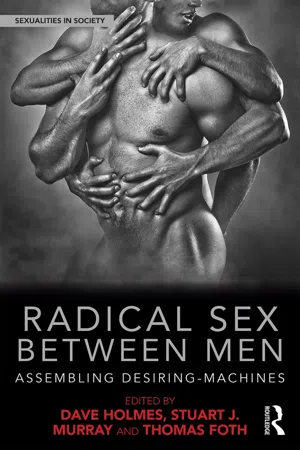
Bringing together theory and public health practice, this interdisciplinary collection analyses three forms of nonconventional or radical sexualities: bareback sex, BDSM practices, and public sex. Drawing together the latest empirical research from Brazil, Canada, Spain, and the USA, it mobilizes queer theory and poststructuralism, engaging the work of theorists such as Bataille, Butler, Deleuze and Guattari, and Foucault, among others. While the collection contributes to current research in gender and sexuality studies, it does so distinctly in the context of empirical investigations and discourses on critical public health. Radical Sex Between Men: Assembling Desiring-Machines will be of interest to advanced undergraduate students, postgraduate students, and researchers in gender and sexuality studies, sexology, social work, anthropology, and sociology, as well as practitioners in nursing, medicine, allied health professions, and psychology.
eBook - ePub
Radical Sex Between Men
Assembling Desiring-Machines
- 220 pages
- English
- ePUB (mobile friendly)
- Available on iOS & Android
eBook - ePub
Radical Sex Between Men
Assembling Desiring-Machines
About this book
Information
Part I
Bareback sex
1 Brothers-in-cum
A critical discourse analysis of barebacking rhetoric
Introduction
Men’s sexual desire for other men has created a plethora of real and virtual spaces for sex (Holmes & Warner, 2005). Indeed, outside the privacy of the home, consensual sexual encounters between men might take place in parks, alleys, restrooms, rest stops, adult theaters, video arcades, bookstores, bars, and gay bathhouses (Bérubé, 1996; Dean, 2009; Lindell, 1996; Shernoff, 2006). In recent years, Internet access has facilitated casual and anonymous sexual encounters, at the same time increasing the number of potential partners (Bull & McFarlane, 2000) given the design and widespread use of many apps on mobile phones, tablets, and laptops (Squirt, Grindr, Scruff, Hornet, etc.), as well as the proliferation of cruising websites. These new virtual environments designed to facilitate sexual encounters constitute an unprecedented key element not only for risk management regarding sexually transmitted infections (STIs) but also for understanding sexual behaviors. Apps and websites are now very common ways, if not the most common ones, to meet sexual partners. Some cater to very specific tastes and needs, such as the one that is at the core of our analysis below.
While unsafe sex has been reported since the beginning of the HIV epidemic, the underlying assumption has been that most gay and bisexual men do not seek to intentionally have unprotected anal sex. However, results of a qualitative Canadian investigation (Gastaldo, Holmes, Lombardo, & O’Byrne, 2009; Holmes, O’Byrne, & Gastaldo, 2006; Holmes & O’Byrne, 2006; Holmes & Warner, 2005) demonstrate that intentional unprotected anal sex among HIV-positive and HIV-negative gay and bisexual men occurs frequently in public spaces such as bars, bathhouses, sex clubs, often following Internet chat. Commonly defined as bareback sex, voluntary (unprotected or unsafe) anal intercourse (VUAI) rose in popularity at the end of the 1990s (Dean, 2009). Barebacking derives from the practice of bareback horse riding, or riding a horse without a saddle (Scarce, 1999). It differs from relapse, which refers to an omission on the part of partners to use condoms. Bareback sex thus constitutes a sexual practice in which condom use is explicitly and consciously excluded from anal intercourse. According to some non-scientific journal articles, gay and bisexual men practice VUAI for various reasons: for an increase in sexual pleasure, for a feeling of true connection and intimacy with one’s partner, for sexual arousal at the thought of transgressing recommendations from public health organizations and HIV prevention campaigns, for symbolic bonding through the exchange of semen between partners, and finally, as a result of new treatments in the battle against HIV/AIDS (Holmes & Warner, 2005; Holmes et al., 2006; Shernoff, 2006). Bareback sex is considered by many as an “extreme sexual practice” that defies public health discourse, and which constitutes a blatant indicator of tensions between public health imperatives and individual desires.
Before we move further, a word of caution is in order. According to Shernoff (2006), there are two forms of barebacking: unsafe and unprotected. Unsafe barebacking refers to an HIV-negative man having anal intercourse with a partner of unknown HIV status or a partner he knows to be HIV-positive, thus increasing the risk for the transmission of HIV. Unprotected anal sex is anal intercourse without a condom between two HIV-negative men. Although we can appreciate Shernoff’s clarification of terms, barebacking is almost solely used in the public realm (which includes gay communities) as voluntary unsafe anal sex with an anonymous partner (whose HIV status may be known or unknown). We concur with other researchers in the field who indicate that bareback sex obeys two principles: the intentional practice of anal sex without a condom and the potential (if not the desire) to be infected with HIV. The barebacking community, if such monolithic collective exists, is far from homogeneous. The “gift-givers” and the “bug-chasers” constitute a very specific subgroup. The gift-giving and the bug-chasing dyad is important to our critical discourse analysis (to follow). Gift-givers are HIV-positive men who offer to transmit (to “give”) HIV to those who desire it. Bug-chasers are men who are HIV-negative and desire to be infected by HIV. Between the two, a transaction is sought: give/receive the “gift” of HIV. It is very important to note that the website selected for our analysis does not promote the exchange of THE gift (HIV) and, as such, the transaction (HIV) between gift-givers and bug-chasers is not the focus of our analysis.
The purpose of this chapter is to conduct a critical discourse analysis of a specific barebacking website called Bareback Brotherhood (www.bbbh.com); we focus more precisely on the “welcome email” to subscribers. According to the website, the “Bareback Brotherhood stands as a beacon” and is a social group of men around the globe from all walks of life agreeing and understanding that sex between men without barriers is a natural and legitimate choice, if not a right. Raw (or unprotected) sex is therefore promoted. Our analysis draws on the seminal work of Deleuze and Guattari (1983, 1986, 1987) to interpret the discourses at play in this website’s welcome email, as well as to better understand the practice of barebacking as it is constituted by this virtual community.
To be sure, public health practice needs to be informed by research that incorporates more of the discourses of barebackers themselves, which has bearing on the prioritization of intimate, “raw” sex with partners over rationalized practices of STI protection (Dean, 2009; Holmes & Warner, 2005; Holmes & O’Byrne, 2006).
Theoretical framework
The current critical analysis is informed by the work of Deleuze and Guattari (1983, 1986, 1987), and in particular their theoretical reflections on assemblages, multiplicities, and nomadology. Our poststructuralist analysis is oriented toward political effects, as well as bodily and embodied (sexual) intensities – and away from an analysis that would privilege a search for meanings or essences. In this respect, many poststructuralist scholars insist that the body has no meaning in itself, no essence; in Deleuze and Guattari’s terms, the body exists in the form of a (political) surface able to connect with other bodies and with other objects where it may find/create a function (Gagnon & Holmes, 2016). Bodies can produce “desire and affective relations, regardless of the identity or form of the objects” (Moreno, 2009, p. 220) – animate or not – in and/or through which they come into contact. Defined through the assemblages they forge with others, bodies are said to be “socialized” or “social” because they are able to interact with their environment(s).
Most environments, such as the places in which we work or live, obey a strict representation of reality, which is permeated and regulated (if not coerced) by discourses on “truth” and political technologies in order to govern individual and collective bodies. Some environments are more flexible and provide opportunities to create, make connections, and allow multiplicities to flourish. Often, these environments subvert the order of things and as such can be called rhizomatic (until these environments are themselves co-opted and become arborescent in their structures). New environments or sites of social interactions (assemblages) are created among multiplicities often to escape the constraints of ordinary life. These assemblages between persons and objects should be understood not in terms of internal structures (or fixed meanings); instead, assemblages must be accounted for in terms of their endless possibilities and multiple, albeit transitory, connections. As Mansfield (2000) notes: “it is not in the excavation of stable structures that things are to be understood, but in the immersion in the endless play on and of surfaces” (p. 140). Of course, in the context of our analysis, these surfaces are barebacking bodies themselves.
These bodies enjoy forming assemblages with others with the help, perhaps, of the mouth and the skin, but more specifically, the barebacking assemblage has more to do with the anus, the penis, and semen in order to allow intensities to flow and to produce new potential becomings and, therefore, new subjectivities.
To be sure, the Bareback Brotherhood (BBBH) website constitutes a marginal space of experimentation outside the normative grid proposed and regulated by public health discourses. But from the moment that a series of connections are rigidly combined and function identically for everyone (as we see potentially operating within the BBBH website), these connections become parts of a stratified assemblage: a machine.
The machine has neither identity nor objective; “it is defined by the specificities of its components” (Nixon, 2012, p. 109). “Within the machine, the fluid and flexible compositions of assemblages are replaced by static connections between elements that make up assemblages” (Gagnon & Holmes, 2016, p. 254). It is not that machinic assemblages are negative in and of themselves, but they become fixed and unable to afford the same level of creativity (for example, dependency on a specific drug regimen for the human machine to survive). In other words, assemblages become machines when experimentation and flux are replaced by dependent connections and fixation: the “machine is like a set of cutting edges that insert themselves into the assemblage undergoing deterritorialization [the act of ‘coming undone’], and draw variations and mutations of it” (Deleuze & Guattari, 1987, p. 367; also see Deleuze & Guattari, 1983, p. 322; Gagnon & Holmes, 2016). As stated above, “according to Deleuze and Guattari (1987), assemblages must avoid (over)coding and remain forever in flux or else run the risk of transforming themselves into an apparatus of capture” (Gagnon & Holmes, 2016, p. 254).
Methodology
Because we were ultimately interested in how the website’s welcome email discursively constructs barebacking identities, communities, and practices, we decided upon critical discourse analysis (CDA). There are many different ways to perform discourse analysis, let alone CDA (see e.g., Jorgensen & Philips, 2002), and instead of being formally rooted or stratified in any one tradition, our approach drew on different sources and inspirations to produce our own methodological assemblage. We maintained three foci within our analyses of barebacking discourses: the construction of objects and subjects, ideological impacts, and textual features.
There is much debate around what discourses are (see e.g., Parker, 1990a, 1990b; Potter et al., 1990); however, at a most general level, they may be understood as systems of statements that construct both objects and subjects (Parker, 1990a, 1990b). Discourses engage in what philosopher Paul Ricoeur (1986) described as a “structuring act,” whereby they assemble an image of the world figured by specific relations, processes, and meanings (p. 10, pp. 76–88). Seminal works abound on the different subjectivities born from various discourses on gender and sexuality (Foucault, 1978, 1985, 1986; Salih & Butler, 2004; Taylor & Vintges, 2004). Discourses address people, instigate a response, and work to determine who can respond and how (Parker, 1990a); discourse analysis, then, must be “oriented to action,” treating language as a production of objects/subjects, rather than an “abstract, essentially referential system” (Potter et al., 1990, p. 209).
With regard to our second focus, discourses often operate within a climate of hegemonic power relations, where certain constructions are accepted more widely than others, leading to the marginalization of alternative subjectivities (Edley, 2011; Fairclough, 2003). We understood the welcome email of the Bareback Brotherhood website as an event within an ongoing competition for legitimacy between different barebacking discourses. In order to locate the email’s ideological inclinations, we looked to the “process of normalization/naturalization” going on within it, as well as “whose interests are best served” by its depictions of reality (Edley, 2011, p. 190). This critical approach situates discourse analysis within “a variety of action research, in which the internal system of any discourse and its relation to others is challenged” (Parker, 1990a, p. 201; also see Van Dijk, 1993).
Our third mode of attention builds upon the recognition that discourses are enacted through texts and must be analyzed in their textual features (Fairclough, 1992; Potter et al., 1990). We drew upon two interrelated forms of textual analysis as suggested by Fairclough (1992). The first includes the “intertextual” relations of discourses to the “orders of discourse” (Fairclough, 1992); the structuring act of discourse involves the assemblage of language into various forms, enlisting different genres, styles, tropes, metaphors, and other formal aspects in the service of the discourse (Fairclough, 2003; Ricoeur, 1986; Todorov, 1981). Discourses do not simply create a world ex nihilo; they utilize the strategies of other discourses and conventions to build linkages, associations, and suggestions within a specific significatory or sociosemiotic context (Fairclough, 2003; Parker, 1990a). Talk of barebacking, for instance, often appropriates and addresses other discourses around and beyond barebacking, employing similar rhetorical strategies and parallel ideologies. Part of the work of CDA is to extricate these embedded intertextual references and their political effects. A second form of textual analysis studies the linguistic structuring of discourse, such as the design and positioning of sentences, the proximity or collocation of terms, grammar usage, etc. (Fairclough, 1992, 2003). Potter et al. (1990) argue that discourses, which they call “interpretative repertoires,” can be seen “using distinct grammatical constructions and styles” (p. 212), and discussion of these features can reveal the “array of interpretative procedures” used within a given context (p. 213). It is through this lens that we understand the form and the content of discourses to be inseparable; indeed, we understand textual analysis and the analysis of discourses to be complementary (Fairclough, 1992; Potter et al., 1990).
A critical discursive analysis of the Bareback Brotherhood website
Analysis of the welcome email rendered five major discursive constructions and effects, presented sequentially as they unfold within the text: 1) positioning barebackers as nomads in search of a smooth space, 2) displaying de-territorialized multiplicity and freedom within a territorialized community, 3) exchanging and assembling words/fluids/politics, 4) stratifying what “brotherhood” means, and 5) constructing the brotherhood’s origin and direction. Each of these discourses employs different genres and strategies to construct barebacking ...
Table of contents
- Cover
- Title
- Copyright
- Dedication
- Contents
- Cover image
- Contributors
- Acknowledgements
- Foreword
- Opening quotes
- Introduction: RadSex in theory and in practice
- Part I Bareback sex
- Part II BDSM practices
- Part III Public sex
- Index
Trusted by 375,005 students
Access to over 1.5 million titles for a fair monthly price.
Study more efficiently using our study tools.
Frequently asked questions
Yes, you can cancel anytime from the Subscription tab in your account settings on the Perlego website. Your subscription will stay active until the end of your current billing period. Learn how to cancel your subscription
No, books cannot be downloaded as external files, such as PDFs, for use outside of Perlego. However, you can download books within the Perlego app for offline reading on mobile or tablet. Learn how to download books offline
Perlego offers two plans: Essential and Complete
- Essential is ideal for learners and professionals who enjoy exploring a wide range of subjects. Access the Essential Library with 800,000+ trusted titles and best-sellers across business, personal growth, and the humanities. Includes unlimited reading time and Standard Read Aloud voice.
- Complete: Perfect for advanced learners and researchers needing full, unrestricted access. Unlock 1.5M+ books across hundreds of subjects, including academic and specialized titles. The Complete Plan also includes advanced features like Premium Read Aloud and Research Assistant.
We are an online textbook subscription service, where you can get access to an entire online library for less than the price of a single book per month. With over 1.5 million books across 990+ topics, we’ve got you covered! Learn about our mission
Look out for the read-aloud symbol on your next book to see if you can listen to it. The read-aloud tool reads text aloud for you, highlighting the text as it is being read. You can pause it, speed it up and slow it down. Learn more about Read Aloud
Yes! You can use the Perlego app on both iOS and Android devices to read anytime, anywhere — even offline. Perfect for commutes or when you’re on the go.
Please note we cannot support devices running on iOS 13 and Android 7 or earlier. Learn more about using the app
Please note we cannot support devices running on iOS 13 and Android 7 or earlier. Learn more about using the app
Yes, you can access Radical Sex Between Men by Dave Holmes, Stuart Murray, Thomas Foth, Dave Holmes,Stuart Murray,Thomas Foth, Dave Holmes, Stuart J. Murray, Thomas Foth in PDF and/or ePUB format, as well as other popular books in Ciencias sociales & Sociología. We have over 1.5 million books available in our catalogue for you to explore.