- 366 pages
- English
- ePUB (mobile friendly)
- Available on iOS & Android
eBook - ePub
On National Socialism
About this book
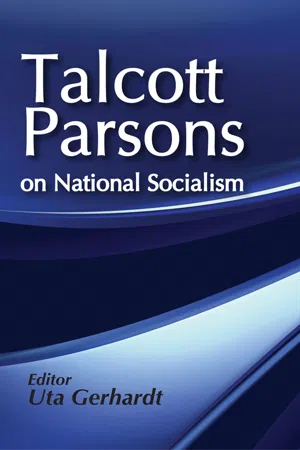
During the years between the publication of the first of his two major works, The Structure of Social Action (1937), and the writing of his second, The Social System (1951), Talcott Parsons was primarily engaged in political activity through the Office of Strategic Services in its efforts to bring about the defeat of the Third Reich and to set the stage for a democratic reconstruction of postwar Germany. Beyond Parsons' analytic skills the essays reveal a dedicated liberal scholar, far removed from the stereotypes with which he came to be pilloried by later critics. The essays in this collection are the by-products of that special period of intense commitment. They reflect a single dominant theme: National Socialist Germany is seen as a tragically flawed social system but one requiring the same rigorous analysis Parsons brought to more normal and normative systems. Since virulent authoritarianism and even more virulent anti-Semitism were the dominant traits of that system as he saw it, Parsons dedicated many pages to each aspect. While he did not know the full horror of the Nazi ""war against the Jews"" he was able to develop a theoretical framework that continues to be a foundation stone for the analysis of national socialism. Gerhardt's editorial labors in the Parsons archive at Harvard have yielded nothing less than a ""new book"" by the foremost American sociological theorist of his time. This collection of both published and unpublished writings conveys Parsons' cohesive intent. To these otherwise fugitive and neglected essays Gerhardt contributes an introductory essay of her own: in part biography, in part intellectual and social history. She discovered Parsons work on National Socialism while studying his sociology of the professions and his use of medical practice to demonstrate how social science could become an antidote for fascism and authoritarianism. Uta Gerhardt is director of the Medical Sociology Unit at Justu
Information
1
Nazis Destroy Learning, Challenge Religion*
The present situation in Germany is very complex and baffling, not only to the feelings and ethical convictions of persons who, like all Americans, have been brought up in the tradition of liberal individualism and democracy, but also from the point of view of the social scientist trying to understand what is going on in the world around him. One of the most fundamental of all the questions which can present themselves on the scientific level is this: is National Socialism, so far as can be discovered from its development thus far, merely a ripple on the surface of the great trends of Western social development, or at least does it represent only a movement at one relatively extreme fringe of an admittedly very complex civilization which is likely to be counterbalanced by other forces so as not to have a very great import. Or does it, as its proponents claim, represent a really radical change of direction?
MOST FORMIDABLE THREAT
Of course anything like a definitive opinion on problems of such scope is out of the question. As I have watched the development of the movement, my own conviction, however, has steadily grown that it is rapidly coming to be the most formidable threat to many of the institutional fundamentals of western civilization as a whole which has been seen for many centuries. In part this may be said of the movement as such, in part it is symptomatic of a still more deep-seated state of affairs which is by no means confined to Germany or even the “dictatorial” countries. It is possible to mention only a few of the considerations underlying this conviction.
In the first place there can be no doubt that science and, more broadly, liberal learning are fundamental to our culture. Though by no means unambiguous in their attitudes toward it, the Nazis have already done an astoundingly thorough job in destroying the great academic institutions in which Germany was so eminent, and insuring that there will be no quick return to the older traditions. In philosophy, history and the social fields the destruction is virtually complete. They have gone least far in the natural sciences, but even there the claim is made that eminence is a function of race and political “reliability” rather than technical achievement in our sense.
CONFLICT WITH CHURCH
The apparently growing acuteness of the conflict with the Christian churches is probably equally important and symptomatic. And there perhaps of deepest significance is the clear-cut challenge to the fundamental principle of religious universalism which has stood fast ever since St. Paul, that salvation was open to every human being regardless of his race or social condition. This universalism in various aspects has had an importance in Western civilization far transcending the narrowly religious sphere. The first statement of the challenge was the exclusion of Jews by birth from eligibility to the ministry of the Protestant state church. To my knowledge no European authority, religious or secular, ever before has in principle excluded a group from eligibility to religious goods on grounds of birth alone, however bitterly they may have persecuted Jews so long as they persisted in what was in Christian terms their heresy.
MORE THAN POLITICAL MOVEMENT
I have mentioned these two points rather than the invasion of civil rights or the destruction of political democracy because, in my opinion, National Socialism is far more than a “political” movement in any narrow sense. It reaches down to the deepest foundations of institutional structure generally. Seen in this perspective the treatment of the Jews, tragic as it is for the victims, is only a small part of the significance of the movement, perhaps even more of symptomatic importance than itself the major danger. For various reasons they, the most widespread and at the same time persistently “unassimilated” cultural minority in Western society, are particularly vulnerable as a symbol and a scapegoat.
Many things in Germany are yet in flux and hanging in the balance. It is even still possible that the explosive forces of the movement will “spontaneously” gradually lessen and it will turn out in the end to be a relatively minor disturbance. So far, however, it seems to have steadily gathered force and such a prediction would be dangerous. I am at the same time far from believing in the inevitability of historic processes. It seems to be probable that the outcome will depend at many points on the cumulative effects of what many millions of people “do” about it, not least those outside Germany.
HOSTILE TO SCIENCE
The ethical attitude toward National Socialism seems to me, for the person seriously imbued with the ideals of science and the academic profession, so obvious that it is scarcely necessary to discuss it. To mention no other considerations, that which is, as a cultural movement, distinctive about National Socialism is deeply hostile, in particular to the spirit of science and the great academic tradition, and more generally to the whole great cultural and institutional tradition of which these are an integral part. This makes it necessarily a deadly enemy for us. We must oppose it with all our strength. What, on the other hand, is the most effective method of doing so, is far too complex a question to enter into here.
* Radcliffe News (November 23, 1938)
2
Academic Freedom (1939)*
The present era seems to be one of unsettlement and controversy over a wide area of the most fundamental parts of our social organization and cultural tradition. One of many such controversial areas is that of the status and proper functions, rights and obligations, desirable qualities and achievements of the college and university professor, scholar or teacher. Much of the controversy in this area has tended to center on the problems of so-called “academic freedom,” of the right of the academic person to “do as he pleases” enjoying immunity from restrictions imposed upon him by others in the community. But from this central focus the discussion has tended to ramify into a wide variety of other problems touching the status and social functions of members of the faculties of institutions of higher learning.
The present essay will discuss a group of these problems not in order of their immediate practical urgency or controversiality, but of their common relevance to certain rather general considerations which have come to be important to the author in the course of a program of study, undertaken in his professional academic capacity, of the social role, status, functions, and conditions of development of the professions in modern Western civilization. In one sense it is in part the outcome of technical study in this field. But it is not, in any sense a research report. In the first place no intensive research investigation of the academic profession has been carried out to serve as a basis for such a report. In the second no attempt will be made to confine the discussion exclusively to a level which would be appropriate to such a report.
Considerations derived from, and playing an important part in technical sociological research will be combined with those involved in personal convictions and in ideals for the development of universities and their functions in our society. Hence whatever authority may lie behind the following pages is only in part that of a technical expert in the sociology of the professions, talking about his own technical subject-matter. In part it is also that of simply a member of a university faculty who is, for personal reasons, seriously interested in problems of status and functions of his own profession; in part again it is that of a citizen of contemporary America who is interested and concerned about the course of development his society is taking, and the place in that development which his own profession has had, and may possibly have. The question of the ethical justification of a university professor embarking on such a project at all will be one of the main ones running throughout the paper.
Attention may be called in particular to one field which lies on the borderline of technical sociological competence, and the personal convictions and standards of the profession and society as a whole, which have been mentioned. It is a matter for the historian and the sociologist to decide on purely technical bases, what kind of society our own is and has been, and what part of its development and functioning the groups known as professions have played and do play. But whether or not this society has on the whole been a desirable society, whether the professions have played a beneficent or a nefarious role in its development is one which involves elements other than a technical knowledge of history and sociology for decision. One of the important features of the present paper will be an ethical approval of certain normative tendencies which seem to the author to be fundamental in the main line of development of our society generally, and of the role of the professions particularly. It is, however, by no means claimed that the approval can be justified on technical scientific grounds alone. He who objects to the thesis that these are tendencies fundamental to Western society should criticize on historical and sociological grounds, he on the other hand who disapproves rather than approves them should use a different critical approach.
Professions would probably be generally agreed to fall within the category of specialized occupational groups, that is groups the members of which perform in some sense common functions not performed by other groups in most of their “working” time, and are mainly, in the usual case, dependent on the remuneration derived from it for their economic support. But among occupationally specialized groups they are further distinguished by two important criteria. The members of a professional group have a technical competence which is considered necessary to the proper performance of their appropriate functions, and which usually presupposes a more or less formalized process of training, and secondly, this competence is distinguished from certain others, such as that of skilled artisan, in that it involves explicit as one major component, generalized knowledge of an intellectual tradition. Thus the physician is not only skilled in certain practical procedures, he is supposed to a greater or lesser extent, to have mastered a body of general knowledge, a substantial part at least of what is called the “science of medicine.” His effective practical work is in part dependent on his knowledge of medicine in this sense. This important feature of the professions is emphasized in the term “learned” which is so frequently applied to them. A professional man is supposed to be a learned man in one of the important branches of the great cultural tradition of our society.
We are generally apt to think of the members of a profession as engaged in the “application” of some branch of learning to practical situations. It is true that a professional man is more than a learned man, in all cases, he is not only a man who “knows a lot,” but he has certain skills. Many of these skills are directed to practical affairs, that of the lawyer, or the medical man or the engineer for instance. But it does not follow that a man whose learning is not in an “applied” field does not share many of the features of the “practical” professions. Indeed precisely in so far as it is generalized knowledge which distinguishes the professional man, his knowledge is directly related to fields of learning which are not directly practical at all, but are rather fields of “pure science” and “pure learning.” We distinguish as a matter of course the physicist from the engineer, the legal scholar from the practising lawyer, the physiologist from the practising physician. In the cases of the “pure” disciplines as distinguished from the applied, the relevant skills are not in the “application” of their knowledge, but in its “advancement” and in its transmission to others.
In so far as the advancement and transmission of the disciplines of pure learning has not been the work of sporadic unorganized persons, but has become formally organized, the seat of this function has been in the “universities.” As the specialized trustees of learning and knowledge indeed the central focus of Western universities has tended to be in the fields of pure learning although the development and transmission of the applied fields has always been of great importance in such fields as theology, law and medicine.
It appears from what has been said that the criterion so far considered which distinguishes a profession from other specialized occupational groups is its relation to learning. And the more it is generalized learning the more it depends on the content of the “pure” fields of learning. If this view of what historically has constituted a profession is correct then the “academic” profession, which may be defined as the profession of learning itself, far from being of dubious professional status because of its “impractical” character, forms the nucleus of the cluster of modern professional groups. The fruitfulness of this mode of considering a profession is confirmed by the very important role, in the established practical professions, of their academic branches, those sections of them which are mainly engaged in the advancement of learning in their professional fields and its transmission to others. Academic medicine is obviously of basic importance in the medical profession as a whole. Hence there is a presumption that social features of a profession which can be shown to be of great importance in such a case as that of the practising physician, are not necessarily irrelevant to the academic group even apart from the applied fields of knowledge.
The generalized knowledge which is the main content of professional learning is by no means confined to what is ordinarily called “science”; it includes also disciplines centered about all the important branches of our culture, such as the so-called “humanities.” But there are certain features of the great tradition of Western learning which, though today most commonly thought of in relation to science, are in fact common to all the disciplines with an unquestioned place in the halls of academic learning. Though it has many ambiguous connotations, perhaps the best single name for these common features is the term “liberal.”
Just what this means is not altogether easy to formulate. The scientist is usually pictured as engaged in the disinterested search for truth. Personal interests and sentiments, preconceived ideas or dogmas, political or religious predilections and the like are all thought of as in some sense subordinated to objective norms. The sense in which scientific objectivity is related to these other things is not simple—it will be discussed somewhat further below—but in some sense as an ideal it is essential to the great tradition of science. A slightly different way of putting it is that the process of development of science has been in large degree a process of “rationalization.” Its two main components in this respect are observation and verification of fact, and rigorous logical reasoning about fact. Without a modicum of these it is impossible to speak of scientific activity.
But what is most conspicuously true of science is also true of the other of the main components of the great Western cultural tradition so far as they have achieved academic status. Theology, for instance, has not been confined to the simple assertion of articles of faith. It has also involved persistent attempts at rational systematization and justification of faith. The theologian may not be in the usual sense a scientist, but he shares some very important traits and attitudes with the scientist, however limited the range within which they apply. The same is true of the historian and the critic of literature and the arts. Accuracy of statement, clarity and logic of reasoning are binding norms in all these fields.
“Liberality” then may, for present purposes, be taken to mean a state of freedom from undue interference with the type of rational objectivity. It is a historical fact that an important range or autonomy of the rational “search for truth” has characterized the great academic tradition of the West. It may then be stated that he who approaches a subject with a fixity of attitude or preconceived ideas, or with a dominance of emotion or sentiment which precludes any important range for this rational process is, in the sense relevant in this context, “illiberal” and is not practising the “liberal arts” or “a liberal profession.”
This yields a further insight into the meaning of the peculiar technical competence characteristic of a professional man. An important component of this competence is a skill, superior to that of his non-professional fellows, in the daily use of liberal rational methods and thought in relation to his subject-matter. Not only has he mastered part of a generalized intellectual tradition, but he has absorbed it and uses it in a liberal spirit. This is fundamental to the traditions of the Western professions.
There is a certain tendency for most commonsense discussions of professional activity to concentrate attention on the technical content of the professional tradition, on the character of the immediate ends served by it, and the situations in which practice is carried on. Attention is seldom called to the fact that efficient functioning of professional services, seen in terms of their role in the community life generally, requires a whole series of other conditions to be met with a relatively high degree of adequacy. The present writer has, as a sociologist, been particularly interested in analyzing the role of a certain group of these factors, what may be called the “normative patterns” of professional practice. Certain aspects of these patterns have been worked out in some detail for one professional group, ...
Table of contents
- Cover
- Half Title
- Title Page
- Copyright
- About the Author
- Table of Contents
- Acknowledgments
- Introduction: Talcott Parsons’s Sociology of National Socialism
- The Collection of Texts
- Chapter 1. Nazis Destroy Learning, Challenge Religion
- Chapter 2. Academic Freedom (1939)
- Chapter 3. Memorandum: The Development of Groups and Organizations Amenable to Use Against American Institutions and Foreign Policy and Possible Measures of Prevention
- Chapter 4. The Sociology of Modern Anti-Semitism
- Chapter 5. New Dark Ages Seen If Nazis Should Win
- Chapter 6. Max Weber and the Contemporary Political Crisis
- Chapter 7. Sociological Reflections on the United States in Relation to the European War
- Chapter 8. Some Sociological Aspects of the Fascist Movements
- Chapter 9. National Socialism and the German People
- Chapter 10. Democracy and Social Structure in Pre-Nazi Germany
- Chapter 11. Propaganda and Social Control
- Chapter 12. Racial and Religious Differences as Factors in Group Tensions
- Chapter 13. The Problem of Controlled Institutional Change: An Essay in Applied Social Science
- Chapter 14. Certain Primary Sources and Patterns of Aggression in the Social Structure of the Western World
- Index
Trusted by 375,005 students
Access to over 1.5 million titles for a fair monthly price.
Study more efficiently using our study tools.
Frequently asked questions
Yes, you can cancel anytime from the Subscription tab in your account settings on the Perlego website. Your subscription will stay active until the end of your current billing period. Learn how to cancel your subscription
No, books cannot be downloaded as external files, such as PDFs, for use outside of Perlego. However, you can download books within the Perlego app for offline reading on mobile or tablet. Learn how to download books offline
Perlego offers two plans: Essential and Complete
- Essential is ideal for learners and professionals who enjoy exploring a wide range of subjects. Access the Essential Library with 800,000+ trusted titles and best-sellers across business, personal growth, and the humanities. Includes unlimited reading time and Standard Read Aloud voice.
- Complete: Perfect for advanced learners and researchers needing full, unrestricted access. Unlock 1.5M+ books across hundreds of subjects, including academic and specialized titles. The Complete Plan also includes advanced features like Premium Read Aloud and Research Assistant.
We are an online textbook subscription service, where you can get access to an entire online library for less than the price of a single book per month. With over 1.5 million books across 990+ topics, we’ve got you covered! Learn about our mission
Look out for the read-aloud symbol on your next book to see if you can listen to it. The read-aloud tool reads text aloud for you, highlighting the text as it is being read. You can pause it, speed it up and slow it down. Learn more about Read Aloud
Yes! You can use the Perlego app on both iOS and Android devices to read anytime, anywhere — even offline. Perfect for commutes or when you’re on the go.
Please note we cannot support devices running on iOS 13 and Android 7 or earlier. Learn more about using the app
Please note we cannot support devices running on iOS 13 and Android 7 or earlier. Learn more about using the app
Yes, you can access On National Socialism by Talcott Parsons in PDF and/or ePUB format, as well as other popular books in Politics & International Relations & Communism, Post-Communism & Socialism. We have over 1.5 million books available in our catalogue for you to explore.