- 220 pages
- English
- ePUB (mobile friendly)
- Available on iOS & Android
eBook - ePub
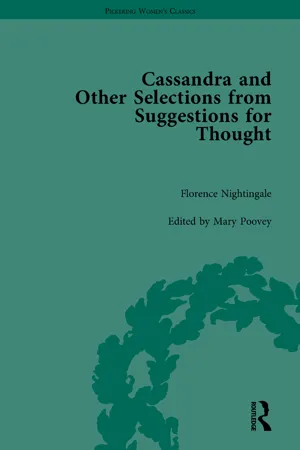
Cassandra and Suggestions for Thought by Florence Nightingale
About this book
Florence Nightingale is famous as the heroine of the Crimean War and later as a campaigner for medical care founded on a clean environment and good nursing. Suggestions for Thought, which contains the novel Cassandra, is a central text in nineteenth-century history of feminist thought.
Information
VOLUME ONE
PART I
Belief in God
1. You ask if we believe in God? If those who disregard authority believe in a God at all, and why they believe Him perfect?
The two questions have one and the same answer. I believe in a perfect being, whom you call God.
But why do you believe in Him?
If you ask that question, we come immediately to the definition of the two words ‘believe’ and ‘God’. What does ‘I believe’ mean?
It means, in common language, sometimes doubt and sometimes affirmation. ‘Is A. B. in London?’ ‘I believe so.’ Here it means, ‘I do not know, but I think it probable’. ‘Why do you think he has been there?’ ‘I believe his word’. Here it means firm persuasion. But even here the belief is qualified by the modest. ‘l’, which means, ‘It is I who believe, I don’t know whether others do’. What is therefore to be understood by ‘belief’? Sometimes a sense of certainty, sometimes of uncertainty.
What will Johnson1 tell us? The sense in which the word has been used by certain writers, called classic. Johnson says that ‘belief’ is credit given on account of authority. But have we really no other sources of belief than authority? There are means of belief in the capabilities of human nature, and human nature makes progress. At least in some things. Ideas make progress. And the meanings attached to words which express ideas cannot, therefore, remain the same. A house may mean a house in all ages, though even in the case of words which express things, the house which we build now signifies a very different thing from the house built by, the painted Briton. How much greater must be the difference in the sense of a word used to express a religious or a political idea! Either we must have new words or new meanings.
Johnson will define religion as ‘virtue founded upon reverence of God and expectation of future rewards and punishments’, and will quote Milton, South, Watts, and Law2 for this sense of the word. Another theologian (belonging to an African tribe) thinks religion means jumping over a stick. If either of these be really religion, we want a new word to express so different an idea as the sense we have of our tie to God.
With what meaning, then, do we ‘believe’ in God?
Man advances to a consciousness and conviction that there does exist a perfect being (whom we may call God), exactly in proportion as his nature is well constituted, well-educated, well exercised. Human nature, when thus well-born and well-bred, will admit of his sense of this truth, and of others inferred from it, being as strong and complete as the sense of truth with which he asserts that the tree before his eyes is a tree, and not a house.
But we must be careful to know that the God whom we believe in is a perfect being. Men often think that they believe in a perfect God when, in fact, they do not, – when they are really wholly incapable of even conceiving of a perfect being. For instance, in the earlier nations, where revenge was considered a virtue in man, it would naturally be thought so in God. Many imperfections, as we now think them, were once deemed virtues, and consequently attributed to a God who was called perfect. The religious history of the Hebrews is especially curious on this account.
Again, the God ‘of Abraham, of Isaac, and of Jacob’, was certainly not the God ‘of the whole earth’. It is true that the Hebrews served but Him alone; they believed, however, in the existence of many Gods. Their own God they reverenced, and despised the other Gods. But it was not till long afterwards that they rose with increasing knowledge to the belief that there was but one supreme. Yet He cannot be perfect if there be more than one. Is it, perhaps, that a knowledge of natural philosophy, such as cannot be attained by an infant nation, is necessary for the conception of one supreme being? The more we learn the more cause we find to think that the whole system of the universe is one scheme. Astronomy leaves no room, so to speak, for more than one throne. The same legislation prevails everywhere. All becomes one whole, with one ruler.
Take those very Hebrews. Moses had learnt in Egypt, had matured in the desert, his noble conception of a Divine Spirit. But his savage Hebrew tribe was incapable of it; and he himself was obliged to allow it to deteriorate to their level. Whenever one man has endeavoured to impose the more perfect idea of a supreme being, which has had its origin in his own more advanced mind, upon a nation less developed than himself, we see it degenerate.
If the stage of civilization be very low indeed, the race is incapable of conceiving of a God at all. One of the French ‘Sisters of Charity’ (the only real ‘women of the world’) who see all nations and all conditions, told me that the single race within their knowledge, who did not possess the idea of any supernatural being, was a tribe in Australia, not far from Perth. They were in the lowest conceivable state of animal existence. She had with her one of their children, which she had bought for a shilling, when about to be eaten by its tribe, and which appeared little above an animal, except that it stood on two legs and had no wings. It imitated like an ape, and stole like a magpie.*
I related this to an operative engineer, and he said slowly and thoughtfully, ‘That is just the condition in which most of my fellow workmen are, and they do not know whether they believe in a God or not. Sometimes they do and sometimes they don’t’.
I am trying to arrive at the meaning which we shall attach to the word ‘belief’, to prove that the highest state of belief, (viz., in the signification of the strongest conviction,) must be the result of the highest stage of development; that, therefore, we cannot be said to ‘believe’ in this sense, except when we have reached that state; and that at an earlier stage of development in man, ‘belief’ will mean a sense of uncertainty; at a later, a sense of certainty. Is it not possible that this sense of uncertainty it is which has led so many lately into the Roman Catholic Church, and some the most learned, the most earnest? Scepticism, not belief, has brought them there. They required their sense of a truth to be stronger and more complete than it was. The more they urged themselves to believe, the less real was their feeling of belief, till, at last, they took refuge in the belief of others to supply that which they had not in themselves.
In this age, however, by far the greater proportion of mankind, have gone the other way; in England, most of the educated among the operatives, especially in the northern manufacturing towns, have turned their faces to atheism or at least to theism3 – not three in a hundred go to any place of worship; the moral and intellectual among them being, almost without an exception, ‘infidels’.
These poor fellows, thinking so hard and so conscientiously, leave out the best element in the food which they so earnestly seek; the most divine element, that which makes confusion into order, that which makes the lowest into the highest; for the highest discoverable principle in existence, perhaps, is the feeling residing in the perfect One, which wills happiness; the thought of the perfect One, that happiness is, by its essence, worked out for the happy by exercise of their own natures and of other natures like theirs. Time is all that intervenes between man as he is, and man made one with God. Time intervenes only because that would not be the spirit of wisdom to which it was possible to will man to be one with God otherwise than through the exercise of man’s faculties.
Whenever man rejects revelation, however, he is too apt to say immediately, ‘God is incomprehensible, we will not seek for Him, because we shall not find Him’. And he is left without a God, even where he does not deny the existence of one.
Such an one will think it fanciful to look upon the ‘Holy Ghost’ as a real existence. Hitherto we have rather looked for it, because it exists in the belief of so many, than felt it to be essential; but the love, the wisdom, the goodness, the righteousness, the power which we can, with our thought and feeling, recognize in law and its expression in the universe: these we may perhaps better call the ‘Holy Ghost’ than God, whom (as so much of the intellect of the present day says) we cannot understand. A distinction is necessary between what we can understand and feel, and what we cannot. Very much mischief has arisen from what has been said and written about the latter. That a Father of the universe exists, but incomprehensible to us, may be shown, not by mathematical proof, but by such strong presumptive evidence (by evidence, too, increasing with our knowledge and the improvements of our being) that man may live and feel in accordance with the fact, as with much else not mathematically proveable. But, with truth, it is said that we cannot comprehend Him, and, disgusted by the dogmatizing of theologians and churches, many are refusing to believe His existence. Instead of saying, ‘I cannot understand the Holy Ghost’, as we with many have said – instead of His appearing in the Trinity one knows not why – perhaps it is a Holy Ghost only that we can understand; perhaps we may find in these words the expression we want for that which each man can feel and comprehend of the Father.
Perhaps Paul unwisely said what we have beforetimes so often admired, ‘Whom ye ignorantly worship, Him reveal I unto you’. He could only reveal that which he had himself felt and understood of God’s truth,* and only to natures capable of receiving that revelation.
Let us distinguish God the Father as the spirit of perfection, incomprehensible to us; God the Holy Ghost, as what is comprehensible to each man of the perfect spirit.
To ‘receive the Holy Ghost’, what a remarkable expression that was! No wonder that those to whom it was addressed said they did not ‘so much as know that there was a Holy Ghost’. This is just the state of those among the men called atheists in the present day, who are thinking and conscientious.
To ‘receive the Holy Ghost’ is to exercise the capabilities of man, in as far as each is able, in apprehending the spirit of perfection. Truly do these atheists say, ‘We cannot understand God’, so they leave the subject entirely as irrelevant. This true consciousness of not being able to understand, to feel God, has led, on the one hand, to being ‘without’ the Holy Ghost, the Comforter, ‘in the world’; on the other, to the making Christ an anomalous being, called God, called not God. We cannot be too careful to admit our present ignorance, and any essential incapability in our nature. Neither can we be too careful to admit no incapability of attainment in human nature, while the individual human being, or successive generations of man, can advance towards attainment.
People have dogmatized about religion, building upon a few words in a book4 (and a book the evidence of whose authenticity it is necessary to master) immense schemes.
Upon the words, ‘Lo! I am with you always even unto the end of the world’, (partly at least, if not entirely,) rests the fabric of the Church, with its high pretensions, its splendid temporalities. If we were to ask the bishops why they are there, will they not say, mainly because of those words?
If we ask the Roman Catholic church why they are there, they will say to hear confessions and absolve sinners. They have founded their scheme upon ‘Whatsoever thou shalt loose on earth shall be loosed in heaven’.
We must admit that people have founded vast schemes upon a very few words.
Feeling the folly of this, others say that we are incapable of knowing anything about God. We cannot be too careful to draw a line of distinction between what we can know positively and what we can only conjecture empirically (i.e., see reason to guess is true), and leave to be confirmed by the exercise of the faculties of ages to come; at the same time acknowledging our ignorance where it exists on those subjects on which it has been asserted that mankind has certain knowledge.
It is impossible to observe and reflect on what does exist and has existed, as cognizable by our various faculities, without tracing a vein of benevolent will, a wise will, and a powerful will.
Can it be denied that the signs, which make us assert that human will has been or is at work when we see machinery in action (even though no possessor of human will is manifest to the senses) – can it be denied that the same signs exist to manifest a will, differing from the human in possessing more wisdom and power to effect those same purposes which human will tries for?
But let us not go on to dogmatize, to assert that this will is perfect and eternal. Supposing the thought and purpose of God to be perfect, its perfect realization is the work of eternity. Therefore no perfect realization can have been recognized by man. Man can only recognize, in what he can learn of present, past, and future, tendencies from which he implies the perfect purpose.
Let us be most careful to keep accuracy in what we say we know, especially with reflective and conscientious men, who disbelieve what may be known, because required to believe what cannot be known.
Evidence may be brought of a will for long time past active, in which we trace some benevolence, wisdom, power. But we are seldom called upon to act and feel only by that of which we have certainty; we often have to act empirically.
The empirical must lead the way to the certain. Empirical laws are ‘those uniformities which observation or experiment has shown to exist, but upon which we hesitate to rely, for want of seeing why such a law should exist. The periodical return of eclipses, as originally ascertained by the persevering observation of the early eastern astronomers, was an empirical law, until the general laws of the celestial motions had accounted for it. An empirical law, then, is an observed uniformity, presumed to be resolvable into ultimate laws, but not resolved into them’.
We find signs of benevolence, wisdom, and power, which appear to indicate that the will, in consequence of which that which exists does exist, desires the well-being of that existence at some time present or future. But there is and has been much suffering in every present with which we are acquainted, and we often cannot discern how it can be leading to a happy future in detail. Evidence may be brought to show, however, that it is leading, in principle, to a happy future – that, to the best happiness, the present is essential.
One and another cause of suffering disappears from time to time by the exercise of man’s capabilities. We can see glimpses of how others might disappear, if he used these capabilities differently from what he has done. Great increase of enjoyment has been opened in certain directions by exercise of man’s capabilities, and here too we have glimpses into immeasurable enjoyment attainable by man.
Do not such observations lead to the conjecture that the higher will intends man to work the way from suffering into happiness by exercise of capability?
The capability of each individual when born, the development and improvement of this capability, are obviously left in large measure to manki...
Table of contents
- Cover
- Half Title
- Title Page
- Copyright Page
- Table of Contents
- Introduction
- Note on this edition
- Chronology
- Works by Florence Nightingale
- Suggestions for thought
- Dedication
- Volume One
- Volume Two
- Volume Three
- Notes
Trusted by 375,005 students
Access to over 1.5 million titles for a fair monthly price.
Study more efficiently using our study tools.
Frequently asked questions
Yes, you can cancel anytime from the Subscription tab in your account settings on the Perlego website. Your subscription will stay active until the end of your current billing period. Learn how to cancel your subscription
No, books cannot be downloaded as external files, such as PDFs, for use outside of Perlego. However, you can download books within the Perlego app for offline reading on mobile or tablet. Learn how to download books offline
Perlego offers two plans: Essential and Complete
- Essential is ideal for learners and professionals who enjoy exploring a wide range of subjects. Access the Essential Library with 800,000+ trusted titles and best-sellers across business, personal growth, and the humanities. Includes unlimited reading time and Standard Read Aloud voice.
- Complete: Perfect for advanced learners and researchers needing full, unrestricted access. Unlock 1.5M+ books across hundreds of subjects, including academic and specialized titles. The Complete Plan also includes advanced features like Premium Read Aloud and Research Assistant.
We are an online textbook subscription service, where you can get access to an entire online library for less than the price of a single book per month. With over 1.5 million books across 990+ topics, we’ve got you covered! Learn about our mission
Look out for the read-aloud symbol on your next book to see if you can listen to it. The read-aloud tool reads text aloud for you, highlighting the text as it is being read. You can pause it, speed it up and slow it down. Learn more about Read Aloud
Yes! You can use the Perlego app on both iOS and Android devices to read anytime, anywhere — even offline. Perfect for commutes or when you’re on the go.
Please note we cannot support devices running on iOS 13 and Android 7 or earlier. Learn more about using the app
Please note we cannot support devices running on iOS 13 and Android 7 or earlier. Learn more about using the app
Yes, you can access Cassandra and Suggestions for Thought by Florence Nightingale by Florence Nightingale in PDF and/or ePUB format, as well as other popular books in Literature & Literary Collections. We have over 1.5 million books available in our catalogue for you to explore.