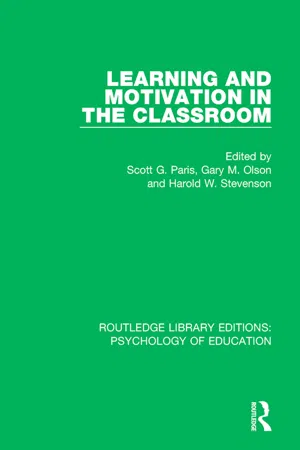
Throughout the twentieth century there had been substantial links between scientific psychology and education. Binet, Dewey, Thorndike, and other early pioneers were strongly interested in both realms. Taking advantage of a period of enthusiasm, this title, originally published in 1983, looks at the amalgamation of the recent advances at the time in theory and research in education and psychology, with a particular focus on cognition, motivation and social policy. This volume presents and discusses the implications of this work on learning and motivation for educational policy.
eBook - ePub
Learning and Motivation in the Classroom
- 348 pages
- English
- ePUB (mobile friendly)
- Available on iOS & Android
eBook - ePub
Learning and Motivation in the Classroom
About this book
Information
IINSTRUCTIONAL ISSUES
The classroom is, fundamentally, a place to learn. Educators have always believed that the psychology of learning is directly relevant to classroom activities. But direct relevance and direct application are quite different things. Despite the intensity with which learning has been studied, the efforts to apply what has been learned to the classroom have been filled with confusion and frustration. During the period when the study of learning focused on rats and pigeons, there were many attempts to generate applications to human learning. As Resnick points out in her chapter, theorists like Thorndike and Skinner had strong interests in educational applications of their principles. But extrapolations from experimental observations in the learning laboratory to the classroom were based on a fragile chain of assumptions. Even when the psychology of learning shifted to studies of verbal learning and memory of adults, there was still a big gap between the world of the psychological experiment and the world of the classroom.
We are now in a different era. The study of learning and cognition is centered in domains that are at the heart of educational curricula: reading, mathematics, and science. Such topics as comprehension, induction, abstraction, inference, understanding and categorization—all of which appear to be related to what students ought to be doing in the classroom—now represent the central focus of much cognitive science research. Of course, just because research is being done on the learning of geometry or physics, on arithmetic or reading, does not mean that the step from basic work to applications is immediate. Resnick points out that cognitive science so far has done a much better job of decomposing tasks and states of understanding than in describing how transitions between states of understanding occur. Thus, even in the domains of reading, mathematics, and science, the task of deriving basic principles is just beginning. Nonetheless, without an understanding of relevant basic principles, the issue of applications is moot. The chapters in this section survey a broad sample of recent research aimed at developing such an understanding. The authors represent diverse substantive interests, research philosophies, and theoretical goals. Nevertheless, there is a central focus throughout these five chapters: the attempt to derive instructional implications from research and theory on cognition.
Lauren Resnick seeks to link research on basic cognitive processes with instructional practices. She points out that cognitive science research in the domains of reading comprehension, science, and math has provided us with thorough analyses of cognitive objectives for instruction although it has not yet provided detailed analysis of learning processes on which to construct a theory of instruction. But the effort to do so has begun, and Resnick describes characteristics that she believes are important for a cognitive theory of learning and ultimately a cognitive theory of instruction. In particular, she suggests that instructional theories will be fairly domain-specific and that a goal of deriving broad principles for all instructional practices may be too simplistic.
Is it possible to construct a model of reading instruction based on present knowledge of theory and practice? David Pearson and Rob Tierney pursue this goal in their chapter. They examine five different areas in search of general principles: models of reading, existing classroom practices, correlations of classroom observations with achievement, program evaluation research, and experiments on instructional practices. They conclude that their examination of the five areas pinpoints three factors that affect the success of a reading program, and thus constitute factors that a model of reading instruction will need to address. These factors are: the orientation toward reading, or the relative emphasis given to meaning versus decoding; the explicitness of instruction, specifically the extent of teacher intervention in the learning of component skills; and finally, the role of practice. The chapter serves as a useful guide to issues in instructional research on reading.
Marlene Scardemalia and Carl Bereiter elaborate a novel theme, viewing the child as co-investigator in the research enterprise. They asked children to think aloud while engaged in a complex cognitive task, in this instance, writing. A frequent “side effect” of their efforts to get children to reveal more about their mental processes was found: the children became interested themselves in discovering what they could about their mental processes. Because research has already shown that awareness of how one’s own mental processes work (i.e., metacognition) may be an important part of cognitive development, they elaborate on the hypothesis that encouraging the child to serve as co-investigator with the experimenter or instructor may facilitate the development of such awareness.
The goal of James Greeno’s chapter is to characterize students’ understanding in high school geometry. This in turn should provide a description of cognitive objectives of instruction in the domain. Many agree that understanding, not rote memorization, should be the objective of school learning. However, objective descriptions of what is meant by understanding are rare. Greeno uses think-aloud protocols, observations of students’ behavior, and computer simulations of their performance to construct descriptions of what it means to understand within these domains. This kind of research represents the first steps toward a cognitive theory of instruction in the sense described by Resnick.
What are the relationships between cognitive development and school learning? Anton Lawson discusses a series of studies on the interrelations of basic principles of cognitive development—primarily derived from Piaget—and science learning in the classroom. Starting from the claim that adolescents are deficient in formal operational thought, he evaluates evidence on the contribution of science curricula to developmental changes in logical thinking. He argues that science learning does help students develop better reasoning skills and he identifies a number of issues that must be considered in assessing the relationship between developmental changes and school learning.
Collectively these chapters offer several provocative hypotheses for cognitive theories of classroom instruction. Although no single theory has emerged within any of these academic domains, these five chapters represent bold attempts to identify cognitive objectives, learning processes, and classroom practices that are relevant to direct educational applications.
1 Toward a Cognitive Theory of Instruction
Lauren B. Resnick
Learning Research and Development Center University of Pittsburgh
Learning Research and Development Center University of Pittsburgh
We are now well accustomed to noting the cognitive “revolution” that has characterized the last decade or two of psychology. The human mind has been rediscovered, or at least reaffirmed; reasoning and thought are central objects of scientific study; and the nature of human cognitive abilities is being examined in fresh ways. It seems evident that the new conceptions of human competence that are emerging ought to affect the practice of education—that a cognitive theory of instruction ought to be emerging alongside our increasingly elaborated theories of cognitive performance and development. What would such a theory look like, how close are we to having one, and what directions must be followed to further its development? These are the questions explored in this chapter. The goal of this inquiry is to build an agenda for research that will result in a cognitive theory of instruction capable of informing educational practice and at the same time extending the limits of our knowledge about how people learn and develop.
Let us begin with some definitions that will serve to set the boundaries of the inquiry. First, I define as instruction anything that is done in order to help someone else acquire a new capability. This is an intentionally broad definition. It means that instruction is not limited to traditional “teacher’s tasks,” such as lecturing or conducting recitations or setting homework assignments—although these are certainly activities that may qualify as instruction. Rather, any act that intentionally arranges the world so that somebody will learn something more easily qualifies as instruction. I think it will become clear as the chapter proceeds why this broad definition of instruction is essential—indeed is dictated by—the view of human learning that is being elaborated by current cognitive psychology.
With this view of instruction as a point of departure, we can now consider the elements of a theory of instruction. Such a theory must be both descriptive, explaining why instruction works and why it does not, and prescriptive, suggesting what to do the next time for better results. For these purposes three requirements must be met. First, a theory of instruction must specify the new capabilities that we are trying to help somebody acquire—that is, the goal of the instructional effort. Second, it must provide a theoretical account of how people acquire these desired capabilities. Finally, an instructional theory must specify how something done by an instructor interacts with the individual’s processes of acquisition so that something new is acquired. There are, then, three components to a theory of instruction: (1) specification of capabilities to be acquired; (2) description of acquisition processes; and (3) principles of intervention.
A BRIEF HISTORY OF PSYCHOLOGICAL THEORIES OF INSTRUCTION
The effort to build a theory of instruction is rooted in today’s cognitive psychology and poses a new challenge, but this is by no means the first time that psychologists have addressed this task. A brief review of some past efforts at drawing instructional implications from psychological theory will help us to appreciate both the goals and the potential pitfalls of our new venture.
E. L. Thorndike and the Theory of Bonds
Our account begins with Edward L. Thorndike, the prominent American associationist. Thorndike had a well-developed instructional theory that grew directly out of his general associationist theory of how the human mind works. For Thorndike, new capabilities to be acquired could be described as collections of “bonds”—that is, associations between stimuli or between stimuli and responses. Thorndike took so seriously the notion of defining instructional goals in these terms that he actually undertook an analysis of school subject matter. In 1922 he published a book entitled The Psychology of Arithmetic, which contains many lists of the bonds he thought made up the subject matter of arithmetic. The book thus essentially offered what we might now call a task analysis of arithmetic, in terms consonant with associationist learning theory. In keeping with associationist principles, there was minimal organization imposed on the lists of bonds. Thorndike implicitly recognized some deeper structure than that reflected in a simple collection of bonds; he proposed that bonds that “go together” should be taught together. Thus, he clustered addition bonds in one list and subtraction bonds in another, and so forth, largely following common sense views of arithmetic content. But his book offered little guidance as to what made things go together.
Despite this limitation, Thorndike’s task analysis proved very powerful. This was in large part because it was accompanied by a strongly articulated theory of acquisition. This theory specified that one acquires new bonds through a trial-and-error process in which associations that are rewarded become stronger, whereas those that are punished or ignored gradually die out. This is the “law of effect.” The law of effect pointed in turn to a very clear theory of instructional intervention: An instructor should organize practice in a way that would strengthen correct bonds, by reward, and weaken incorrect ones. This theory led to several decades of research in mathematics education in which investigators tried to determine empirically which bonds were easiest to form and which were hardest, so that practice could be organized from easiest to hardest. Such practice would give maximum opportunities for rewarding correct answers and thus strengthening correct bonds.
This approach to mathematics teaching still continues. For example, much computer-assisted drill-and-practice instruction can be viewed as a sophisticated manifestation of Thorndike’s theory. The Stanford CAI (computer-assisted instruction) programs for math (Suppes & Morningstar, 1972), for example, fit that theory very well even though there is no mention in any of the program descriptions of association theory. Thus the Thorndikian theory of instruction has had a real influence on educational practice.
Skinner and Operant Conditioning
Another psychologist who has had a profound impact on the theory and practice of instruction is B. F. Skinner (Glaser, 1978; Skinner, 1958). His effect was to lead instruction even further away from a central concern with the structure of knowledge and its interrelatedness. Skinner and other radical behaviorists denied that a science of mental life was possible because mental events were not open to public observation. With respect to instruction, the radical behaviorist position dictated a definition of the capabilities to be taught entirely in terms of observable performances. This has led to an entire technology of behavioral objectives (cf. Mager, 1961), still one of the more powerful influences on curriculum design and teaching practice.
Although the Skinnerian formulation was explicit about the terms in which capabilities to be induced through instruction should be stated, Skinner himself never did the kind of detailed work on the analysis of instructional subject matter that Thorndike did. Thus, there were no guidelines in Skinner’s own writing explaining how to arrive at the content of objectives or how to order them. Robert Gagné’s theory of cumulative learning (Gagné, 1962, 1968) and the methods of task analysis and learning hierarchy specification based on it (cf. Resnick, 1973) filled this gap, providing a method of task analysis that is still very influential.
As was the case with associationism, there was a strong acquisition theory associated with the Skinnerian view of learning. Much was shared with Thorndike, since learning was seen to be the result of patterns of reinforcement, or reward. But Skinner went beyond Thorndike. He proposed that wrong responses produce such negative side effects in learning that it would be best to avoid them completely. He and his associates (e.g., Terrace, 1963) showed that “errorless learning” was possible through shaping of behavior by small successive approximations. This led naturally to an interest in a technology of teaching by organizing practice into carefully arranged sequences through which an individual gradually acquires the elements of a new and complex performance without making wrong responses en route. This was translated for school use into “programmed instruction”—a form of instruction characterized by very small steps, heavy prompting, and careful sequencing so that children would be led step by step toward ability to perform the specified behavioral objectives. Meanwhile, the same general principles were applied to methods of organizing and maintaining desired social behavior in the classroom and keeping children’s attention on the assigned work. This line of application became known as “behavior modification” (Kazdin, 1981).
Both associationism and behaviorism, then, provided a coherent theory of instruction that included methods of specifying the capabilities to be taught, a general theory of acquisition, and principles for intervention. Neither, however, offered a thorough analysis of thinking or knowledge, and so both were often judged inadequate by educators and psychologists interested in promoting reasoning and understanding. These groups found the theories of Piaget and other psychologists, such as those of the Gestalt school, more compatible with their concerns. We turn next to these early cognitive psychologists.
Gestalt ...
Table of contents
- Cover
- Half Title
- Title Page
- Copyright Page
- Table of Contents
- Preface
- PART I: INSTRUCTIONAL ISSUES
- 1. Toward a Cognitive Theory of Instruction
- 2. In Search of a Model of Instructional Research in Reading
- 3. Child as Coinvestigator: Helping Children Gain Insight into their own Mental Processes
- 4. Forms of Understanding in Mathematical Problem Solving
- 5. Investigating and Applying Developmental Psychology in the Science Classroom
- PART II: MOTIVATION AND ACHIEVEMENT
- 6. Motivated Cognitions
- 7. Some Thoughts about Feelings
- 8. On Doing Well in Science: Why Johnny No Longer Excels; Why Sarah Never Did
- 9. Conceptions of Ability and Achievement Motivation: A Theory and its Implications for Education
- 10. Children’s Theories of Intelligence: Consequences for Learning
- PART III: EDUCATION AND PUBLIC POLICY
- 11. Intellectually Talented Students: The Key is Curricular Flexibility
- 12. Fostering Student Learning and Motivation in the Elementary School Classroom
- 13. Social Science and Social Policy: A Role for Universities
- Author Index
- Subject Index
Trusted by 375,005 students
Access to over 1.5 million titles for a fair monthly price.
Study more efficiently using our study tools.
Frequently asked questions
Yes, you can cancel anytime from the Subscription tab in your account settings on the Perlego website. Your subscription will stay active until the end of your current billing period. Learn how to cancel your subscription
No, books cannot be downloaded as external files, such as PDFs, for use outside of Perlego. However, you can download books within the Perlego app for offline reading on mobile or tablet. Learn how to download books offline
Perlego offers two plans: Essential and Complete
- Essential is ideal for learners and professionals who enjoy exploring a wide range of subjects. Access the Essential Library with 800,000+ trusted titles and best-sellers across business, personal growth, and the humanities. Includes unlimited reading time and Standard Read Aloud voice.
- Complete: Perfect for advanced learners and researchers needing full, unrestricted access. Unlock 1.5M+ books across hundreds of subjects, including academic and specialized titles. The Complete Plan also includes advanced features like Premium Read Aloud and Research Assistant.
We are an online textbook subscription service, where you can get access to an entire online library for less than the price of a single book per month. With over 1.5 million books across 990+ topics, we’ve got you covered! Learn about our mission
Look out for the read-aloud symbol on your next book to see if you can listen to it. The read-aloud tool reads text aloud for you, highlighting the text as it is being read. You can pause it, speed it up and slow it down. Learn more about Read Aloud
Yes! You can use the Perlego app on both iOS and Android devices to read anytime, anywhere — even offline. Perfect for commutes or when you’re on the go.
Please note we cannot support devices running on iOS 13 and Android 7 or earlier. Learn more about using the app
Please note we cannot support devices running on iOS 13 and Android 7 or earlier. Learn more about using the app
Yes, you can access Learning and Motivation in the Classroom by Scott G. Paris,Gary M. Olson,Harold W. Stevenson in PDF and/or ePUB format, as well as other popular books in Psychology & Classroom Management. We have over 1.5 million books available in our catalogue for you to explore.