Originally published in 1995, within the previous decade there had been significant developments in our understanding of the learning and motivation, together with the conceptual and cognitive development, of older adults. This understanding had been enhanced by findings from longitudinal studies which were now becoming available. These findings demonstrated the gains that had been made in research. In the past, inappropriately conceived studies have led to the perpetuation of myths and stereotypes about the intellectual development of older people. Special attention is paid in this book to changing perceptions of ageing and intelligence, learning aptitude, memory and intelligence testing. The important topic of ageing and wisdom is also discussed.
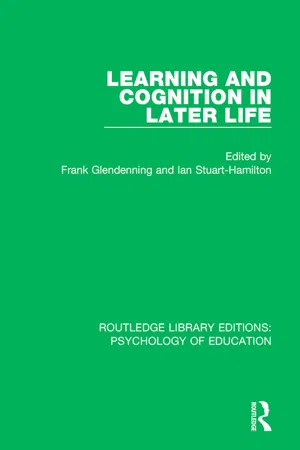
- 154 pages
- English
- ePUB (mobile friendly)
- Available on iOS & Android
eBook - ePub
Learning and Cognition in Later Life
About this book
Information
1 Changing perspectives on ageing and intelligence
Frank Glendenning
I was able to go to the Christmas Party being given by the Labour peers. As I walked in I saw, sitting on the left, the ghastly living corpse of Attlee, now virtually stone deaf and almost inarticulate. Patricia Llewelyn-Davies said to me, “Do go and talk to the old man. He wants company”. I had to say to her, “I’m sorry, I can’t face it. He always hated me and now I hate him”. I’m afraid I walked the other way.
It is nearly twenty years since I heard this quotation from the political diaries of R.H.S. Crossman in a lecture given in London by the psychologist D.B. Bromley (1976, p.54). It is a powerful reminder that not everyone would admit so openly to their feelings about old people as Crossman did. But such a reaction is by no means unique. There are many widely held stereotypes of older people. Norman (1987), for example, discusses words like ‘senile’, ‘crumbly’, ‘wrinkly’, ‘gaga’ and even ‘geriatric’, pointing out that we do not call a sick child a ‘paediatric’, or a woman who has just had a hysterectomy, an ‘obstetric’. She goes on to say that we regard old people as being in danger from hypothermia or social isolation because they are old – not because they do not have sufficient income to heat or repair their house, or to pay for a taxi or a telephone. Instead they are seen to be pathetic objects of charity.
Sidney Jones, who began in earnest the British national debate about ‘Education for the Elderly’ nearly twenty years ago, wrote in one of his early papers on the subject:
We learn to be old. We observe our parents, our grandparents, and others of the age-group. We acquire the stereotype from literature, from film and from the stage. Above all there comes a time when we are treated differently by the young. We learn the myths and we are taught what it is to be old. The garb, the ways of behaving, the outlook, the occupations, the leisure pursuits, our sexual behaviour: all are expected to conform to a role which constrains and sometimes determines behaviour. So effective is the learning and the role performance that we actually feel more comfortable in fitting the niche created for us; revolt is rare … It can be a prison house for the old. The stereotype of the old is pernicious but very effective because it permeates the self-image of the older person [whose] needs and demands are diminished at the source: himself (Jones, 1976, p. 9).
Myths and stereotypes
Over very many years, a series of myths about older people developed which Robert Butler (1969) has defined as ‘ageism’ and ‘a process of systematic stereotyping of and discrimination against people because they are old’ (Butler, 1975).
Prejudice against older people begins already in childhood and is an attempt by younger generations to shield themselves from the fact of their own eventual aging and death and to avoid having to deal with the social and economic problems of increasing numbers of older people. It provides a rationalisation for pushing older people out of the job market without spending much thought on what will happen to them when they are no longer allowed to work (Butler and Lewis, 1982, p.176).
Butler’s myths include (1) the myth of unproductivity (but substantial numbers of people become unusually creative for the first time in old age); (2) the myth of disengagement (the perpetuation of the theory by Cumming and Henry (1961) that older people prefer to disengage from life); disengagement is only one reaction to old age, even though ***Bromley regarded it as synonymous with retirement in the 1966 edition of his text on the psychology of ageing, a position revised considerably in the 1988 edition; (3) the myth of inflexibility (which has more to do with character formation than ageing); (4) the myth of senility (which stresses mental decline, forgetfulness and confusion), often confuses brain damage with mental problems and emotional concerns in later life; (5) the myth of serenity which portrays old age as an adult fairyland. (With retirement comes peace, relaxation and serenity – a view which Butler as a psychiatrist denies, observing that older people experience more stresses than any other age group: depression, anxiety, anger, chronic discomfort, grief, isolation and lowered self-esteem (Butler, 1975, p.10).
The violence of these myths and stereotypes is mirrored in this sentence by Alex Comfort:
Ageism is the notion that people cease to be people, cease to be the same people, or become people of a distinct and inferior kind, by virtue of having lived a specified number of years.
Hepworth wrote eleven years later:
Whilst on the one hand we think of elderly people as men and women who should be treated with respect and concern, on the other we think of growing old as an unpleasant fact of life to be avoided or hidden for as long as humanly possible (Hepworth, 1988, p. 4).
Not surprisingly then, in recent years, a few commentators have been turning their attention to the history of old age (Graebner, 1980; Phillipson, 1982; Fennell, Phillipson and Evers, 1988).
The history of old age
Phillipson, in his rigorous study of the emergence of retirement (1978, 1982) has drawn attention to a number of economic factors that have led to negative attitudes towards old age: the fear of impoverishment in old age; periods of famine where older people have been regarded in societies which were dependent on human labour power as ‘an unproductive element’; country labourers fearing eviction from their tied cottages when they were regarded by their employers as too old to work; poverty within the family which might lead to the withdrawal of help from the old person and in the years gone by, driving them to the workhouse. It is not difficult to understand why expectations about retirement from full-time paid work were low.
Indeed, it was axiomatic right up to the second world war that most people would want to stay at work until they could no longer perform what was required of them. Phillipson quotes from Hansard part of Lloyd George’s speech in the parliamentary debate on the Old Age Pensions Bill in 1908, when George, in discussing whether the pension should be given at 70 or 65, argued in favour of 65, saying that between 65 and 70, the test for continued employment was to be ‘infirmity’.
I think when we come to deal, as I hope we will in the near future, with the problem of infirmity, that will be the time to consider the question of the broken down old man of 67 or 68 who is left to charity (Phillipson, 1978, p.15).
Phillipson points out that at the time 606 out of every 1,000 men over sixty-five were still working and of the term ‘broken down old man’, he commented:
Its accuracy for elderly men, after a life-time of labour in a harsh industrial and social environment, and with varying standards of nutrition, cannot be under-estimated. But the fact that the problem is put just in terms of men is significant, ignoring the point that it is women who live longest, and who are likely to directly experience old age; and the term itself is important, reflecting as it does a historical tradition of identifying the retired working class elderly as useless, worn out and unemployable – to be grouped with the infirm and feeble-minded as a category in social policy (Phillipson, 1978, p.15).
The stereotype of old age as ‘enfeeblement’ was therefore established. After the second world war and into the 1950s, the employment and economic situations were such that older workers were encouraged to remain in employment when they reached the age of 60 or 65. But Sheldon (1948) was already issuing pessimistic warnings that retirement was detrimental to health. This could not be proved, and although accepted anecdotally nearly fifty years later, it has not been the subject of a major scientific study. Enfeeblement and pessimism joined the constant spectre of poverty in old age, which was a fearful expectation for very many people throughout the century. The reason for this fear is epitomised in the state retirement pension itself which has steadily reduced as a proportion of average male earning since 1979, when it became related to increase in prices rather than earnings, and in 1992 for a single person was equivalent to 17.8 per cent of average male earnings (Oppenheim, 1993, p.69). Since 1986, there has been a noticeable increase in occupational pensions, but nevertheless, over one and a half million pensioners claimed the means-tested Income Support in 1989–90 and a further approximately 0.9 million did not claim at all (Family Policy Studies Centre, 1991, p. 11).
When a research interest in social gerontology began to emerge in the 1940s and 1950s, against this background of enfeeblement, pessimism and anticipated poverty, the orientation was to uncover the potential problems and dangers connected with an ageing population. To achieve their aim of alerting members of society to the coming demographic changes, the researchers wrote of the ‘burden’, the ‘dangers’, the ‘anxieties’ of retirement.
The most powerful image of the elderly which emerged was of large numbers of people dying a slow death in their armchairs, utterly disorientated by an embarrassing surfeit of leisure time (Phillipson, 1978, p.28).
These images were not dissimilar from those emanating from industrial psychologists in America. Graebner cites Professor Cherington of Harvard Graduate School of Business Administration (1936) as saying that with the approach of middle age ‘could be observed … such qualities as lack of adaptability, devotion to routine, reluctance to adventure, chronic impatience and rigidity’. ‘The point was clear’, wrote Graebner, ‘Concentrate on the young, for the old are beyond redemption’ (Graebner, 1980, p.34). From the mid–1920s retirement in America came to be seen as the antidote to unemployment of younger workers.
In all the advanced or capitalist industrial societies, throughout the twentieth century, retirement has been regarded by employers and trade unions with ambivalence. Phillipson (1978), Graebner (1980), and Fennell, Phillipson and Evers (1988), provide ample evidence that retirement was seen at different times and in different countries throughout the century as the device to deal with the long-term unemployment of middle-aged and younger workers. The rhetoric swings and changes from generation to generation. Certainly by the 1960s, we were seeing in Britain that old age was simply not just a social construction which was formed as a result of demographic changes, and economic and employment patterns. Old people themselves were beginning to speak up through oral historians, and through health service personnel who had begun to specialise in work with elderly people.
There was to be a growing movement emphasising the positive benefits of increased life expectancy, although the emphasis on the biomedical model of old age encouraged the general feeling that after retirement, life was a matter of inevitable decline. In the training of both social workers and health service personnel from doctors to health visitors, little opportunity was given to consider the context within which older people were living, very many of them being in structured dependence and dependent on the ‘welfare mentality’ of late twentieth century post-industrial society.
Regrettably, the effect of all this was to construct a situation where age discrimination became normative. It affected institutions, organisations, industry, employment, education, language, the written word, appointments and the judgement of individuals. Why will the vast majority of employers not employ older workers? Why should a person over 62 in Britain not be able to become a non-executive member of a National Health Service Trust? Why may a British magistrate not continue on the Bench beyond 70 years of age? Older people are clearly restrained and even persecuted. There is no statutory obligation to end or refrain from age discrimination. In Britain there is the Race Relations Act, which commits British society to racial equality. There is also Equal Opportunities legislation but there are no statutory safeguards against age discrimination. It is essential in the future that we should move speedily in Britain towards the recognition of competence rather than chronological age.
Images and reality
During the last decade and more, Featherstone and Hepworth have been pre-eminent in Britain in uncovering the images of ageing in popular culture, and testing out the tensions between images and social realities. In one of their recent papers (1993), they observe the stereotypes of ageing as being ‘a symbolic stigmatisation which finds its way through to practical everyday action thereby giving meaning (in this example a negative meaning) to the experience of growing old’. There is tension in the experience of growing old itself. Chronological age is by no means an accurate guide as to how an ageing person perceives themself. Puner, for example cites the author J.B. Priestley, at the age of 79 and provides a good example of the power of the ageist stereotype:
It is as though walking down Shaftesbury Avenue as a fairly young man, I was suddenly kidnapped, rushed into a theatre and made to don the grey hair, the wrinkles and the otherattributes of age, then wheeled on-stage. Behind the appearance of age I am the same person, with the same thoughts, as when I was younger (Puner, 1978, p.7).
In the view of Featherstone and Hepworth, such physical features are:
a gradual masking of the individual’s personal sense of true personal identity which is increasingly concealed and more difficult to express as time passes (Featherstone and Hepworth, 1993, p. 310).
As an example of this, they cite a vignette from Barbara Macdonald’s Look me in the Eye, which relates the experience of Macdonald’s younger friend, Cynthia Rich:
It is I who receive the eye contact; questions are less often addressed to her. When we go to a hardware store and Barbara asks about something, the man behind the counter looks at me when he responds (Macdonald, 1984, p.11).
They also remind us that the source of reverence for older people in pre-industrial Britain appears to have been wealth and power and add
With diminished resources of physical strength, money and social influence, the ageing process left many who survived into old age totally dependent on the goodwill and charity of family or neighbours (Featherstone and Hepworth, 1993, p. 318).
They quote numerous historians (Thomas, 1976; Laslett, 1977; Macfarlane, 1986) who in recent years have come to acknowledge that the most noteworthy feature of traditional images of ageing in Britain was lack of reverence for frail and elderly people, which is epitomised in an ambivalence towards ageing and death (Kastenbaum, 1974). Death in pre-industrial society was much more taken for granted than in modern society where, as Aries (1981) in his monumental study of death suggests, it tends to be medicalised, hospitalised and hidden from public view.
With increasing numbers of old people, the association of death with old age and very old age is inevitable, but in recent years there has been a radical change of view on the part of many old people themselves. With increased life expectancy, very many are remaining healthy and active longer. Although a very considerable number of retired people require Income Support in addition to their state pension in order to keep themselves away from the poverty line, there is also a considerable number who have sufficient income to continue to lead a life of comfort. When these changes are linked to the increasing consumerism targeted at elderly people who are comfortably off (travel, leisure wear, activities, health foods, hou...
Table of contents
- Cover
- Half Title
- Title Page
- Copyright Page
- Dedication
- Table of Contents
- List of contributors
- Acknowledgements
- Introduction
- 1. Changing perspectives on ageing and intelligence
- 2. Problems with the assessment of intellectual change in elderly people
- 3. Ageing and wisdom
- 4. Memory changes in older people
- 5. Learning aptitude in later life
- 6. Some concluding comments
- Bibliography
- Index
Trusted by 375,005 students
Access to over 1.5 million titles for a fair monthly price.
Study more efficiently using our study tools.
Frequently asked questions
Yes, you can cancel anytime from the Subscription tab in your account settings on the Perlego website. Your subscription will stay active until the end of your current billing period. Learn how to cancel your subscription
No, books cannot be downloaded as external files, such as PDFs, for use outside of Perlego. However, you can download books within the Perlego app for offline reading on mobile or tablet. Learn how to download books offline
Perlego offers two plans: Essential and Complete
- Essential is ideal for learners and professionals who enjoy exploring a wide range of subjects. Access the Essential Library with 800,000+ trusted titles and best-sellers across business, personal growth, and the humanities. Includes unlimited reading time and Standard Read Aloud voice.
- Complete: Perfect for advanced learners and researchers needing full, unrestricted access. Unlock 1.5M+ books across hundreds of subjects, including academic and specialized titles. The Complete Plan also includes advanced features like Premium Read Aloud and Research Assistant.
We are an online textbook subscription service, where you can get access to an entire online library for less than the price of a single book per month. With over 1.5 million books across 990+ topics, we’ve got you covered! Learn about our mission
Look out for the read-aloud symbol on your next book to see if you can listen to it. The read-aloud tool reads text aloud for you, highlighting the text as it is being read. You can pause it, speed it up and slow it down. Learn more about Read Aloud
Yes! You can use the Perlego app on both iOS and Android devices to read anytime, anywhere — even offline. Perfect for commutes or when you’re on the go.
Please note we cannot support devices running on iOS 13 and Android 7 or earlier. Learn more about using the app
Please note we cannot support devices running on iOS 13 and Android 7 or earlier. Learn more about using the app
Yes, you can access Learning and Cognition in Later Life by Frank Glendenning,Ian Stuart-Hamilton in PDF and/or ePUB format, as well as other popular books in Psychology & Cognitive Psychology & Cognition. We have over 1.5 million books available in our catalogue for you to explore.