![]()
[1]
Intelligence
Intelligence is often confused with learning, thinking, problem solving, concept formation, attainment and achievement. It is none of these but it affects them all in a positive way, i.e. it improves performance. This concept has caused considerable controversy in recent years and there are two main reasons for this: firstly intelligence is thought to be connected with achievement and is therefore of importance in our society and educational system; and, secondly, some people are thought to be more intelligent than others. Such an, apparently, unequally distributed yet desirable attribute is naturally of interest to people concerned with individual development.
1 The concept of intelligence
There are many definitions of intelligence which do not say what it is but point to the results of having it. Thus a certain level of performance is taken as evidence of a person possessing this quality to a greater or lesser extent than others. Such an approach was characterized by Karl Popper (1945) as methodological nominalism:
Instead of aiming at finding out what a thing really is, and at defining its true nature, methodological nominalism aims at describing how a thing behaves in various circumstances, and especially, whether there are any regularities in its behaviour. In other words, methodological nominalism sees the aim of science in the description of the things and events of our experience, and in an ‘explanation’ of these events, i.e. their description with the help of universal laws. The methodological nominalist will never think that a question like ‘what is energy?’ or ‘what is movement?’ or ‘what is an atom?’ is an important question for physics; but he will attach importance to a question like: ‘How can the energy of the sun be made useful?’ or ‘How does a planet move?’ or ‘Under what conditions does an atom radiate light?’
Popper contrasted this with methodological essentialism: ‘… the view, held by Plato and many of his followers, that it is the task of pure knowledge or “science” to discover and describe the true nature of things, i.e. their hidden reality or essence … and a description of the essence of a thing they all called a “definition″.’
Considerable confusion has been caused by nominalist descriptions of intelligence masquerading as essentialist definitions. However, views of intelligence can be divided roughly into three: first, ‘intelligence as product’; second, ‘intelligence as process’; and third, ‘intelligence as judgement’.
1.1 Intelligence as product (F. Galton, A. Binet, C. Burt)
To see ‘intelligence’ as a name given to the product of an intelligence test is, historically, the most accurate view, as Cyril Burt (1968) reminds us: ‘″Intelligence” was from the very outset a technical term used by erudite specialists; and it is only during the last 60 years or so, since its adoption by a small group of psychologists that it has filtered through into everyday parlance.’ Three early specialists who were particularly significant for the development of the psychometric concept of intelligence were Francis Galton, Alfred Binet and Cyril Burt.
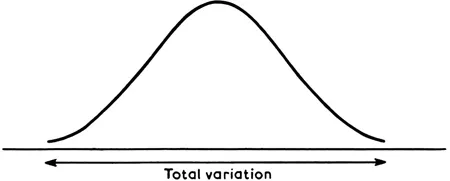
Although it is often said today that all children are born with the same intelligence, this idea is relatively recent as Galton’s (1870) original thinking was based on the statistical assumption that mental capacity would be ‘normally distributed’. In 1849 an English translation of Quetelet’s Letters on Probability was published in which Quetelet showed that the height of 100,000 French conscripts was normally distributed, i.e. a few were very short, a few very tall, and the majority fell between these two extremes. Diagrammatically this normal distribution can be expressed by the bell-shaped Gaussian Curve (Fig. 1.1).
Galton (1870) therefore argued that:
… if this is the case with stature, then it will be true as regards every other physical feature – as circumference of head, size of brain, weight of grey matter, number of brain fibres, etc. and thence, by a step on which no physiologist will hesitate, as regards mental capacity.
Fig. 1.1 A normal curve
Thus the notion of inequality between individuals was built into the original formulation of the concept of ‘mental capacity’.
Galton next became concerned with the mental resources of the nation. Writing to a friend, he said: ‘You are wondering what amount of coal the nation possesses and where it lies; I am wondering what mental abilities we possess and where it is to be found.’ In 1902 he persuaded the anthropological section of the British Association to finance a survey of Britain which would include mental as well as physical characteristics and be carried out through the schools. Burt was one of those who were asked to devise a set of tests to be used in this survey. Therefore the first intelligence tests arose in a context in which mental ability was thought of as something which was normally distributed, like height and weight, and the function of the tests was to measure individual variations in this trait.
Meanwhile, in France, Alfred Binet was also concerned with individual differences. Having studied his own two daughters, he was particularly interested in the nature of thought. Indeed his idea of intelligence, particularly in his early work, was closely linked with thought. Reeves (1965) points out that Binet had taken the term ‘intelligence’ directly from Taine’s D’Intelligence: ‘… for Taine “l’intelligence” meant thinking, but explained in terms of the patterning and re-patterning of images derived from sensory experience.’
Binet however was not so much concerned with intelligence in the normal population as with separating out those who were educationally retarded, and then subdividing this retarded group into the subnormal and the educationally deprived. In 1905 Binet, together with his co-worker, Simon, published the results of the testing which they had been doing in the schools since, in Binet’s case, 1894. They had used many types of tests but ultimately retained only those items which discriminated between bright and dull children. These tests were entirely empirical in that Binet watched the children and used their behaviour as his guide in item selection. It is largely due to the context within which Binet worked that ‘intelligence’ is now thought of as being exhibited in certain characteristic situations. Since in the Parisian schools in 1900 the instruction was academic and authoritarian, Binet’s primary criterion for item selection was whether the children who passed certain items were seen to be successful in this rather narrow context.
The 1905 scale arranged all the items in order of difficulty and the child worked through until he could do no more, but in the 1908 revision the items were grouped according to age. In any group 60 to 75 per cent of the mental age group were expected to be able to perform the tasks. Binet then compared the child’s mental age with his chronological age and if the latter was more than two years behind the former this was regarded as ‘a serious deficiency’. This original scale has since been revised and improved, notably by the Americans, Termain and Merrill. Today, the revised scale, called the Stanford–Binet Intelligence Scale, is one of the best known measures of intelligence.
Sir Cyril Burt has been one of the most influential figures in Britain in the area of intelligence testing and, it is worth considering how views on the nature of psychology and on the concept of intelligence have changed since the time of his early work. When he submitted his first article to the new British Journal of Psychology, the editor, Ward, did not wish to print, ‘so lengthy an article based merely on experimental or statistical research’ and wrote to Burt regretting that he had, ‘devoted so much time and industry to a transient problem, like mental testing, which holds so little promise for the future’. Today psychologists attempt to express their findings in quantitative terms but at that time Burt’s statistics, which accompanied the article, were initially relegated to an appendix and subsequently left out of the published version.
Burt studied classics at Oxford but took psychology as a special subject in finals after which he did postgraduate work and set up an informal child guidance centre where he and Keating tested backward and delinquent children. In 1907 he went to Liverpool where he started a new course of psychology for medical students and prospective teachers. In order to get more information on the children he had to deal with he lived in the Nile Street settlement. At this time there was growing dissatisfaction with the way in which doctors were certifying mentally defective school children. Burt quotes the following description as being typical of the methods used: ‘The pupils are drawn up in ranks, in standards, i.e. class or grade at a time … The trained observer can then read off the physiognomy of the individual’s features and other bodily parts, as quickly as a printed book’ (Warner, 1890). As a result of this dissatisfaction, and of pressure from professional bodies, the London County Council decided to employ an education psychologist for an experimental three-year period. Burt was chosen and he tells how the Scottish Sir Robert Blair, chief education officer, gave him his blessing with the words: ‘Young man, ye’re the fust official psychologist in the wurrld, and ye’ve all London at yer feet! Now come back in a week and tell me what ye’re going to do.’
What Burt did was to instigate the large scale testing of pupils and open the schools to research students. He carried out over thirty extensive investigations in the next fifteen years. Once again he sought field experience by living in a settlement near Euston and staying with ‘a docker in Stepney, a coster in Kennington, and a burglar in a back street off the Seven Sisters Road’ (Burt, 1952) in order to learn more of the background of his pupils. Later he managed to infiltrate a criminal gang to follow up delinquents he had studied. He felt this field work to be especially important, remarking: ‘Nowadays it is so often forgotten that to appreciate the cultural outlook of the child you are studying you must yourself have shared it.’ As early as 1910 he had started to prepare a revision of the Binet–Simon Intelligence Scale and after the war he concentrated on constructing standardized age norms and developing group and performance tests. At this time he combined the case study and statistical approach, working on the assumption that intelligence was ‘an innate, general, cognitive ability’.
One result of the researches of these early workers was to establish the psychometric concept of intelligence, i.e. intelligence was seen as something which could be measured. This gave rise to the operational definition of intelligence as ‘what the tests test’. An operational definition is akin to Popper’s nominalist description in that it defines scientific concepts in terms of physical operations (thus acid is any substance that turns blue litmus paper red). The fact that Galton, Binet and Burt all worked within an educational setting of a particular kind has meant that their tests are tests of a specific set of behaviours and it is therefore unwise to extrapolate from such findings to more general behaviour.
1.2 Intelligence as possession (C. E. Spearman, L. L. Thurstone, J. P. Guilford)
It is perhaps unfortunate that the notion of intelligence as a ‘product’ became transformed into that of a ‘possession’. Intelligence is often spoken of as if it were similar to height or weight, not just a quality which can be measured in the same way. People are therefore thought to have a fixed intelligence waiting to be assessed, as if it were a mental secretion or something the brain ‘had’ in the way blood has red corpuscles.
If this approach is accepted too uncritically it is very easy to confuse intelligence with attainment, achievement, or even, ability. Although it can affect all of these it should not be thought to be interchangeable with any. An example may make this clearer: Two pupils sit ‘A’ levels, both have identical motivation, John has an IQ of 130 and gets an A in Chemistry, an A in Physics and a C in German. Jane has an IQ of 11o and gets a C in French, a C in German and an E in Physics. Both pupils have attained ‘A’ level standard, both pupils have achieved the level they required. John appears to have more scientific than linguistic ability, Jane the reverse. But John is more intelligent than Jane and therefore, as they have equal motivation, his final scores exceed hers.
How has this confusion of intelligence with ability, in particular, arisen? To answer this it is necessary to take a brief look at the statistical background. The statistical technique of factor analysis is often applied to test scores. This is a technique based on correlation. Two scores, or sets of scores, are said to be correlated if they co-vary, i.e. if A increases when B increases or A decreases when B increases; in the former case the correlation would be positive in the latter negative (Table 1.1).
Table 1.1 Correlation patterns
| | Perfect positive | Perfect negative |
| | test A | test B | test A | test B |
| Child 1 | 70 | 70 | 70 | 30 |
| Child 2 | 65 | 65 | 60 | 40 |
| Child 3 | 60 | 60 | 50 | 50 |
| Child 4 | 55 | 55 | 40 | 60 |
| Child 5 | 50 | 50 | 30 | 70 |
The correlation obtained expresses the closeness of fit between two sets of measures. A high correlation can be illustrated if we think of scores as two dancers who may either move side by side (positive correlation) or, as in ballroom dancing, face to face, so that one advances whilst the other retreats (negative correlation). The important point is that they move together and it is this mutual relationship which a correlation expresses. A correlation of ‘0’ means that there is no correlation; a correlation of +0.1 to +1.00 expresses varying degrees of positive correlation and a correlation of -0.1 to -1.00 expresses varying degrees of negative correlation; in both cases the higher the figure the closer the correlation.
If we have an array of test scores some tests in the battery correlate more highly with each other than with other tests; i.e. more people who score high on test B score high on tests E, F and G. If we ask what does test B have in common with tests E, F and G to result in this similarity an answer can be arrived at by the technique of factor analysis. This breaks down the components which compose the final score, and shows if any of these components are common to several tests. These components are called factors. Therefore a factor is something which both accounts for part of the score in an individual test and links this individual test with others which have this same factor as part of their score.
If scores on...