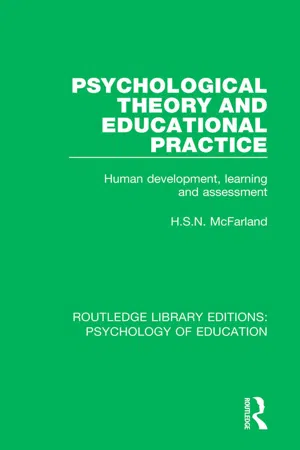
Originally published in 1971, this book was a critical introduction to the psychology of human development, learning and assessment. It was written with special attention to the needs of students of education and teachers, keeping in view the practical implications of psychological evidence. The author's purpose was to provide a clear and straightforward account of these matters, while at the same time promoting a thoughtful and critical response. If the book is to be called a textbook, it is so in this best sense.
eBook - ePub
Psychological Theory and Educational Practice
Human Development, Learning and Assessment
- 338 pages
- English
- ePUB (mobile friendly)
- Available on iOS & Android
eBook - ePub
Psychological Theory and Educational Practice
Human Development, Learning and Assessment
About this book
Information
Psychology and education | 1 |
There are two extreme views of the relationship between psychology and education. One views psychology optimistically as a kind of dispensary handing out specific psychological remedies for sundry educational ills, if not a universal panacea. The other view is the pessimistic one. Psychology has to do with artificial situations in laboratories, with rats and machines rather than human beings, and, therefore, is irrelevant to the practical world of education. A more accurate assessment of the relationship lies somewhere between these extremes and it will be the business of this chapter to try and make such an assessment. This is important both in itself as a step towards clarifying fundamental questions and for the better understanding of subsequent chapters dealing with particular areas of educational psychology.
Teachers, parents and administrators
Since teachers are the main users of educational psychology, it is justifiable to look first at the problems that confront them. In doing so one remembers that there are other groups of educators—parents, administrators, or counsellors, for example—who have their own interests in psychology. But we shall take teachers first and divide them into student teachers and experienced teachers. Student teachers are typically concerned with certain immediate practical problems, such as how to maintain or restore order in a class of pupils, how to organize a lesson or other section of school work so that it fits both the available time and the capacities of the learners, how to create and sustain interest and activity in learning, how to organize work so that there is cumulative learning over longer periods of time, how to deal with typically diverse rates of learning, and particularly with slow learners, how to reconcile their own ideas about tasks and methods with the human, organizational and physical constraints of particular schools, and, generally, how to sustain and develop their self-esteem in relation to a professional task that can be extremely demanding in personal terms.
Experienced teachers mostly lose the earlier anxieties of the student teacher. They do not expect to fall off the bicycle. Having fairly complete responsibility for a job helps one to make a job of it. Increasing practice in specific skills (class control, work organization, use of suitable and interesting material, etc.) helps to make these skills more fluent and effective. Relative or complete acceptance of the assumptions and supporting social apparatus of a particular school diminishes the areas of doubt about what one’s assumptions ought to be and about the means there may be to uphold them. Student teachers may have greater doubts because of their relative inexperience and because their tutors properly encourage them to spend part of their time in critical doubt about some established practices. Experienced teachers can give and receive satisfaction by conforming to a clearly established norm within a particular school, whereas student teachers must to some extent confront detailed appraisal against ideal norms.
These models of the student teacher and experienced teacher are, of course, only first approximations. Pursuing the bicycle-riding analogy, one recognizes that some teachers keep on wobbling for a long time, just as some student teachers are immediate candidates for the Tour de France. But, generally, experience of the right kind does count, and the experienced teacher, if he looks to psychology for help, is not looking for solutions to elementary problems. Once he knows that he can work within a particular scholastic mould he may begin to consider how the mould itself could be improved. Once he can teach his children and his subject competently he may want to excel rather than just be adequate. He may want to relate his particular classwork more fully to the broader educational achievement of the school community, or to the social community outside the school. He may come against new practical problems for which he has had no special preparation—serious scholastic backwardness; alarming delinquency; radical innovations in curriculum, method, or examinations; reorganization of the school system itself. These professional challenges throw a teacher back to first principles, including his whole conception of the psychology of children and their learning.
Teachers typically have to deal with children in relatively small groups—thirty or forty at a time, or smaller groups still. Sometimes, as in primary schools, they spend most of the time with one group. Sometimes, as in secondary schools, they may spend rather limited periods with a greater number of groups. One can contrast these situations with that of parents on the one hand and educational administrators on the other. Parents naturally concentrate their educational and psychological attention on their own few darlings. Administrators must, in justice, try to act in the interests of very large numbers of individuals. These different and understandable circumstances may suggest why different people look for different kinds of educational help from psychology. Parents can reasonably be expected to take an interest in the idiosyncrasies of individual psychology, while the administrator may be more professionally interested in techniques of assessing, guiding and providing for whole categories of children, including some with very special needs, such as the physically, intellectually, emotionally or socially handicapped. Teachers occupy an intermediate position. They try to treat children as individuals, but they cannot be parents (except to their own offspring, of course). They share the administrator’s concern with just categorization and guidance but probably repudiate the apparent impersonality of administrative justice. These varying orientations may be relevant to some of the conflicting emphases that can be detected in attitudes towards the psychology of education.
Educational administrators are largely responsible, within politically determined policies, for the material and major organizational equipment of the educational system, for its different kinds of schools, different special and ancillary institutions and services, and different development programmes. Psychological considerations are only one set among many—political, economic, social, religious, historical, etc.—that must enter into the administrator’s calculations, but they sometimes have particular importance. Psychological evidence and techniques played a vital part in the pattern of English secondary schooling between (roughly speaking) 1930 and 1960, just as newer psychological evidence has been used to support different patterns in more recent times. Psychological evidence and techniques have been essential in defining various categories of intellectual and emotional handicap, in identifying individuals apparently coming within the categories, and in developing suitable educational treatments. The psychological measurement movement has made administrators, as well as teachers, more critically aware of how to use and interpret examination marks, test results, individual reports and personal information: none of this in the simplistic sense of ‘Psychology tells us …’, but in the sense that psychological evidence, techniques and criteria have been part of the basis for educational decision and action.
Enough has now been said to illustrate the situations of those, particularly teachers, who are professionally interested in educational applications of psychology. The next chapter will look at the psychological aspect of the teacher’s role in more detail. What matters in this chapter is to establish the teacher’s understandable concern with practicalities, that is, with techniques for solving specific current problems, preferably without delay, and in the context of things as they are, not as they might be if painful, laborious or expensive changes were made. There is some tendency to put a low estimation on what is called ‘theory’ (even if there is also reluctance to recognize the different uses of this word and their different implications). The ‘theory’ problem will be taken up again later. What can be seen now is the need to analyse this gap that is commonly felt between the educational problem and the psychologist’s contribution to its solution.
The educator’s viewpoint—some problems
The problem arises from the fact that there is only a partial overlap between the kind of interest taken in human behaviour by an educator and that taken by a psychologist. Some psychologists in virtue of their jobs are particularly interested in the applications of psychology, but these applications may be limited to special areas. Academic psychologists are not primarily or even at all concerned with applications but with developing scientific explanations of observed behaviour. What constitutes a scientific explanation will be discussed shortly, but the main criterion is not immediate practical utility. Educators, on the other hand, are primarily interested in initiating people, and particularly young people, into the values and skills which adult society wishes to perpetuate or foster. This poses two different kinds of problem. The first is to decide what values and skills ought to be instilled. This is a question of aims and purposes and cannot be answered by psychology, even if it would be folly to disregard psychological fact in the process of deciding what values to pursue. The second problem is to decide the best ways of instilling whatever values and skills ought to be instilled. Here psychology might have more legitimate advice to offer, although actual psychologists vary considerably in the caution or rashness with which they offer it.
The facts that psychology is only marginally relevant to the problem of deciding one’s educational values and purposes, and that even legitimate applications of psychology are a secondary interest of the psychologist as scientist, are not the only obstacles to a facile marriage between education and psychology. A third difficulty can be expounded via an analogy with maps. Anyone who has tried to find his way on foot or by car with the aid of maps knows that there are many snags en route. Many of the detailed problems can be paralleled in attempts to educate children with the aid of psychological maps. From what point of view is one looking? Is the available map just a rough sketch or done accurately to scale? Is it a large-scale representation of a small area or the other way round, or something in between? How professionally competent was the map-maker and how old is the map? Was the map simplified for unsophisticated users or drawn with some particular bias—economic, political, or any other—which may not coincide with the bias of the user’s interest? Then there are problems about the user. How intelligent, experienced or conscientious a map-reader is he? And problems about the changing face of the landscape—new roads and buildings since the map was made, old landmarks obliterated, periodical fogs that remove convenient clues, changing seasons that make the same scene radically different in appearance. Briefly, there is no reason to expect that psychology, any more than maps, should give sure and detailed guidance unless much effort goes into studying and interpreting it. The landscape of human behaviour is certainly no less complex than the landscape of geography.
A fourth difficulty arises from the way social and educational decisions are made. Even if psychology offers clear and sound guidance on some educational matter and the decision-makers understand the relevant psychology perfectly clearly, there are further factors that enter into the situation. Many decisions must be complex compromises, not mathematical solutions to clear problems; attempts to minimize worst consequences rather than bring about the unqualified best. Simon (1964) opposes the view that decisions are simply a matter of pursuing an obvious route to a specified goal with the suggestion that ‘it is easier, and clearer, to view decisions as being concerned with discovering courses of action that satisfy a whole set of constraints’. Peston (1969) expresses a similar line of thought in terms which will strike a sympathetic chord in the minds of teachers:
The straightforward formulation of a problem, its analysis, and the bringing to bear of relevant evidence, all as careful preparation for the application of criteria of value are not the commonplaces of decision makers at any level of administration. Plunging in the dark, reacting to crisis, and making the best of overcommitment, are much more favoured activities.
This applies to the teacher, not just the administrator. Or one can say that every teacher is partly an administrator, establishing rules and patterns of organization within his classes, promulgating a constant stream of minor, occasionally major, decisions on their interpretation and implementation. Psychology, even once understood, must take its educational place among a complexity of other considerations. Here again psychologist and educator must tread somewhat divergent paths.
A fifth difficulty about the relationship between psychology and education is the false assumption frequently made that, because there is a name, Psychology of Education, there is some quite distinct branch of study corresponding to it which ought to be able particularly to emit answers to educational problems. Of course, if one looks at the assumption in a sufficiently loose kind of way, it is not utterly false. There is undoubtedly such a study which has helped to solve some specific educational problems. The point is that it is not ‘quite distinct’ from psychology in general. It is those parts of general psychology—the study of children’s development and behaviour, to give one example—which have relevance to educational problems. But those parts of psychology, as much as all other parts, depend on the chances of human purpose for their applications. They represent usable knowledge, but it is the users who must define what the uses will be and work out the practical details. Bridges must obey the laws of physics but it is engineers that design and build them. The maintenance and restoration of health must accord with the laws of physical science, but one consults a doctor, not a physicist. Even within the physical sciences themselves, the reported experiments and theories are mathematically neat and elegant for publication, but may surface from a sea of abortive experiments, untidy notes on envelopes, odd hunches in prepared minds, professional rivalries and so on. One has to work at translating the general into the particular, and vice versa.
A sixth difficulty, and the last that will be mentioned in the present context, is the problem of so-called intangibles. Perhaps this is really a by-product of the preceding difficulties. It is not surprising that many people should have difficulty in seeing their way through situations that are complex by their very nature. This being so, there is a strong temptation to retreat from the complexities and attribute significance to vague intangibles which are thought to influence what must happen in unanalysable ways. The danger of this is that present incapacity to understand something will be used to argue that the something cannot be understood, even should not be understood. This seems to be a pointless obscurantism. If it is believed that there is not even a chance of understanding, one had better remain silent. Of course, the tangible/intangible dichotomy has various possible meanings. Can the thing be observed or not? Identified or not? Specified in detail or not? Expressed in quantitative terms or not? In this series, any one question might be answered positively and yet the ensuing questions negatively. Not to want to persist through the series as far as possible is to want not to think. This can be defended, for mysteries sometimes generate a pleasurable emotion, but only as a self-indulgence.
It is clear that the educator must struggle with the problem of conflicting values, that he can use psychological help only as part of a much more complex operation, that he must expect to work hard at psychology in order to understand its true contribution to understanding, that he must develop the intellectual and practical skill of applying his psychological understanding appropriately and subtly, and that he must not be driven into the comforting, mildly exciting world of intangibles as a substitute for thinking hard about the intricacies of human behaviour. But it must not be imagined that the educator alone faces the difficulties of the partnership, and it is now time to look at the psychologist’s side of things.
The language of psychology
It is an almost irresistible convention of language to speak about the psychologist, the educator, the child, the anyone-else, although these species really contain a wide range of differing individuals. Many professional psychologists are as concerned as any teacher with working out practical solutions to immediate problems arising in the hurly-burly of everyday life. Like teachers these must strive with all the complexities already outlined, for they are called upon to recommend, decide, and act—not just explain in general terms. However, those psychologists whose job it is to teach psychology and to advance their subject by research tend to be less immediately concerned with detailed applications and more concerned with sustaining the image of psychology as a scientific discipline, sometimes in the teeth of scepticism among their colleagues in the physical sciences.
Given this strong and reasonable aspiration towards scientific status, it is understandable that psychologists should sometimes seem particularly eager to dissociate themselves from traditional associations that might impede their aim. This could be illustrated from many psychological texts. To select one arbitrarily as an example, Cattell (1965) puts literary and philosophical approaches to psychology firmly in their place:
Undoubtedly there are gems of scientific truth about personality, lying available in this literary approach, but there is no way—except through the fresh start of scientific research—to separate the living truths from the pasteboard shams.
He goes on to point out the defects of early clinical approaches to personality, with their undue stress on abnormalities and lack of a proper quantitative foundation. The quantitative and experimental approach of real sc...
Table of contents
- Cover
- Half Title
- Title page
- Copyright Page
- Table of Contents
- List of tables and figures
- Foreword and acknowledgments
- 1 Psychology and education
- 2 The adult as learner and teacher
- 3 The psychology of early childhood
- 4 The psychology of middle childhood
- 5 The psychology of adolescence
- 6 Learning and learning theory
- 7 Human learning: intelligence, remembering and motivation
- 8 Human learning: attitudes, systems and policies
- 9 Educational and psychological assessment
- 10 Assessment and guidance
- 11 Handicap and behaviour problems
- 12 Psychological theory and educational practice
- Bibliography
- Name Index
Trusted by 375,005 students
Access to over 1.5 million titles for a fair monthly price.
Study more efficiently using our study tools.
Frequently asked questions
Yes, you can cancel anytime from the Subscription tab in your account settings on the Perlego website. Your subscription will stay active until the end of your current billing period. Learn how to cancel your subscription
No, books cannot be downloaded as external files, such as PDFs, for use outside of Perlego. However, you can download books within the Perlego app for offline reading on mobile or tablet. Learn how to download books offline
Perlego offers two plans: Essential and Complete
- Essential is ideal for learners and professionals who enjoy exploring a wide range of subjects. Access the Essential Library with 800,000+ trusted titles and best-sellers across business, personal growth, and the humanities. Includes unlimited reading time and Standard Read Aloud voice.
- Complete: Perfect for advanced learners and researchers needing full, unrestricted access. Unlock 1.5M+ books across hundreds of subjects, including academic and specialized titles. The Complete Plan also includes advanced features like Premium Read Aloud and Research Assistant.
We are an online textbook subscription service, where you can get access to an entire online library for less than the price of a single book per month. With over 1.5 million books across 990+ topics, we’ve got you covered! Learn about our mission
Look out for the read-aloud symbol on your next book to see if you can listen to it. The read-aloud tool reads text aloud for you, highlighting the text as it is being read. You can pause it, speed it up and slow it down. Learn more about Read Aloud
Yes! You can use the Perlego app on both iOS and Android devices to read anytime, anywhere — even offline. Perfect for commutes or when you’re on the go.
Please note we cannot support devices running on iOS 13 and Android 7 or earlier. Learn more about using the app
Please note we cannot support devices running on iOS 13 and Android 7 or earlier. Learn more about using the app
Yes, you can access Psychological Theory and Educational Practice by H.S.N. McFarland in PDF and/or ePUB format, as well as other popular books in Education & Educational Psychology. We have over 1.5 million books available in our catalogue for you to explore.