- 734 pages
- English
- ePUB (mobile friendly)
- Available on iOS & Android
eBook - ePub
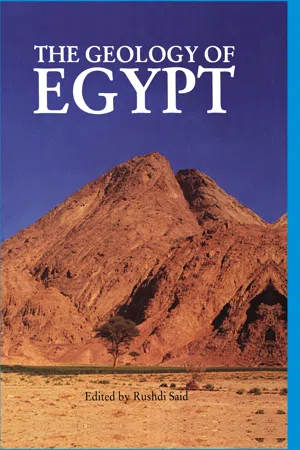
The Geology of Egypt
About this book
Scholars from Egypt, Germany and the US review and analyze the results of work carried out on the geology of Egypt: geomorphology and evolution of landscape, tectonics, geophysical regime, volcanicity, Precambrian geology, geologic history and paleogeography, paleontology of selected taxa, ore depos
Information
PART 1
General
CHAPTER 1
History of geological research
Rushdi Said
Consultant, Armandole, Virginia, USA and Cairo, Egypt
The published and unpublished literature on the geology of Egypt is extensive (for a bibliography, see Keldani 1939, Said & El-Shazly 1957, Said et al. 1975, Glenn & Denman 1980 and El-Baz 1984).
The history of geological research in Egypt may be divided into three episodes.
First Episode
The first episode, extending from the French Expedition (1798-1801) to the establishment of the Geological Survey of Egypt in 1896, was characterized by sporadic research conducted by individual naturalists and travellers, by commissioned scientists and, in rare instances, by expeditions organised by institutes of learning in Europe. Lured by the mineral wealth of the country or its ancient civilization, these authors collected a great variety of information on the natural history of the country, and wrote several travel books which recorded their findings.
In this episode Napoleon’s and Rholf’s expeditions are of special importance. The first was responsible for bringing Egypt to the attention of the scientists of Europe by the publication of the memorable Description de I’Egypte. This work includes in many of its volumes, and especially the second volume (published in 1813), several chapters that are of interest to geologists and mineralogists and contains the first reliable map of the Eastern Desert of Egypt. The collections of the expedition, which are housed in Paris, were the subject of further study up to the end of the last century. Savigny’s collection of Recent shells formed the basis of the magnificent work of Issel (1870) which still remains valid in its essence particularly in its discussion on the differentiation of the faunas of the Mediterranean and the Gulf of Suez.
Rholf’s expedition (1874-1875) must be singled out for its significant contribution to the geology of Egypt. Led by Rholf and joined by such able men as Jordon and Zittel and accompanied on occasions by Ascherson, this expedition laid down the foundation of modem Egyptian geology, in fact, the modem scientific survey of the country. Ascherson published the results of his botanical observations; Jordon wrote on the geography and meteorology of the Western Desert; and Zittel wrote his notable geological contributions which were published in 1883 together with paleontological studies by such authorities as Schenck, Fuchs, Mayer-Eymr, Schwager, de la Harpe, Quaas, Wanner, de Loriol, Pratz and others. This expedition also published the first reliable geological map of the extensive deserts of Egypt to the south of the latitude of Fayum (scale 1:300,000). In his work Zittel benefitted from earlier literature, particularly from the results of Schweinfurth’s studies which were used to complete the mapping of large tracts of the desert not surveyed by the expedition. This map remained the standard geological map of the country up to the publication of the Survey map of 1910. The divisions which Zittel made for the upper Cretaceous and lower Tertiary rocks of the Western Desert influenced subsequent authors. His conclusions on the distribution of Cenomanian strata in the northern part of the Eastern desert, which he had based on Schweinfurth’s studies, were accepted for a long time and, in fact, formed the basis of the Survey geological map of 1910 and that of 1928.
The most prominent scientist of this episode was Georg Schweinfurth (1836-1925) who started his brilliant career in Egypt with the publication of the work describing his visit to the remote Gebel Elba region (1864) and who continued until the outbreak of World War I to produce excellent papers on the geology, geography, archeology, cartography and botany of Egypt. He became the central figure in natural history research in Egypt for more than fifty years. He supplied European scholars with large collections of rocks and fossils and kept up a fruitful correspondence with many outstanding scientists such as Beyrich, Martens, Heer and Eck. He wrote the section on the geography of Egypt in Baedecker’s Aegypten. He was responsible for the discovery of the Wadi Araba Carboniferous (1885), the Sad El-Kafara dam in the desert of Helwan (1885), the Cretaceous region of Abu Roash (1889) and the fossil vertebrates of Fayum (1886). His pioneer visit to Gebel Elba resulted in the monograph on the geography and botany of this remote region. Schweinfurth’s wanderings off the beaten tracks of the Eastern Desert resulted in the publication of a detailed account of the central Eastern Desert with a map which was publishued in ten sheets between 1899 and 1910. Schweinfurth’s capacities as organiser were notable; he founded the Société géographique d’Egypte and was the president of the Institut d’Egypte for many years.
Among the scientists whose interest was aroused by Schweinfurth was Walther, the famous German geologist. Walther’s description of the Wadi Araba region (1890), the coral reefs of the Red Sea (1888), and the geomoiphology of desert lands embodied in his classic Das Gesetz der Wuestenbildung (1900) are among the notable works of this episode.
During this episode practically every eminent European scientist of the age contributed to the studies of Egyptian geology in some form or another. Fraas crossed the desert between Qift and Quseir (1867) and published a map and a ‘geognostic’ profile of this area. Ehrenberg, who accompanied Minutoli’s expedition to the oasis Jupiter Ammon in the twenties of the last century, reported in his classic Mikrogeologie on some rock collections he had made. D’Orbigny reported in his Paleontologie franpise upon Lefebvre’s collections in Paris. D’Archiac found Lefebvre’s, Gaillardot’s and Delanoue’s collections in Paris of value when he wrote his famous Histoire de Géologie and his and Haime’s Description des Animatafossiles du Group litique de l’Inde (1853). Greco and Stefanini studied in detail the collections of Figari which were housed in the museum of Florence.
Second Episode
The episode which extends from the establishment of the Geological Survey of Egypt in 1896 until the revolution of 1952 firmly laid down the foundations of the regional geology of Egypt. This episode culminated in the publication of the geological map of Egypt in 1928 and Hume’s Geology of Egypt (1925-1937).
The Geological Survey of Egypt was founded by H.G. Lyons and was staffed by competent men whose published memoirs still remain among the best and most authentic records on the geology of the surveyed regions. The history of the Geological Survey of Egypt from the date of its foundation until 1925 is given in Hume’s Geology of Egypt and from that date until 1971 in Said (1971). Among the early members of the Survey were Beadnell, Barron, Ball, Hume and Blanckenhom. Ferrar and Stewart joined the Survey in its early days. Fourtau, who had been active in Egyptian paleontology for years, finally joined the Survey as a paleontologist in 1911 and remained on its staff until his untimely death in 1920. Sadek joined the Survey in 1917 and gave his efforts mainly to the newly established Petroleum Research Board which was strengthened by the appointment of Madgwick and Moon in the same year. Sadek did not only distinguish himself as a brilliant scientist but was also instrumental in promoting geological studies in his executive capacities as Director of the Mines and Quarries department and later as a Cabinet Minister. Although primarily a geographer and surveyor, G.W. Murray’s numerous publications attest to his thorough familiarity with the physical and human aspects of the Egyptian deserts.
Several workers outside the survey contributed to the geological study of Egypt during this period. Among these mention must be made of Barthoux, the geologist of the Suez Canal Company. He discovered the Jurassic exposures at Maghara, north Sinai, and sent fossil material to Paris where it was studied by Douvillé (1916). Barthoux’s work on the Roches ignées du Desert arabique (1922) is a classic.
During this episode several eminent geologists visited the country. Of these mention must be made of Osborn, the famous vertebrate paleontologist, who collected with the assistance of the American Museum of Natural History, a large amount of the Fayum fossil vertebrates. Sandford and Ariceli, aided by funds from the Oriental Institute, Chicago University, made their valuable study on the Egyptian Pleistocene. Stromer von Reichenbach’s expeditions to the fossil vertebrate localities in the Western Desert and the upper Nile Valley resulted in a large number of classical publications on the subject.
From time to time the Geological Survey sent materials to be examined abroad. These made the subject of valuable papers. Andrews gave the descriptions of the Fayum fossil vertebrates; Bullen Newton identified many of the fossil invertebrates. Seward examined numerous fossil plants, and Chapman identified many foraminiferal species.
Although this episode of geological research resulted in the discovery of a large number of economically viable mineral deposits, there occurred a lull in geological activity in the latter part of this episode. The Geological Survey was relegated to a subsidiary position. Most of the contributions of these later years came from the universities which had been established during these years. Other contributions came from the oil sector which had seen an expansion in the thirties as a result of the promulgation of a new mining law encouraging oil exploration work. Almost the whole of the sedimentary area to the north of latitude 28°N was mapped to scales varying from 1:500,000 to 1:25,000 and occasionally to smaller scales. The area was completely covered by gravity survey and large parts were covered by magnetic and seismic surveys. A total footage of about 540,000 was drilled during this period. Although much of the information gathered by these oil companies was never synthesized in one major work, as had happened with the material of the earlier episode by Bowman (1925, 1926 and 1931), a great deal of the information filtered through the literature either in the form of papers or was abridged and included in relevant contributions.
Third Episode
The episode which extends from 1952 to the present was one of great expansion. Nineteen sixty two saw the publication of Said’s treatise on The Geology of Egypt (1962) in which an attempt was made to find some order in the large amount of information that had accumulated over the previous years by fitting it into a conceptual framework.
Between 1954 and 1976, the Geological Survey of Egypt conducted an aggressive program of exploration for economic mineral deposits which were sought for the fulfillment of the five-year industrialization plan of the country. The survey underwent great changes during this period. The scale and urgency of the operation forced an enormous expansion. The number of scientists engaged was unprecedented, and new methods were introduced including geophysical and geochemical surveying as well as drilling and mining techniques. After the period of expansion, the Survey was reorganised in 1968 to become the central institute for applied geological research. The library was enlarged to file and keep all documents related to the applied earth sciences in Egypt.
The program of mineral research comprised three successive phases. The first was the re-examination of older mineral records. The second was the systematic study of the mineral deposits which could be used as raw materials for the industries that were to make use of the hydro-electric power expected to be generated from the Aswan High Dam which was then being built The third was the carrying out of a detailed program to study the potential of part of the basement complex of the Eastern Desert of Egypt. The three phases spanned the years from 1954 to 1974.
The first phase resulted in the development of the Aswan iron ores which were to be used by a small iron and steel plant that was built in Helwan to the south of Cairo. Further work brought to light the potential of the Bahariya iron ores. These and the then recently discovered coal deposits at Gebel Maghara in Sinai were thoroughly studied during the second phase. The Bahariya ore was then developed and became the main source for the expanded iron and steel industry in Helwan.
The second phase comprised a survey of the raw materials which were to be used in the various metallurgical industries planned: the nepheline syenites of the ring complexes of the south Eastern Desert as a possible raw materia...
Table of contents
- Cover Page
- Half Title Page
- Title Page
- Copyright
- Dedication
- Table of Contents
- Introduction
- PART I: GENERAL
- PART 2: BASEMENT COMPLEX
- PART 3: GEOLOGY OF SELECTED AREAS
- PART 4: DISCUSSION
- PART 5: ECONOMIC MINERAL DEPOSITS
- PART 6: PALEONTOLOGICAL NOTES
- PART 7: ANNEXES
- References
- Index of subjects
- Index of formations
- Index of oilfields, gasfields and oil wells
- List of contributors
Trusted by 375,005 students
Access to over 1.5 million titles for a fair monthly price.
Study more efficiently using our study tools.
Frequently asked questions
Yes, you can cancel anytime from the Subscription tab in your account settings on the Perlego website. Your subscription will stay active until the end of your current billing period. Learn how to cancel your subscription
No, books cannot be downloaded as external files, such as PDFs, for use outside of Perlego. However, you can download books within the Perlego app for offline reading on mobile or tablet. Learn how to download books offline
Perlego offers two plans: Essential and Complete
- Essential is ideal for learners and professionals who enjoy exploring a wide range of subjects. Access the Essential Library with 800,000+ trusted titles and best-sellers across business, personal growth, and the humanities. Includes unlimited reading time and Standard Read Aloud voice.
- Complete: Perfect for advanced learners and researchers needing full, unrestricted access. Unlock 1.5M+ books across hundreds of subjects, including academic and specialized titles. The Complete Plan also includes advanced features like Premium Read Aloud and Research Assistant.
We are an online textbook subscription service, where you can get access to an entire online library for less than the price of a single book per month. With over 1.5 million books across 990+ topics, we’ve got you covered! Learn about our mission
Look out for the read-aloud symbol on your next book to see if you can listen to it. The read-aloud tool reads text aloud for you, highlighting the text as it is being read. You can pause it, speed it up and slow it down. Learn more about Read Aloud
Yes! You can use the Perlego app on both iOS and Android devices to read anytime, anywhere — even offline. Perfect for commutes or when you’re on the go.
Please note we cannot support devices running on iOS 13 and Android 7 or earlier. Learn more about using the app
Please note we cannot support devices running on iOS 13 and Android 7 or earlier. Learn more about using the app
Yes, you can access The Geology of Egypt by R. Said in PDF and/or ePUB format, as well as other popular books in Physical Sciences & Geology & Earth Sciences. We have over 1.5 million books available in our catalogue for you to explore.