eBook - ePub
Snow Engineering 2000: Recent Advances and Developments
- 470 pages
- English
- ePUB (mobile friendly)
- Available on iOS & Android
eBook - ePub
Snow Engineering 2000: Recent Advances and Developments
About this book
This volume presents the background to the recently developed European standard (CEN standard) on snow loads. Many of the papers on ""structural engineering"" describe results from a European snow project that was completed in 1999.
Information
1 Invited paper
Snow loads on roofs in Europe: Research and standardization
L. Sanpaolesi
Department of Structural Engineering, University of Pisa, Italy
ABSTRACT: This note deals with structural engineering and, at the same time, links research and standardization. Nowadays the perfecting of design is correlated to the streamlining of structural knowledge, which in turn can only result from research and, in particular from research addressed to the definition of actions on structures, which is most beneficial to realizations in terms of cost reduction and improvement of safety standards. In 1996 the European Commission DGIII/D-3 sponsored a wide pre-normative research aimed at improving the knowledge in the field of snow loads on structures. At the same time, in 1998, the Commission stated to prepare, through CEN, the final EN 1991-1-3 Snow Loads standard text. In the present note are given information about the links between the European research project and in the CEN normative activity in the field of snow loading, which were both leaded by the Author.
1 Introduction
The title of this note makes it clear that we are discussing structural engineering and, at the same time, correctly links research and standardization.
Actually, this link has always existed but perhaps it has increased recently, also due to project complexities towards which we are heading, abandoning oversimplified design criteria. I mean to say that the perfecting of design is correlated to the streamlining of structural knowledge, which in turn can only result from research.
I am convinced that, with current knowledge standards, we can aim at refining structural projects further in terms of cost reduction and higher safety standards by working more on actions than on structural computation techniques. That is to say, it is worth intensifying research on actions because they are most beneficial to realizations.
One of the major aspect that have by now permeated both research and standardization is the probabilistic evaluation of all phenomena and this has helped to compound problems.
In recent years I dealt with a major European research program and here I shall illustrate some of the main aspects that will be examined in the numerous papers on the subject addressed to our Conference.
In 1996 the European Commission General Direction III sponsored a pre-normative research aimed at improving scientific knowledge and models to determine snow loads on buildings by producing a sound common scientific basis acceptable to all European countries involved in the drafting of new European standards.
In fact the main part of existing studies about snow loads on structures were carried out in cold climatic areas; studies conducted in continental and Mediterranean Europe therefore present a major and new contribution to scientific knowledge in the snow loading field.
The study, started in December 1996 and concluded in June 1999, was carried out by the following research Institutes from six different European countries:
- Building Research establishment Ltd, Construction Division (United Kingdom)
- CSTB, Centre de Recherche de Nantes (France)
- Ecole Polytechnique Fédérale de Lausanne, (Switzerland)
- IMES, Structural Engineering Department (Italy)
- Joint Research Centre, ISIS (EU)
- SINTEF, Civil and Environmental Engineering (Norway)
- University of Leipzig, Institute of Concrete Design (Germany)
- University of Pisa, Department of Structural Engineering (Italy)
The research program is in two consecutive phases. Phase I provides methods and techniques to determine ordinary and exceptional snow loads on the ground in order to produce a new European ground snow load map. Phase II provides methods and techniques to determine snow loads on roofs and define appropriate criteria to determine serviceability loads on such roofs.
At the same time, since 1998, the European Commission has started preparing, through the CEN (European Normalization Committee), the final EN-1991-1-3 Snow Loads standard text, to be applied right across Europe, specifically in the nineteen CEN member states.
The Snow Loads on buildings standard forms part of the important Eurocode program, structural engineering design standards to be progressively adopted throughout Europe, replacing current national sets of standards and covering all the various aspects: the Basis of Design, Actions, Design Rules for Reinforced Concrete, for Steel Constructions, for Masonry, etc.
Here too, I had the fortune to be involved with other Colleagues as Researchers, with fresh results made available to us, and as Regulators at the same time. To tell the truth, this was not always an “easy” position to be in due to the numerous evident uncertainties in the field of research and on account of the way we are conditioned by the body of legislators.
Nonetheless, we are trying to do our best and we hope to be able to help develop knowledge in our field.
However, before examining more technical subjects, I would like to comment on Standardization, particularly in Europe.
First and foremost, research is universal, free and unites Researches worldwide.
Standardization is highly conditioned on the following accounts, for example;
- the legal validity of Standards which varies greatly in various European Countries;
- regulative traditions;
- various habits and local typologies in various countries;
- the stickiness manifested in many countries by National Competent Authorities with each regulative change.
On the other hand, Europe is steeped in tradition and history and it is not easy, not even in an apparently neutral sector such as Action Standards, to standardize different, well-established opinions and guidelines.
That is why the European Commission makes slow progress in the regulative sector, trying to get members to agree rather than forcing its ideas and accepting in between stages in approaching a common standard.
A last remark on the recently approved standard ISO/4355, Determination of Snow Loads on Roofs. It is undoubtedly an excellent, up-to date set of standards but amongst the European Code Study Group the prevalent opinion was to set a special standard better suited to the European situation, which ranges from temperate Mediterranean climates to North European climates such as the Scandinavian countries and Iceland, as the ISO standard appears to be slightly too complex and more fitting for North European countries. However, they still intended to acquire major parts of the ISO/4355 standard.
Having started these general remarks, I would now like to pass on to more technical subjects.
2 The European Ground Snow Loads Map
The Research work reviewed current practice in eighteen European countries and, in consultation with the appropriate National Meteorological offices, identified statistical techniques and data that were both available and essential in determining characteristic snow load values.
The analyzed database consist of 2600 weather stations, where records have usually been kept for 20 to 40 winters, though at some stations over 90 winters.
Similarities and differences between individual national approaches were identified, creating the need to develop a reference model for statistical analysis of ground snow loads, to be adopted all across Europe. This statistical model was defined according the values of the best correlation coefficients, obtained during interpolation of the sampled snow data, based on the following three different cumulative distribution functions: Gumbel (Type I), Lognormal and Weibull.
In order to avoid inconsistencies it was agreed to use, as reference procedure, the Gumbel (Typel) distribution, determining its parameters by means of the least square method.
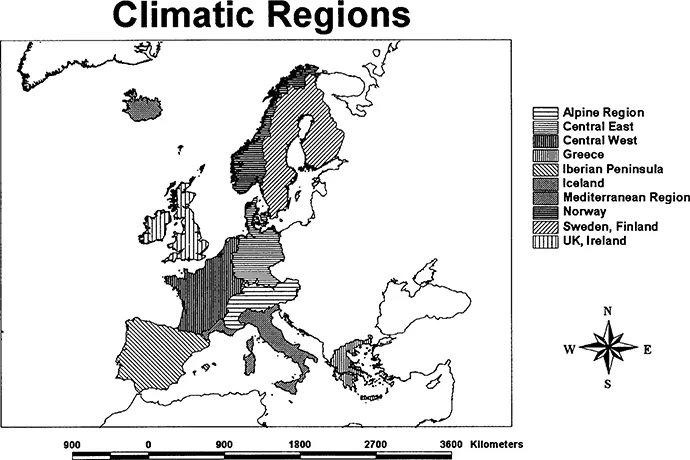
Figure 1 European climatic regions.
Having obtained 50-years characteristic ground snow loads at each weather station, the next step is to investigate the geographic variation in loads through regionalisation of available data.
Ten different homogeneous climatic regions were identified on the basis of geographic and climatic consideration.
These regions are shown in figure 1.
Within a distinct climatic region, snow load is considered to be a function of site altitude, yet affected by random deviation (including topographical effects). This allows a mean altitude function to be defined for each climatic region, except for those areas which show a poor correlation with altitude (e.g. Norway).
A spatial interpolation analysis was performed with GIS techniques (Geographical Information System) to obtain the spatial representation of the variation of snow loads on the ground, reduced at sea level, right across the examined climatic area.
Particular attention was paid to setting GIS interpolation phase parameters and to reduce inconsistencies at borderlines between climatic regions.
Figure 2 shows, as an example, the altitude function for the climatic region of Sweden and Finland.
Figure 3 shows the ground snow map of Sweden and Finland and figure 4 indicates the location of Weather Stations.
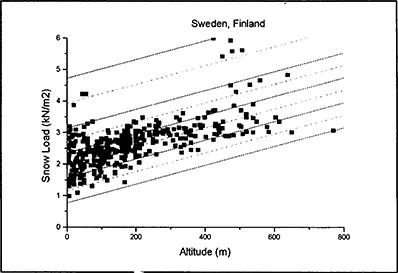
Figure 2 Climatic Region: Sweden and Finland: altitude - load relationship.
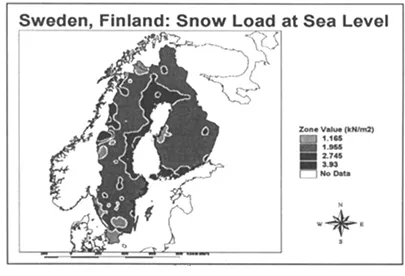
Figure 3 Climatic Region: Sweden and Finland: ground snow load map.
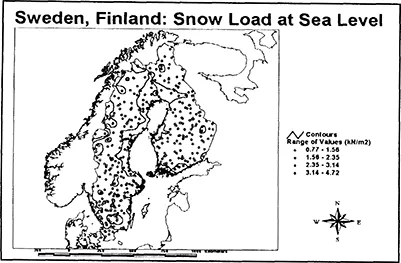
Figure 4 Climatic Region: Sweden and Finland: location of weather stations
Several checks ware done to finalize maps. Two of them are particularly relevant:
- a comparison of values calculated using maps with values obtained directly at each weather station as result of the statistical procedure and values obtained from the ENV 1991-2-3 Snow Loads (preliminary code);
- the verification of snow load steps encountered at borderlines between climatic regions.
Both of the above checks gave good result, showing that the map obtained from studies gives a good representation of the variation in snow loads across Europe according to the updated snow database retrieved and that differences at borderlines between defined climatic regions are sufficiently limited.
However, a map thus obtained as a final Research product cannot be introduced as such into the European code, as annex, for numerous reasons:
- the map obtained is physical, whereas standard wise administrative boundaries have to be taken into account;
- local situations and requirements better known to each country must be considered;
- there must be consent and agreement with National Competent Authorities.
Therefore, it was decided to place the physical European map in an “Informative Annex” and to introduce National Competent Authorities’ update maps, based on the physical European map, into the code.
This is evidently a compromise that enables...
Table of contents
- Cover Page
- Half title
- Title Page
- Copyright Page
- Table of Contents
- Foreword
- Postscript
- Part 1 Invited paper
- Part 2 Snow technology and science
- Part 3 Structural engineering
- 4 Housing and residential planning
- 5 Transportation
- Subject index
- Author index
Trusted by 375,005 students
Access to over 1.5 million titles for a fair monthly price.
Study more efficiently using our study tools.
Frequently asked questions
Yes, you can cancel anytime from the Subscription tab in your account settings on the Perlego website. Your subscription will stay active until the end of your current billing period. Learn how to cancel your subscription
No, books cannot be downloaded as external files, such as PDFs, for use outside of Perlego. However, you can download books within the Perlego app for offline reading on mobile or tablet. Learn how to download books offline
Perlego offers two plans: Essential and Complete
- Essential is ideal for learners and professionals who enjoy exploring a wide range of subjects. Access the Essential Library with 800,000+ trusted titles and best-sellers across business, personal growth, and the humanities. Includes unlimited reading time and Standard Read Aloud voice.
- Complete: Perfect for advanced learners and researchers needing full, unrestricted access. Unlock 1.5M+ books across hundreds of subjects, including academic and specialized titles. The Complete Plan also includes advanced features like Premium Read Aloud and Research Assistant.
We are an online textbook subscription service, where you can get access to an entire online library for less than the price of a single book per month. With over 1.5 million books across 990+ topics, we’ve got you covered! Learn about our mission
Look out for the read-aloud symbol on your next book to see if you can listen to it. The read-aloud tool reads text aloud for you, highlighting the text as it is being read. You can pause it, speed it up and slow it down. Learn more about Read Aloud
Yes! You can use the Perlego app on both iOS and Android devices to read anytime, anywhere — even offline. Perfect for commutes or when you’re on the go.
Please note we cannot support devices running on iOS 13 and Android 7 or earlier. Learn more about using the app
Please note we cannot support devices running on iOS 13 and Android 7 or earlier. Learn more about using the app
Yes, you can access Snow Engineering 2000: Recent Advances and Developments by E. Hjorth-Hansen,I. Holand,S. Loset,H. Norem in PDF and/or ePUB format, as well as other popular books in Technology & Engineering & Civil Engineering. We have over 1.5 million books available in our catalogue for you to explore.