- 204 pages
- English
- ePUB (mobile friendly)
- Available on iOS & Android
eBook - ePub
About this book
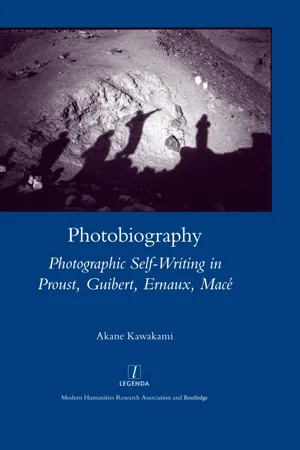
"Why do photographs interest writers, especially autobiographical writers? Ever since their invention, photographs have featured - as metaphors, as absent inspirations, and latterly as actual objects - in written texts. In autobiographical texts, their presence has raised particularly acute questions about the rivalry between these two media, their relationship to the 'real', and the nature of the constructed self. In this timely study, based on the most recent developments in the fields of photography theory, self-writing and photo-biography, Akane Kawakami offers an intriguing narrative which runs from texts containing metaphorical photographs through ekphrastic works to phototexts. Her choice of Marcel Proust, Herve Guibert, Annie Ernaux and Gerard Mace provides unusual readings of works seldom considered in this context, and teases out surprising similarities between unexpected conjunctions. Akane Kawakami is a Senior Lecturer in French and francophone literature at Birkbeck University of London."
Information
Chapter 1
Photography and Proust
Proust was no Luddite: on the contrary, he was fascinated by, and knowledgeable about, the effect of mechanical devices on human ways of perceiving the world.1 He lived at a time when certain modern inventions familiar to us today had only just entered the realms of the collective imagination: as a result, the telephone, the camera, X-rays, even the aeroplane all found their ways into La Recherche, at both the thematic and stylistic levels.2 But the camera was a special favourite, and some of the most innovative narrative devices and themes to be found in the novel are ‘photographic’ in a variety of senses ranging from the purely metaphorical to the almost concrete, as we will see in this chapter.
Much has been written recently about Proust and photography: most famously by the photographer Brassaï in his posthumously published Proust et la photographie (1997), and more recently in a detailed and comprehensive study by Áine Larkin, with many other books, chapters, and essays in between.3 This chapter does not seek to repeat their work, but aims to look at both the primary and critical material with the specific link between photography and self-writing in mind, in order to show how Proust is the unlikely ancestor of Guibert, Ernaux, and Macé in this field. We will see how his references to photographs and the photographic in La Recherche anticipate the metaphorical, analogical, and concrete uses made of the same by the writers who were to come after him, and how, in at least one passage of his novel, he seems to envision his writing as a form of writing with light. As he is a ‘precursor’, however, this chapter is shorter than those which follow, and contains several sections: starting with Proust’s relationship with photography during his life, I will go on to discuss three instances in La Recherche corresponding to three key aspects of photography, then end on the strange ways in which photography has led to a blurring of the boundaries between the novel and reality for certain celebrated readers of Proust.
Proust had a reputation as a benevolent photomane, wont to pester his friends for photographs of themselves and to bore new acquaintances with his vast collection.4 There are plentiful anecdotes, as well as evidence in the correspondence, about his obsessive desire to obtain photographs as well as the eagerness with which he would offer his own. When Charles Maurras asked Proust for a photograph to accompany his review of Les Plaisirs et les jours, Proust immediately wrote back:
Quand avez-vous besoin de ma photographie? Si c’est tout de suite je vous en enverrai une qui n’est pas bonne. Si j’avais une dizaine de jours ou un peu plus j’irais me faire faire chez Otto une photographie digne je ne dis pas de moi, mais de vous.5
[Exactly when will you need my photograph? If you need it at once, I will send you a bad one. If I could have a dozen days or a few more, I will go to Otto’s and have one done which will be worthy, I would not say of me, but of you.]
When the handsome young Armand Duc de Guiche failed to send him a promised photograph, Proust wrote a reproachful, almost sulky complaint at the end of a longer letter: ‘Quand à votre photographie à vous, c’est peu gentil de l’avoir promise et pas donnée’ [As for your photograph, it is not kind of you to have promised and not sent it].6 A couple of weeks later, the reproach having worked and the coveted image duly received, Proust’s tone was transformed by the joy of possession: ‘Il faut toujours vous remercier puisque vous êtes toujours gentil. J’ai reçu la belle photographie, très ressemblante, très précieuse pour fixer les souvenirs d’un oublieux’ [I must thank you, as always, because you are always so kind. I have received the beautiful photograph, very like, vital for a forgetful man who needs to fix his memories].7
Proust was hardly alone in being an exchanger, so to speak, of photographs: it was common practice at the time amongst socialites of Proust’s class. What has been more remarked upon by his contemporaries, and was therefore probably more singular, was his insistence on displaying his collection to others, usually new acquaintances. Many a visitor was obliged to examine, with real or feigned interest, the piles of ‘photos de cocottes et de duchesses, de ducs et de valets de pied de grandes maisons’ in the boulevard Haussmann apartment.8 Why was Proust so keen to show off his photographs? In the eighteenth century, it was customary for men of taste and privilege to have a gallery of portraits of their friends: Pope had one in his house in Twickenham. Such a gallery was an accepted form of self-representation, and Proust’s collection would almost certainly have functioned, at least on one level, as a self-portrait. The gift of a photograph implies trust, so a collection of such photographs would be, effectively, a list of testimonials constituting a glowing portrait of the owner’s capacity for friendship.9
There are darker thoughts that can be associated with the collection of one’s friends’ photographs, however. Collecting has been associated with moral dubiousness since the eighteenth century, because of its private and self-indulgent nature;10 it is not just in this sense, however, that Proust’s collecting activities became problematic. The collection of photographs — of small representations of real people, effectively, which can be used and abused without the knowledge of the models — is clearly fraught with taboo possibilities. Proust freely admitted that he used his photographs to flesh out the characters of La Recherche, to seek proof of how family resemblances, for instance, were passed from generation to generation regardless of sex, but he apparently also enjoyed scouring his friends’ photographs for incontrovertible evidence of ageing.11 Even more worrying are reports that:
à l’hôtel Marigny, il aurait un jour tendu un paquet de photos à l’un des jeunes et vigoureux garçons bouchers qui lui tenaient compagnie afin qu’il crache sur les portraits d’amies célèbres: la comtesse Greffulhe, Mme de Chevigné, etc. Et il aurait lui-même craché sur celui de Mme Proust.
[At the Hotel Marigny, it is said that one day he held out a packet of photographs to one of the young and vigorous butcher boys who kept him company, for him to spit on the portraits of his famous friends: Countess Greffulhe, Madame de Chevigné, and so on. And apparently he himself spat on a photograph of Madame Proust.]12
Whether or not this is true (Céleste Albaret denies it vehemently), such an act is not so much that of a collector as of someone who is using — and abusing — the power wielded by any possessor of a photograph.
I have argued elsewhere that the narrator of La Recherche does not have the characteristics of a possessive and self-indulgent collector,13 and it is tempting to conclude that his creator was not one either, on the evidence of the eventual fate of his prized photograph collection. When forced to move out of his Boulevard Haussman apartment, Proust was obliged to dispose of a large quantity of his papers and photographs. In a letter dated April 1919, he writes that he asked Céleste to burn them: ‘j’ai brûlé des autographes précieux, des manuscrits dont il n’existe pas de copie, des photographies devenues rares’ [I burned precious autographs, manuscripts of which there are no copies, rare photographs].14 Self-proclaimed collectors move might and main to ensure the survival of their collections beyond their own deaths.15 Proust’s attitude to his photographs suggests that he did not consider it a ‘collection’ in its own right, to pass onto posterity, but regarded it more as a personal, autobiographical assemblage, or even simply as material for his novel, and therefore not destined to outlive him.
Photography and Writing the Self in La Recherche
As mentioned earlier, the importance of photography to Proust’s creative imagination — and thence in La Recherche, both on the level of theme and of structure — has been much discussed by other critics.16 What I therefore hope to offer in this section is not a comprehensive account of the place of photography in La Recherche, but some illuminating links between self-writing and the photographic in Proust, uses of metaphors and analogical thinking which firmly embed the photographic into the act of writing the self. I will discuss these through three close readings of passages involving photography in La Recherche: a ‘photographic’ vision of his grandmother; X-rays and composite photographs; and transfiguration of the self through photography as writing.
The narrator’s grandmother is photographed on several occasions. One of the earliest instances occurs in the first part of Le côté de Guermantes, where the narrator experiences a moment of ‘photographic’ vision when he sees his grandmother after a period of absence.17 Returning from his travels, the Narrator enters the salon where his grandmother is reading, unnoticed by her:
Hélas, ce fantôme-là, ce fut lui que j’aperçus quand, entré au salon sans que ma grand-mère fût avertie de mon retour, je la trouvai en train de lire. J’étais là, ou plutôt je n’étais pas encore là puisqu’elle ne le savait pas, et […] elle était livrée à des pensées qu’elle n’avait jamais montrées devant moi. De moi […] il n’y avait là que le témoin, l’observateur, […] le photographe qui vient prendre un cliché des lieux qu’on ne reverra plus. Ce qui, mécaniquement, se fit à ce moment dans mes yeux quand j’aperçus ma grand-mère, ce fut bien une photographie.18
[Alas, it was this phantom that I saw when, entering the drawing-room before my grandmother had been told of my return, I found her there reading. I was in the room, or rather I was not yet in the room since she was not aware of my presence, and […] she was absorbed in thoughts which she had never allowed to be seen by me. Of myself […] there was present only the witness, the observer, […] the photographer who has called to take a photograph of places which one will never see again. The process that automatically occurred in my eyes when I caught sight of my grandmother was indeed a photograph.]19
In this moment when he is still ‘not there’, when he is not present as a loving viewer but only as a camera-like, passive set of eyes (‘ce qui, mécaniquement, se fit à ce moment dans mes yeux’), the Narrator sees his grandmother for the first time as she truly is. Usually we do not see our loved ones in this way, because our love and tenderness blur our vision. Occasionally, however,
[nos regards] fonctionnent mécaniquement à la façon de pellicules, et nous montrent, au lieu de l’être aimé qui n’existe plus depuis longtemps mais dont elle [notre intelligence] n’avait jamais voulu que la mort nous fût révélée, l’être nouveau que cent fois par jour elle revêtait d’une chère et menteuse ressemblance. (ii, 439, my italics)
[(our eyes) set to work mechanically, like films, and show us, in place of the beloved person who has long ago ceased to exist but whose death our tenderness has always hitherto kept concealed from us, the new person whom a hundred times daily it has clothed with a loving and mendacious likeness.] (iii, 156, my italics)
Proust makes it clear that to see a loved one ‘photographically’ is to see her in the context of her impending death. ‘As a mechanical and chemical process, photography acts as the embalming of reflections past […] photographic images are effigies’, even when they represent people who are still alive.20 (Indeed photography has even been held responsible for setting off and accelerating the ageing process, as we will see in the next chapter.) Habitually, our love for the person superimposes a younger image onto the ageing face, and it is only when we are given — in spite of ourselves — a moment of photographic vision that we are forced to contemplate the person’s mortality.
However traumatic its effect may be, photographic vision is also a way of seeing which makes it possible for us to see a loved person as an other:
Moi pour qui ma grand-mère c’était encore moi-même, moi qui ne l’avais jamais vue que dans mon âme, toujours à la même place du passé, à travers la transparence des souvenirs contigus et superposés, tout d’un coup, dans notre salon qui faisait partie d’un monde nouveau, celui du Temps, celui où vivent les étrangers dont on dit ‘il vieillit bien’, pour la première fois et seulement pour un instant car elle disparut bien vite, j’aperçus sur le canapé, sous la lampe, rouge, lourde et vulgaire, malade, rêvassant, promenant au-dessus d’un livre des yeux un peu fous, une vieille femme accablée que je ne connaissais pas. (ii, 439–40)
[I, for whom my grandmother was still myself, I who had never seen her save in my own soul, always in the same place in the past, through the transparency of contiguous and overlapping memories, suddenly, in our drawing-room which formed part of a new world, that of Time, that which is inhabited by the strangers of whom we say “He’s begun to age a great deal’, for the first time and for a moment only, since she vanished very quickly, I saw, sitting on the sofa beneath the lamp, red-faced, heavy and vulgar, sick, day-dreaming, letting her slightly crazed eyes wander over a book, an overburdened old woman whom I did not know.] (iii, 156–57)
Proust describes the way in which the Narrator sees his grandmother using terms borrowed from photography, although unlike Guibert, as we will see, his knowledge of the processes is much less specialized and therefore perhaps not quite detailed enough to make this instance of alienated seeing analogically photographic. It is nevertheless a fully developed metaphor, that of one’s eyes working mechanically and creating an image on a film, helped by a particular stage and light source: ‘sur le canapé, sous la lampe’. And the result is an ‘objective’ image of a loved one, taken from the camera’s point of view, not from the self’s. The Narrator’s grandmother has always been a part of him, until the moment when photographic vision places her in the ‘monde […] du Temps’, and shows her to him as an ageing woman. It may seem paradoxical that photographic vision should do this, because we usually think of photographs not as putting things back into, but taking them out of time, capturing a moment and making it eternal.21 But Proust here shows how it is the Narrator’s affective imagina...
Table of contents
- Cover
- Half Title
- Title
- Copyright
- CONTENTS
- Acknowledgements
- Introduction
- 1 Photography and Proust
- 2 Hervé Guibert: Photography and Love
- 3 Annie Ernaux: Photography and the Real
- 4 Gérard Macé: Photography and Self-Creation
- Conclusion
- Appendix 1: Interview with Annie Ernaux
- Appendix 2: Macé’s photo-texts
- Select Bibliography
- Index
Trusted by 375,005 students
Access to over 1.5 million titles for a fair monthly price.
Study more efficiently using our study tools.
Frequently asked questions
Yes, you can cancel anytime from the Subscription tab in your account settings on the Perlego website. Your subscription will stay active until the end of your current billing period. Learn how to cancel your subscription
No, books cannot be downloaded as external files, such as PDFs, for use outside of Perlego. However, you can download books within the Perlego app for offline reading on mobile or tablet. Learn how to download books offline
Perlego offers two plans: Essential and Complete
- Essential is ideal for learners and professionals who enjoy exploring a wide range of subjects. Access the Essential Library with 800,000+ trusted titles and best-sellers across business, personal growth, and the humanities. Includes unlimited reading time and Standard Read Aloud voice.
- Complete: Perfect for advanced learners and researchers needing full, unrestricted access. Unlock 1.5M+ books across hundreds of subjects, including academic and specialized titles. The Complete Plan also includes advanced features like Premium Read Aloud and Research Assistant.
We are an online textbook subscription service, where you can get access to an entire online library for less than the price of a single book per month. With over 1.5 million books across 990+ topics, we’ve got you covered! Learn about our mission
Look out for the read-aloud symbol on your next book to see if you can listen to it. The read-aloud tool reads text aloud for you, highlighting the text as it is being read. You can pause it, speed it up and slow it down. Learn more about Read Aloud
Yes! You can use the Perlego app on both iOS and Android devices to read anytime, anywhere — even offline. Perfect for commutes or when you’re on the go.
Please note we cannot support devices running on iOS 13 and Android 7 or earlier. Learn more about using the app
Please note we cannot support devices running on iOS 13 and Android 7 or earlier. Learn more about using the app
Yes, you can access Photobiography by Akane Kawakami in PDF and/or ePUB format, as well as other popular books in Languages & Linguistics & Languages. We have over 1.5 million books available in our catalogue for you to explore.