- 186 pages
- English
- ePUB (mobile friendly)
- Available on iOS & Android
eBook - ePub
About this book
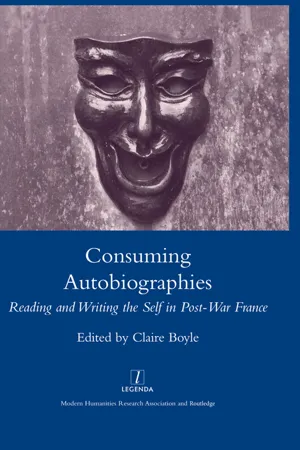
"Since 1975, French literary writing has been marked by an autobiographical turn which has seen authors increasingly often tap into the vein of what the French term ecriture de soi. This coincides, paradoxically, with the 'death of autobiography', as these authors self-consciously distance themselves and their writings from conventional autobiography, founding a 'nouvelle autobiographie' where the very possibility of autobiographical expression is questioned. In the first book-length study in English to address this phenomenon, Claire Boyle sheds a new light on this hostility toward autobiography through a series of ground-breaking studies of estrangement in autobiographical works by major post-war authors Nathalie Sarraute, Georges Perec, Jean Genet and Helene Cixous. She identifies autobiography as a site of conflict between writer and reader, as authors struggle to assert the unknowableness of their identity in the face of a readership resolutely desiring privileged knowledge. Autobiography emerges as a deeply troubling genre for authors, with the reader as an antagonistic consumer of the autobiographical self."
Information
Chapter 1
Autobiography
Orthodoxies and Paradoxes
If we assent to the idea that autobiography is a label that can no longer be decently applied to personal narratives with autobiographical qualities, autobiography dies. What does that mean? It clearly does not mean that people, even literary writers, stop writing autobiographically: the personal narrative with autobiographical qualities lives on, in twentieth- and twenty-first-century France as elsewhere. Rather, what it means is a change to the frame surrounding that narrative. My major focus in this book is the question of where the impetus to change the frame comes from: this requires not only close attention to what the writers of the autobiographical texts I study have to say about their relationship to the frame, or even yoke, that the genre of autobiography provides; it also requires some exploration of that frame beyond the contours it takes on in the eyes of these writers. Although autobiography may appear to have been dealt a mortal blow, with the apparent demise of the genre and the rise of newer nomenclatures to designate narratives of the self, it does not follow that we need give autobiography as a genre no further thought. Raylene Ramsay argues that 'new autobiographies [...] place the territories of old autobiographies, to use a Derridean term "under erasure" ("sous rature")': meaning that, whilst an attempt may be made to have the genre of autobiography in its traditional form 'struck out', it 'will not be fully erased but [...] still perceptible'.1 It will be important to cast a critical eye on the implicit and explicit insistences made by Sarraute, Perec, Genet and Cixous that their works do change the frame surrounding self-writing. Similarly, it will be important to consider from a point of view that extends beyond the author's necessarily self-interested one what the contours of this frame are, and what it is about this frame that might make changing or discarding it seem desirable, or indeed undesirable. This chapter therefore seeks to provide foundations for my later critique of the relationship Sarraute, Perec, Genet and Cixous have with the genre of autobiography. It does this via an exploration of how autobiography as a genre has been perceived, both in life and death, by critical readers, focussing particularly on the variety and vacillation of expectations attached to what otherwise risks being thought of as a monolithic genre (if we allow ourselves to be excessively influenced by the way it is depicted by modern French practitioners).
Over the course of this book, it will become clear that any one conception of the genre of autobiography is intertwined with a specific conception of how it is to be read: models of autobiography as a genre will be seen implicitly to contain within them models of readerly participation. (This is not to suggest that readers always adhere to such models: the accounts that I give of the reception of autobiography provide ample proof to the contrary.) Thus, in this chapter, I shall be particularly attentive to exploring what critics of autobiography have to say about the possibilities that the genre of autobiography holds out to its readers: what it offers them; what it fails to offer them, or cannot; and what obligations or constraints it places on them. This will provide the starting point for a reflection on what the stance taken towards the genre of autobiography by those who write the self suggests to us about the relationship they have, or wish to build, with their readers.
1. Autobiography in Theory
Autobiography: defining moments
We are confronted with evidence that autobiography is not a monolithic genre with a distinct, readily recognizable identity as soon as we stop to consider what is meant by the term. The existence of autobiography as an object of academic study has been recognized by critics ever since Georg Misch's mammoth Geschichte der Autobiographie, which appeared in embryonic form in 1907; albeit that Lejeune, writing in 1975, records a persistent resistance in French universities to the study of autobiography as literature.2 However, a scholarly consensus as to exactly what autobiography is has never been reached. Misch's understanding of what autobiography is is extremely loose: he applies the description to forms of writing such as ancient Egyptian tomb inscriptions, enabling him to trace back the history of autobiography into antiquity as far as the twenty-eighth century BC, providing the genre with a founding origin, and thus, academic respectability.3
The inauguration of what would now be recognized as autobiography study in France came with a far shorter work by Georges Gusdorf, published in 1956.4 His 'Conditions et limites de l'autobiographie' shares something of Misch's preoccupation with typology, but, although his essay is concerned with the properties of autobiography, Gusdorf remained content to describe the conditions giving rise to autobiography, assuming a common and unproblematic definition of autobiography to exist. The notable features of his essay are that — contradicting Misch — it insists that the genre of autobiography is Socio-historically contingent, and is only seen in societies that appreciate the individual as a singular and autonomous being.5 Crucially, as an early follower of Lacan's, Gusdorf sees the writing of autobiography as a performative act which brings into being a subject that does not pre-exist the text: he dismisses approaches which privilege the factual aspects of the autobiographical narrative and argues for autobiography to be considered as primarily a literary, not historical, document.6 This is in marked contrast to the traditional scholarly view of autobiography amongst Anglophone critics, according to which autobiography seizes a pre-existing self The writer of autobiography 'memorializes himself in the form of a book', as John Sturrock puts it; he (the pronoun is used advisedly) is engaged in a 'process of singularization', capturing his own individuality in print, asserting it, and thereby preserving it from anonymity and oblivion.7 Gusdorf's intervention can thus be seen as already sounding the death knell of autobiography at the point of its birth. Gusdorf anticipates what later passes almost as a truism in literary and academic circles, namely that it is unrealistic and simplistic to imagine that by reading autobiography readers can know the person that the author is; an idea which depends on seeing the autobiography as a reliable repository of knowledge; as a text which itself has possession of the author's identity. This contrasts starkly with the widely-accepted position that '[t]here is no such thing as a "uniquely" true, correct, or even faithful autobiography'.8
Only after Gilsdorf's article, however, did the assumption that defining autobiography was straightforward come to be contested. Jean Starobinski posited a definition in 1970 that is potentially very wide: autobiography is a self-written biography (biography being the writing of the 'tracé d'une vie' [course of a life]).9 The ancient Greek roots autos + bios + graphē [self + life + writing] supply an etymologically derived understanding of the term: one that still has the most currency amongst scholars, in particular amongst feminist critics. Importantly, despite his initial effort at definition, Starobinski proceeds to argue that seeking to define autobiography exactly is a useless task, for every writer will wish to impose their own individual style on their autobiography in order to convey their individuality. Efforts to define autobiography were not to cease, however, with rival definitions of autobiography emerging in the 1970s. De Man, for one, took vehement issue with what he considered the sterility of the drive, inspired by a structuralist mindset, to define autobiography as a literary genre, insisting that the body of work concerned itself resists this) 'autobiography lends itself poorly to generic definition; each specific instance seems to be an exception to the norm.'10 In consequence, for De Man, '[a]ttempts at generic definition seem to founder in questions that are both pointless and unanswerable'; the fact that one of these questions concerns truth and the author's sincerity has, in the light of De Man's own concealed truth, retrospectively somewhat weakened the force of this view.11
Notwithstanding such criticisms, these definitions are valuable in highlighting different conceptions of what constitutes the essence of autobiography. For example, in his L'Autobiographie, Georges May considers the commitment to delivering the truth (as opposed to supplying only fictions) to be the defining feature.12 This reflects the widely-held view that the hallmark of a 'genuine' autobiography is its 'intentionality': the author intends at least to impart the truth about him- or herself, even if that truth is more of an ontological 'Truth' about the situation of the autobiographer than it is a verifiably factual account of their life.13 For May, autobiography is therefore defined, and can be differentiated from other literary genres, on the basis of its non-fictional status. Accordingly, May sets autobiography at one pole of a spectrum of fictionality that he devises, with the novel occupying the opposite pole of fiction. Of the five intermediate categories he identifies, two are occupied by variants of autobiography, which, to differing degrees, each incorporate fiction. In an anticipation of later developments in autobiography studies (in particular the concept of autofiction), May's suggestion that there is autobiography and also hybrids of autobiography alerts us to the interesting possibility of there being not just one genre of autobiography, but many.14
The most significant contribution to the definition debate comes from Lejeune, whose Le Pacte autobiographique of 1975 formulated a definition which radically reconceived autobiography and, for the first time, acknowledged the centrality of the reader to this genre of writing. The insights Le Pacte autobiographique contains on the situation of the reader of autobiography will prove crucially important for the arguments that I shall go on to develop in this book.
A product of a structuralist outlook, Lejeune's work argues that 'le genre autobiographique est un genre contractuel' [the genre of autobiography is a contractual genre]; autobiography is any text that the reader, in reply to an invitation from the author, undertakes to read autobiographically.15 If this seems a nebulous definition, it is supplemented by a formula that is nonetheless quite precise, setting out the circumstances under which this reading will arise:
La définition met en jeu des éléments appartenant à quatre catégories différentes:
- Forme du langage:
- récit.
- en prose,
- Sujet traité: vie individuelle, histoire d'une personnalité.
- Situation de l'auteur: identité de l'auteur (dont le nom renvoie à une personne réelle) et du narrateur.
- Position du narrateur:
- identité du narrateur et du personnage principal,
- perspective rétrospective du récit.16
[The definition brings into play elements belonging to four different categories:
- Form of linguistic expression:
- narrative.
- in prose.
- Subject treated: life of the individual, history of the development of the self.
- Situation of the author: identicalness between the author (whose name refers to a real person) and the narrator.
- Position of the narrator:
- identicalness between the narrator and the principal protagonist,
- retrospective narrative perspective.]
Autobiography thus results, for Lejeune, from the production of a specific type of reader: a reader who consents to read the text as autobiographical. This reading will be invoked by the presence of the textual signals enumerated above. These will most usually emerge, Lejeune suggests, from a mixture of textual and peritextual elements (i.e. information, such as blurb, that surrounds and packages the text) that will establish an identité [identicalness] — an exact correspondence — between narrator, writer and protagonist ('identité' in French has, amongst others, the mathematical sense described in English as 'congruence').17 An important (although until now largely undeveloped) implication of Lejeune's thinking is that a vital function of autobiography is to produce its reader (that is to say, one who will confer on the text the status of autobiography). Once the reader recognizes the distinguishing features, a pacte autobiographique [autobiographical pact] will be concluded and for that reader, the text in question will be an autobiography. Although Lejeune admits that there will be exceptions to this rule — there will b...
Table of contents
- Cover
- Half Title
- Title
- Copyright
- Contents
- Dedication
- Acknowledgements
- Introduction
- 1 Autobiography: Orthodoxies and Paradoxes
- 2 Sarraute Writing the Self: The Drama of Self-Possession
- 3 Perec: Autobiography, Possession and the Dispossessed Self
- 4 Genet Inside and Out: Autobiography, Marginality and Empowerment
- 5 Hélène Cixous: Autobiography, the Ethics of Knowledge and Strategies of Self-Writing
- Conclusion
- Bibliography
- Index
Trusted by 375,005 students
Access to over 1.5 million titles for a fair monthly price.
Study more efficiently using our study tools.
Frequently asked questions
Yes, you can cancel anytime from the Subscription tab in your account settings on the Perlego website. Your subscription will stay active until the end of your current billing period. Learn how to cancel your subscription
No, books cannot be downloaded as external files, such as PDFs, for use outside of Perlego. However, you can download books within the Perlego app for offline reading on mobile or tablet. Learn how to download books offline
Perlego offers two plans: Essential and Complete
- Essential is ideal for learners and professionals who enjoy exploring a wide range of subjects. Access the Essential Library with 800,000+ trusted titles and best-sellers across business, personal growth, and the humanities. Includes unlimited reading time and Standard Read Aloud voice.
- Complete: Perfect for advanced learners and researchers needing full, unrestricted access. Unlock 1.5M+ books across hundreds of subjects, including academic and specialized titles. The Complete Plan also includes advanced features like Premium Read Aloud and Research Assistant.
We are an online textbook subscription service, where you can get access to an entire online library for less than the price of a single book per month. With over 1.5 million books across 990+ topics, we’ve got you covered! Learn about our mission
Look out for the read-aloud symbol on your next book to see if you can listen to it. The read-aloud tool reads text aloud for you, highlighting the text as it is being read. You can pause it, speed it up and slow it down. Learn more about Read Aloud
Yes! You can use the Perlego app on both iOS and Android devices to read anytime, anywhere — even offline. Perfect for commutes or when you’re on the go.
Please note we cannot support devices running on iOS 13 and Android 7 or earlier. Learn more about using the app
Please note we cannot support devices running on iOS 13 and Android 7 or earlier. Learn more about using the app
Yes, you can access Consuming Autobiographies by Claire Boyle in PDF and/or ePUB format, as well as other popular books in Languages & Linguistics & Languages. We have over 1.5 million books available in our catalogue for you to explore.