- 179 pages
- English
- ePUB (mobile friendly)
- Available on iOS & Android
eBook - ePub
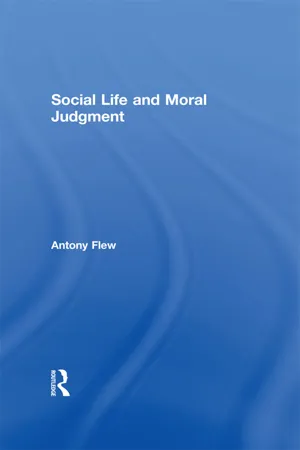
Social Life and Moral Judgment
About this book
"In Social Life and Moral Judgment, author and philosopher Antony Flew examines the social problems induced by the mature welfare state. Welfare states make ever-increasing financial demands on their citizenry, yet the evidence clearly supports that such demands are not sustainable. In this superlative collection of thematic essays, Flew investigates and explains why this is so, and calls for a return to individual responsibility.The first essay establishes the philosophical basis for his argument. ""Is Human Sociobiology Possible?"" answers its titular question in the negative, asserting that we are all members of a peculiar type of creature that can, and therefore must, be responsible for whatever choices between various courses of action or inaction that are open to us as individuals. In other essays, Flew shows how state welfare systems inevitably corrupt and demoralize their citizens by encouraging ever-more people to apply for welfare entitlements and reducing the incentives to avoid or escape the conditions warranting those entitlements. He investigates the origins of this new kind of welfare entitlement, and shows how very different what politicians and public sector employees produce is from what these people claim to be producing.Flew shows that the drive for ""social"" justice appears to require that the justly acquired income and wealth of all citizens should be progressively taxed away or supplemented by the state so that the eventual result is more, though never perfect, equality. This objective, he asserts, must be radically distinguished from old-fashioned, without prefix or suffix, justice. It was this type of justice Adam Smith referred to when he famously said that it is a virtue ""of which the observance is not left to the freedom of our wills"" but ""which may be extorted by force."" Flew question the aims of those who would discredit wealth creators and wealth-creating investment, showing that these are the same people who prom"
Information
1
Is Human Sociobiology Possible?
Sociobiology is defined as the systematic study of the biological basis of all social behavior.—E. O. Wilson, Sociobiology: The New Synthesis (p. 4)
The second word in the title of this first chapter is crucial. For there can be no doubt but that the possibility of sociobiology below the human level has already been abundantly realized in, for instance, the main body of E. O. Wilson’s enormous and encyclopaedic treatise Sociobiology: The New Synthesis. What may more reasonably be doubted, and what is about to be questioned here is whether, as Wilson and others hoped and expected, there is much, or indeed any room for a sociobiology of our own notoriously wayward and idiosyncratic species. In proposing and pursuing that project, Wilson and his associates have seen themselves as promoting a climactic conquest for evolutionary biology. For surely, they seem to have thought, it is now, more than a century after Darwin, high time and over time to launch the final assault upon the last citadel.
There are however, as we shall proceed to argue, reasons—reasons which were available at least in outline even to Darwin himself—why the ideas that have been so triumphantly successful in explaining The Origin of Species cannot properly be applied to what is in truth a fundamentally different task. They cannot, that is to say, properly be transferred to explain developments either within or out of the particular problem species of which the author of that book, along with both all the authors and all the readers of all other books, have been themselves members. For there are fundamental differences between the natural and the human sciences, the latter including the (human) social sciences. These fundamental differences are consequences of the essential peculiarities of that peculiar species of which we are all members: homo sapiens. It is the main purpose of this present chapter and of its immediate successor to elucidate the nature of these peculiarities and their implications for both the understanding and the application of the findings of the (human) social sciences—hereafter described as usually they are, as without qualification, the social sciences.
The Project of Human Sociobiology
By itself, the claim that biology provides the basis of all social behavior might imply everything or almost nothing. The foundations of a building, the basis without which that building must inevitably collapse, place only the broadest and most generous limitations upon what can be erected upon and supported by those foundations. It is also only when archaeologists possess considerable knowledge of the people who built what used to rest upon some still surviving foundations can they begin to make reasonable conjectures about the architecture, the materials, and the function of a structure that exists no longer. At the other extreme, we sometimes used to hear brashly dogmatic Marxists maintaining that the material foundations of any society—its forms of “production and reproduction in real life”—must more or less rigorously determine and necessitate whatever is going on in the ideological superstructure of that society.
In applying sociobiological ideas to the study of human social behavior, Wilson himself, whose own main previous research was on The Insect Societies, inclined to the latter extreme. In a final chapter of that earlier book, a chapter surveying the prospects for “a unified sociobiology,” he envisaged that “the same principles of population biology and comparative zoology” that had “worked so well in explaining the rigid systems of the social insects could be applied point by point to vertebrate animals.”1 How this application was to be achieved Wilson indicated in the paragraph of Sociobiology: The New Synthesis that contained the definition already quoted. It would, apparently, involve a take-over by evolutionary genetics. For “Sociology sensu stricto…still stands apart from sociobiology because of its largely…nongenetic approach… Taxonomy and ecology…have been reshaped entirely…by integration into neo-Darwinist evolutionary theory—the ‘Modern Synthesis’ as it is often called—in which each phenomenon is weighed for its adaptive significance and then related to the basic principles of population genetics.”2 This particular paragraph, however, concluded cautiously: “Whether the social sciences can be truly biologicized in this fashion remains to be seen.”
In subsequent writings Wilson was less cautious and more explicit in his reductionist ambitions. Biology, he later went on to argue, is the “antidiscipline” of the social sciences, and of anthropology in particular, “which has already become the social science closest to sociobiology.”3 It is, it seems, the scientific function of an antidiscipline to reduce to its own level the explanations of the science next above it. So it falls to sociobiology, as the antidiscipline of anthropology, to demonstrate that the explanation of cultural practices is really to be found in biological processes. The issue at stake is the extent to which human cultures, and the behaviors that are elements in them, can be accounted for by “genetic determinism.” It is on the interpretation of this “key phrase,” as Wilson stressed, that “the entire relation between biology and the social sciences depends” (E. O. Wilson, 1978, p. 55).
The final chapter of Sociobiology: The New Synthesis is entitled “Man: From Sociobiology to Sociology.” It gets off to a splendid start with the sentence: “Let us now consider man in the free spirit of natural history, as though we were zoologists from another planet completing a catalog of social species on Earth” (E. O. Wilson, 1975, p. 547). Unfortunately, after having so rightly and so immediately insisted that this is what needed to be done, Wilson did not, either then or later, go on to actually do it. Instead, he proceeded by his subsequent off-the-cuff remarks about human nature to provoke explosions of fury from various individuals and collectives committed to the defense of social democratic or Marxist orthodoxies. No doubt Wilson himself saw this reaction as clear confirmation for his claim that human beings are “absurdly easy to indoctrinate.”4
How to Inherit Acquired Characteristics
What needed to be done but was not done, either by Wilson himself or even by Kitcher5—by far the most well-girded and fair-minded of all Wilson’s critics—was to ask which, if any, of the distinctive peculiarities of our species are or should be of especial professional interest to biologists. Suppose now that we actually were to begin, as Wilson, on the first page of the final chapter of Sociobiology: The New Synthesis, recommended that we should begin, by considering “man in the free spirit of natural history, as though we were zoologists from another planet completing a catalog of social species on Earth.” Then the first peculiarities we would have to pick out would surely be the far-extended period between birth and maturity, the incomparable capacity for learning that makes it possible to take full advantage of that far-extended period, and the consequent importance of learned (as opposed to instinctual) behavior. Our unrivalled capacity for learning, together with its instrument and expression developed language, provides our species with a serviceable substitute for the (genetic) inheritance of acquired characteristics.
This is a point that seems first to have been made, very forcefully, by Julian Huxley.6 His making it in 1923 is all the more impressive in that he was at that time much concerned to put down all Lamarckist suggestions that any acquired characteristics might be (genetically) inherited. It is this serviceable substitute for the (genetic) inheritance of acquired characteristics that constitutes the first threat to the project for a human sociobiology. For the genetic inheritance of acquired characteristics itself, as opposed to this or any other substitute, is something most emphatically precluded by—Huxley’s phrase—the “Modern Synthesis.”
No doubt this unrivalled capacity for learning, like all other innate capacities and innate dispositions, is itself genetically determined. But the directions to which we turn such capacities, and how far we inhibit or pursue such inclinations, is precisely not already determined by our genes. It is instead for us to decide. And in this, as we shall see in the following section, lies the second main threat to the project for a human sociobiology.
It is perhaps significant that Wilson here mentions only sociology and anthropology as the disciplines or discipline for which sociobiology is to be the antidiscipline. For different reasons, neither of these makes much room for history or tradition. Yet fully to understand any human as opposed to insect society it is essential to take account of its past. In the oft-quoted words with which Marx begins the second paragraph of The Eighteenth Brumaire of Louis Bonaparte:
Men make their own history, but they do not make it just as they please; they do not make it under circumstances chosen by themselves, but under circumstances directly encountered, given and transmitted from the past. The tradition of all the dead generations weighs like a nightmare7 on the brain of the living (Marx [1852] 1934, p. 10).
What is peculiar to our species, it must be emphasized, is not the exogenetic (i.e. non-genetic) transmission of specific possible behaviors from one generation to the next, as such, but the enormous number and variety of possible behaviors which, thanks to the hypertrophy of the human brain and to the presumably concurrent and connected development of language, can now be and often are transmitted exogenetically. Wilson himself is, of course, far too good a biologist not to have noticed both what is and what is not peculiar to our species. What he noticed in Sociobiology: The New Synthesis is that populations of primates and other animals possess traditions, “specific forms of behavior that are passed from generation to generation by learning,” by processes, that is, which are specifically exogenetic. These traditions, when viewed collectively, constitute the culture of an animal population; and, as Wilson also notices, from the researches of primatologists during recent decades, it has now been established that “the rudiments of culture are possessed by higher primates other than man, including the Japanese monkey and the chimpanzee” (E. O. Wilson, 1975, p. 168).
For populations of both the Japanese monkey and the chimpanzee, we now possess decisive evidence of the exogenetic transmission of information between successive generations.8 Moreover, the fact that the information transmitted is rudimentary in form is of particular significance when seen in an evolutionary perspective. For in both of these meticulously documented cases we are given a glimpse of the way in which the cultural transmission of information emerges: through the operation of entirely natural processes from pre-existing genetically determined adaptations. The fact that Wilson himself noticed the emergence of this phenomenon of exogenetic cultural inheritance at an infrahuman level made it all the more remarkable, not to say mildly scandalous, that he should then seem not to see the significance for his own ambitious project of the explosive, exponential growth of the same phenomenon at human level.
How to Frustrate Your Genes
Many and various are the differentials that have been suggested in order to produce per genus et differentiam definitions expressing what the definers took to be an, if not the, essential peculiarity of our species. Such differentials have usually been chosen in order to maintain the purportedly objective centrality of whatever happened to be the chief interest of the chooser. Thus we have been categorized under the class-descriptions of “the religious animal,” “the animal which knows it has to die,” and innumerable others. Quite the best for our present purpose is the first. It was, appropriately enough, the one provided by the Founding Father of biological science.
For Aristotle proposed to define and distinguish man as “the rational animal.” Here the word “rational” has to be construed as meaning capable of rationality, and it is opposed (not to the word “irrational” but) to the word “non-rational.” For us, the prime implication of this definition is that man becomes essentially a language-using creature. But Aristotle also distinguished two sorts of reason: theoretical and practical. Both of these are equally essential to man, and both of course presuppose linguistic capacities. Practical reason is reason in and for action: it is a matter of the reasons one may have for acting or not acting, or for acting in this way rather than that. To possess and to be able to employ practical reason presupposes that one is an agent, rather than a mere patient. But to act—as opposed to merely behaving in the way in which, we presume, the brutes merely behave—is always and necessarily to be able to do otherwise than in fact we do do. Creatures which are, in this understanding, agents are, therefore, a kind of creatures which can, and cannot but, make choices; and which may have and know that they have practical reasons for making the particular choices they do make in the senses in which they do make them. It is thus certain fundamental defining and distinguishing peculiarities of our species, rather than the offensiveness of its findings to various militant ideologies, which must necessarily frustrate all aspirations to develop a human sociobiology.
The first biologically relevant peculiarity of our species here distinguished is our capacity to inherit some acquired characteristics. The second biologically relevant peculiarity of our species is that we are all, to a greater or lesser extent, agents. Since agents as such always could—in a strong sense that will be explained in chapter 2—have done and could do other than they did do and do do, there sometimes arise for all of us possibilities of, as it were, frustrating our genes. Presumably there are in some non-human mammals embryonic developments in this direction—just as, as we have seen, there certainly are cases of the exogenetic inheritance of the acquired characteristic of a learned behavior in several species other than ours. In both instances, however, the prehuman anticipations of what has in our species become a vastly extended and elaborately sophisticated development appear to be comparatively minor. It is this second peculiarity of our species, even more than the first, which makes the human sciences irreducibly different from the natural. In his own way, Wilson recognized the reality of choice. But, once again, he failed altogether to appreciate its revolutionary and relevant significance.
As was said before, the issue at stake is the extent to which human cultures, and the behaviors that are part of them, can be explained in terms of “genetic determinism.” It is on the interpretation of this “key phrase,” as Wilson stressed, that the entire relation between biology and social sciences depends (E. O. Wilson, 1975, p. 532). As an example of an organism whose behavior is genetically “predestined,” he instanced the mosquito: “The mosquito,” he wrote, “is an automaton” with “a sequence of rigid behaviors programmed by the genes to unfold swiftly and unerringly from birth to the final act of oviposition” (E. O. Wilson, 1987, p. 55).
He then immediately went on to take as an example of “restricted behavior” in humans the phenomenon of handedness: “Each person is biologically predisposed to be either left or right handed” (E. O. Wilson, 1978, p. 57). Nevertheless, as he himself notes, while parents in present-day Western societies tend not to interfere with the “direction set by the gene affecting this trait,” the position is decidedly different in “traditional Chinese societies,” in which “a strong social pressure for right-handed writing and eating” is still exerted. Thus, a then-recent study of Taiwanese children9 “found a nearly complete conformity in these two activities, but little or no effect on handedness in other activities not subjected to special training” (E. O. Wilson, 1978, p. 57).
The conclusion Wilson drew from this instructive example is ...
Table of contents
- Cover
- Half Title
- Title
- Copyright
- Contents
- Introduction and Acknowledgements
- 1. Is Human Sociobiology Possible?
- 2. Anti-Social Determinism
- 3. State Welfare and Individual Demoralization
- 4. Self-Improvement and Social Action
- 5. Welfare Rights for the Formerly Disadvantaged
- 6. Sincerity, Rationality, and Monitoring
- 7. Selfishness, Exploitation, and the Profit Motive
- 8. “Social” Justice and Private Property
- 9. Moral Education in Secular State Schools
- Bibliography
- Name Index
Trusted by 375,005 students
Access to over 1.5 million titles for a fair monthly price.
Study more efficiently using our study tools.
Frequently asked questions
Yes, you can cancel anytime from the Subscription tab in your account settings on the Perlego website. Your subscription will stay active until the end of your current billing period. Learn how to cancel your subscription
No, books cannot be downloaded as external files, such as PDFs, for use outside of Perlego. However, you can download books within the Perlego app for offline reading on mobile or tablet. Learn how to download books offline
We are an online textbook subscription service, where you can get access to an entire online library for less than the price of a single book per month. With over 1.5 million books across 990+ topics, we’ve got you covered! Learn about our mission
Look out for the read-aloud symbol on your next book to see if you can listen to it. The read-aloud tool reads text aloud for you, highlighting the text as it is being read. You can pause it, speed it up and slow it down. Learn more about Read Aloud
Yes! You can use the Perlego app on both iOS and Android devices to read anytime, anywhere — even offline. Perfect for commutes or when you’re on the go.
Please note we cannot support devices running on iOS 13 and Android 7 or earlier. Learn more about using the app
Please note we cannot support devices running on iOS 13 and Android 7 or earlier. Learn more about using the app
Yes, you can access Social Life and Moral Judgment by Antony Flew,Karl-Dieter Opp in PDF and/or ePUB format, as well as other popular books in Medicina & Atención sanitaria. We have over 1.5 million books available in our catalogue for you to explore.