- 345 pages
- English
- ePUB (mobile friendly)
- Available on iOS & Android
eBook - ePub
About this book
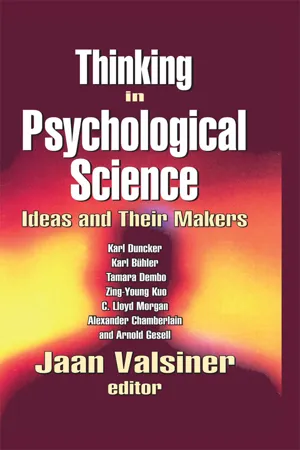
"This book explores the development of ideas in psychology's past. It is the initial volume in a series intended to shape such ideas into a valuable resource for the discipline's future. Scientists, in general, are known to ignore their own history, considering it to be a graveyard of failures. In Thinking in Psychological Science, selected ideas of key figures in the cognitive, comparative, and developmental sides of psychology Karl Duncker, Karl Biihler, Tamara Dembo, Zing-Young Kuo, C. Lloyd Morgan, Alexander Chamberlain, and Arnold Gesell are traced, and the social contexts of their ideas are given a collective analysis, focusing on the potential of these ideas for the present state of psychology.Representing the scientist as ""hero"" has become a necessary component when applying for research monies from governmentally controlled funding agencies. Yet the reality is just the opposite: Science is not just the product of ""heroes""; it is the product of many individuals who often search for solutions to basic problems throughout their lifetimes while only a few arrive at breakthroughs. Still, familiarity with the flow of thought in the efforts to solve the basic problems of humankind is necessary for any understanding of creativity. This book analyzes the processes involved in the search for solutions to major theoretical problems of development (Kuo, Gesell), action and cognition (Biihler, Bunker, Dembo), and methodology (Morgan). Ultimately, this is an exciting volume that reveals real science in the making.Thinking in Psychological Science will be of interest to students of the social sciences and intellectual history. It is ideal for graduate and upper-level undergraduate courses in psychology, the sociology of science, and cognitive science."
Information
Table of contents
- Cover
- Half Title
- Title
- Copyright
- Contents
- List of Tables
- List of Figures
- Introduction—How our Future can be Observed in Our Past: Mental Bases for Scientific Inquiry
- Part I. Roots of Cognitive Science: Karl Duncker
- Part II. Abstractive Generalization through Language: The Legacy of Karl Bühler
- Part III. Thinking and Speaking: Development through Thinking, Acting, and Speaking
- Part IV. The Dynamic Whole: Gestalt Ideas and Social Practices
- Part V. Dissecting Methodology and Thinking of Development
- Index
Trusted by 375,005 students
Access to over 1.5 million titles for a fair monthly price.
Study more efficiently using our study tools.
Frequently asked questions
Yes, you can cancel anytime from the Subscription tab in your account settings on the Perlego website. Your subscription will stay active until the end of your current billing period. Learn how to cancel your subscription
No, books cannot be downloaded as external files, such as PDFs, for use outside of Perlego. However, you can download books within the Perlego app for offline reading on mobile or tablet. Learn how to download books offline
Perlego offers two plans: Essential and Complete
- Essential is ideal for learners and professionals who enjoy exploring a wide range of subjects. Access the Essential Library with 800,000+ trusted titles and best-sellers across business, personal growth, and the humanities. Includes unlimited reading time and Standard Read Aloud voice.
- Complete: Perfect for advanced learners and researchers needing full, unrestricted access. Unlock 1.5M+ books across hundreds of subjects, including academic and specialized titles. The Complete Plan also includes advanced features like Premium Read Aloud and Research Assistant.
We are an online textbook subscription service, where you can get access to an entire online library for less than the price of a single book per month. With over 1.5 million books across 990+ topics, we’ve got you covered! Learn about our mission
Look out for the read-aloud symbol on your next book to see if you can listen to it. The read-aloud tool reads text aloud for you, highlighting the text as it is being read. You can pause it, speed it up and slow it down. Learn more about Read Aloud
Yes! You can use the Perlego app on both iOS and Android devices to read anytime, anywhere — even offline. Perfect for commutes or when you’re on the go.
Please note we cannot support devices running on iOS 13 and Android 7 or earlier. Learn more about using the app
Please note we cannot support devices running on iOS 13 and Android 7 or earlier. Learn more about using the app
Yes, you can access Thinking in Psychological Science by Jaan Valsiner in PDF and/or ePUB format, as well as other popular books in Psychology & History & Theory in Psychology. We have over 1.5 million books available in our catalogue for you to explore.