- 282 pages
- English
- ePUB (mobile friendly)
- Available on iOS & Android
eBook - ePub
About this book
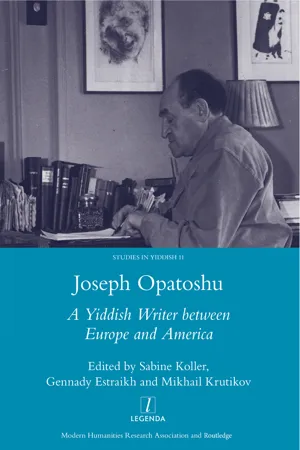
"At the turn of the twentieth century East European Jews underwent a radical cultural transformation, which turned a traditional religious community into a modern nation, struggling to find its place in the world. An important figure in this 'Jewish Renaissance' was the American-Yiddish writer and activist Joseph Opatoshu (1886-1954). Born into a Hassidic family, he spent his early childhood in a forest in Central Poland, was educated in Russia and studied engineering in France and America. In New York, where he emigrated in 1907, he joined the revitalizing modernist group Di yunge - The Young. His early novels painted a vivid picture of social turmoil and inner psychological conflict, using modernist devices of multiple voices and mixed linguistic idioms. He acquired international fame by his historical novels about the Polish uprising of 1863 and the expulsion of Jews from Regensburg in 1519. Though he was translated into several languages, Yiddish writing always fostered his ideas and ideals of Jewish identity. Although he occupied a key position in the transnational Jewish culture during his lifetime, Opatoshu has until recently been neglected by scholars. This volume brings together literary specialists and historians working in Jewish and Slavic Studies, who analyse Opatoshu's quest for modern Jewish identity from different perspectives. The contributors are Shlomo Berger (Amsterdam), Marc Caplan (Baltimore, MD), Gennady Estraikh (New York), Roland Gruschka (Heidelberg), Ellie Kellman (Boston), Sabine Koller (Regensburg), Mikhail Krutikov (Ann Arbor, MI), Joshua Lambert (Amherst, MA), Harriet Murav (Urbana-Champaign, IL), Avrom Novershtern (Jerusalem), Dan Opatoshu (Los Angeles), Eugenia Prokop-Janiec (Krakow), Jan Schwarz (Lund), Astrid Starck (Basel/Mulhouse), Karolina Szymaniak (Krakow) and Evita Wiecki (Munich)."
CHAPTER 1
Joseph Opatoshu's Search for Yidishkayt
Gennady Estraikh, Sabine Koller, and Mikhail Krutikov
In 1922 the young American Yiddish writer Joseph Opatoshu was travelling back to Europe on the RMS Aquitania. Looking at the stars above him made him remember the past generations of his family, which directed his thought to the meaning of yidishkayt, a concept that can be broadly described as Jewish world-view and way of life:
The night was starry. Above me, the enormous heaven. The heaven and the stars. Everywhere around me, water only. And you felt so small, and even smaller — a speck in the middle of the sea. While I was looking at the heaven, a star suddenly had fallen. Another star followed, crossing the sky, and a thought had been born in my head. An intimate thought. Thirty-odd years ago my father travelled as a third-class passenger across the same sea. Here — in the middle of the sea — fifteen hundred miles from New York and fifteen hundred miles from Paris, my father dropped a question which he had inherited from his grandfather, his great-grandfather: What is the meaning of yidishkayt? This thought continued to hover between the heaven and the water. I perceived this thought as part of the ship, of the people on the ship, of the surrounding element. I was the mouthpiece of my father, my grandfather, generations, generations: What is the meaning of yidishkayt? Whose yidishkayt? Of the Prophets? Of Rambam, Moses Hess or Yitzkhok Leybush Peretz?
And I am saying: yidishkayt is all of this and also something else. However, this ‘something else’ is difficult to define.1
Opatoshu’s moment of meditation under the open sky in the middle of the Atlantic Ocean brings to mind both the biblical story of creation and Immanuel Kant’s famous dictum. Yet, in Opatoshu’s case, it is neither God’s spirit hovering between heaven and earth nor the bond between the starry sky above his head and the universal moral law in his heart, but rather Yitzkhok Leybush Peretz’s vision of yidishkayt as the ‘golden chain’ that connects generations of the Jewish people. The exact meaning of this concept escapes a precise definition, for it always contains ‘something else’, problematic issues that Opatoshu raises, but does not resolve, in his writings.
Sixteen years later, Opatoshu made his last trip to pre-war Europe. Travelling on train from France to Poland through Nazi Germany and witnessing a German official demanding that German Jews give their seats to ‘Aryan’ passengers, Opatoshu pondered the same question: ‘What power do we, contemporary Jews, have to fight with the malice of the world? The power of religion? Of social justice? Of secularity? Of yidishkayt?’2 (Despite the stark contrast between the transcendental tranquillity of the 1922 transatlantic voyage and the crossing of Nazi Germany on the eve of Kristallnacht, Opatoshu evokes the same set of names: the biblical prophets and the medieval Jewish thinkers Maimonides and Yehuda Halevi, the German Jewish philosopher Moses Hess, and, of course, Peretz, the great master of Yiddish letters, who gave the aspiring young writer his somewhat ironic blessing: ‘when you write something else — bring it to me’.)3
The issue of yidishkayt in its manifold aspects — social, historical, religious, psychological, ideological — remained central for Opatoshu’s writing during his entire literary career, which spanned for more than four decades. He began as a member of the Di Yunge (The Young Ones) literary group, which emerged in New York around 1907 as a protest against the utilitarian approach to Yiddish literature practised by Yiddish press and Jewish political movements. Opatoshu described them as ‘a circle of young people who wanted to establish themselves in New York, and they succeeded in a certain sense’. The young Yiddish writers, Opatoshu argues, became ‘American’ even earlier than their English-language contemporaries: ‘it was easier for us to shake off Warsaw, Odessa, Vilna, whereas the Americans had to shake themselves free from a thousand-year old [English] literature’.4 Mostly remem bered today for its poets, Di Yunge also included a group of prose writers, most prominent among whom were Joseph Opatoshu and Dovid Ignatov.
Although Opatoshu saw Di Yunge first of all as an American literary group, his early works, such as the short story ‘Oyf yener zayt brik’ (On the Other Side of the Bridge, 1910) and the novella A roman fun a ferd-ganev (Romance of a Horse Thief, 1912) were set in the environment of central Poland, around his native shtetl Mława, and made use of some autobiographical elements. Most of them appeared in the almanacs Literatur (Literature) and Shriftn (Writings), edited by Ignatov. Opatoshu’s heroes represented a new type of Jewish character: young, active, wilful, and energetic, ready to break established social norms and cultural conventions, and sometimes even the law. His shtetl stories are free of nostalgia and sentimentality. In his first American story, ‘Moris un zayn zun Filip’ (Morris and His Son Phillip), Opatoshu went even further in his representation of the low life, something that at that time was only possible in Yiddish, which was not subject to the strict obscenity regulations that controlled American literature, as Josh Lambert demonstrates in his article. Opatoshu’s stories began to appear in the more mainstream publications such as Dos naye land (The New Country, edited by Avrom Reisen) and Di tsukunft (Future), and had a strong impact on Yiddish literature around the world, reaching as far as Kiev where a group of young writers, inspired by the ‘overwhelming’ (iberrashendik) novelty of Opatoshu’s style and content, began ‘quietly to prepare an attack against the fortified Yiddish literary Warsaw’.5 This initial enthusiastic reception of Opatoshu’s work among the writers of the Kiev Group forged a strong personal connection which, until 1948, linked Opatoshu with Soviet Yiddish literature.
In 1914 Opatoshu broke up with Ignatov and started a new publication, Di naye heym (The New Home). As the American scholar Ruth Wisse explains, ‘[t]he differences were too substantive to yield to diplomatic overtures, and Opatoshu’s ambition too strong to be contained within Ignatoff’s [sic] publication’.6 The split within Di Yunge was ascribed by the critic Borekh Rivkin, who sided with Opatoshu, to the difference between the ‘sober’ [nikhtere] adherents of naturalist style who left with Opatoshu and the ‘intoxicated’ [shikere] neo-romantics and symbolists who stayed with Ignatov.7 In the first (and only) issue of Di naye heym Opatoshu published the novella Fun Nyu-yorker geto (From the New York Ghetto), which was marked by a radically new approach to the American theme in Yiddish literature. At the same time he made his first approach to the historical theme in the novel Aleyn (Alone, 1919), which introduced the character of Mordkhe, who was to become the central figure in the historical novels In poylishe velder (In Polish Woods) and 1863. Together with Alone as the concluding part, these three novels form Opatoshu’s ‘Polish’ trilogy, which covers the second half of the nineteenth and the early twentieth centuries. In Polish Woods became Opatoshu’s first international success: it was translated into several languages, including Hebrew, Polish, Russian, Ukrainian, German and English, and turned into a film in Poland (1930). During the celebration of the first twenty-five years of his literary work Opatoshu declared this novel his most important work to date. Echoing Marx’s famous call to study the ‘everyday Jew’ rather than ‘Sabbath Jew’, Opatoshu proclaimed that Jewish historians had so far written the history of the ‘Jewish Sabbath’ and the ‘Jewish festivals’, skipping the six working days of the week.8 The Jewish writer, Opatoshu contended, begins his work where the Jewish historian has left his: ‘our artist must do the “dirty” work of the historian’ by ‘kneading the clay and preparing the bricks’ for the construction of the edifice of the Jewish historical past.9
From the very beginning of his literary career, Opatoshu’s search for yidishkayt was going on at two different levels, in the past and in the present. An indefatigable traveller, he made several extensive visits to Western and Eastern Europe and Palestine. In Poland and the Soviet Union he was actively engaged in cultural life and even entertained the idea of settling permanently. Poland was the primary market and audience for his works, and during 1928–36 Boris Kletskin, the pre-eminent publisher of quality Yiddish literature, issued Opatoshu’s collected works in fourteen volumes. Although Opatoshu never associated himself with communism, he enjoyed generally warm relationships with the Soviet Yiddish literary establishment, particularly with his close friend Peretz Markish, but he also managed to maintain friendship with the veteran literary historian Israel Zinberg, who for ideological reasons remained outside official Soviet literature.
Past and present are always closely intertwined in Opatoshu’s works. Past looms large behind the present even in his stories from contemporary American life, and his historical fiction, even when it is set in the ancient world or the Middle Ages, is informed by contemporary concerns. Opatoshu, as was noted by critics, was the writer of conflicts and contradictions: ‘he read the man at two levels simultaneously, as the under-man (untermentsh) and the super-man (oybermentsh)’.10 This duality of vision, Borekh Rivkin argued, produced a duality of style. Rivkin describes Opatoshu’s method as ‘subjective objectivism’, whereby the writer dissects the ‘intimate secrets’ of his characters with his ‘sharp lancet’ to expose them with ‘cold objectivity’. Opatoshu rushes to tell his story; he writes in short, truncated sentences in order to conquer the new space, to ‘narrate the space’ by turning time into space, as Rivkin puts it.11 Thus time and space, past and present inevitably clash, producing multiple conflicts in Opatoshu’s works: between the old and the new generations, between Europe and America, between men and women, between classes and races, humans and animals. Conflict became the organizing principle for editions of Opatoshu’s works. His collections are organized not chronologically but thematically, always around an issue or a dichotomy such as: Klasnkamf (Class Struggle), Lintsheray (Lynching), Mentshn un khayes (People and Animals).
As a prose writer, essayist, and brilliant orator, Joseph Opatoshu inexhaustibly constructed and reconstructed this virtual space of yidishkayt between the Jewish past and the Jewish present. The written or oral word was his favourite vehicle for the affirmation of a free Jewish identity against the triple danger of assimilation in America, Nazism and aggressive nationalism in Central Europe, and Soviet Stalinism. In his eyes, the ‘productive human word’ that he held in high esteem was a pre-eminent cultural achievement of the Jews. In a 1938 interview with Literarishe bleter (Literary Pages), the leading Yiddish literary publication in interwar Poland, Opatoshu praised the ‘word’ as an incarnation of the divine Logos. In contrast to the Babylonian and Egyptian cultures, whose rites of idolatry gave birth to the worship of architectural, sculptural, or pictorial objects, the word became the religious and cultural basis of the Jewish people as the People of the Book, the am-haseyfer, and in turn laid the foundation of Christianity and Islam.12
And while it was prohibited on Mount Sinai to make images and sculptures, the word was proclaimed instead. Everybody heard the word between the thunder and the lightning. The medium was here of a different kind, acoustic instead of optic.13
Opatoshu might appear here as a logocentric iconoclast. And yet the opposite is true. Along with the high ethical value of the Torah, Opatoshu also appreciated its metaphorical power. The biblical language contained for him visual images of extraordinary beauty, which greatly contributed to the flourishing of Jewish literature. At the same time, they link language and literature to art — against the prohibition of images.
It is not true that yidishkayt is in its essence against art. The sages of the Talmud, who had as one of their principles ‘thou shalt not make unto thyself a graven image’ — those same sages included the Song of Songs, the Book of Job and the Book of Ecclesiastes into the Bible and canonized these three purely artistic works.14
Opatoshu acts here as a spokesman for art. Moreover, his poetics contains close ties between word and image. The vibrancy of his poetics grows from his visual metaphors and pictorial similes. The composition of his novels often follows the aesthetic principles of visual art: portraits of the protagonists are intertwined with panoramic views, and intimate interiors with broad landscapes. A masterful example of this technique can be found in his last two-volume novel Der letster oyfshtand (The Last Revolt, i (1948), ii (1955)) where the contrast between the portraits of Rabbi Akiva and Bar Kochba, and the depictions of fight and war produces an impressive historical painting of the Jewish rebellion against the Roman rule in the second century ce. The same holds true for A tog in Regnsburg (A Day in Regensburg). Opatoshu’s closeness to art has not been unnoticed by Yiddish critics. Thus, Yankev Shatski compared Opatoshu’s short novel with the Dutch–Flemish Baroque school of painting: the depictions of mass scenes reminded him of Jakob Jordaens, the portraits had the fleshiness of Rubens, while his female characters were depicted with the same ‘tamed idealization’ (getsoymter idealizatsye) as Rembrandt’s portraits.15 The opening of A Day in Regensburg evokes the famous etching by Albrecht Altdorfer (c. 1448–1538), the founder of the South German Danube School of painting which introduced landscape into the history of art. Altdorfer made this engraving of the synagogue of Regensburg right before the Jews were expelled in February 1519.16 Opatoshu might have come across this picture in the November– December 1928 issue of the German Jewish journal Menorah, which also contained a review of his novel In Polish Woods as well as a series of articles about the history of Jews in Bavaria. Thus, the reception of his Polish novel in Germany may have been the trace which led him from the Polish woods of the 1860s into the Regensburg ghetto of 1519.17
Ber Borokhov, the founding father of Labour Zionism as well as a prominent Yiddish philologist, pointed out to the cine...
Table of contents
- Cover
- Half Title
- Title
- Copyright
- Contents
- Acknowledgements
- 1 Joseph Opatoshu's Search for Yidishkayt GENNADY ESTRAIKH, SABINE KOLLER, and MIKHAIL KRUTIKOV
- 2 In New York Velder: Yosef/Joseph Opatoshu — Constructing a Multinational, 20th Century, (very) Modern Yiddish Identity DAN OPATOSHU
- 3 Soviet Dreams of a Cultural Exile GENNADY ESTRAIKH
- 4 Faint Praise: The Early Critical Reception of Joseph Opatoshu's in poylishe velder ELLEN KELLMAN
- 5 The Two Souls of Mordkhe: In poylishe velder SABINE KOLLER
- 6 In poylishe velder and The Brothers Karamazov. A Comparative Study HARRIET MURAV
- 7 'Such a Rag-Bag': The Historical Novel as Spectacle, neo-Hasidic Hagiography, and Pseudo-territory JAN SCHWARZ
- 8 A tog in Regensburg and Elye Bokher: Opatoshu's 1933 Vision of Early Yiddish and Medieval Ashkenazi Culture, his Scholarly-Yiddishist Models, and Means of Representation ROLAND GRUSCHKA
- 9 A tog in Regensburg: Scholarly Research and a Novel's Outline SHLOMO BERGER
- 10 The Flesh and the Spirit: Opatoshu's novel Di tentserin (The Dancer) AVRAHAM NOVERSHTERN
- 11 Cityscapes of Yidishkayt: Opatoshu's New York Trilogy MIKHAIL KRUTIKOV
- 12 Opatoshu's Eroticism, American Obscenity JOSH LAMBERT
- 13 Yiddish Exceptionalism: Lynching, Race, and Racism in Opatoshu's Lintsheray MARC CAPLAN
- 14 Mentshn un khayes (1938): Snapshots of Jewish life in America and Europe ASTRID STARCK-ADLER
- 15 Literature for Children? The Case of Joseph Opatoshu EVITA WIECKI
- 16 Bibliography of Joseph Opatoshu HOLGER NATH
- Index
Frequently asked questions
Yes, you can cancel anytime from the Subscription tab in your account settings on the Perlego website. Your subscription will stay active until the end of your current billing period. Learn how to cancel your subscription
No, books cannot be downloaded as external files, such as PDFs, for use outside of Perlego. However, you can download books within the Perlego app for offline reading on mobile or tablet. Learn how to download books offline
Perlego offers two plans: Essential and Complete
- Essential is ideal for learners and professionals who enjoy exploring a wide range of subjects. Access the Essential Library with 800,000+ trusted titles and best-sellers across business, personal growth, and the humanities. Includes unlimited reading time and Standard Read Aloud voice.
- Complete: Perfect for advanced learners and researchers needing full, unrestricted access. Unlock 1.5M+ books across hundreds of subjects, including academic and specialized titles. The Complete Plan also includes advanced features like Premium Read Aloud and Research Assistant.
We are an online textbook subscription service, where you can get access to an entire online library for less than the price of a single book per month. With over 1.5 million books across 990+ topics, we’ve got you covered! Learn about our mission
Look out for the read-aloud symbol on your next book to see if you can listen to it. The read-aloud tool reads text aloud for you, highlighting the text as it is being read. You can pause it, speed it up and slow it down. Learn more about Read Aloud
Yes! You can use the Perlego app on both iOS and Android devices to read anytime, anywhere — even offline. Perfect for commutes or when you’re on the go.
Please note we cannot support devices running on iOS 13 and Android 7 or earlier. Learn more about using the app
Please note we cannot support devices running on iOS 13 and Android 7 or earlier. Learn more about using the app
Yes, you can access Joseph Opatoshu by Sabine Koller in PDF and/or ePUB format, as well as other popular books in Languages & Linguistics & Languages. We have over 1.5 million books available in our catalogue for you to explore.