Events are increasingly used instrumentally to achieve goals of society such as cultural development, destination branding or economic development. Event impacts are, however, routinely measured from a purely economic perspective. Event Impact fills an important niche and a void in the literature on events by taking a holistic approach, incorporating issues like value creation, experiential value, value measurement, sustainability and impact assessment. It is one of the first books devoted to comprehensively dealing with the subject of event impacts, combining the ideas of an international group of academics to tackle an expanding area of research that cannot be met by the work of a single researcher. Methodological concepts such as triple impact assessment, cost–benefit analysis, travel cost method and Q-sort are combined, applied and tested in an event context, creating a unique book that broadens and deepens our knowledge about event impacts theoretically, methodologically as well as empirically. This book was originally published as a special issue of the Scandinavian Journal of Hospitality and Tourism.
- 118 pages
- English
- ePUB (mobile friendly)
- Available on iOS & Android
eBook - ePub
Event Impact
Subjects and objects of event impact analysis
Event impact research has been at the core of event studies since its beginnings (Ritchie, 1984; Ritchie & Beliveau, 1974). And it still is (Getz, 2012). One reason is that an event has an almost ideal methodological set-up for research: during a few days, the individuals, the community and the region are subject to the impact of a well-defined event. Thus both the cause and effect are comparatively easy to define, limit and measure in terms of space and time. Furthermore, event participants are often within a fenced-off area that can only be accessed through a small number of turn-stiles which provides a perfect situation to sample event visitors randomly.
Does this mean that academics look for the lost key under the lamp post because that’s where you have the best conditions for research albeit not the best likelihood to find the key? The public interest in the results of event studies describing the impacts is however mostly overwhelming, particularly for economic impact studies, but also for other types of impact studies. This is a fact which strengthens the social relevance and contradicts the view of event impact studies as only an intrinsic academic exercise.
Results are often discussed and referred to in newspapers’ sections on entertainment and culture where events and news have a symbiotic relation – both feeding on, and feeding, each other. Thus event studies are in the periphery of the entertainment industry and to some extent subject to temptations of simple conclusions and one-liners. This is often the case when consultancy firms with few scruples compete for the lime-light with academic researchers. Academic event researchers, as well as tourism researchers in general, therefore not seldom find themselves waging a two-front war both against academic peers looking contemptuously upon research results being given attention in daily newspapers (in the entertainment section!) and against a poor standard. Both in terms of the production of many non-academic event studies and in terms of how the results are interpreted and used in public debates and decision making.
Academic researchers need to get together and gather strength, to review the status and progress and to map out future endeavors in event impact research. Another good reason for event researchers to review and calibrate the bearings of the situation is the expanding field of studies and the growing demand of academic competence from different academic areas that generates a number of specialized schools of thought within event impact research.
For a long time, the object of study has been strongly focused on the expenditure by event visitors and the economic impact, often limited to the direct economic impact but sometimes also including indirect impacts. There is however now a growing body of literature with a focus on the social impacts as the object of study and, following the strong trend of research about sustainability, environmental impacts of events are expected to become an object of study rapidly growing in importance. This large variety in terms of objects of study requires a wide spectrum of theoretical competence. Whereas a well-made economic impact study is based on knowledge of economic input–output analysis and general equilibrium theory, social impact studies require a psychological and/or a sociological academic background. Environmental impact studies will need a thorough understanding of natural science and environmental economics.
Needless to say, the expanding area of objects to study in terms of event impacts presents challenges for event researchers that hardly can be met by a single researcher anymore. This is a natural process for a maturing domain of study that parallels the development of, for example, tourism research in general. Thus the future will certainly see event researchers developing knowledge in a number of academic disciplines. Based on the idea of subjects and objects of study, impact analyses can be categorized in terms of the subject of impact, that is, who is affected by the impact (determining from what perspective the analysis is made), and an object of impact, that is, what type of impact is analyzed. Figure 1 attempts a simplified overview of present and future topics of research on event impacts in terms of subjects and objects of study respectively.
This Special Issue is a follow up on the “Symposium on Impacts of Events” arranged by the Centre for Tourism at the University of Gothenburg in 2014. Selected papers from this symposium have been developed into articles for this Special Issue on Event Impacts with the aim to present state-of-the-art research on event impacts to a wider audience.
The first three articles elaborate on event impact analyses with economic impact as the object of study and describe event impacts in terms of monetary value. The following four articles shift the focus toward social, cultural and environmental objects of study.
Initially Dwyer, Jago, and Forsyth (2016) discuss a prevailing weakness among many event evaluations in clearly identifying the object of the analysis. While the aims of events and event funders may concern value creation in terms of social benefits and changes in welfare, impact studies often focus on local, regional or national financial returns. The two dominant methods: economic impact analysis (EIA) and cost-benefit analysis (CBA) are reviewed. The two methods can however give conflicting results and differences between the methods are outlined. An approach bridging the gap between EIA and CBA is also recommended. The authors stress the importance of destination managers, who evaluate event performance in terms of political objectives, also clearly define and relate the analysis to these.
In an empirical study, Heldt and Mortazavi (2016) focus on the object of economic welfare and how events can contribute to the community. The authors apply two non-market valuation techniques, stated choice and travel cost method, to assess the welfare contribution of an event in terms of experiential value. Based on extensive data material, the authors estimate the impact on welfare both by a stated preference method (CVM) and a revealed preference method (TCM). The results indicate that the use of stated choice experiments is consistent with economic theory while the travel cost method is sensitive to both functional form and how the costs are defined. Large variations were observed for consumer surplus estimates for the travel cost method which suggests that conducting sensitivity analyses are important, particularly if the travel cost method is used.
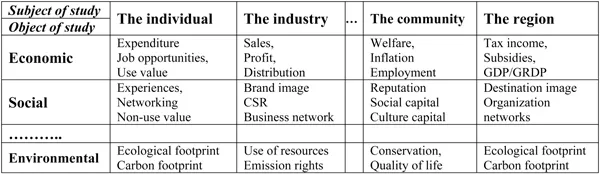
Figure 1. A categorization of event impacts according to subjects and objects of study.
Ulvnes and Solberg (2016) address the question if big events positively affect future tourism to the event destination. They develop a model describing factors that influence individuals’ intention to visit previous host destinations. One explanatory factor is individuals’ explicit memory of previous host destinations and another factor is individuals’ attitude toward media coverage of events. The study reveals that both attitude toward media coverage of events and explicit memory have positive impacts on individuals’ intention to visit a destination. The results of the model test are convincing and significantly advance our understanding of how major sports events induce future tourism.
Andersson, Armbrecht, and Lundberg (2015) make an attempt to extend the impact assessment of events to cover all three major objects of study: economic, sociocultural and environmental impacts. Furthermore, they aim to assess all these event impacts in one common monetary metric. Commensurability is achieved through an integration of concepts from economic, sociocultural and environmental measurement techniques (Andersson & Lundberg, 2013). Thus a monetary assessment is based on several concepts including expenditure, use- and non-use-value, consumer surplus, direct economic impacts, ecological footprint analysis, emission rights and shadow cost. The model is tested on the European athletics indoor championship 2013. The results indicate that sociocultural impacts carry more weight than economic impacts do whereas environmental impacts have little importance for the total monetary assessment mainly explained by a dysfunctional market for emission rights. It is argued that the commensurable assessment provides an opportunity to monitor strategies focusing simultaneously on social, economic and environmental impacts to increase welfare.
Event bidding may present potential solutions to a range of social, cultural and possibly also environmental urban and regional problems and has become more important for destinations. As a result, competition to stage major cultural and sporting events is intensifying, and the cost of bidding is continuously rising (Richards, Dodd, & Palmer, 2014). At the same time, research to assess the impacts of these events has developed different perspectives. Little attention has however been given to the impacts of unsuccessful bidding processes. Using an innovative approach, Richards and Marques (2016) study impacts for local cultural structures and tourism from bidding processes for the European Capital of Culture in the Netherlands in 2018. In particular the authors focus on the less tangible, non-economic effects of an unsuccessful bid, such as network formation, public support for the bidding process and social cohesion.
The contribution of Havlikova (2016) primarily focuses on methodologies to assess the object of social benefits in terms of residents’ perception of a film festival. A Likert scale method is compared to Q-sort methodology. Respondents are confronted with the same set of impacts twice in order to compare the results using the two methods. The results indicate that the Likert scale provided better statistical relevance and easier interpretation of results as well as lower impact variability than Q-sort methodology did. This article gives a good introduction to two useful methods for social impact studies and furthermore identifies advantages with each method as well as differences between the two.
In an attempt to enrich our knowledge about the object of perceived social benefits from festival experiences Meretse, Mykletun, and Einarsen (2015) collect and analyze data on perceived benefits among visitors to Gladmatfestivalen, an annual food event in Stavanger, Norway. Six “Benefit factors” are identified from an exploratory factor analysis. They were: Meeting the performers; Tradition and celebration; Buying and tasting; Food enjoyment and atmosphere; Networking and socializing; and Personal pride and identity. These dimensions constitute a promising avenue to enhance the measurability and our understanding of social impacts of events.
In summary, these articles broaden and deepen our knowledge about event impacts theoretically, methodologically as well as empirically. This fits well with an ambition to develop the Nordic School of festival and event studies (Andersson, Getz, & Mykletun, 2014; Getz & Andersson, 2009). This Special Issue takes stock of research in Nordic countries which expands the domain of study both in terms of objects and subjects of study. The need for new methodologies is addressed as is the demand for a wide academic knowledge base. But research on the social, cultural and environmental impacts and how these can be integrated into holistic models to assess the sustainability of events needs further attention. Innovative methods to describe and examine event experiences, innovations and changes in welfare need to be developed. Much of this future development will attract the attention of researchers in the Nordic school of event studies and their colleagues and collaborators around the academic world.
References
Andersson, T. D., Armbrecht, J., & Lundberg, E. (2015). Triple impact assessments of the 2013 European athletics indoor championship in Gothenburg. Scandinavian Journal of Hospitality and Tourism, 16, 158–179. doi:10.1080/15022250.2015.1108863
Andersson, T. D., Getz, D., & Mykletun, R. J. (Eds.). (2014). Festival and event management in Nordic countries. New York, NY: Routledge.
Andersson, T. D., & Lundberg, E. (2013). Commensurability and sustainability: Triple impact assessments of a tourism event. Tourism Management, 37, 99–109. doi:10.1016/j.tourman.2012.12.015
Dwyer, L., Jago, L., & Forsyth, P. (2016). Economic evaluation of special events: Reconciling economic impact and cost benefit analysis. Scandinavian Journal of Hospitality and Tourism, 16, 115–129. doi:10.1080/15022250.2015.1116404
Getz, D. (2012). Event studies: Theory, research and policy for planned events (2nd ed.). New York: Routledge.
Getz, D., & Andersson, T. D. (2009). Editorial. Scandinavian Journal of Hospitality and Tourism, 9(2–3), 109–111. doi:10.1080/15022250903216979
Havlikova, M. (2016). Likert scale versus Q-table Measures – A comparison of host community perceptions of a film festival. Scandinavian Journal of Hospitality and Tourism, 16, 196–207. doi:10.1080/15022250.2015.1114901
Heldt and Mortazavi. (2016). Estimating and comparing demand for a music event using stated choice and actual visitor behavior data. Scandinavian Journal of Hospitality and Tourism, 16, 130–142. doi:10.1080/15022250.2015.1117986
Meretse, A. R., Mykletun, R. J., & Einarsen, K. (2015). Participants’ benefits from visiting a food festival–the case of the Stavanger food festival (Gladmatfestivalen). Scandinavian Journal of Hospitality and Tourism, 16, 208–224. doi:10.1080/15022250.2015.1108865
Richards, G., Dodd, D., & Palmer, R. (2014). European cultural capital report. (Vol. 5). Arnhem: ATLAS.
Richards, G., & Marques, L. (2016). Bidding for success? Impacts of the European capital of culture bid. Scandinavian Journal of Hospitality and Tourism, 16, 180–195. doi:10.1080/15022250.2015.1118407
Ritchie, J. B. (1984). Assessing the impact of hallmark events: Conceptual and research issues. Journal of Travel Research, 23(1), 2–11. doi:10.1177/004728758402300101
Ritchie, J. B., & Beliveau, D. (1974). Hallmark events: An evaluation of a strategic response to seasonality in the travel market. Journal of Travel Research, 13(2), 14–20. doi:10.1177/004728757401300202
Ulvnes & Solberg. (2016). Can major sport events attract tourists? A study of media information and explicit memory. Scandinavian Journal of Hospitality and Tourism, 16, 143–157.
John Armbrecht
School of Business, Economics and Law at University of Gothenburg,
Gothenburg, Sweden
Tommy D. Andersson
School of Business, Economics and Law at University of Gothenburg, Gothenburg,
Sweden and Molde University College, Molde, Norway
Table of contents
- Cover
- Half title
- Title Page
- Copyright Page
- Table of Condents
- Citation Information
- Notes on Contributors
- 1 Subjects and objects of event impact analysis
- 2 Economic evaluation of special events: Reconciling economic impact and cost–benefit analysis
- 3 Estimating and comparing demand for a music event using stated choice and actual visitor behaviour data
- 4 Can major sport events attract tourists? A study of media information and explicit memory
- 5 Triple impact assessments of the 2013 European athletics indoor championship in Gothenburg
- 6 Bidding for Success? Impacts of the European Capital of Culture Bid
- 7 Likert scale versus Q-table measures – a comparison of host community perceptions of a film festival
- 8 Participants’ benefits from visiting a food festival – the case of the Stavanger food festival (Gladmatfestivalen)
- Index
Trusted by 375,005 students
Access to over 1.5 million titles for a fair monthly price.
Study more efficiently using our study tools.
Frequently asked questions
Yes, you can cancel anytime from the Subscription tab in your account settings on the Perlego website. Your subscription will stay active until the end of your current billing period. Learn how to cancel your subscription
No, books cannot be downloaded as external files, such as PDFs, for use outside of Perlego. However, you can download books within the Perlego app for offline reading on mobile or tablet. Learn how to download books offline
Perlego offers two plans: Essential and Complete
- Essential is ideal for learners and professionals who enjoy exploring a wide range of subjects. Access the Essential Library with 800,000+ trusted titles and best-sellers across business, personal growth, and the humanities. Includes unlimited reading time and Standard Read Aloud voice.
- Complete: Perfect for advanced learners and researchers needing full, unrestricted access. Unlock 1.5M+ books across hundreds of subjects, including academic and specialized titles. The Complete Plan also includes advanced features like Premium Read Aloud and Research Assistant.
We are an online textbook subscription service, where you can get access to an entire online library for less than the price of a single book per month. With over 1.5 million books across 990+ topics, we’ve got you covered! Learn about our mission
Look out for the read-aloud symbol on your next book to see if you can listen to it. The read-aloud tool reads text aloud for you, highlighting the text as it is being read. You can pause it, speed it up and slow it down. Learn more about Read Aloud
Yes! You can use the Perlego app on both iOS and Android devices to read anytime, anywhere — even offline. Perfect for commutes or when you’re on the go.
Please note we cannot support devices running on iOS 13 and Android 7 or earlier. Learn more about using the app
Please note we cannot support devices running on iOS 13 and Android 7 or earlier. Learn more about using the app
Yes, you can access Event Impact by John Armbrecht, Tommy D. Andersson, John Armbrecht,Tommy D. Andersson in PDF and/or ePUB format, as well as other popular books in Business & Hospitality, Travel & Tourism Industry. We have over 1.5 million books available in our catalogue for you to explore.