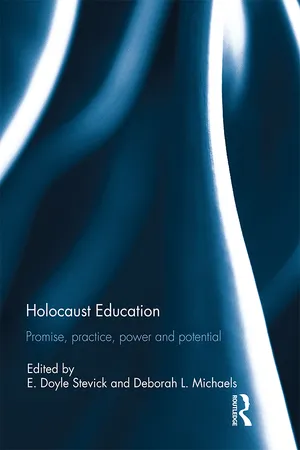
Holocaust Education: Promise, Practice, Power and Potential provides timely studies of some of the most pressing issues in teaching and learning about the Holocaust around the world. Europe is experiencing both anti-Semitic attacks, many by radicals claiming the banner of Islam, and the resurgence of right wing movements that are openly hostile to minority rights, particularly for marginalized and vulnerable groups like the Roma/Sinti, and Muslim refugees. Can Holocaust education, an encounter with the most extreme racial ideology to afflict the continent, reduce violence and prejudice against Jewish and other minority groups? The important studies in this volume address these and other pressing issues for the field, including the progress of Central and Eastern European countries that experienced both Soviet hegemony and Nazi terror in grappling with the history of the Holocaust. This book was originally published as a special issue of Intercultural Education.
eBook - ePub
Holocaust Education
Promise, Practice, Power and Potential
- 190 pages
- English
- ePUB (mobile friendly)
- Available on iOS & Android
eBook - ePub
About this book
Information
Holocaust education in the ‘Black Hole of Europe’: Slovakia’s identity politics and history textbooks pre- and post-1989
Education Department, Grinnell College, Grinnell, IA, USA
Holocaust education in Slovakia stands at the confluence of diverse discourses of state and supra-national legitimation. Principles of national self-determination, minority rights, and political ideologies inform and lend credence to how Slovaks’ national and state identities are narrated in Slovak history textbooks. For small nation-states with limited economic and military power, such as Slovakia, tapping into these discourses is critical to the state’s survival as they signal belonging to larger entities – whether that be the Soviet bloc, the European Union, or more obtusely ‘the West’ – and thus help to forge alliances with more powerful states. However, actors in these same nation-states can be adept at reimagining these international discourses to meet their own national agendas. Through an analysis of secondary-school textbooks published before and after the fall of state socialism, this article evidences how these competing discourses interact to alternately advocate for, obstruct, and complicate the narration of the Holocaust across time and regime change in Slovak schools.
Introduction
In 1997, European Union (EU) representatives discovered that they had sponsored the publication of a Slovak history textbook that glossed over the atrocities of the Holocaust and, in particular, the role that the Slovak government during World War II played in the deportation of more than 70,000 Slovak Jews and hundreds of Slovak Roma, the majority of whom died in Nazi labor camps.1 The textbook in question was Dejiny Slovensko a Slovákov (The History of Slovakia and the Slovaks), written by Slovak émigré historian Milan Ďurica. The Slovak Ministry of Education, headed by the Slovak ethnic nationalist party Slovenská národná strana (SNS), had approved the textbook in 1995 for use in eighth-grade classrooms. The ministry ordered 90,000 copies of the book, which it distributed free of charge to public schools throughout the country with the help of European funding. The irony was that at this time the EU was particularly concerned with suppressing ethnic nationalism in post-socialist countries and promoting multiculturalism in light of the civil wars in Yugoslavia – goals which the Ďurica textbook undermined.
Throughout the 1990s, the Council of Europe invested heavily in Central and Eastern Europe (CEE) in education programs that emphasized ethnic tolerance and multiculturalism – two principles that were to help secure the peaceful and stable expansion of the EU. After the fall of state socialism, Holocaust education in particular had become a litmus test of democratization – a test that Slovakia was evidently failing. Post-socialist states that did not meet US and Western European standards of political, social, and economic transition faced the threat of being denied entry into the North Atlantic Treaty Organization (NATO) and the EU. Indeed, in early 1998, soon after the Ďurica textbook affair became widely publicized, then US Secretary of State Madeleine Albright provocatively decried Slovakia as ‘a black hole on the map of Europe.’2 A year later, Slovakia was overlooked in the 1999 wave of NATO enlargement that admitted to the alliance Slovakia’s neighbors, the Czech Republic, Hungary, and Poland. Slovakia would have to wait another five years before gaining entry into NATO.
Why is it that despite the apparent political and economic advantages of complying with Western pressures, the Slovak government resisted teaching comprehensively about the Holocaust in its school textbooks? In this article, I explore this question by illustrating how Holocaust education in Slovakia stands at the confluence of diverse and, at times, conflicting discourses of state and supra-national legitimation. Principles of national self-determination, minority rights, and political ideologies inform and lend credence to how Slovaks’ national and state identities are narrated in Slovak history textbooks. For small nation-states with limited economic and military power, such as Slovakia, tapping into these discourses is critical to the state’s survival as they signal belonging to larger entities – whether that be the Soviet bloc, the EU, or more obtusely ‘the West’ – and thus help to forge alliances with more powerful states.3 However, actors in these same nation-states can be adept at reimagining these international discourses to meet their own national agendas. Through an analysis of secondary-school textbooks published before and after the fall of state socialism, this paper evidences how these discourses interact to alternately advocate for, obstruct, and complicate the narration of the Holocaust across time and regime change in Slovak schools.
I begin with a section that provides the basic historical and political context necessary to understand the source of Holocaust education debates in Slovakia. I then describe my data sample of history textbooks and weigh the strengths and limitations of textbooks as sources in educational research. I weave into this section comments on the relationship between national identity and narration. The bulk of this paper is dedicated to an analysis and discussion of my findings from studying World War II narratives in Slovak secondary-school textbooks from 1948 to 2010. Specifically, I focus on selected events and figures that dominated descriptions of World War II in pre- and post-1989 Slovak textbooks at the expense of attention to the Holocaust.
Historical and political contexts of the Slovak state
A regional perspective sheds considerable light on the issue of why resistance to Holocaust education exists in Slovakia. As historian Timothy Snyder stresses in Bloodlands (2010), CEE is the territory on which an estimated 14 million people were murdered during World War II in ethnically and politically motivated mass killings. In a bid to distance their national reputations from the crimes against humanity that happened in their own backyard, CEE countries have often denied or downplayed local collaboration with the Nazis and, in turn, emphasized the victimization of their own ethnic nationals during the war.4 Such reactions are obviously counterproductive to an open discussion of the Holocaust in schools.
On top of these issues that are relevant to CEE, more generally, the specific political history of Slovakia provides additional insights into Holocaust education – and the lack thereof – in Slovak schools since the end of the war. The region of Slovakia became, for the first time, its own state during World War II. This achievement of statehood is a point of pride for many Slovak nationals. It signals both the independence of Slovakia from the Hungarian Kingdom, under whose dominion Slovakia had fallen for roughly a millennium, and Slovaks’ autonomy from the Czechs, who politically dominated the First Czechoslovak Republic (1918–1938) and Czechoslovak Socialist Republic (1948–1989). In other words, any emphasis on the Holocaust and Slovakia’s role in it would marr the image of the founding of the First Slovak Republic as a momentous achievement of Slovak national independence.
It became particularly salient to Slovak politicians in the early 1990s to refer to the First Slovak Republic as a landmark event of Slovak statehood. Within a few years after the fall of state socialism, negotiations began between the Czech Prime Minister Václav Klaus and his Slovak counterpart Vladimír Mečiar to split Czechoslovakia into two separate states. This separation was achieved peacefully in 1993 in what became known as the Velvet Divorce, with Slovakia and the Czech Republic emerging as autonomous states. During the Velvet Divorce and in the years immediately following it, the historical precedent of a Slovak state during World War II validated the idea of a post-1989 independent Slovakia – serving as evidence that Slovaks were equipped to manage their own state institutions. In addition, by a nationalist logic of ‘once a nation-state, always a nation-state’ and the principle of self-determination, the very existence of a prior Slovak state dictated the right of Slovaks to an autonomous state in the present.
Unfortunately, this agenda of legitimation worked to obscure important historical facts related to the First Slovak Republic. First and foremost, the reality that some 70,000 Slovak Jews and hundreds of Slovak Roma were stripped of their property and civil rights during this period and transported to death camps obviously undermined the positive picture of the First Slovak Republic that nationalists wished to propagate. Hence, they downplayed or ignored the facts of the Holocaust in their rhetoric. Similarly, questions regarding the degree of complicity of the Slovak leadership as well as that of ordinary Slovak citizens in the atrocities of the Holocaust were unwelcome specters in the 1990s to the Slovak nation-building project.
Another historical issue for post-1989 Slovak nationalists was just how much autonomy the Slovak president Jozef Tiso and his government had during World War II, given the military threat of Nazi Germany. On the one hand, acknowledging the limitations of Slovak autonomy during the war could serve the agenda of Slovak nationalists in the post-socialist era in that it would lessen, though by no means absolve, Slovaks of responsibility for the mass killings of Slovak Jews and Roma. On the other hand, admitting that the First Slovak Republic was a puppet state of the Nazis would erase the historical precedent of an independent Slovak state, which the nationalists depended on in their post-1989 rhetoric.
Meanwhile, emphasizing the diversity of pre-World War II Slovakia with its substantial Jewish and Romani populations ran counter to another ethnic nationalist objective in post-socialist Slovakia: namely, defining what it meant to be ‘Slovak’ in ethnic terms. As nationalist scholars have repeatedly noted, national identity is often constructed against an imagined ‘other.’ In particular, depicting ‘Slovaks’ as distinct from ‘Czechs’ was important in this era of Velvet Divorce to explain the split of Czechoslovakia to the international community as well as to those Czechoslovak citizens commited to the idea of the Czechoslovak Republic. However, constructing Slovakness as essentially different from Czechs, Hungarians, Germans, Roma, Jews, and other neighbors clashed with the ethos of ethnic tolerance that the EU wanted to foster among its potential new member states.
Ethnic tolerance was vital to the EU project, and yet expressions of ethnic nationalism were prevalent in post-socialist Europe, from the civil wars and genocides occurring at this time in the Balkans to the splintering of the former Soviet Union in various corners of its former empire. To the core Western European powers, these ethnic nationalist movements in CEE represented a ghost of Europe Past, of two world wars and Nazi eugenics. In contrast, Europe Future, as imagined by the EU member states in the early 1990s, was to be animated by the spirit of multiculturalism and pan-European identity.5 How then to exorcise the phantom of exclusive ethnic nationalisms from the post-socialist countries of Europe? The EU, along with the US and Israel, deployed to the region a vanguard of educational programs that emphasized tolerance and multiculturalism as key democratic values. Holocaust education was a particularly important facet of these initiatives. The horrors of the Holocaust were to remind CEE citizens of the dangers of ethnic nationalism and simultaneously serve as an object lesson of the value of tolerance.
Contrary to what Western European politicians thought, some subjects of CEE states saw their own expressions of ethnic nationalism not as a regression but as a progression into a future beyond state socialism. In the Soviet bloc during the decades of state socialism, Communist Party leaders tended to emphasize the importance of Communist identity over national identity. Marxist–Leninist doctrine viewed ethnic nationalism as a construct of the bourgeois ruling class that diverted workers in capitalist societies from realizing their common oppression and undermined the creation of a united, international proletariat. Of course, suppressing ethnic nationalism also served the Communist Party leaders in Moscow by subjugating national leaders in satellite states to the Kremlin: as ethnic national identity faded from social relevance in the ideal Communist vision, allegiance to national politicians would also disappear and the Communist vanguard, taking cues from Moscow, would be free to lead. Thus, the rise of ethnic nationalisms in post-socialist Europe was a reaction to and rejection of their state-socialist past and the imposed notion of a Communist, supra-national identity.
Seen in this historical context, the reassertion of Slovak national identity in school textbooks in the 1990s is significantly a response to socialist-era historiography. As this paper will demonstrate, the remaking of World War II narratives in history textbooks in Slovakia in the 1990s tended to follow a pattern of replacing Communist heroes with Slovak heroes and Communist victims with Slovak victims. However, most school textbooks in the decades of state socialism and in the 15 years following the Velvet Revolution hold as a common trait the minimization, if not complete omission, of the Holocaust.
Methodology and rationale for sample selection
My data sources for this paper consist primarily of history textbooks written in Slovak and approved by the Slovak Ministry of Education. This article draws on a subset of the data I collected for a larger study, in...
Table of contents
- Cover
- Half Title
- Title Page
- Copyright Page
- Dedication
- Table of Contents
- Citation Information
- Notes on Contributors
- Introduction – Empirical and Normative Foundations of Holocaust education: Bringing research and advocacy into dialogue
- 1. Holocaust education in the ‘Black Hole of Europe’: Slovakia’s identity politics and history textbooks pre- and post-1989
- 2. The Holocaust as reflected in Communist and post-Communist Romanian textbooks
- 3. ‘And Roma were victims, too.’ The Romani genocide and Holocaust education in Romania
- 4. Teaching about the genocide of the Roma and Sinti during the Holocaust: chances and challenges in Europe today
- 5. The danger of not facing history: Exploring the link between education about the past and present-day anti-Semitism and racism in Hungary
- 6. To teach the Holocaust in Poland: understanding teachers’ motivations to engage the painful past
- 7. Reluctant learners? Muslim youth confront the Holocaust
- 8. Teaching about the Holocaust in English schools: challenges and possibilities
- 9. Holocaust education: global forces shaping curricula integration and implementation
- 10. Reconceptualising the Holocaust and Holocaust education in countries that escaped Nazi occupation: a Scottish perspective
- Index
Trusted by 375,005 students
Access to over 1.5 million titles for a fair monthly price.
Study more efficiently using our study tools.
Frequently asked questions
Yes, you can cancel anytime from the Subscription tab in your account settings on the Perlego website. Your subscription will stay active until the end of your current billing period. Learn how to cancel your subscription
No, books cannot be downloaded as external files, such as PDFs, for use outside of Perlego. However, you can download books within the Perlego app for offline reading on mobile or tablet. Learn how to download books offline
We are an online textbook subscription service, where you can get access to an entire online library for less than the price of a single book per month. With over 1.5 million books across 990+ topics, we’ve got you covered! Learn about our mission
Look out for the read-aloud symbol on your next book to see if you can listen to it. The read-aloud tool reads text aloud for you, highlighting the text as it is being read. You can pause it, speed it up and slow it down. Learn more about Read Aloud
Yes! You can use the Perlego app on both iOS and Android devices to read anytime, anywhere — even offline. Perfect for commutes or when you’re on the go.
Please note we cannot support devices running on iOS 13 and Android 7 or earlier. Learn more about using the app
Please note we cannot support devices running on iOS 13 and Android 7 or earlier. Learn more about using the app
Yes, you can access Holocaust Education by E. Doyle Stevick,Deborah Michaels in PDF and/or ePUB format, as well as other popular books in Education & Education General. We have over 1.5 million books available in our catalogue for you to explore.