eBook - ePub
Tunnels and Underground Structures: Proceedings Tunnels & Underground Structures, Singapore 2000
- 700 pages
- English
- ePUB (mobile friendly)
- Available on iOS & Android
eBook - ePub
Tunnels and Underground Structures: Proceedings Tunnels & Underground Structures, Singapore 2000
About this book
This text describes topics discussed at the conference, including: tunnelling and construction in soft ground and rocks; geological investigations; tunnelling machines; planning for underground infrastructure; safety issues and environmental and social aspects of underground development.
Information
Political and social aspects of present and future tunnelling
International Tunnelling Association (ITA)
ABSTRACT: The use of underground space is winning more and more importance all over the world. This development is justified by the proven positive impact of subsurface construction especially to densely built-up areas. ITA - the International Tunnelling Association - is supporting those activities as one of the key tools for getting our cities more worthwhile to live in as well as more loveable and to form the social and hygienic basis for the increasing number of megalopolises.
1 SIGNIFICANCE OF SUBSURFACE CONSTRUCTION
Generally speaking, we experience our cities from the surface. We can find our way around here, can recall certain groups of buildings and are thus aware at any time just where we are. In cities with which we are unfamiliar, we can obtain decisive initial impressions when encountering it for the first time and compare and evaluate the character of the place we are visiting with towns we have got to know before. This normal pattern of behaviour also explains why so many of our fellow human beings prefer transportation systems which are on the surface.
Most inhabitants of a city as well as its visitors are far more familiar with the structure above ground than the multifareous infrastructure below the surface of the earth. Supply lines for gas, water, electricity, telecommunications and distance heating are located here along with a diversified network of disposal lines (Fig. 1). In large cities, there are also transport tunnels for rail commuter traffic, long-distance trains, motor vehicles and pedestrians. In many cases, this subsurface urban landscape is rounded off in built-up areas by private transport tunnels, underground garages, with as many as four or five storeys in the case of large administrative buildings, subterranean shopping malls and storage rooms, covered watercourses and many other special facilities.
Should local conditions demand and facilitate this, even production halls, offices, sports facilities and churches are set up underground. In this connection, especially impressive examples are to be found in North America, Japan and Scandinavia.
Our modern cities are almost incapable of sustaining themselves without this subsurface infrastructure, which is not identifiable at first glance. This very soon becomes evident when the chaotic conditions prevailing in some cases in the multimillion cities on the African, Asian and South American continents are taken into consideration. This does not simply apply to the hopelessly congested streets in the downtown areas. If anything, it is shown here too that a subsurface infrastructure represents an important prerequisite for public health right up to banishing the danger of disease. Even during the 1990s, this has been clearly underlined through examples of cholera and plague epidemics in parts of Central and South America as well as on the Indian sub-continent.
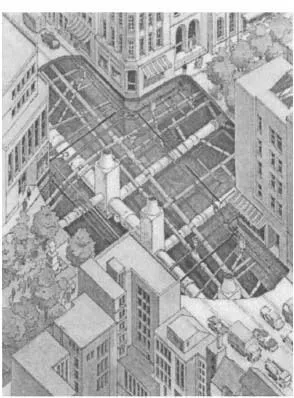
Fig. 1: Variety of the underground infrastructure of a city
The overriding significance of an inner urban subsurface infrastructure in order to create decent conditions in the major built-up areas was once again emphasised not all that long ago at the United Nations HABITAT-II Conference in Istanbul, Turkey, in June 1996. More than 15,000 delegates from all over the world mulled over and discussed the prerequisites for humane living conditions in human settlements taking the varying climatic, topographical and cultural marginal conditions in different regions of the globe into account.
Apart from the built-up areas themselves, the utilisation of underground space is experiencing high and ever increasing significance in less densely populated regions. Attractive and fast transport links between industrial centres call for high-performance transport arteries for the economic, speedy and unhampered carriage of people and goods. Important impulses for the economic power of a region or nation are provided by transport development and links. As a consequence, tunnels for roads and railways are being built or planned to a great degree for crossing mountain ranges, rivers and straits.
Let us briefly mention at this point that apart from the use of underground space for civil purposes, there is in some cases, exploitation world-wide for all kinds of military facilities. The construction and maintenance of these facilities possess a not inconsiderable economic importance.
There is no doubt that the construction of transport tunnels and subsurface construction in general has reached a high standard in many countries. In more than 100 cities with populations in excess of 500,000, metros, urban railways or rapid transport systems travelling beneath the surface in inner urban areas have been built or further developed during the last 30 to 40 years. In Europe, Berlin, Budapest, Hamburg, London and Paris are numbered among the first cities starting with such modern rail commuter systems at the end of 19th, beginning of 20th century.
In conjunction with building tunnels for long-distance road and rail links, in Europe, first and foremost, the efforts which started in the early 1980s to develop high-speed rail traffic deserve mention (Fig. 2). A number of these new lines possess a very high proportion of tunnels between say 30 and 40 per cent with overall section lengths of 100 to 350 km. Basically, the situation world-wide is similar as e.g. in Japan, or plans drawn up in Taiwan, South Korea as well as other countries.
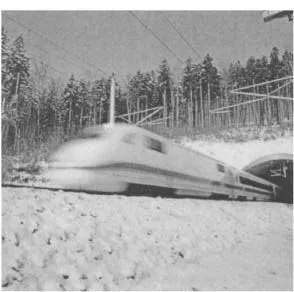
Fig. 2: Fast train ICE leaving a tunnel
In summing up, it can be established that currently there are a number of countries which are extremely active in tunnelling (Fig. 3). In Germany for instance, contracts were awarded for roughly 25 km of transport tunnels annually on average during the last ten years, which were then completed following a commensurate length of time. 10 to 12 km of this total is accounted for by metro, urban and rapid transit system tunnels, some 5 km by long-distance rail tunnels and around 10 km by road tunnels. For the years to come, an increase especially with respect to long-distance rail tunnels can be anticipated. Mining has not been included in this study.
Currently, the overall length of operational transport tunnels in Germany alone can be accepted to amount to roughly 1,200 km. Throughout Europe, the figure is well in excess of 10,000 km, in other words, more than from Lisbon to Moscow and back! The situation elsewhere in the world, for instance in North America or in South-East Asia is similar.
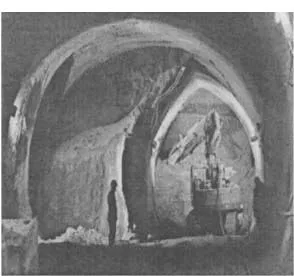
Fig. 3: Constructing a traffic tunnel by using the sequential excavation method
2 EFFECTS OF SUBSURFACE CONSTRUCTION ON THE ENVIRONMENT
“Till the earth and subdue it!” This biblical saying from the First Book of Moses (Genesis), Chapter 1, Verse 28 calls for a high degree of responsibility not only vis-a-vis one’s fellow human beings but also with regard to dealing with nature and the world around us in a responsible fashion. Tunnelling and underground construction in general can afford a considerable contribution in this respect. Many examples from all over the world have been able to underline this, particularly over the past years. Thus the financial efforts which have gone on in Europe, North America and Japan for some three to four decades now in conjunction with constructing metros, the relocating of especially busy roads in inner urban areas at greater depths, the conversion of railway lines into high-speed routes, and finally the expansion or renovation of many main collectors...
Table of contents
- Cover
- Half Title
- Title Page
- Copyright Page
- Table of Contents
- Foreword
- Organisation
- 1 Keynote papers
- 2 Tunnelling in Asian regions
- 3 Tunnelling in soft ground
- 4 Tunnelling in rocks
- 5 Deep excavation
- 6 Settlement and structures
- 7 Planning, investigation and ground improvement
- Author index
Trusted by 375,005 students
Access to over 1.5 million titles for a fair monthly price.
Study more efficiently using our study tools.
Frequently asked questions
Yes, you can cancel anytime from the Subscription tab in your account settings on the Perlego website. Your subscription will stay active until the end of your current billing period. Learn how to cancel your subscription
No, books cannot be downloaded as external files, such as PDFs, for use outside of Perlego. However, you can download books within the Perlego app for offline reading on mobile or tablet. Learn how to download books offline
Perlego offers two plans: Essential and Complete
- Essential is ideal for learners and professionals who enjoy exploring a wide range of subjects. Access the Essential Library with 800,000+ trusted titles and best-sellers across business, personal growth, and the humanities. Includes unlimited reading time and Standard Read Aloud voice.
- Complete: Perfect for advanced learners and researchers needing full, unrestricted access. Unlock 1.5M+ books across hundreds of subjects, including academic and specialized titles. The Complete Plan also includes advanced features like Premium Read Aloud and Research Assistant.
We are an online textbook subscription service, where you can get access to an entire online library for less than the price of a single book per month. With over 1.5 million books across 990+ topics, we’ve got you covered! Learn about our mission
Look out for the read-aloud symbol on your next book to see if you can listen to it. The read-aloud tool reads text aloud for you, highlighting the text as it is being read. You can pause it, speed it up and slow it down. Learn more about Read Aloud
Yes! You can use the Perlego app on both iOS and Android devices to read anytime, anywhere — even offline. Perfect for commutes or when you’re on the go.
Please note we cannot support devices running on iOS 13 and Android 7 or earlier. Learn more about using the app
Please note we cannot support devices running on iOS 13 and Android 7 or earlier. Learn more about using the app
Yes, you can access Tunnels and Underground Structures: Proceedings Tunnels & Underground Structures, Singapore 2000 by Rahan Krishnan,Jian Zhao,J. Nicholas Shirlaw,J. Zhao,J.N. Shirlaw,Krishnan R. in PDF and/or ePUB format, as well as other popular books in Tecnologia e ingegneria & Ingegneria civile. We have over 1.5 million books available in our catalogue for you to explore.