- 517 pages
- English
- ePUB (mobile friendly)
- Available on iOS & Android
eBook - ePub
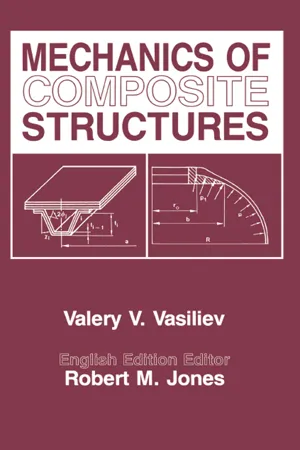
Mechanics Of Composite Structures
About this book
This book compiles techniques used to analyze composite structural elements ranging from beams through plates to stiffened shells. The content is suitable for graduate-level students with a basic background in mechanics of composite materials. Moreover, this book will be placed in an active spot on the bookshelves of composite structures designers as well as researchers.
Information
Chapter 1
INTRODUCTION TO STRUCTURAL PROPERTIES OF COMPOSITE MATERIALS
A composite material is a nonhomogeneous material having two or more components including reinforcing elements that provide necessary mechanical characteristics of the material and a matrix that allows uniform deformation of the reinforcements. The mechanical behavior of a composite material is determined by the properties of reinforcements and the matrix as well as by the adhesive strength at their interfaces. The properties of the composite material depend on those of the initial components and the methods used to combine them in one material. Different matrices and reinforcements can be combined to synthesize composite materials possessing both the properties of the initial components and also some new valuable characteristics. For example, interfaces between the reinforcements and the matrix substantially increase the fracture toughness of the material. Therefore, in contrast to metals, in composite materials, an increase in the static strength results, as a rule, and an increase in fracture toughness according to Mileiko [1]. In the following, we consider the main properties of reinforcements, various matrices, and composite materials made from them.
1.1 FIBERS
In modern composite materials, extensive use is made of thin, 5-200 × 10−6m in diameter, continuous or chopped fibers playing the part of reinforcements themselves or providing the basis for producing yarns, yarn bundles, and cloth of various weave types. Fibers must meet a set of operational and technical conditions. These requirements are imposed on their strength, stiffness, density, and stability during their operating life. Processability of fibers allows the development of efficient manufacturing processes. One more important requirement is the compatibility of fibers with the matrix material. Components are considered to be compatible if the adhesive strength at their interface is close to the matrix strength. Now consider the basic types of fibers.
1.1.1 Glass Fibers
Continuous glass fibers are 3-20 × 10−6m in diameter and are characterized by 2-6 GPa tensile strength, 50-100 GPa modulus of elasticity, and 2400-2600 kg/m3 density. The strength of such glass fibers essentially depends on temperature. With a decrease in temperature down to −196°C, the tensile strength increases by a factor of 1.5-2.0. Increasing the temperature decreases the tensile strength, especially below 300°C. The stiffness of glass fibers decreases only slightly with temperature rise up to the softening point.
In 1920, Griffith used glass fibers in the experiments that gave rise to mechanics of brittle fracture [2]. He established the major property of thin fibers – their high tensile strength in comparison with monolithic materials. As is well known, the strength of a material predicted with solid state physics considerably exceeds the experimental strength of real materials. In particular, the calculated tensile strength of glass was estimated by Griffith as 14 GPa, whereas the tensile strength of glass rods 1 × 10⁻³m in diameter turned out to be 1...
Table of contents
- Cover
- Half Title
- Title Page
- Copyright Page
- Table of Contents
- Preface
- Translation Editor’s Preface
- Chapter 1 INTRODUCTION TO STRUCTURAL PROPERTIES OF COMPOSITE MATERIALS
- Chapter 2 EQUATIONS OF COMPOSITE STRUCTURE MECHANICS
- Chapter 3 COMPOSITE BEAMS, COLUMNS, AND RINGS
- Chapter 4 THIN-WALLED BEAMS
- Chapter 5 COMPOSITE PANELS AND PLATES
- Chapter 6 CIRCULAR CYLINDRICAL SHELLS
- Chapter 7 AXISYMMETRIC DEFORMATION OF SHELLS OF REVOLUTION
- References
- Index
Trusted by 375,005 students
Access to over 1.5 million titles for a fair monthly price.
Study more efficiently using our study tools.
Frequently asked questions
Yes, you can cancel anytime from the Subscription tab in your account settings on the Perlego website. Your subscription will stay active until the end of your current billing period. Learn how to cancel your subscription
No, books cannot be downloaded as external files, such as PDFs, for use outside of Perlego. However, you can download books within the Perlego app for offline reading on mobile or tablet. Learn how to download books offline
Perlego offers two plans: Essential and Complete
- Essential is ideal for learners and professionals who enjoy exploring a wide range of subjects. Access the Essential Library with 800,000+ trusted titles and best-sellers across business, personal growth, and the humanities. Includes unlimited reading time and Standard Read Aloud voice.
- Complete: Perfect for advanced learners and researchers needing full, unrestricted access. Unlock 1.5M+ books across hundreds of subjects, including academic and specialized titles. The Complete Plan also includes advanced features like Premium Read Aloud and Research Assistant.
We are an online textbook subscription service, where you can get access to an entire online library for less than the price of a single book per month. With over 1.5 million books across 990+ topics, we’ve got you covered! Learn about our mission
Look out for the read-aloud symbol on your next book to see if you can listen to it. The read-aloud tool reads text aloud for you, highlighting the text as it is being read. You can pause it, speed it up and slow it down. Learn more about Read Aloud
Yes! You can use the Perlego app on both iOS and Android devices to read anytime, anywhere — even offline. Perfect for commutes or when you’re on the go.
Please note we cannot support devices running on iOS 13 and Android 7 or earlier. Learn more about using the app
Please note we cannot support devices running on iOS 13 and Android 7 or earlier. Learn more about using the app
Yes, you can access Mechanics Of Composite Structures by V.V. Vasiliev in PDF and/or ePUB format, as well as other popular books in Technology & Engineering & Civil Engineering. We have over 1.5 million books available in our catalogue for you to explore.