
eBook - ePub
Soft Soil Engineering
- 720 pages
- English
- ePUB (mobile friendly)
- Available on iOS & Android
eBook - ePub
Soft Soil Engineering
About this book
This volume contains seven keynote lectures and over 100 technical contributions by scientists, researchers, engineers and students from more than 25 countries and regions worldwide on the subject of soft soil engineering.
Information
Long term behavior finite element analysis of a dam with in situ measurements of the viscoplastic properties of its foundations
Laboratory of Soils, solids and Structures, Joseph Fourier University, Grenoble, France
ABSTRACT: This paper first deals with the validation of a Soft Soil Creep Model (SSCM) applied to model the behavior of a dam. The well-known logarithmic creep law for secondary compression is transformed in to a differential form in order to include transient loading conditions. This 1-D creep model for oedometer-type strain conditions is then extended towards general 3-D states of stress and strain by incorporating concepts of Modified Cam-Clay and viscoplasticity. The behavior of earth works on soft soils is the second aim of this paper. Considering the study led by EDF (Electricity of France), related to the settlement of the Flumet dam (south east of France), and the in situ Diflupress tests at the Flumet site, it can be seen that phenomena such as secondary compression, are quite well represented by the model. Comparing the theoretical results with the experimental settlements measured, it appears that the SSCM is successfully validated, and therefore suitable for predictive computations.
1 INTRODUCTION
Modelling of the behavior earth works founded on soft soils is the aim of this communication. It is well known that some long term evolution are caused by the creep of soft soil loaded by embankments; these problems are of two types: stability and settlement. A prior study should define the law of settlement as a function of time and should recommend possible methods to reduce or to accelerate this settlement. Then, a solution should be chosen, on the one hand, from economic considerations and, on the other hand, from the technical data arising from the conclusions of the stability and settlement studies. The technical aspects of this paper essentially deal with the study of the settlement of constructions on soft soil. The aim of these researches was to follow and describe the behavior of one dam and using a new in situ device called “Diflupress” and to interpret the observations [Bufi (1990), Leidwanger et al (1994a), Leidwanger et al (1994b)]: The in situ device is a pressuremeter adapted to long time loading (Typical loading time: about 15 days) with probes of 1m in length. The study presented in this paper has been achieved by the undertaking of a research program in order to validate the elastic viscoplastic model that accounts for secondary compression (SSCM), formulated by Vermeer et al (1997, 1999).
After a review of the features of the model used, the data of the Flumet dam, the hypotheses and the results of the finite element calculations will be presented, and then compared with the settlements observed during a period of more than twenty years on the site.
2 DESCRIPTION OF THE SOFT SOIL CREEP MODEL
Within the Soft Soil Model of PLAXIS (1995), it is assumed that there is a logarithmic relation between the volumetric strain, εv, and the equivalent effective stress, P’, which can be formulated as:
(1) |
The parameter λ* so-called “modified compression index”, allows for determining the compressibility of the material in primary loading. When plotting Eq. (1) one obtains a straight line as shown in figure 1. During isotropic unloading and reloading a different line is followed, verifying the equations:
(2) |
The dimensional the validity of expressions (1), (2) results from using a minimum value of (P’0) equal to 1 (stress units). The parameter к* is the so. called “modified swelling index”, which determines the compressibility of the material in unloading and subsequent reloading. The soil response during unloading and reloading is assumed to be elastic, which explains the superscript ‘e’ in Eq. (2). If should be noticed that λ*, к* differ from the more conventional indexes λ, к as used e.g. by Burland (1965). This is because Eq. (1) and (2) involve the volumetric strain instead of the void ratio. The ratio λ*/κ* is, however, equal to the ratio λ/κ.
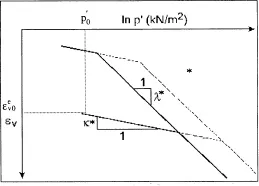
Figure 1 Meaning of the parameters λ* and к* in isotropic compression at a constant rate of loading. For higher loading rates, the primary compression line (λ*) will move parallel.
The Soft Soil Model is a plasticity model with a cap hardening. In this model strains are composed of elastic (reversible) strains and plastic (irreversible) strains. The Soft Soil model is very useful to simulate the behavior of normally consolidated clays and peat in primary loading, as long as time aspects are of minor importance. Although the model can be used in a consolidation analysis, it is not suitable for secondary compression (creep). For a detailed description and theoretical formulation of the Soft Soil Model see Brinkgreve (1994).
The ne...
Table of contents
- Cover
- Half Title
- Title Page
- Copyright Page
- Table of Contents
- Preface
- Organisation
- Keynote Lectures
- Slope Stability and Landslide
- Hazard Mitigation and Risk Management
- Foundation Settlement
- Centrifuge and Physical Modelling
- Analytical Analysis and Constitutive Modelling
- Numerical Modelling
- Case Study and Large-scale Experiment
- Soil Improvement Technique
- Embankment
- Chemical Stabilisation and Modification
- Material Behaviour
- Theoretical Analysis and Development
- Mini-symposium on Marine Clay
- Author index
Trusted by 375,005 students
Access to over 1.5 million titles for a fair monthly price.
Study more efficiently using our study tools.
Frequently asked questions
Yes, you can cancel anytime from the Subscription tab in your account settings on the Perlego website. Your subscription will stay active until the end of your current billing period. Learn how to cancel your subscription
No, books cannot be downloaded as external files, such as PDFs, for use outside of Perlego. However, you can download books within the Perlego app for offline reading on mobile or tablet. Learn how to download books offline
Perlego offers two plans: Essential and Complete
- Essential is ideal for learners and professionals who enjoy exploring a wide range of subjects. Access the Essential Library with 800,000+ trusted titles and best-sellers across business, personal growth, and the humanities. Includes unlimited reading time and Standard Read Aloud voice.
- Complete: Perfect for advanced learners and researchers needing full, unrestricted access. Unlock 1.5M+ books across hundreds of subjects, including academic and specialized titles. The Complete Plan also includes advanced features like Premium Read Aloud and Research Assistant.
We are an online textbook subscription service, where you can get access to an entire online library for less than the price of a single book per month. With over 1.5 million books across 990+ topics, we’ve got you covered! Learn about our mission
Look out for the read-aloud symbol on your next book to see if you can listen to it. The read-aloud tool reads text aloud for you, highlighting the text as it is being read. You can pause it, speed it up and slow it down. Learn more about Read Aloud
Yes! You can use the Perlego app on both iOS and Android devices to read anytime, anywhere — even offline. Perfect for commutes or when you’re on the go.
Please note we cannot support devices running on iOS 13 and Android 7 or earlier. Learn more about using the app
Please note we cannot support devices running on iOS 13 and Android 7 or earlier. Learn more about using the app
Yes, you can access Soft Soil Engineering by A.K.L. Kwong,C.K. Lau,C.F. Lee,C.W.W. Ng,P.L.R. Pang,J.-H Yin,Z.Q. Yue in PDF and/or ePUB format, as well as other popular books in Technology & Engineering & Civil Engineering. We have over 1.5 million books available in our catalogue for you to explore.