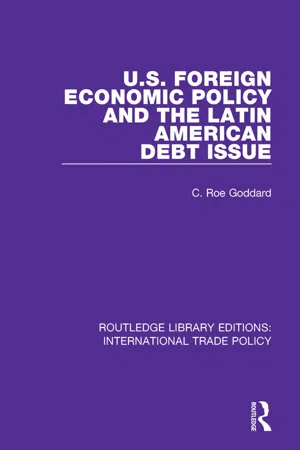
This book, first published in 1993, closely examines the United States government's policy toward the Latin American debt crisis in the years 1982 to 1985. The United States under Reagan sought to maintain the problem as strictly a private creditor/debtor issue, and avoided the internationalization of the problem. With the election of Bush, however, government policy changed in 1989, and this book analyses the different approaches of both administrations, the successes and failures of their policies, and the eventual resolution of the debt crisis.
- 168 pages
- English
- ePUB (mobile friendly)
- Available on iOS & Android
eBook - ePub
U.S. Foreign Economic Policy and the Latin American Debt Issue
Chapter 1
The International Debt Crisis Enters the 1980s
The international debt crisis as it unfolded in the 1980s had a disastrous impact on the economies of the Latin American debtors. The debt problems of Mexico, Brazil and Argentina have wreaked havoc on their economies and dramatically reduced the standard of living of their populations. While there is widespread agreement concerning the results of the payments crises, there is considerable disagreement over the original causes.
It is difficult to attribute the origins of the debt crisis to a single cause. Economics in general and international economics in particular lack the scientific precision that would allow us to recreate the debtor countries’ economic histories, distinguish among and assign weights to national and international economic and social factors, and rank these factors in terms of their positive or negative impacts on a country’s economic health. This inability to identify the causes of the debt crisis with scientific precision, let alone to reach an international consensus on how to address the debt problem, translates into an ongoing debate. The contending parties divide along ideological, national, and organizational lines.
Even to catalogue the disparate views concerning the causes of the debt crisis is not an easy task. Classification schemes invariably lose much of the richness of the debate. However, for readers unfamiliar with the international debt issue and dynamics of the international financial marketplace as a whole, an exercise of this sort will serve a useful function. Although a virtually unlimited number of factors contributed to the debt problems of Mexico, Brazil and Argentina, they can be clustered into two general sets: national and international.
National factors
Many observers emphasize the national economic policies adopted by the Latin American governments, both past and present, as the major source of the debt problem. Those adopting this position trace the seeds of the crisis back to the region's spectacular growth of the 1960s and the desire to maintain that level of growth in the changed international environment of the 1970s. In the period from 1950 until the quadrupling of oil prices in 1973, Latin America was able to achieve a relatively high level of growth. In fact, between the years 1950 and 1980, Latin America’s growth averaged 5.5 percent annually. By the mid-1960s, Latin America’s percentage of world trade hit previously unmatched levels, encouraging further expansion and diversification of the export sector. By the time of the 1973-74 oil crisis, Latin America’s growth rate was higher than that of the industrialized world.1
The events of 1973 changed the international economic environment dramatically. The stable environment upon which Latin America’s growth was predicated in the three previous decades disappeared with the quadrupling of oil prices in 1973-74. As the price of energy rose, it produced serious contractions in the world economy. Both the industrialized and the developing world felt the stresses of higher energy costs and the resulting inflation and recession. Following the 1973 Arab-Israeli War, the price of crude oil increased from $3 to $12.50 per barrel.2 The anti-inflationary, and consequently, recessionary policies adopted by the industrialized countries imposed downward pressures on exports from the less developed countries (LDCs). The impact of these policies was to reduce the price index for Latin America’s major agricultural exports from 121.2 in 1974 to 100 in 1975. Latin America’s reserves were also feeling the pinch of the new international economic environment. Whereas, in 1973, the region paid $1,610 million for crude oil imports, the figure jumped to $5,065 million in 1974.3
Five general policies adopted by the Latin American governments are contributing factors to their debt problems: the contracting of international loans in order to maintain high growth levels, import-substitution development strategies, opposition to direct foreign investment, the pursuit of monetary policies conducive to capital flight, and a general unwillingness to impose austerity measures on their populations.
Economic Growth Through International Loans. The attempt to maintain high growth rates characteristic of the pre-embargo era in the post-1973 international economy is the key to Latin America’s borrowing patterns. Instead of confronting the changed environment by accepting the inflationary impact of higher energy prices and a slower level of growth, the Latin American governments sought to avoid the adjustments and to maintain pre-1973 levels of growth. In the 1970-75 period, the region averaged a 6.4 percent gross domestic product (GDP) annual growth rate. By the end of 1975 the international recession had reduced the rate to 1.2 percent. This slowdown simply was not acceptable to the Latin American governments. Trying to maintain the pre-1973 growth rates, and faced with the dilemma of expanding productive capacities without inflation or serious balance of payments problems, Latin America became dependent on external indebtedness as the source of capital for continued deficit spending. Accordingly, Latin America ’s public sector deficit spending increased from 2.41 percent GDP in 1973 to 3.69 percent in 1975.4
The method by which Latin America achieved such high growth rates contributed to the structural dilemmas and the debt repayment problems it would confront in the 1980s. In lieu of an adequate supply of domestic savings, the region adopted a strategy of economic development through international borrowing. The planned goal was to supplement capital input to increase investment and economic growth. Since credit was widely available and inexpensive, deficit spending quickly became excessive. In addition, high growth rates and external borrowing were reinforcing. The more successful economies experienced rapid economic growth as a result of their investments. This, in turn, encouraged deficit spending, and as the sovereign borrowers became more accustomed to high growth rates, they also became more dependent upon external private sources of capital.5
It is certainly arguable that a portion of the new credit ultimately found its way into productive equity investment. However, much of the financing supported “indiscriminate policies of greater external openness which implied a sharp expansion of imports.”6 Unfortunately, a high proportion of these imports were consumer and not capital goods. Thus, while during the 1970-to-1980 period, Latin America did experience an increase in exports, the import volume also increased significantly.7 Funds that were not used for the purchase of consumer goods were invested largely in the notoriously inefficient state sector. Public spending in Latin America increased considerably as a proportion of GDP throughout the 1970s. By 1982, Mexico’s public enterprise deficit was estimated to be 10 percent of GDP.8 The tremendous growth experienced in the state sector during the 1970s was largely a product of the dramatic increase in external borrowing.
Inefficiency and corruption within the state enterprises were also major factors behind the large deficits and the subsequent need for additional external financing. Since public enterprises typically do not function under competitive pressures, there is little incentive for cost control. Furthermore, governments often hold down the prices of the enterprises’ outputs to control inflation, which in turn decreases revenues to the enterprises and propels them to seek other sources of financing.
The need for external financing for a growing public sector negatively impacts the overall economy in several other respects. First, by absorbing available capital, it can crowd out or raise the cost of capital to the private sector. In this manner, the private sector’s operating costs increase, having an adverse impact on their international competitiveness. Second, inflation also will increase as public sector borrowing from the central bank increases the rate of monetary growth. Thus general inefficiency and monetary complications result when the public sector, reliant upon external sources of capital, serves as the engine of growth for the national economy.
More responsible policies might have produced a reduction in deficit spending in an effort to adjust to the increase in the price of oil imports and the recession in the global economy. However, Latin America’s national economic policies precluded any reduction in growth and spending. As a result, in a few brief years, the growth of the region’s external debt became a major characteristic of its development efforts and of its inability to adjust to the new international economic environment.
Policy of Import-Substitution Industrialization. The second national economic policy that contributed to Latin America’s debt problems by detracting from its ability to compete in the international economy was the policy of import-substitution industrialization. To demonstrate this point, compare the development strategies of several of the more successful East Asian nations with the strategies of the Latin American LDCs. Since the East Asian nations pursued different development strategies and are coping quite well with recent strains in the world economy, this exercise may reveal flaws in Latin American development strategies.
In the early 1950s, the East Asian newly industrializing countries (NICs), adopted strategies of import-substitution that were much milder than those of other developing countries. Although they adopted the usual protectionist policies, including import-licensing, tariffs, overvalued exchange rates, and artificially low interest rates, their application was more flexible, less severe, and of a shorter duration than in the Latin American countries.9
During an import-substitution phase, the home market eventually becomes saturated and growth rates level off. At this point, the government must choose between two options if growth levels are to be maintained. The first option retains import-substitution but shifts to other imported goods that may not employ the elements of the production process, such as capital or labor, with which they are naturally endowed. This decreases the overall efficiency of the economy and hinders the competitiveness of that particular industry. The second option exports originally substituted goods that employed those elements of the production process with which they were endowed. To pursue the second option, a change in government policy, away from market intervention, must occur.
In order for domestic industries to compete, exchange and interest rates need to be maintained at a more realistic level, and overall protection needs to be curtailed.10 The pursuit of the second option by the East Asian NICs accounts for their more enviable trade position.
The Latin American NICs also adopted import-substitution policies. These policies were both more severe and longer in duration. The East Asian NICs, at the end of their initial import- substitution phase, shifted to export-oriented policies employing those factors of production with which they were naturally endowed. The Latin American countries continued and broadened their import-substitution by shifting to more sophisticated capital- and technology-intensive goods. They did this without first exhausting their labor surplus by means of export substitution.11
The result of this divergence was that the East Asian NICs were more competitive and export-oriented than the Latin American countries. Since the end of World War II East Asian exports have risen from 10% to 60% of GDP while Latin American exports have risen from 10% to only 15% of GDP.12 Consequently, East Asia’s capacity for generating foreign earnings for debt repayment far exceeds the limited debt-servicing capacity of the Latin American economies.
Opposition to Direct Foreign Investment. ln addition to having inefficient patterns of industrialization and an expanded public sector, the Latin American countries opposed direct foreign investment. Their rejection of this alternative source of developmental capital to external borrowing also affected the current debt picture. Rising opposition in the 1960s and 1970s to direct foreign investment by multinational corporations has forced the Latin American countries to rely on other sources of foreign capital. As a result of this opposition the net inflows of direct foreign investment have declined relative to flows from other sources. For example, during the 1950s and 1960s, direct investment was the dominant form of external capital, far surpassing other sources of external capital. Between 1950 and 1976, direct investment had increased from $12 billion to $140 billion. However, by the end of the 1970s direct investment as a percentage of total capital inflows had dropped to 20 percent from a high of 30 percent in the 1960s.13
This decline could be explained as a consequence of the relative increase in the recycling of petrodollars. However, the evolving relationship between multinational corporations (MNCs)and the LDCs of Latin America also comes into play. Mutual dissatisfaction had arisen between the MNCs and host LDCs. Distasteful MNC practices such as transfer pricing, corruption, and domestic political involvement have all provoked the host countries to reevaluate the advisability of direct investment as a source of external capital. To control the MNCs, host countries have instituted regulations concerning ownership, source of inputs, and profit remittance.
Rising LDC regulation and declining western government influence in the third world dampened MNC interest in direct investment in many third world countries.14 Declining foreign investment and LDC reliance on other sources of finance have heavily impacted the LDC debt structure. In the past, the debt structure had been imbalanced in favor of equity over debt; now the exact opposite was true.
Persistence of Capital Flight. Another feature common to Latin American countries, which decreased their debt-servicing ability, was capital flight. National economic policies, in many instances, worsened the domestic economic situation and induced or created conditions conducive to capital flight. Distorted exchange-rate and interest-rate policies have been an important cause of capital flight. Overvalued exchange rates not only decreased the competitiveness of LDC exports and worsened the trade deficit but also encouraged local residents to borrow abroad. Additionally, interest rates, which were kept artificially low, further contributed to capital flight by making foreign-currency- denominated assets more profitable.15 Mexico, Brazil, and Argentina pursued domestic policies that seriously increased their financing problems by inducing capital flight.16
Lack of Political Will to Impose Austerity Measures. In light of the potential for political instability in the Latin American debtor countries, it is not surprising that the political leadership pursued policies that might in the long run be harmful but in the short run maintain a stable domestic economic environment. In a general sense, the debtor governments were faced with two broad policy options when dealing with deficits of the magnitude that existed following the 1973-74 and 1978-79 oil price shocks. They could have pursued a politically more risky course, which would have involved abruptly slowing down economic growth by curbing development objectives, imposing tight import restrictions, and rejecting the lure of external capital. This course of action would have imposed severe hardships on their populations and cou...
Table of contents
- Cover
- Half Title
- Title Page
- Copyright Page
- Table of Contents
- Preface and Acknowledgments
- Introduction
- 1 The International Debt Crisis Enters the 1980s
- 2 U.S. Intervention in the Debt Renegotiations of Mexico, Brazil and Argentina: AnEffort in Market Maintenance
- 3 A Systemic-centered Explanation of U.S. Foreign Economic Policy and the Latin American Debt Crisis
- 4 Common Beliefs, Values, and Perspectives: The Economic Culture of the Reagan Administration
- 5 Anatomy of the State: The Role of Governmental Structure and Process
- 6 Conclusion
- Notes
- Bibliography
- Index
Trusted by 375,005 students
Access to over 1.5 million titles for a fair monthly price.
Study more efficiently using our study tools.
Frequently asked questions
Yes, you can cancel anytime from the Subscription tab in your account settings on the Perlego website. Your subscription will stay active until the end of your current billing period. Learn how to cancel your subscription
No, books cannot be downloaded as external files, such as PDFs, for use outside of Perlego. However, you can download books within the Perlego app for offline reading on mobile or tablet. Learn how to download books offline
Perlego offers two plans: Essential and Complete
- Essential is ideal for learners and professionals who enjoy exploring a wide range of subjects. Access the Essential Library with 800,000+ trusted titles and best-sellers across business, personal growth, and the humanities. Includes unlimited reading time and Standard Read Aloud voice.
- Complete: Perfect for advanced learners and researchers needing full, unrestricted access. Unlock 1.5M+ books across hundreds of subjects, including academic and specialized titles. The Complete Plan also includes advanced features like Premium Read Aloud and Research Assistant.
We are an online textbook subscription service, where you can get access to an entire online library for less than the price of a single book per month. With over 1.5 million books across 990+ topics, we’ve got you covered! Learn about our mission
Look out for the read-aloud symbol on your next book to see if you can listen to it. The read-aloud tool reads text aloud for you, highlighting the text as it is being read. You can pause it, speed it up and slow it down. Learn more about Read Aloud
Yes! You can use the Perlego app on both iOS and Android devices to read anytime, anywhere — even offline. Perfect for commutes or when you’re on the go.
Please note we cannot support devices running on iOS 13 and Android 7 or earlier. Learn more about using the app
Please note we cannot support devices running on iOS 13 and Android 7 or earlier. Learn more about using the app
Yes, you can access U.S. Foreign Economic Policy and the Latin American Debt Issue by C. Roe Goddard in PDF and/or ePUB format, as well as other popular books in Business & Business General. We have over 1.5 million books available in our catalogue for you to explore.