Clause structure: The main road of MAP Grammar
MAP Grammar starts with the following assumptions and research findings from linguistics and applied linguistics:
- Second Language Acquisition (SLA) research has revealed that every second or foreign language learner makes grammatical errors (see, for example, Corder, 1981; Ellis, 1994), and such learner errors can be differentiated in terms of gravity for communicative purposes – i.e., ‘global errors’ and ‘local errors’ (see Burt, 1975).
- Since English is a fixed-word-order language (Pinker, 1994), errors in its clause structure, which can be regarded as ‘global errors’, should be avoided.
- Sharing the conceptual elements with Halliday’s Systemic Functional Linguistics (SFL), the English clause structure can be viewed as a single structure consisting of ‘meaning units’ (see Halliday, 1994; de Oliveira & Schleppegrell, 2015).
If this is the case, a critical question to be addressed would be ‘What kind of errors should be avoided first for communicative purposes?’ Therefore, when communicating in English, word order would be of the utmost importance as it can determine the meaning of what we say or write (Kuiper & Nokes, 2014). Considering that the English language is “a fixed-word-order, poorly inflected, subject-prominent language” (Pinker, 1994, p. 235) and that meaning can be determined by the ordering of words or phrases, errors in word order would surely impede communication. As Examples 1a and 1b show, if one reverses the word order of ‘the dog’ and ‘the biscuit’, it would result in completely different meanings.
- 1a.The dog ate the biscuit. (It was the dog that performed the action of eating.)
- 1b.The biscuit ate the dog. (It was the biscuit that performed the action of eating.???)
- 1c.Dog ate biscuit.
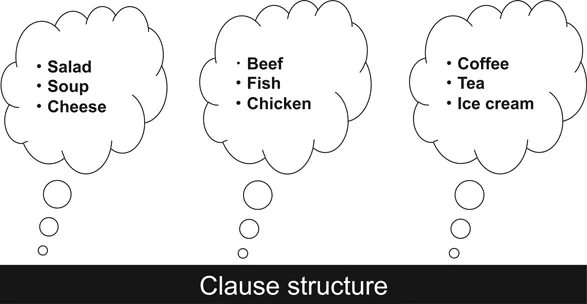
Figure 1.2 Clause structure on a horizontal axis
In applied linguistics, such errors (as in Examples 1a and 1b) can be categorized as ‘global errors’, which are the sort of errors that impede the meaning of an utterance or sentence (see, for example, Burt, 1975). On the other hand, ‘local errors’ are those that do not necessarily distort the meaning of an utterance, such as the dropping of the third-person singular s or articles (as in Example 1c).
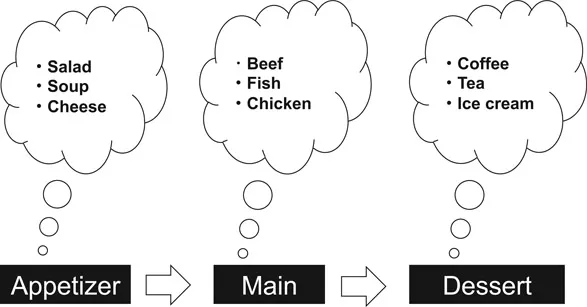
Thus, for communicative purposes, we should help learners avoid making ‘global errors’ (e.g., errors in word order). This is not, of course, to say that reducing ‘local errors’ is not of importance, but rather it is simply a question of ‘error gravity’ – i.e., which errors to target first. Therefore, like the course meal, we can take clause structure as the main road (i.e., horizontal axis) and grammatical items as the side streets (i.e., vertical axis) of MAP Grammar (see Figure 1.2).
Clause structure: The order of meanings
As we know, the so-called seven clause patterns have been most commonly used.1 This may be quite reasonable from an analytic perspective; that is, metalanguage terms (e.g., Subject and Object) are used in order to analyze English clauses, leading to the seven clause patterns. However, we should ask if this is the most appropriate way for learners if our teaching purposes include a ‘communicative aspect’ and if it is also viewed from the learners’ perspectives.
According to the Oxford Dictionary of English (2006), for example, ‘to communicate’ refers to “share or exchange information, news, or ideas”. It would be fair to say that grammar should serve to meet this need, and thus, the teaching of clause structure should be meaning-based. For this purpose, we take the SFL model proposed by M.A.K. Halliday which tells us how grammar works. SFL interprets language “not as a set of structures but as a network of SYSTEMS, or interrelated sets of options for making meaning” (Halliday, 1994, p. 15), and classifies the function of language into three broad categories: the ideational, the interpersonal, and the textual metafunctions. In other words, these are the “three aspects of the ways grammar makes meaning” (de Oliveira & Schleppegrell, 2015, p. 47). The ideational function involves understanding and representing the world; the interpersonal one, interacting with and enacting relationships with others; and the textual one, relating what is said or written to the rest of the text (Bloor & Bloor, 2013; Coffin, Donohue, & North, 2009).
Among these three aspects of language, we have chosen to focus on the ideational function (i.e., understanding and presenting ideas). From a pedagogical perspective, without the ideational function, the interpersonal and textual functions would have little or no role to play. Thus, MAP Grammar takes the id...