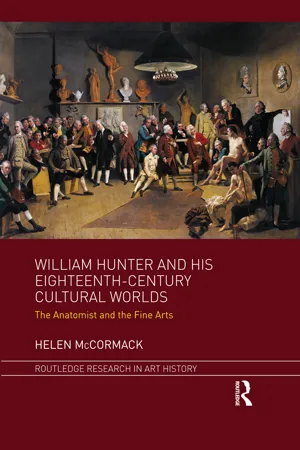
The eminent physician and anatomist Dr William Hunter (1718-1783) made an important and significant contribution to the history of collecting and the promotion of the fine arts in Britain in the eighteenth century. Born at the family home in East Calderwood, he matriculated at the University of Glasgow in 1731 and was greatly influenced by some of the most important philosophers of the Scottish Enlightenment, including Francis Hutcheson (1694-1746). He quickly abandoned his studies in theology for Medicine and, in 1740, left Scotland for London where he steadily acquired a reputation as an energetic and astute practitioner; he combined his working life as an anatomist successfully with a wide range of interests in natural history, including mineralogy, conchology, botany and ornithology; and in antiquities, books, medals and artefacts; in the fine arts, he worked with artists and dealers and came to own a number of beautiful oil paintings and volumes of extremely fine prints. He built an impressive school of anatomy and a museum which housed these substantial and important collections. William Hunter's life and work is the subject of this book, a cultural-anthropological account of his influence and legacy as an anatomist, physician, collector, teacher and demonstrator. Combining Hunter's lectures to students of anatomy with his teaching at the St Martin's Lane Academy, his patronage of artists, such as Robert Edge Pine, George Stubbs and Johan Zoffany, and his associations with artists at the Royal Academy of Arts, the book positions Hunter at the very centre of artistic, scientific and cultural life in London during the period, presenting a sustained and critical account of the relationship between anatomy and artists over the course of the long eighteenth century.
eBook - ePub
William Hunter and his Eighteenth-Century Cultural Worlds
The Anatomist and the Fine Arts
- 208 pages
- English
- ePUB (mobile friendly)
- Available on iOS & Android
eBook - ePub
William Hunter and his Eighteenth-Century Cultural Worlds
The Anatomist and the Fine Arts
About this book
Information
Table of contents
- Cover
- Title
- Copyright
- Dedication
- Contents
- List of figures
- Acknowledgements
- Introduction: art, science, curiosity and commerce
- 1 Forming the museum: context and chronology
- 2 The Great Windmill Street Anatomy School and Museum
- 3 Patronage and patriots: Hunter and a national school of artists
- 4 Collecting ambitions (1770–83): the grand tour paintings
- 5 Pursuing the imitation of nature in and beyond the Royal Academy of Arts
- 6 Conclusion
- Bibliography
- Index
Trusted by 375,005 students
Access to over 1.5 million titles for a fair monthly price.
Study more efficiently using our study tools.
Frequently asked questions
Yes, you can cancel anytime from the Subscription tab in your account settings on the Perlego website. Your subscription will stay active until the end of your current billing period. Learn how to cancel your subscription
No, books cannot be downloaded as external files, such as PDFs, for use outside of Perlego. However, you can download books within the Perlego app for offline reading on mobile or tablet. Learn how to download books offline
Perlego offers two plans: Essential and Complete
- Essential is ideal for learners and professionals who enjoy exploring a wide range of subjects. Access the Essential Library with 800,000+ trusted titles and best-sellers across business, personal growth, and the humanities. Includes unlimited reading time and Standard Read Aloud voice.
- Complete: Perfect for advanced learners and researchers needing full, unrestricted access. Unlock 1.5M+ books across hundreds of subjects, including academic and specialized titles. The Complete Plan also includes advanced features like Premium Read Aloud and Research Assistant.
We are an online textbook subscription service, where you can get access to an entire online library for less than the price of a single book per month. With over 1.5 million books across 990+ topics, we’ve got you covered! Learn about our mission
Look out for the read-aloud symbol on your next book to see if you can listen to it. The read-aloud tool reads text aloud for you, highlighting the text as it is being read. You can pause it, speed it up and slow it down. Learn more about Read Aloud
Yes! You can use the Perlego app on both iOS and Android devices to read anytime, anywhere — even offline. Perfect for commutes or when you’re on the go.
Please note we cannot support devices running on iOS 13 and Android 7 or earlier. Learn more about using the app
Please note we cannot support devices running on iOS 13 and Android 7 or earlier. Learn more about using the app
Yes, you can access William Hunter and his Eighteenth-Century Cultural Worlds by Helen McCormack in PDF and/or ePUB format, as well as other popular books in Art & Art General. We have over 1.5 million books available in our catalogue for you to explore.