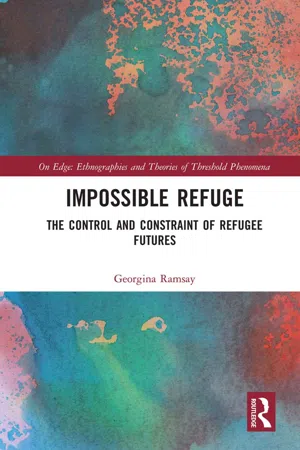
Impossible Refuge brings the perspectives of refugees into rapidly emerging dialogues about contemporary situations of mass forced migration, asking: what does it mean to be displaced? Based on multi-sited ethnographic research conducted with refugees from Central Africa living in situations of protracted asylum in Uganda and resettlement in Australia, the book provides a unique comparative analysis of global humanitarian systems and the experiences of refugees whose lives are interwoven with them. The book problematises the solutions that are currently in place to resolve the displacement of refugees, considering that since displacement cannot be reduced to a politico-legal problem but is an experience that resonates at an existential level, it cannot be assumed that politico-legal solutions to displacement automatically resolve what is, fundamentally, an existential state of being. Impossible Refuge therefore offers a new theoretical foundation through which to think about the experiences of refugees, as well as the systems in place to manage and resolve their displacement. The book argues that the refuge provided to refugees through international humanitarian systems is conditional: requiring that they conform to lifestyles that benefit the hegemonic future horizons of the societies that host and receive them. Impossible Refuge calls for new ways of approaching displacement that go beyond the exceptionality of refugee experience, to consider instead how the contestation and control of possible futures makes displacement a general condition of our time. As such, it will appeal to scholars across the social sciences with interests in migration and refugees, humanitarianism and violence, sovereignty and citizenship, cosmology and temporality, and African studies, broadly.
- 214 pages
- English
- ePUB (mobile friendly)
- Available on iOS & Android
eBook - ePub
About this book
Information
Part I
Exodus
1 Cosmology and futurity
Chaos. Pacing. Doors slammed as people file in, and then back out, of the house. Hushed voices speaking Swahili softly but forcefully over intercontinental phone calls. Cups of forgotten tea left in inconvenient places. More pacing. Small children whimpering, sensing the anxiety but only partially understanding the cause. We circulate around the television set. The television broadcasts a running loop of news headlines about the unfolding “situation” in Goma: footage of tanks, indistinguishable men dressed in camouflage gear, and the occasional blue flash of a UN Peacekeeper.
That morning I had turned up to visit Nyomanda at her home feeling confident that the day would unfold as any other ordinary day in a regional Australian city would. For people in the cluster of suburban houses around us, mostly oblivious to the politics and conditions of nations in Africa, it probably did. But that November morning in 2012 was far from ordinary for my friends from the DRC who had been resettled in Australia. Arriving, I had been dramatically rushed into the house and swept into a tense flurry of activity. I barely saw Nyomanda, who I had intended to visit, as she weaved in and out of family members and friends who, also from the DRC, had made her home the central vantage point to an unfolding crisis in the eastern states of their origin country. I was told, in whispers, “They have taken Goma.”
On November 20, 2012, a militia group called the M23, which had formed to rebel against the government of the DRC, took control of Goma, the capital city of the North Kivu province in the eastern region of the DRC. In the few weeks before the M23 militia withdrew from Goma, tens of thousands of people fled from the region (Jones and Smith 2012). This included relatives of the resettled refugees I had come to know in Australia.
From the sitting room of a house in a suburban Australian neighbourhood, phone calls were being made to connect with relatives in the DRC and to establish their safety in, and in some cases passage from, the city. Snatches of one-sided phone conversations emphasised the crucial role played by resettled refugees in protecting relatives in situations of conflict violence. “Stay with Rebecca, for now…” I heard, then “Meet Moise at…” followed by “It is not safe to leave now, maybe tomorrow…” I was not only witnessing how conflicts in Africa reverberate across transnational contexts of asylum and resettlement. I was also witnessing how these transnational circuits of support historicise and particularise the experiences of refugees.
Resettled refugees are not neutral subjects whose opportunities to create new lives in Australia mean the evisceration of their pasts. This transnational network of support, so readily activated across numerous nodes of social relations whilst evidently responsive to specific instances of need, reflects existing structures of sociality that have persisted for these refugees across experiences of exodus, asylum, and eventual resettlement.
Dominant representations of refugees too often, however, de-historicise and decontextualise their experiences (Malkki 1996). Indeed, the humanitarian system of responding to refugees is broadly organised through processes that coach refugees into positions of passive victimhood, whereby the particularities of their social, cultural, and political worlds are obliterated.
Through the process of acquiring refugee status determination and applying for resettlement, refugees must tell “their story” of persecution numerous times: recounting their experiences as a linear narrative, recalling specific details of traumatic events, and carefully maintaining consistency upon each re-telling in order to affirm the veracity of their own lived experiences (Jansen 2008). The system of humanitarian governance through which the lives of refugees are structured often work to discredit them based on an assumption that they are deceptive (Thomson 2012: 198), a popular characterisation that Cindy Horst (2006a) refers to as the portrayal of refugees as “cunning crooks.” Proving the veracity of a claim to refugee status requires that refugees differentiate themselves from this stereotype of the “cunning crook” and instead embody a status of “vulnerable victim,” which nonetheless similarly erases personal characteristics and experiences. This trope of the refugee as victim has infiltrated dominant representations of refugee lives, so that even in academic scholarship it is common to recount the experiences of peoples who have become refugees as if their lives begin at exodus.
But the lives of refugees do not begin at exodus. They begin where most other lives begin. In the arms of family members, in a house that makes up part of a larger neighbourhood or village, and in particular social and cultural contexts that, eventually, shape how peoples who become refugees come to conceptualise and experience what it means to be displaced. In this chapter, I depart from the typical de-historicising structure of recounting refugee experiences in which analytical inquiry begins at exodus. Instead, I trace the personalised logics from which refugees constitute and experience what it means to be displaced and through which they attempt to reconcile their contemporary existences into a sense of refuge.
Cosmology of regeneration
I spent a lot of time in the kitchens of women I conducted fieldwork with. Over long afternoons spent discussing cooking techniques and sharing recipes, I was often confronted with a question that seemed, at first, to be unrelated to preparing meals, that is, “How many babies will you have?” As an unmarried woman with no children, then in my early twenties, my reproductive status was, to the refugees I came to know, a topic of public consternation. “To my people,” I was told once through a fit of giggling by a woman my own age who already had one child, “you are a husk of maize.” After this comment, we could not contain our shared laughter over the apparent absurdity of this cooking and plant metaphor being applied to me. When we finally recovered from our amusement, my friend added an offhand comment, however, that finally enabled me to put together what had seemed to be an irrelevant, and yet pervasive, connection between the activity of cooking and the experience of motherhood. “You are eating for free,” she told me.
I was to hear this idiom, “eating for free,” many more times during fieldwork, spoken always in reference to women that did not have children. This metaphor of infertility as a state of “eating” suggests an inverse metaphor between fertility and a state of “cooking.” Indeed, soon after being referred to as a “husk of maize,” I began to pick up on other metaphors that directly linked fertility to the processual trajectory of cooking and the cyclic growth and degeneration of subsistence plant foods, such as references to pregnancy as “cooking,” procreative sexuality as “mixing,” the womb as a “field” and the baby as a “plant,” and the practice of birth spacing as a cycle of “growth” and “rest.” But such expressions of human reproduction, the growth of plants, and the cooking and eating of plant foods as interwoven cycles of regeneration were not just metaphorical. These parallels between activities of cyclic regeneration express a whole cosmology of existential being.
The concept of a cosmology, broadly, refers to the implicit expectations that inform how people perceive and experience the world. The term is used to describe culturally specific patterns through which people categorise, and make sense of, their worlds (Douglas 1973) and the underlying premises that order how human experience is understood in relation to what is perceived to be an extrinsic structuring of events, objects, and time (Tambiah 1985). Cosmologies are those seemingly self-evident laws and logics of human existence and the universe that make some ways of being seem natural. An especially pervasive cosmological logic, which manifests across numerous cultural, religious, and historical contexts, is that which attaches assumptions of reproductive potentiality to female bodies and links human fertility to the fecundity of nature (Delaney 1991).
In anthropological work with peoples in equatorial Africa, broadly, and the region of Central Africa, specifically, this cosmological intertwining of gendered existential purpose and seemingly natural cycles of regeneration is well documented. Both Audrey Richards (1956) and Victor Turner (1967) describe how initiation rituals for young women in Central African groups involve specific acts of eating plant foods. These kinds of ritual activities are of cosmological significance for the involved women because, according to Turner (1967: 24), “the food stands for her reproductive power and her role as cultivator and cook.” More recently, anthropologists who have conducted research with groups in Central and Southern Africa have similarly recognised this link between social reproduction and biological reproduction as related to seemingly natural cycles of growth and continuity (Devisch 1993; Feldman-Savelsberg 1999, 2016; Kaspin 1996; Silva 2009). The work of Christopher Taylor (1988, 1990, 1992, 1999a, 1999b) is especially significant. Based on extensive research in Rwanda, Taylor (1988: 1343) describes how “patterns which are implicit and pervasive in Rwandan culture” centre on assumptions of existence as a trajectory of blockage and flow, which is symbolised in the organisation of everyday life through the fluidity and stagnation of liquids that are crucial to maintaining human existence, that is, those liquids associated with food, drink, and sexual exchange. Though it pertains to diverse ethnographic contexts, this corpus of research points to the circulation of similar cosmological logics amongst groups in equatorial Africa and Central Africa, specifically in which existence is understood through a dialectic of reproductive potentiality and stagnation: that is, a cosmology of regeneration.
When referring to me as a person who is “eating for free” and using other metaphors linking fertility and regeneration, the refugees I conducted fieldwork with were expressing what I had otherwise only observed as an implicit, but nonetheless pervasive, pattern of cosmological logics. Their lives were often structured around an imperative to regenerate life, in terms of both biological and social reproduction. Seemingly separate domains of fertility, subsistence gardening, and cooking were, in fact, intimately interwoven as a cosmology of regeneration. It was apparently expected that my own reproduction trajectory and the activity of cooking would be brought up in the same context because neither is separate: questions and discussions about fertility, cooking, and plants are, to these refugees, as much existential as they are practical.
An ontology of “feeding”
I arrived to visit Nyomanda one morning around 10 a.m. to find the curtains drawn and the house unusually quiet. I knocked loudly, twice, on the front door but received no response. Going to the back door of the house, which was kept unlocked for close friends of Nyomanda and her family to enter, I made my way into the house, calling out to see if she was there. Eventually, I heard muffled movements from her bedroom. Nyomanda emerged, still in her pyjamas, and apologised for not being up to greet me. I, in turn, apologised profusely. After we both finished laughing at our shared awkwardness, Nyomanda explained why she had woken up so unusually late. She had been on the phone with “her boy,” she said, “my sister’s son, Richard.”
Twelve months previously, Nyomanda’s sister, who had remained in the DRC despite the conflicts of the past years, died unexpectedly. She left behind many children with no father. Despite her physical distance from the children, Nyomanda provided care for them. She told me, “I am their mother, now.”
After the death of his mother, 14-year-old Richard had remained in the DRC, but his younger siblings had been sent into Uganda to live with relations in a refugee camp. Richard lived in Goma in a room shared with other young men employed as garment makers. I asked Nyomanda if something had happened to him. “Oh, no,” she told me quickly, “Richard is fine, now. But he needed someone to talk to … even though it was 3am in the morning here. I knew he had to talk with me. It is hard for him there.” Again, Nyomanda emphasised that she does this because she is a “mother.”
Motherhood is not, for these Central African refugees, able to be singularly understood as a social role of bearing and rearing offspring. Motherhood, to them, is an ontology: that is, a way of being. In recent years, the concept of ontology has been especially problematised in anthropological debates in regard to what is called an “ontological turn,” in which anthropologists have sought to challenge previously held assumptions of ontology as a universal basis of experiential being (Holbraad and Pederson 2014). Within this context of increasing recognition of multiple modalities of being, Marilyn Strathern (2012) has characterised “eating” as a particular ontology of being. Based on a re-working of ethnographic material from Melanesia in relation to recent theorisations of ontology from anthropological work in Amazonian contexts, Strathern (2012) writes:
What difference would it make to our apprehension of relations if the activity for (in place of) describing states of being were Eating?… Across Amazonia (the act of) eating is a fundamental classificatory or logical operator. And there are countless instances of the very being deployed in ways outsiders often take as metaphorical, as is true in Melanesia. These instances do not simply concern rules about eating food, though such rules are part of it; “eating” is applied to actions that from an English-speaking perspective do not involve taking in food in any immediate sense.
(Strathern 2012: 1–2)
The ontology of “eating” that Strathern (2012) describes refers to a way of being that is characterised by consuming productive resources, such as food, material objects, and people, without replenishing those stocks. The “eating” ontology is a mode of parasitism that recalls the ways in which I, and other women who did not have children, were referred to as people who were “eating for free.” That is, people who consume worldly resources without actively regenerating life.
In contrast to the ontology of “eating” that Strathern (2012) puts forward, the existential imperative to become a mother can be conceptualised as an ontology of “feeding.” By “feeding” as a way of being, women who become mothers not only embody relations of care to their biological offspring. They also embody a whole mode of being that requires them to stimulate, more expansively, the regenerative potential of existence.
It is upon giving birth to a first child that this ontology of “feeding” is triggered. Women who, like myself, had not given birth to a child, were implicitly excluded from a number of activities that symbolise regeneration. For example, when helping to prepare for social events, I and other non-mothers were allowed to help with preparing food for cooking but were rarely invited to support in the process of cooking itself. When gardening, I was allowed to provide ancillary assistance, but it was mothers who oversaw that seeds and plants were nourished through watering. Upon giving birth, the status of a woman changes: she is trusted and tasked with activities that, more broadly, stimulate the regenerative potential of existence. These activities of providing care to children, nourishing the plant foods that sustain human life, and preparing and cooking foods that, when eaten, affirm survival are interwoven into a “feeding” ontology that is associated with motherhood, which reflects a cosmological imperative centred on regeneration.
The existential imperative of motherhood
The cosmology of regeneration I describe here is an analytical platform from which to characterise the existential premise of life as understood by the Central African refugees I got to know during fieldwork. However, this rendering of a cosmological imperative to regenerate life through reproduction, subsistence agriculture, and cooking and eating food is clearly based on assumptions about, as well as culturally specific readings of, gender. As I observed during fieldwork, this cosmology of regeneration is at once expansive, in that procreative sexuality is a dominant expectation for both women and men, and particularised, in that this expectation is experienced differently by peoples depending on whether their bodies are coded as male or female.
To experience personhood, a concept that refers to social recognition of an individual as a whole and actualised person, both men and women were required, it seemed, to have a child. Upon the birth of a first child, for example, the individual birth names of both biological parents would be dropped from common vernacular amongst family and close friends to be replaced with “Mama-” or “Papa-” followed by the individual birth name of the first child. Personhood, usually a concept that is applied to the realisation of the individual person, appeared, for these refugees, to signal the realisation of new and shifted forms of relatedness between peoples: between new parent and child, mother and father, and parent and wider relations. Becoming recognised as a parent, however, was not gender neutral. Motherhood and fatherhood are distinctly gendered roles within this shared constituting of personhood.
“The daddy gives the seed,” I was told by one woman, Rachael, once again while standing in front of a stove. “And I grow the baby, here, in my stomach.” By that stage of my life, I was already keenly aware of the biological processes through which human reproduction is achieved, but as a woman who had not yet borne a child, I was often brou...
Table of contents
- Cover
- Half Title
- Title Page
- Copyright Page
- Table of Contents
- Acknowledgments
- List of terms and abbreviations
- Introduction
- PART I Exodus
- PART II Asylum
- PART III Resettlement
- Conclusion
- Index
Trusted by 375,005 students
Access to over 1.5 million titles for a fair monthly price.
Study more efficiently using our study tools.
Frequently asked questions
Yes, you can cancel anytime from the Subscription tab in your account settings on the Perlego website. Your subscription will stay active until the end of your current billing period. Learn how to cancel your subscription
No, books cannot be downloaded as external files, such as PDFs, for use outside of Perlego. However, you can download books within the Perlego app for offline reading on mobile or tablet. Learn how to download books offline
Perlego offers two plans: Essential and Complete
- Essential is ideal for learners and professionals who enjoy exploring a wide range of subjects. Access the Essential Library with 800,000+ trusted titles and best-sellers across business, personal growth, and the humanities. Includes unlimited reading time and Standard Read Aloud voice.
- Complete: Perfect for advanced learners and researchers needing full, unrestricted access. Unlock 1.5M+ books across hundreds of subjects, including academic and specialized titles. The Complete Plan also includes advanced features like Premium Read Aloud and Research Assistant.
We are an online textbook subscription service, where you can get access to an entire online library for less than the price of a single book per month. With over 1.5 million books across 990+ topics, we’ve got you covered! Learn about our mission
Look out for the read-aloud symbol on your next book to see if you can listen to it. The read-aloud tool reads text aloud for you, highlighting the text as it is being read. You can pause it, speed it up and slow it down. Learn more about Read Aloud
Yes! You can use the Perlego app on both iOS and Android devices to read anytime, anywhere — even offline. Perfect for commutes or when you’re on the go.
Please note we cannot support devices running on iOS 13 and Android 7 or earlier. Learn more about using the app
Please note we cannot support devices running on iOS 13 and Android 7 or earlier. Learn more about using the app
Yes, you can access Impossible Refuge by Georgina Ramsay in PDF and/or ePUB format, as well as other popular books in Social Sciences & Sociology. We have over 1.5 million books available in our catalogue for you to explore.