The Kalahandi district in the state of Odisha in Eastern India is regarded as an iconic region of underdevelopment, and is often perceived to be the 'Somalia' of the country. It is also the site of a large number of governmental interventions.
This book focuses on processes of governance in Odisha, and provides an ethnographic account of the changing forms of governmental actions in Kalahandi by analysing the implementation of WORLP (Western Orissa Rural Livelihoods Project), a new generation watershed development project. The book also shows the morphings of the forms of the state on the ground, and the ways in which it is perceived by the agents and objects of statist actions. Arguing that changes in the institutions and practices of the state in India over the last three decades are better understood through the conceptualisation of state-fabrication, rather than of state-formation, the author describes the governmental tactics related to emergent modes of governmental action. The book identifies an increasing convergence in the everyday practices of governmental and non-governmental organisations, and the growth of 'the social' as a terrain and object of governmental actions, as two important effects of the process of deployment of these tactics. It argues that the vernacular sphere of toutary is a key domain of sociality that frames the perceptions and actions of people related to the state in Odisha. As a domain, toutary is populated by social agents, called touters; toutary can be understood as the interstitial zone between state and society shaped by the increasing penetration by the state into society through social technologies.
By providing an alternative analysis of state and politics in India, this book adds to the literature surrounding the everyday state by illuminating recent changes in state-society relations. It will be of interest to academics in the field of Political Science, Public Policy, Development Studies, Social Anthropology/Sociology, Social Work, and South Asian studies.
eBook - ePub
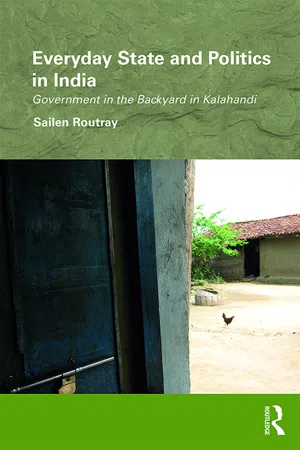
Everyday State and Politics in India
Government in the Backyard in Kalahandi
- 122 pages
- English
- ePUB (mobile friendly)
- Available on iOS & Android
eBook - ePub
About this book
Trusted by 375,005 students
Access to over 1.5 million titles for a fair monthly price.
Study more efficiently using our study tools.
Information
Subtopic
Ethnic StudiesIndex
Social Sciences1 Framing Kalahandi as an iconic backward district
Put away the road maps now.To go there,you do not needhelicopters any more:wherever there is hunger,there Kalahandi is.The god of rainturned away his face.There was not one green leaf lefton the trees to eat.The whole village a graveyard.The ground, cracked,river sand, dried up.All the plans failed;the poverty linereceded further.Wherever you look,there is a Kalahandi:in the sunken eyes of living skeletons,in rags which do not coverthe frail bodies,in the utensilspawned off for food,in the crumbling hutswith unthatched roofs,in the exclusive prosperityof owning two earthen pots.Kalahandi is everywhere:in the gathering of famished crowdsbefore charity kitchens;in market places where children areauctioned off.in the sighs of young girlssold to brothels;in the silent processionof helpless peopleleaving their hearth and home.Come, look at Kalahandi closer:in the crocodile tearsof false press statements,in the exaggerated statisticsof computer print-outs,in the cheap sympathiesdoled out at conferencesand in the false assurancespresented by planners.Kalahandi is very close to us:in the occasional contritionof our souls,in the unexpected nagging of our conscience,in the rare repentanceof the inner self,in the nightmares appearingthrough sound sleep,in disease, in hunger,in helplessness,in the abject fearof an impending bloodshed.How could we then walkinto the celebrated portalsof the twenty-first century,leaving Kalahandi behind?‘Kalahandi’, J.P. Das1
Kalahandi: an introduction
All stories need three things: sthana, kala, and patra – place, time, and people. The ‘place’ for my story is Kalahandi, eastern Odisha, India. Kalahandi, the very name, evokes a geography of hunger, a history of backwardness where repeated droughts have broken the backbone of a long-suffering population. A place where development has failed, where the state does not reach and cannot deliver its services; a place characterised by failure of public action. Even now, news reports once in a while find their way from Kalahandi and the Greater Kalahandi region into the national media narrating stories of distress sale of children or of starvation deaths (Banik 2008). It forms a part of a broader region in the south-west part of Odisha called the KBK (taking the initials of the undivided districts of Kalahandi, Bolangir, and Koraput) region that is characterised by widespread poverty, lack of health and other public services, and low levels of attainment in socio-economic indicators (Dash 2007). The district occupies the south-western portion of Odisha, bordered to the north by the districts of Balangir and Nuapada, to the south by Rayagada and Koraput districts, to the west by the districts of Nabarangpur in Odisha and Raipur in Chhattisgarh, and to the east by Rayagada and Kandhamal districts in Odisha.
The time is the ethnographic present, although to be able to make sense of this ‘now’ I have taken a short detour into ‘the long 1980s’, and what transpired in that eventful decade. The period of the long 1980s (1977–1991) is a significant period of shift in which the modes of statecraft changed substantially in India. The characters are the people of (and in) Kalahandi, ordinary villagers, governmental staff (of projects and departments), project beneficiaries, and intellectuals. But one key character in this story is Kalahandi herself.
Kalahandi is an erstwhile princely state that was incorporated into the Indian state of Odisha in the post-independence period. The subdivision of Nuapada was added to it later. The district of Nuapada was carved out of Kalahandi in 1992 when the 13 districts of Odisha were divided into 30 to facilitate effective administration (Currie 2000). The erstwhile zamindari of Kashipur had traditionally been a part of the princely state of Kalahandi. Subsequently, it formed a part of the Kalahandi district. In 1962, Kashipur was separated from it and incorporated into the undivided Koraput district. This was done for purported reasons of administrative efficiency. Kashipur, after the process of reorganisation of districts, now forms a part of Rayagada district. The Greater Kalahandi region thus comprises of the present districts of Kalahandi and Nuapada and the Kashipur block of Rayagada district.
Kalahandi has a reputation of being overwhelmingly tribal. Around 29 per cent of the district’s population comprises Scheduled Tribes (STs). In comparison, Odisha’s tribal population stands at around 22 per cent of the total. While Kalahandi does have a substantial tribal population, this is proportionally not significantly larger than that of Odisha as a whole. But by popular perception and self-assertion by the tribal group of Kondhs, Kalahandi is seen as being the land of the Kondhs, and this tribal group is believed to be the original inhabitants of the district. Despite the immigration of a larger number of social groups from neighbouring regions, they still make for around 13 per cent of the district’s population. The other numerically significant demographic group, the Scheduled Castes (SCs) comprise 17.67 per cent of the population (Banik 2008). The area of the district is 7,920 sq. km, and it has a population of 1,573,054 according to the 2011 Census of India2 (Sethi 2011). A large part of the district comprises valleys of rivers such as Tel, Udanti, and Utei. Important rivers such as Indravati originate in the hills of the district. Parts of the district occupy the north-eastern portions of the Eastern Ghat mountain ranges and are heavily forested. But significant parts of the district, especially in the Dharmagarh subdivision, consist of extensive plains. These are now irrigated with water from the Upper Indravati Project on the River Indravati.
The erstwhile princely state of Kalahandi was ruled by the Naga dynasty more or less continuously for over a thousand years till its integration into the republic of India in 1948. At various points of time, it was a feudatory state to many regional and national empires and political formations. These include those of the Eastern Gangas, the Suryavamsi Gajapatis, the Marathas, and the British. The self-perception of the district is that it is a peaceful and peace-loving region. But its history, at least its recent history related to British colonialism, is quite bloody. The 1882 rebellion of the Kondhs and its suppression by the colonial state was one of the most violent episodes in Odisha’s recent history. This rebellion took place because of a governmental initiative to improve the kingdom’s agriculture and economy by settling Kulthas, a peasant caste, in tribal areas (Deo 2009). These interventions, the response to it by the administration, and its subsequent framings, have provided continuing tropes for looking at Kalahandi’s social reality. Stories about statist interventions, their types and efficacy, have shaped narratives about this region. Even when governmental actions and interventions are supposed to saturate the descriptions of social processes in the district, good accounts of changes in the form of governmental actions and the ways in which people perceive and act with respect to these actions are not available.
Since the mid-1980s, Kalahandi has hit the headlines in newspapers regularly for the repeated drought situation and for reported starvation deaths and child sales. This has led to it becoming a favourite site for development projects including the famous KBK Project initiated by the Government of India in 1994. There has been a significant and increasing presence of non-governmental organisations (NGOs) in the district (Nayak 2002). But, despite such interventions and programmes, the condition in Kalahandi continues to be one of deprivation and distress.
This has to be contrasted with the following facts. The average annual rainfall in Kalahandi is higher than the national average. The per capita production of food grains in the district has been higher than the Indian average for most of the years for which data is available. Kalahandi is a net exporter of food grains. And the district is one of the major contributors of rice in Odisha to the Food Corporation of India (FCI), a state-owned corporation for sourcing and distributing food grains in the country. As these facts show, the socio-economic deprivation in Kalahandi has been ‘naturalised’ (Prasad 2001). Kalahandi’s deprivation is portrayed as resulting from its geography (lack of water) and the consequent droughts. This, in turn, ignores the politico-economic reasons for the continued marginalisation of the region. There is an obvious contradiction between framing Kalahandi as drought-prone and backward due to ‘natural’ reasons, on one hand, and the realities of the district, on the other (Sainath 1996). The contradiction is glaring, and the persistence of the dominant discourse needs to be interrogated.3
Kalahandi is seen as a drought-prone district. This is perceived as resulting in resource degradation and the concomitant erosion of livelihood opportunities. Politics in the district is seen as focusing on the logistics of elections rather than tackling issues of deprivation. Many development programmes are perceived as being launched without taking into account the basic underlying causes of poverty and deprivation (Mohanty 1998). Livelihood programmes based on sustainable usage of local natural resources have been advocated as a developmental intervention that can meet the district’s needs (Pradhan 1993). Kalahandi has not only been framed by ‘facts’. It has also been framed by an interesting set of stories provided by a variety of narrators. Central to the emergence of Kalahandi as an iconic underdeveloped region are the ways in which many different stories have been told about it. We come to perceive and know a social entity not only by governmental data sets. Stories are important ways in which we perceive and experience social spaces.
Emergence of Kalahandi as a metaphor for hunger and destitution
Key to framings of Kalahandi as a land of drought, hunger, and deprivation were reports that came out of the Greater Kalahandi region surrounding starvation deaths and the distress sale of children in the mid-1980s. Among these stories, one of the biggest was that of Phanas Punji. She was a girl apparently sold by her sister-in-law, Banita Punji, for 40 rupees because of distress. After the news broke in the national media, Rajiv Gandhi, the then prime minister, visited the district to have a first-hand experience of the situation. Most newspaper reports framed the stories of starvation deaths and ‘child sale’ in Kalahandi as events and not as outcomes of broad structural processes (Sainath 1996).

Map 1.1 Location of Kalahandi district in Odisha and India
© Biswajit Apat (Reproduced with permission)
A report published in the Mumbai-based journal Economic and Political Weekly (EPW) in 1985, along with other reports in the national English-language press, brought Kalahandi to public attention. These reports framed the district as the most backward of Odisha’s 13 districts. The EPW report was organised around certain key tropes. These have since then been consistently used to construct narratives regarding the district and the Greater Kalahandi region. These include references to droughts of the pre-independence period4 and the droughts in 1954–1955, 1965–1966, 1974–1975, and finally in the year 1985. This report identified the problem in Kalahandi as one of unequal distribution of productive resources such as land, resource extraction by the state (especially through land revenue and forest cess), and investments in non-productive assets such as television stations. It saw the neglect of traditional water-harvesting structures and systems as a major reason for the inability of the district to cope with the recurrent bouts of drought. Further, it argued that the work of both international and local philanthropic and socio-political organisations was not making any headway in addressing the district’s problems (Purohit et al. 1985).
EPW continued to report and comment on Kalahandi during this period (Economic and Political Weekly 1987a, 1987b). The year 1987 saw one of the biggest droughts in the history of postcolonial India that affected this region. Despite the failed monsoons and the consequent drought, there were no deaths due to famine. Still, there were widespread reports of deprivation and misery in the rural areas occasioned by the drought (Economic and Political Weekly 1988). The newspaper reports covering the region over the last two and half decades or so have been consistently similar in their form and approach. They paint pictures of the district in a style reminiscent of the accounts of sub-Saharan Africa in the international media. Many different sets of actors have been at work in the creation of such an image. English-language newspapers in particular have played an important role in the emergence of Kalahandi as a metaphor for destitution in India because of their national reach. Often, though, these stories were broken first by Odia newspapers. English newspapers such as The Hindu and The Indian Express and periodicals such as Sunday and Illustrated Weekly of India played an important role in this process (Jayal 1999; Currie 2000; Banik 2008).
But the journalistic narratives that dominantly seem to frame the district are two collections of reportage; the first is Everybody Loves a Good Drought by P. Sainath (1996) and the second is Diary Saga Saga by Tejinder that was published in Hindi by Rajkamal Prakashan in 2004. Both these books have been translated into Odia. Sainath’s book was translated by Abhay Singh and published by a leading local NGO, Sahabhagi...
Table of contents
- Cover
- Half Title
- Title Page
- Copyright Page
- Table of Contents
- List of illustrations
- Preface
- Acknowledgements
- Abbreviations
- 1. Framing Kalahandi as an iconic backward district
- 2. Understanding state-led development: emergence of the mission mode
- 3. ‘The government has become the biggest NGO these days’
- 4. Everyday practices of GOs and NGOs
- 5. The vernacular domain of toutary
- 6. Conclusion
- Appendix I: A note on Odisha Watershed Development Mission (OWDM)
- Appendix II: A Note on District Watershed Mission (DWM), Kalahandi
- Appendix III: A note on Western Orissa Rural Livelihoods Project (WORLP)
- Appendix IV: A demographic profile of Kalahandi
- Appendix V: Developmental indicators for Kalahandi
- Appendix VI: Profiles of presidents and secretaries of the ten committees of the NGO PIA
- Appendix VII: Comparison between the two villages under the GO and NGO PIAs
- Index
Frequently asked questions
Yes, you can cancel anytime from the Subscription tab in your account settings on the Perlego website. Your subscription will stay active until the end of your current billing period. Learn how to cancel your subscription
No, books cannot be downloaded as external files, such as PDFs, for use outside of Perlego. However, you can download books within the Perlego app for offline reading on mobile or tablet. Learn how to download books offline
Perlego offers two plans: Essential and Complete
- Essential is ideal for learners and professionals who enjoy exploring a wide range of subjects. Access the Essential Library with 800,000+ trusted titles and best-sellers across business, personal growth, and the humanities. Includes unlimited reading time and Standard Read Aloud voice.
- Complete: Perfect for advanced learners and researchers needing full, unrestricted access. Unlock 1.5M+ books across hundreds of subjects, including academic and specialized titles. The Complete Plan also includes advanced features like Premium Read Aloud and Research Assistant.
We are an online textbook subscription service, where you can get access to an entire online library for less than the price of a single book per month. With over 1.5 million books across 990+ topics, we’ve got you covered! Learn about our mission
Look out for the read-aloud symbol on your next book to see if you can listen to it. The read-aloud tool reads text aloud for you, highlighting the text as it is being read. You can pause it, speed it up and slow it down. Learn more about Read Aloud
Yes! You can use the Perlego app on both iOS and Android devices to read anytime, anywhere — even offline. Perfect for commutes or when you’re on the go.
Please note we cannot support devices running on iOS 13 and Android 7 or earlier. Learn more about using the app
Please note we cannot support devices running on iOS 13 and Android 7 or earlier. Learn more about using the app
Yes, you can access Everyday State and Politics in India by Sailen Routray in PDF and/or ePUB format, as well as other popular books in Social Sciences & Ethnic Studies. We have over 1.5 million books available in our catalogue for you to explore.