eBook - ePub
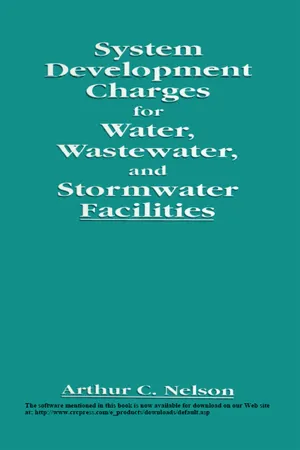
System Development Charges for Water, Wastewater, and Stormwater Facilities
- 192 pages
- English
- ePUB (mobile friendly)
- Available on iOS & Android
eBook - ePub
System Development Charges for Water, Wastewater, and Stormwater Facilities
About this book
This book presents a comprehensive method by which to determine the proportionate share of the costs and revenues generated by the development of new water, wastewater, and stormwater facilities. It presents a rational, legally defensible approach to assessing charges based on the use of new and existing facilities to support new system development. Written by a consultant who has helped hundreds of communities deal with how to pay for growth, the book is designed for all communities presently engaged in calculating and administering charges for new development, as well as those planning for future growth.
1 | The Need for System Development Charges |
INTRODUCTION
System development charges (SDCs) are one-time charges paid by new development to finance the construction of public facilities needed to serve it. SDCs represent a major departure from past local government facility financing policies. Historically, local residents and property owners have been charged taxes to build facilities to accommodate new growth, which in turn provides homes and jobs; but taxes have risen faster than taxpayers can tolerate. Moreover, the state and federal roles in financing water, wastewater, and stormwater systems have changed in dramatic ways. Twenty years ago, many local governments received $0.75 in federal revenue for every $0.25 that it spent on wastewater treatment facilities. Those days are gone. Yet the federal government still requires local governments to make expensive wastewater system improvements while no longer providing significant levels of support for expanding facilities to accommodate future new growth. As a result, local government has been reluctant to raise taxes as needed to support new growth and development. This chapter traces the evolution of development exaction policy leading to increasingly widespread use of system development charges.
EVOLUTION OF EXACTION POLICY
Early land use controls focused primarily on subdivision design issues. Alignment of streets, often in accordance with a master street plan, was a key issue. Gradually, local governments developed higher expectations for developers. Many began to require more than merely the construction of streets. They began to require developers to pave streets, install curbs and gutters, and sometimes build sidewalks. As the use of public sewer and water systems spread, local governments began to require that developers install lines under the streets of the new subdivision. There was little litigation over these early exaction practices and little reason for dispute. Clearly, if communities did not require developers to make minimal improvements, they would be faced with paving rutted roads or retrofitting neighborhoods with sewer lines. Paying for such improvements would involve special assessments or general taxes, neither of which was an attractive alternative to local officials.
Subdividers also may have seen increased value accruing to their lots from the installation of such public improvements. A developer lacking such basic facilities in a new subdivision would, after all, have a less marketable project in most urbanized areas. Thus, the direct benefits of the improvements may have been as influential as the obvious need for the improvements in limiting the number of court challenges to early exaction requirements. All of these early exactions involved the dedication of land and the installation of improvements within subdivisions. As the regulatory system evolved, however, communities began to go farther.
Improvements Required Within the Boundaries of Development
Development exactions are a product of the evolution in public policy regarding land use and the provision of public facilities. Before the 1920s, most growing communities had no effective land use controls. It was not uncommon to find speculators, for example, subdividing vast tracts of land considerable distances from cities in anticipation that purchasers and home builders would eventually receive city services (Nelson, 1988a). There were no land use regulations controlling the location, timing, or dimensions of those developments, nor were public facility extension policies linked to land use regulation.
The U.S. Department of Commerce’s model planning and zoning enabling acts, written in the late 1920s, are the genesis of modern land use regulation. Today, a person can travel to many states and find commonalities in land use regulation that are rooted in the model acts. One important result of the model acts was regulations requiring developers to provide facilities necessary to accommodate development within the boundaries of that development. These are called “on-site” improvements. Prior to the model acts, developers often demanded and received from cities street, water, sewer, and drainage facilities to each part of their development. The model acts gave public officials the policy rationale for requiring developers to internalize that cost (Nelson, 1988b). These early forms of exaction recognized that to protect the public health, safety, and general welfare of the community, developers themselves must be held responsible for the installation of improvements within the boundaries of their development. Such exactions thereby have a regulatory role because their objective is the protection of the public. Requiring developers to provide adequate facilities has become commonplace. Modern subdivision regulations require subdividers to provide a number of public facilities as a condition of development approval.
Mandatory Land Dedication and In-Lieu Fees
The four decades following the 1920s saw public officials wrestle with providing facilities outside the boundaries of the development. Many officials realized that fiscal resources could not satisfy the demand created by new development for new parks and schools. In response, many local governments now require developers of residential subdivisions to dedicate land for park and school use (Hagman and Juergensmeyer, 1986). This is usually facilitated by state enabling legislation.
Sometimes, land dedicated by development was in the wrong place, too small, or not otherwise appropriate to satisfy the purpose of the exaction to provide land for parks and schools. Payments of money in lieu of dedication came into use. The amount of money given in lieu of dedication is normally calculated as equal to the value of the land that would have been dedicated (Hagman and Juergensmeyer, 1986).
By the 1940s, local government’s power to demand land or money for facilities located off-site was firmly established. But mandatory dedication and in lieu laws did not necessarily enable modern SDCs. This is because in lieu fees are related to mandatory land dedication, but there is usually no mandatory land dedication for water, sewer, drainage, roads, and many other facilities (Juergensmeyer, 1988). The need for these facilities and services would have to be satisfied on a different, but related, basis.
Extension to Off-Site Exactions
Two forces have influenced the evolution of exaction policy: reconsideration of the growth ethic and local government fiscal stress.
Until the 1960s and 1970s, most communities believed that growth and new development were fundamentally good because they brought an improved tax base that could be used to build better facilities that all community residents enjoyed. In effect, growth meant improving services at declining average cost to taxpayers. Challenges to the growth ethic arose in the 1960s, however, as residents of desirable, rapidly growing communities discovered that unbridled growth caused pollution, congestion of streets, overuse of other facilities, and a general lowering of the quality of life (Reiley, 1974). Cost-revenue studies began showing that, in many cases, new development placed incremental demands for community facilities that increased average tax burdens for existing taxpayers (see Burchell and Listokin, 1978). Many citizens in certain parts of the country, and especially those in rapidly growing areas, concluded that growth was inimical to their reasons for choosing to live where they were (see Scott, Brower, and Miner, 1975). A new land use regulation ethic emerged calling for new development to internalize all the costs it imposes on existing residents (Bosselman, Callies, et al., 1972).
Regulations based on this logic have been found to be within the power of local jurisdictions provided that there is a clear public purpose and that the regulations are reasonable (see, e.g., Callies and Freilich, 1986). Some development proposals may be denied if the facilities needed to support it are lacking [see Golden v. Planning Board of Town of Ramapo, 30 N.Y. 2d 359, 285 N.E. 2d 291, 334 N.Y.S. 2d 138 (1972)]. Development is acceptable only when it provides needed facilities. Thus, growth is acceptable in many communities only when it pays its own way. Using this logic, many local governments now hold development at least partially responsible for either constructing or paying for off-site improvements such as roads, parks, fire and police stations, and water-related system expansions.
However, since the late 1970s taxpayers have called for substantial changes in the manner in which local government receives tax revenue. This was manifested in electorates imposing severe restrictions in the taxation of real property on local government. Propositions 13 in California and 2½ in Massachusetts are only two of the more visible outcomes of this revolt (Chapman, 1981). During the 1980s, virtually every state enacted some form of property tax limit that effectively reduced local government’s ability to expand infrastructure from taxes.
These tax limit efforts often ignored three factors: (1) the effects of inflation on the purchasing power of tax collections; (2) rising water and wastewater treatment standards; and (3) rising expectations among citizens for higher-quality services. The net result of all these factors is that local governments have been forced to consider all possible revenue-enhancing sources, such as new or higher user fees, privatization of some services, negotiated exactions of new development requiring planning approval, and SDCs.
Refinement of Concepts
Along with the evolution of exaction policy has come an evolution of terms. Recall that exactions have evolved from an “on-site” to an “off-site” orientation. Until recent years, exactions were classified as either on-site or off-site, with most of the policy and legal disputes centering on the extent to which developers should be held accountable for providing or paying for off-site improvements. But this is an inadequate distinction. Developments that generate considerable volumes of traffic may need to have acceleration and deceleration lanes, and traffic signals installed to provide safe ingress and ingress to the development. Yet, these improvements are clearly “off-site”. Alternatively, oversized water mains installed by a developer “on-site” may provide greater benefit to future development off-site. A new view is emerging in which improvements are classified as either “system” or “project” improvements.
Generally speaking, “project improvements” are site improvements and facilities that are planned and designed to provide service for a particular development project and that are necessary for the use and convenience for the occupants or users of the project and are not “system improvements”. The character of the improvement controls a determination of whether an improvement is a project improvement or a system improvement, and the physical location of the improvement on-site or off-site is not by itself determinative of whether an improvement is a project improvement or a system improvement. If an improvement or facility provides or will provide more than incidental service or facilities capacity to persons other than users or occupants of a particular project, the improvement or facility should be considered a system improvement and should not be considered a project improvement. “System improvements” are capital improvements to the system that are designed to provide service to the community at large, in contrast to project improvements.
Separating the two is not always clear. For example, installation of a main along a highway arterial adjacent to a development project may benefit a local government’s entire water system inasmuch as this would clearly fit the definition of a system improvement and it could be eligible for impact fee financing, at least in part. But are right-of-way dedications for water mains that improve service to the development considered project or system improvements? (While a share of the mains improve the distribution network, right-of-ways or easements serve abutting development and are considered project improvements.)
LOCAL GOVERNMENT RATIONALE FOR SYSTEM DEVELOPMENT CHARGES
Consider the taxpayer revolt mentioned earlier. Between 1972 and 1990, there was a movement away from property taxes — caused in large part by voter resistance to the size and regressive nature of the tax. Property tax revenue fell from 36 to 26% of total local revenue. However, there was a 22% increase in debt and increases of 28% in general revenue, 59% in taxes not on property, and 87% in other charges on a per capita basis (Statistical Abstract, 1974 and 1993). The figures thus portray the effect of fiscal revolt — costs were being shifted away from the community at large to new development and users of services. Yet, the level of local taxation and state and local debt still increased faster than incomes. Total state and local government revenue as a percentage of personal income rose from 18% in 1972 to 22% in 1990.
For their part, local governments rationalize SDCs for as many as five major reasons (Frank and Downing, 1988a):
• To shift fiscal burdens from existing development to new development
• To synchronize the construction of new or expanded facility capacity with the arrival of new development
• To subject new development decisions to pricing discipline.
• To respond to locally vocal anti-tax sentiments
The significance of these motivations are now discussed.
Shift Fiscal Burdens
Existing development enjoys facilities that were greatly subsidized by federal, state, and community wide resources. Nowadays, those subsidies have been reduced or canceled. Federal aid for water and sewer systems used to pay for up to (and sometimes more than) 75% of the cost of those facilities. The community needed only to raise the other 25% or so. When general obligation or revenue bonds were used to finance the community share, the tax burden falling on all residents was very small; but when federal support for these systems was eliminated in the 1980s to reduce the federal debt, communities had to find other means to finance facilities. The trouble was that voters in many of those communities refused to raise their taxes or rates in order to pay for new facilities serving other people.
Also, communities have historically underpriced the use of existing facilities. Prudent facility pricing policies would raise enough revenue to pay for necessary rehabilitation and replacement of existing capital stock. Largely to provide politically popular, low user prices (in the form of direct user fees or indirect taxes), local public officials kept the price of those services artificially low. The result is that, today, communities face a mounting, unfunded capital improvement maintenance and replacement debt that is quite large, by some estimates running over $ 1 trillion across the nation. Faced with this prospect, occupants of existing development do not wish to have to pay for rehabilitation or replacement of existing facilities, and certainly not for new facilities that over time will also require rehabilitation or replacement. The attitude is that, since existing facilities were paid for by existing development, communities strapped with maintaining or replacing those facilities must require new development to install, maintain, and replace its own facilities.
The political reality is that no one wants to pay the bill for either new facilities or rehabilitation of existing facilities.
Synchronize Facility Expansion and New Development
Leap frog urban sprawl, often considered the most costly development pattern, is caused in part by the extension of facilities into undeveloped areas, allowing development to skip over land closer to existing development. Extension of those facilities in advance of development is also costly if existing development does not immediately use it. Thus, to keep facility costs down, communities now use facility ext...
Table of contents
- Cover
- Title Page
- Copyright Page
- Dedication
- Table of Contents
- Chapter 1. The Need for System Development Charges
- Chapter 2. Legal Considerations of System Development Charges
- Chapter 3. Applying Rational Nexus Principles to the Calculation of System Development Charges
- Chapter 4. Administrative Considerations of System Development Charges
- Chapter 5. Implications of System Development Charge Policy
- Chapter 6. Alternative Methods of Calculating System Development Charges
- Chapter 7. Calculating System Development Charges for Water and Wastewater Facilities Based on Total Cost Attribution
- Chapter 8. Calculating System Development Charges for Stormwater Facilities
- Appendix 1. Engineering News and Record Construction Costs Index and Current Value Factors to 1993
- Appendix 2. Calculation of System Development Charge Credits Attributable to Past and Future General Obligation Bond Debt Service
- Appendix 3. Adjustments to Meter Size Ratios To Account for Peak Demand
- References and Selected Bibliography
- Index
Trusted by 375,005 students
Access to over 1.5 million titles for a fair monthly price.
Study more efficiently using our study tools.
Frequently asked questions
Yes, you can cancel anytime from the Subscription tab in your account settings on the Perlego website. Your subscription will stay active until the end of your current billing period. Learn how to cancel your subscription
No, books cannot be downloaded as external files, such as PDFs, for use outside of Perlego. However, you can download books within the Perlego app for offline reading on mobile or tablet. Learn how to download books offline
Perlego offers two plans: Essential and Complete
- Essential is ideal for learners and professionals who enjoy exploring a wide range of subjects. Access the Essential Library with 800,000+ trusted titles and best-sellers across business, personal growth, and the humanities. Includes unlimited reading time and Standard Read Aloud voice.
- Complete: Perfect for advanced learners and researchers needing full, unrestricted access. Unlock 1.5M+ books across hundreds of subjects, including academic and specialized titles. The Complete Plan also includes advanced features like Premium Read Aloud and Research Assistant.
We are an online textbook subscription service, where you can get access to an entire online library for less than the price of a single book per month. With over 1.5 million books across 990+ topics, we’ve got you covered! Learn about our mission
Look out for the read-aloud symbol on your next book to see if you can listen to it. The read-aloud tool reads text aloud for you, highlighting the text as it is being read. You can pause it, speed it up and slow it down. Learn more about Read Aloud
Yes! You can use the Perlego app on both iOS and Android devices to read anytime, anywhere — even offline. Perfect for commutes or when you’re on the go.
Please note we cannot support devices running on iOS 13 and Android 7 or earlier. Learn more about using the app
Please note we cannot support devices running on iOS 13 and Android 7 or earlier. Learn more about using the app
Yes, you can access System Development Charges for Water, Wastewater, and Stormwater Facilities by Arthur C. Nelson in PDF and/or ePUB format, as well as other popular books in Economics & Infrastructure. We have over 1.5 million books available in our catalogue for you to explore.