- 304 pages
- English
- ePUB (mobile friendly)
- Available on iOS & Android
eBook - ePub
Switching Phenomena in High-Voltage Circuit Breakers
About this book
Showing the relation of physics to circuit interruption technology, describes for engineers the switching phenomena, test procedures, and applications of modern, high-voltage circuit breakers, especially SF, gas-blast, and the vacuum types used in medium-voltage ranges. Applies the physical arc mode
1
OVERVIEW
1.1 FUNCTIONS AND REQUIREMENTS FOR CIRCUIT BREAKERS (Y. Yoshioka, K. Hirasawa, Y. Ohshita)
Circuit breakers, which have the function of opening and closing a circuit, are indispensable for protecting other transmission devices in a power system. When a short-circuit fault occurs, they quickly eliminate the fault to secure system stability. They are also used for modifying the system configuration under normal conditions. The International Electrotechnical Commission (IEC) defines the circuit breaker as a mechanical switching device, capable of making, carrying and breaking currents under normal circuit conditions and also making, carrying for a specified time and breaking currents under specified abnormal circuit conditions such as those of short-circuit. It adds, as a note, that a circuit-breaker is usually intended to operate infrequently, although some types are suitable for frequent operation.
Circuit breakers must have the following basic functions:
1. When closed, they are good conductors, and they withstand normal currents as well as short-circuit currents, thermally and mechanically.
2. When open, they are excellent insulators, and they withstand the voltage to ground or to the other phase and the voltage between contacts.
3. When closed, they can interrupt a rated, or lower, interrupting current quickly without generating an abnormal voltage.
4. When opened, they can close a shorted circuit quickly and safely without incidental contact erosion.
Some of these functions have mutually contradictory requirements, and therefore the development of a circuit breaker entails overcoming several difficulties, but they are interesting and challenging subjects, technically and theoretically.
Power-system load capacities are increasing annually, in line with economic growth, and, as shown in Fig. 1.1, this tendency is expected to continue. To transmit such huge amounts of energy, the transmission capacity per line must also continue to increase. This has been promoted by various means, such as the use of multiple larger diameter wires and the introduction of higher voltage class power systems. Through similar processes, power systems should continue to grow and, with increases in the short-circuit capacity, the breaking capacity of circuit breakers must also continue to increase.
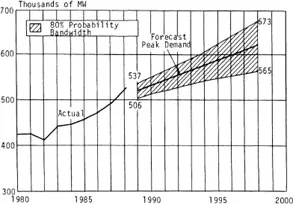
Fig. 1.1 Trend forecast of summer peak load (United States). (IEEE, Power Engineering Review, 1989. © IEEE.)
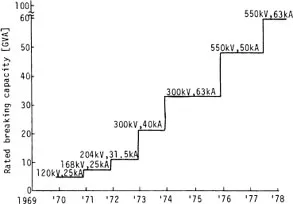
Fig. 1.2 Trend of voltage and capacity rise of puffer-type gas circuit breaker.
Figure 1.2 shows the trend in the breaking capacity of power system gas circuit breakers. There was a tenfold increase in the decade of the 1970s. A general high-voltage circuit breaker consists of several interrupter units connected in series; for economy, the breaking capacity per interrupter unit is increased to reduce the number of units required. Performance requirements for circuit breakers also include high-speed interruption, ensuring power system stability, high-speed closing, and suppression of switching surge, particularly for ultrahigh-voltage (UHV) systems. Resistance to mechanical vibration, low-noise operation, and easy maintenance and checkup are also desirable features.
This chapter stresses the basic principles and theory of circuit-breaker techniques. The reader is encouraged to refer to the quoted references for details of other topics.
1.2 BASIC PHYSICS OF INTERRUPTING ARCS
(Y. Yoshioka, Y. Ohshita, Y. Kurosawa)
(Y. Yoshioka, Y. Ohshita, Y. Kurosawa)
1.2.1 General Description
The basic function of the power circuit breaker is a switching action consisting of opening and closing an electric circuit, that is, making and breaking the current under any conceivable circuit conditions. In that sense, it can be described as a circuit element whose function is intrinsically similar to that of the switches routinely met in daily life. However, major differences are that the current or circuit voltage used in a power transmission system are considerably large and the switching time must be very short, which raises technical problems. Thus circuit-breaker development constitutes one of the fields where the most advanced techniques are required.
“Switching action” refers to the mutual conversion of conductor and insulating material in a part of the circuit at a given potential. In addition to arc plasma, several physical phenomena are capable of being utilized as circuit elements; examples are semiconduction (i.e., change of conductivity by control of electron energy level in a solid material), superconductivity (i.e., temperature control in a superconductive area), and vacuum electron current (i.e., potential control). However, the switching capacity of these phenomena is somewhat lower than that of arc plasma. In power circuit breakers, the intensity of the current that flows through the conductors and the voltage level that must be sustained by the insulating material are very high, and at present the only practical approach may be the use of arc plasma.
Present commercial circuit breakers resort to plasma temperature control as the basis for their function. To be more precise, arc discharge is used as a circuit element for switching.
Historically, the first industrial uses of circuit breakers did not actively take advantage of arc plasma. When parts of the conductor are separated in order to interrupt a circuit current, an arc is generated before the current is extinguished; it is considered that current breaking refers to extinguishing this arc. Arc discharge was thought to be an obstacle to current interruption, and the technical concern in circuit interruption was how quickly and effectively to extinguish the arc. In fact, “current breaking” and “arc extinction” were used as synonyms. However, from the basic...
Table of contents
- Cover
- Half Title
- Title Page
- Copyright Page
- Table of Contents
- Preface
- Contributors
- 1 OVERVIEW
- 2 ANALYSIS AND DESIGN
- 3 RECENT DEVELOPMENTS IN CIRCUIT BREAKERS
- 4 TESTS AND DIAGNOSTICS
- Appendix Basic Thermodynamic Equations
- Index
Trusted by 375,005 students
Access to over 1.5 million titles for a fair monthly price.
Study more efficiently using our study tools.
Frequently asked questions
Yes, you can cancel anytime from the Subscription tab in your account settings on the Perlego website. Your subscription will stay active until the end of your current billing period. Learn how to cancel your subscription
No, books cannot be downloaded as external files, such as PDFs, for use outside of Perlego. However, you can download books within the Perlego app for offline reading on mobile or tablet. Learn how to download books offline
Perlego offers two plans: Essential and Complete
- Essential is ideal for learners and professionals who enjoy exploring a wide range of subjects. Access the Essential Library with 800,000+ trusted titles and best-sellers across business, personal growth, and the humanities. Includes unlimited reading time and Standard Read Aloud voice.
- Complete: Perfect for advanced learners and researchers needing full, unrestricted access. Unlock 1.5M+ books across hundreds of subjects, including academic and specialized titles. The Complete Plan also includes advanced features like Premium Read Aloud and Research Assistant.
We are an online textbook subscription service, where you can get access to an entire online library for less than the price of a single book per month. With over 1.5 million books across 990+ topics, we’ve got you covered! Learn about our mission
Look out for the read-aloud symbol on your next book to see if you can listen to it. The read-aloud tool reads text aloud for you, highlighting the text as it is being read. You can pause it, speed it up and slow it down. Learn more about Read Aloud
Yes! You can use the Perlego app on both iOS and Android devices to read anytime, anywhere — even offline. Perfect for commutes or when you’re on the go.
Please note we cannot support devices running on iOS 13 and Android 7 or earlier. Learn more about using the app
Please note we cannot support devices running on iOS 13 and Android 7 or earlier. Learn more about using the app
Yes, you can access Switching Phenomena in High-Voltage Circuit Breakers by Kunio Nakanishi,Nakanishi in PDF and/or ePUB format, as well as other popular books in Technology & Engineering & Physics. We have over 1.5 million books available in our catalogue for you to explore.