This study, originally published in 1972, examines the connections between human society and the rest of the universe that are attributable to economic activity. These include the inputs from the environment to industry, such as oxygen, used in the combustion of mineral fuels. Also included are the industrial outputs which are fed back into the environment in the form of waste products. An attempt will be made to establish functional relations between the extent and character of economic activity and the flow of materials in both directions between the economy and the environment. This title will be of interest to students of environmental and natural resource economics.
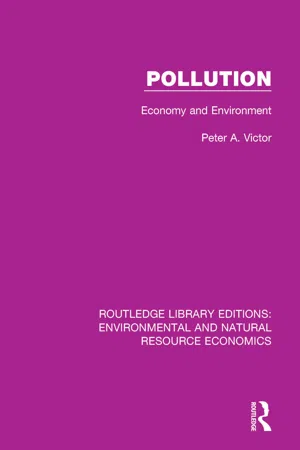
- 244 pages
- English
- ePUB (mobile friendly)
- Available on iOS & Android
eBook - ePub
About this book
Information
CHAPTER III
Commodity-by-Industry Input-Output Models and the Study of Economic-Environmental Interactions
A. Introduction
The purpose of this chapter is to examine, in considerable detail, the analytical properties of two input-output models that can be used to describe some important relations between economic activity and the environment. In order to avoid confusion at a later stage it is useful to begin with a presentation of the conceptual framework of these models. Following this will be a discussion of the accounting data on which a variety of models can be based. The way will then be clear for the development of the two analytical models, which have been selected as the basis for the empirical section of this study.
B. The Conceptual Framework
Up to now it has been implicitly assumed that a valid distinction can be made between an economy and the environment. Before proceeding further this assumption must be critically examined since the distinction between an economy and the environment is fundamental to the theoretical models discussed in the previous chapter as well as to the models to be developed in this chapter.
To avoid getting too deep into philosophical issues it is taken for granted that the physical world really does exist. As human beings we are constituent parts of this physical world, though it is conceptually possible, and useful for theoretical analysis, to consider ourselves apart from the rest of the physical world. This ‘rest’ becomes, in a sense, our total environment. The interaction of human beings is not a random process and is conveniently referred to as social behaviour. Although the similarities far outweigh the differences, when the differences in social behaviour of groups of human beings are considerable, different societies are said to exist. One of the features of these societies that is shared by all is the existence of certain types of human behaviour which are described as economic. This behaviour, which is directed towards the satisfaction (and creation?) of human wants requires the manipulation of materials found in the total physical environment. It is this manipulation of material by man that the term ‘economy’ refers to. The economy therefore is a set of activities, whereas the environment provides the setting-the energy and materials-for the activities.
One of the main purposes of this study is to link economic behaviour with the associated flow of materials. It is useful to be able to identify the point at which material is first obtained from the environment for use in the economy, and also when it is finally discharged from the economy. All economic activity requires inputs of raw materials. These inputs may come from privately owned parts of the environment, such as coal from the land, or from publicly or non-owned parts, such as oxygen from the air. In either case, these material inputs, on their first introduction into the economy, will be called ecologic commodities. However, once the material is being processed for further use or is satisfying the demand of a final consumer, it will be referred to as an economic commodity. Only when it is discarded by an economic agent, that is a producer or a consumer, and so leaves the economy, does it become once again, an ecologic commodity. For most purposes this distinction between economic and ecologic commodities will be clear. Factories, machines and consumer goods are all economic commodities. Waste products discharged into the air, into water courses or onto land are all ecologic commodities. The distinction can become blurred, however, when material enters the economy. If the ...
Table of contents
- Cover Page
- Half Title
- Title Page
- Copyright Page
- Contents
- I Introduction and Summary
- II A Review of the Literature on the Construction of Models that Include the Interactions of Economic Activity and the Environment
- III Commodity-By-Industry Input-Qutput Models and the Study of Economic-Environmental Interactions
- IV An Empirical Survey of the Use of Water and the Production and Disposal of Wastbs in Canada for the Year 1961
- V Some Examples of the Use of Economic-Ecologic Input-Qutput Models
- VI An Economic-Ecologic Input-Output Model for Britain?
- Glossary
- Bibliography
- Index
Trusted by 375,005 students
Access to over 1.5 million titles for a fair monthly price.
Study more efficiently using our study tools.
Frequently asked questions
Yes, you can cancel anytime from the Subscription tab in your account settings on the Perlego website. Your subscription will stay active until the end of your current billing period. Learn how to cancel your subscription
No, books cannot be downloaded as external files, such as PDFs, for use outside of Perlego. However, you can download books within the Perlego app for offline reading on mobile or tablet. Learn how to download books offline
Perlego offers two plans: Essential and Complete
- Essential is ideal for learners and professionals who enjoy exploring a wide range of subjects. Access the Essential Library with 800,000+ trusted titles and best-sellers across business, personal growth, and the humanities. Includes unlimited reading time and Standard Read Aloud voice.
- Complete: Perfect for advanced learners and researchers needing full, unrestricted access. Unlock 1.5M+ books across hundreds of subjects, including academic and specialized titles. The Complete Plan also includes advanced features like Premium Read Aloud and Research Assistant.
We are an online textbook subscription service, where you can get access to an entire online library for less than the price of a single book per month. With over 1.5 million books across 990+ topics, we’ve got you covered! Learn about our mission
Look out for the read-aloud symbol on your next book to see if you can listen to it. The read-aloud tool reads text aloud for you, highlighting the text as it is being read. You can pause it, speed it up and slow it down. Learn more about Read Aloud
Yes! You can use the Perlego app on both iOS and Android devices to read anytime, anywhere — even offline. Perfect for commutes or when you’re on the go.
Please note we cannot support devices running on iOS 13 and Android 7 or earlier. Learn more about using the app
Please note we cannot support devices running on iOS 13 and Android 7 or earlier. Learn more about using the app
Yes, you can access Pollution by Peter A. Victor in PDF and/or ePUB format, as well as other popular books in Commerce & Commerce Général. We have over 1.5 million books available in our catalogue for you to explore.