Introduction
Our philosophical investigation starts from the formulation of a key philosophical problem, the problem of the meaning of human existence. It is indeed true – the thesis will be a fundamental premise of our investigation – that the key question of philosophy is the question posed by Albert Camus, the question of whether life is worth living and whether it has any meaning. We must pose this question with absolute seriousness even if (or maybe because) it is embarrassingly banal. The fact that the question has been asked exhaustively does not change the seriousness of the question itself. If anything, the banality of the question of the meaning of life backed by the narrow-minded arrogance of an analytical philosopher maintaining that it is meaningless, begs us to pose it anew. Our contention is that this question itself has to be asked historically in as much as human life is marked by temporality and historicity. The horizon of human life is history and culture, and it is more so than ever before. Our horizon is no longer nature or, to be more precise, almost no longer nature, but culture, it is man-made, something which has history. The elementary thesis of historical materialism is noteworthy and broadly correct. It could be concisely put as follows: human existence is temporal and historical; it requires the production of means of subsistence; the satisfaction of needs produces new needs; new generations build their lives on the basis of what was created by previous generations, thus they find the existing horizon of material culture – environmental horizon, ‘the world’ – which shapes their needs; the satisfaction of needs is possible through the creative and productive processes in which they are actively engaged.
This thesis should not be understood in its traditional opposition to idealism. The sterile discussion on materialism versus idealism is of no philosophical concern to us. In fact our emphasis on the temporality and historicity of human existence and of the question of the meaning of being can be equally formulated in genealogical or hermeneutical terms, that is, from the point of view of philosophical analysis of, what Michel Foucault called, discursive regimes or from the point of view of the history (or hermeneutics) of ideas. No matter how we look at it, the point remains: our identities and our ability to understand ourselves are always historical. Therefore, the question of the meaning of being should be posed against the historical background of the present as well. Thus an historical account of modernity ought to be developed. A central thesis of this chapter is that entropy of meaning is at the core of modernity. One of the tasks of this chapter will be to articulate and explain it.
Martin Heidegger, Jean-Paul Sartre, and Albert Camus raised the questions of the meaning of being and human existence seriously. Yet, as I will argue in this book, their answers, at least as far as Camus and Heidegger are concerned, are not philosophically convincing and need to be reflected anew. More recently, a number of important attempts have tackled these questions philosophically either via philosophical commentary on the aforementioned philosophers (a notable example is the outstanding work of Robert C. Solomon (2001 and 2007)) or via introductory, popularised attempts to introduce readers to the ‘perennial’ meaning of life questions (e.g. Eagleton 2007; Klemke and Cahn 2008). However, we must instead attempt to think through these ‘existentialist’ questions from a non-existentialist philosophical point of view. The central claim of this philosophical investigation will be that neo-Aristotelian philosophy can and should play an important role in this task. In this respect far too little, if any, research, examining the existentialist assumptions and questions from the perspective of virtue ethics, has been done. Hence, this book will aim to fill the lacuna.
I will readdress this imbalance by developing an Aristotelian approach to the question of the meaning of existence. To do so I will develop a philosophical conception of ‘structures of meaning’. Such a philosophical analysis will pose the question of meaning through the analysis of practices and activities that sustain human life, that enable humans to flourish, and that give meaning to it. The guiding question within which the analysis of the structures of meaning will be developed is: how are we philosophically to conceptualise practices and structures of meaningful human existence in the late/post-modern world? In order to address this question discussing the cultural context of late modernity – that is, the present – is imperative. Thus, I will advance the neo-Aristotelian philosophical analysis of ‘structures of meaning’ against the background of the philosophical articulation of the thesis of the temporality of human existence and the sense of the loss of meaning in modernity.
Modernity and the sense of meaninglessness
European modernity, at least since the second half of nineteenth century, has been characterised by a plethora of cultural narratives of meaninglessness, the absurdity of human life, cultural crises, and pessimism. Thus, a number of scholars have argued that the contemporary culture of late modernity, especially in so far as it has been influenced by modernist movements, is marked by nihilism (e.g. Vattimo 2002: 11–24; Weller 2011; Hemming et al. 2011). At least since Friedrich Nietzsche’s Twilight of the Idols (1998), Thus Spoke Zarathustra (1995), and Genealogy of Morals (1994), nihilism and the sense of meaninglessness have been recurring themes. In the Birth of Tragedy Nietzsche claims:
“Do not go away, but listen first to what popular Greek wisdom has to say about this inexplicably serene existence you see spread out before you here.” An ancient legend recounts how King Midas hunted long in the forest for the wise Silenus, companion of Dionysos, but failed to catch him. When Silenus has finally fallen into his hands, the King asks what is the best and most excellent thing for human beings. Stiff and unmoving, the daemon remains silent until, forced by the King to speak, he finally breaks out in shrill laughter and says: “Wretched, ephemeral race, children of chance and tribulation, why do you force me to tell you the very thing which it would be most profitable for you not to hear? The very best thing is utterly beyond your reach not to have been born, not to be, to be nothing. However, the second best thing for you is: to die soon.”
(Nietzsche 1999: 23)
Of course, it was Arthur Schopenhauer, Nietzsche’s intellectual knight ‘with the hard, steely gaze’, as he called him in The Birth of Tragedy, that gave philosophical rise to European pessimism. He started from Kant and, turning him upside down, identified his Ding an sich with the will, the driving force of the world, the irrational force which cannot be fully understood and conceptualised even though its objective traces are indeed comprehensible. He argued that ‘absence of all aim, of all limits, belongs to the essential nature of the will in itself, which is an endless striving’ (Schopenhauer 1969: 164). Schopenhauer also insisted that traditional argument that we ‘first know a thing to be good, and in consequence will it, instead of first willing it’ should be reversed and that the ‘will is first and original; knowledge is merely added to it as an instrument belonging to the phenomenon of the will’ (ibid: 292). In so arguing he gave birth to the longstanding tradition of irrationalism in the history of Western philosophy. His irrationalism, however, was that of a peculiar sort. He accepted Kantian critique of dogmatic philosophising and naïve realism, as he called them, and pushed Kant’s focus on the subjective conditions of knowledge, the forms of human intellect to the modified fourfold principle of sufficient reason. Stressing the essential interdependence between subject and object Schopenhauer argued that the world was comprehensible only in the form of representations which were subject to space, time, causality, and inference. Thus for Schopenhauer humans are able to know the world only in the form of appearances, the deceptive ‘veil of Maya’, while its essence remains beyond objective knowledge. Assigning the essence of being to the will as Kantian thing-in-itself he unconvincingly argued that the essence of all inorganic and organic things was irrational striving to be – the ceaseless will to overtake each inorganic thing as well as each organic form of life at the expense of one another. While taking humans to be the highest objectification of this irrational cosmic will Schopenhauer concluded that the essence of human life therefore was suffering. Hence his ethics of ‘perfect saintliness’ consisting in ‘the denial and surrender of all willing’ (ibid: 408). Putting Kant on his head Schopenhauer insisted on the necessity to the wholehearted renunciation of the will: ‘salvation, deliverance from life and suffering, cannot even be imagined without complete denial of the will’ (ibid: 397). When the intrinsic meaningfulness of the world has been shattered by the introspection into the subjective possibility and conditions of knowledge and the essence of life is conceptualised through the irrationality of pure striving, the logical conclusion is indeed the denial of life itself.
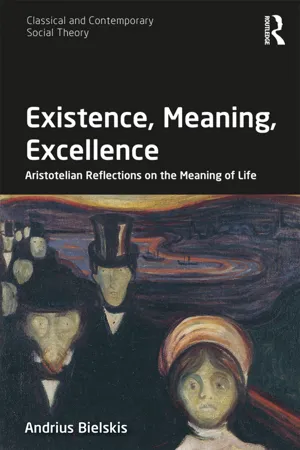
This Nietzschean-Schopenhauerian ‘wisdom’ – the capturing of the sense of existential despair and meaninglessness – is probably best depicted in Skrik (The Scream), the famous painting of Edvard Munch. Originally painted in 1893 it portrays a man on a bridge screaming out of anguish and desolation. The viewer of the painting is tormented as despair of unbearable loneliness and existential alienation are some of the immediate impressions. Painted in the style of art nouveau, portraying the experience of near-madness, it depicts the neurotic annihilation of almost any boundary between the personality of the character (or to be more precise, the depersonalised character of the author himself) and nature, whose revenge threatens with destruction of the sanity of human subjectivity. Commenting on the painting Munch famously described his experience as hearing ‘the enormous, infinite scream of nature’ (c.f. Faerna 1995: 17). It is as if the scream is that of nature being raped, the scream of a neurotic soul of an artist identifying himself with nature. The personification of nature and the depersonalisation of the subject are the way to collapse modernity into the horrors of a disenchanted myth.
In literature, Samuel Beckett’s play Waiting for Godot (1949/2004) is another well-known example of the sense of the absurd in the modern cultural imagination and sensibility. Although the play has none of the painfulness of Munch-like insanity, it is nonetheless an aesthetic document aimed at expressing, according to Beckett, ‘the irrational state of unknowingness wherein we exist, this mental weightlessness which is beyond reason’ (quoted from Graver 2004: 22). As one early reviewer of the play in London put it, Waiting for Godot is a metaphor about human life making ‘a particular appeal to the mood of liberal uncertainty which is the prevailing mood of modern Western Europe’ (ibid: 14). No doubt, the play is neither a celebration of the loss of coherence of the familiar set of meanings nor its lamentation, however, the starting premise and the end point of Godot are the absence, ‘existence by proxy’ (to use Beckett’s own terms), and the meaninglessness of human life in a highly complex compartmentalised modern society. When the horizons of existing structures of meaning, both in terms of the meaningfulness of practices and narratives, are shattered, our ability to tell any convincing and truthful account of ourselves, of the world, of what we dream of and do, is irreversibly broken. The character of Vladimir – the only protagonist in the play who remembers – can be interpreted as a frustrated memory trying to reflect and make sense of life, of what is happening and has happened, to tell the difference between yesterday and today, reminding us that we are waiting for someone or something that never comes. It is the life of post-history, when everything is ‘achieved’, where we have no collective narratives to tell or battles to fight for, a life of liberal banality and disenchantment, a life of impotence, an existence of dreaming and pretending that we are okay.
The themes of crisis and of the loss of meaning are present in philosophical reflections as well. Oswald Spengler’s Decline of the West (1918/1926) is probably one of the main examples of European pessimism, a lamentation of the loss of its cultural vitality and greatness written at the outset of the Great War. Although his morphology of cultures and civilisations was discarded by many as far too elusive and esoteric, Spengler’s influence and pessimism shaped the inter-war European moral imagination considerably. It is not surprising that, although Edmund Husserl’s work in the 1930s was predominantly concerned with the reflective re-examination of his phenomenology, he shared with Spengler, as Dermot Moran (2012: 38) rightly indicates, and the sense of wariness about the fate of European civilization. Thus his famous Vienna lecture ‘Philosophy and the Crisis of European Man’, later included in The Crisis of European Sciences and Transcendental Phenomenology (1970), is an important philosophical treatise dealing with the crisis of sciences in the midst of the greatest barbarity of European politics. Admiring the spirit of Enlightenment, exemplified in ‘the glorious “Hymn to Joy” of Schiller and Beethoven’, Husserl laments its greatest contrast with ‘our present situation’ (Husserl 1970: 10). There he criticises one-sided rationalism that reduces rationality and human sciences to naturalism, psychologism, and narrow-minded empiricism-based scientific objectivity while urging ‘the rebirth of Europe from the spirit of philosophy’ (ibid: 299). The crisis of European civil-isation for Husserl is the crisis of the faith in the universality of rationality, its reductionist version rooted first of all in positivism. Unreflective positivism ends up producing highly mathematised sciences which, unable to pose deeper philosophical questions about the meaning of human existence, ‘decapitates philosophy’. The crisis of European humanity therefore lies in the crisis of the idea of universal philosophy and its lack of proper systemic reflection furnishing sciences with the solid methodological foundation. As he puts it:
A definite ideal of a universal philosophy and its method forms the beginning; this is, so to speak, the primal establishment of the philosophical modern age and all its lines of development. But instead of being able to work itself out in fact, this ideal suffers an inner dissolution. As against attempts to carry out and newly fortify the ideal, this dissolution gives rise to revolutionary, more or less radical innovations. Thus the problem of the genuine ideal of universal philosophy and its genuine method now actually becomes the innermost driving force of all historical philosophical movements. But this is to say that, ultimately, all modern sciences drifted into a peculiar, increasingly puzzling crisis with regard to the meaning of their original founding as branches of philosophy, a meaning which they continued to bear within themselves. This is a crisis which does not encroach upon the theoretical and practical successes of the special sciences; yet it shakes to the foundations the whole meaning of their truth. This is not just a matter of a special form of culture – “science” or “philosophy” – as one among others belonging to European mankind. For the primal establishment of the new philosophy is (…) the primal establishment of modern European humanity itself – humanity which seeks to renew itself radically, as against the foregoing medieval and ancient age, precisely and only through its new philosophy. Thus the crisis of philosophy implies the crisis of all modern sciences as members of the philosophical universe: at first a latent, then a more and more prominent crisis of European humanity itself in respect to the total meaningfulness of its cultural life, its total “Existenz”.
(Husserl 1970: 12)
My task here is not to assess Husserl’s philosophical arguments in Crisis, but to illustrate the claim that the sense of crisis of scientific rationality and of European civilisation is at the centre of philosophical reflection by Europe’s leading philosophers. And although Husserl’s argument is not fully convincing in this work, 1 his urge for philosophical reflection and its importance for social and human sciences, that is, as the methodological foundation of these sciences rather than all sciences as Husserl thought, is important here. It is so because a renewed philosophical reflection on the meaningfulness of human life together with its teleologically structured activities and practices, the normative phenomenology of structures of meaning, is indeed, as I will argue, central to human sciences.
Another example of dark Western pessimism at work – the true European bleak and gloom – is Max Horkheimer and Theodor Adorno’s Dialectic of Enlightenment. If Husserl was worried but still optimistic about the renewal of European humanity through a universal philosophy and sciences, Horkheimer and Adorno, writing in exile during the Second World War, had no illusions about the Enlightenment ideal of philosophy and sciences. Not only did they argue that modern rationality failed to liberate humanity from dogmatism and the superstitions of myth, but also that Enlightenment and science themselves created a new form of enlightened despotism, the despotism of instrumental rationality, a social condition where everything is measured in terms of fascist-like efficiency. In their view modern sciences serve the reification of the status quo and the reinforcement of distorted power relations. Also, modern science has nothing to say about meaning and meaningful hum...