With its appeal predicated upon what civilized society rejects, there has always been something hidden in plain sight when it comes to the outlaw figure as cultural myth. Damian A. Carpenter traverses the unsettled outlaw territory that is simultaneously a part of and apart from settled American society by examining outlaw myth, performance, and perception over time. Since the late nineteenth century, the outlaw voice has been most prominent in folk performance, the result being a cultural persona invested in an outlaw tradition that conflates the historic, folkloric, and social in a cultural act. Focusing on the works and guises of Lead Belly, Woody Guthrie, and Bob Dylan, Carpenter goes beyond the outlaw figure's heroic associations and expands on its historical (Jesse James, Billy the Kid), folk (John Henry, Stagolee), and social (tramps, hoboes) forms. He argues that all three performers represent a culturally disruptive force, whether it be the bad outlaw that Lead Belly represented to an urban bourgeoisie audience, the good outlaw that Guthrie shaped to reflect the social concerns of marginalized people, or the honest outlaw that Dylan offered audiences who responded to him as a promoter of clear-sighted self-evaluation. As Carpenter shows, the outlaw and the law as located in society are interdependent in terms of definition. His study provides an in-depth look at the outlaw figure's self-reflexive commentary and critique of both performer and society that reflects the times in which they played their outlaw roles.
eBook - ePub
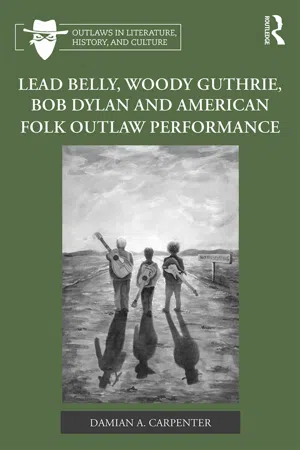
Lead Belly, Woody Guthrie, Bob Dylan, and American Folk Outlaw Performance
- 232 pages
- English
- ePUB (mobile friendly)
- Available on iOS & Android
eBook - ePub
Lead Belly, Woody Guthrie, Bob Dylan, and American Folk Outlaw Performance
1Long ways from home
Introduction
In a brief essay from the early 1940s, Woody Guthrie asks, “Why do people set down and write up great songs and ballads about their outlaws? (And never about governors, mayors, or police chiefs?)” (Pastures of Plenty 79–80). Guthrie’s answer reflects his understanding and treatment of the outlaw as well as the Depression era’s popular and social representation of the outlaw figure as a populist hero: “an outlaw does one big thing … He tries. Tries his best. Dies for what he believes in. Goes down shooting. Politicians don’t try. They shoot the bull and hot air, but they don’t try their best to make the world better” (Pastures of Plenty 80). For Guthrie, the outlaw figure is an agent of change, and songs are the expression of the people’s wish for change through the example of this agent. It is the outlaws, rather than “the law,” that try, even at the cost of their lives, to make the world better for those whose freedom is threatened by unjust laws or an unfair economic system. This is the portrayal of the outlaw Guthrie grew up with in the oil boom plains and Dust Bowl devastation of Oklahoma and Texas, and this is the outlaw role Guthrie portrayed in his performance persona and songs.
It does not take much critical insight to debunk this romantic view of the outlaw, especially when considering the actual deeds and lives of “classic” outlaw figures like Jesse James or Billy the Kid. But the factual biography of classic outlaws is not essentially what this study is interested in; nor is it particularly interested in debunking myths surrounding the outlaw figure. This is not to say that the biographies and mythic structures of the outlaw should not be and are not considered in this study. Getting to the root, the facts and the contexts from which traditional and mythic systems grow, brings to light much that is often glossed over or forgotten over time in rigid traditions and dominant myths.
Take John Henry’s story, for example. An historical moment and performance that became an enduring folkloric tradition and myth sung about for over a century, Henry’s epic battle against machine is full of a rich and perplexing ambiguity that is often lost when it is read merely in a positive light. Taking the tale as a whole, we might consider a number of readings: is John Henry’s victory over the steam drill a story representing the American will to succeed, an affirmation of the primacy and necessity of human labor in an increasingly urban–industrial society, or a cautionary tale of the dangers of overwork and hubris? Certainly, we do not have to settle on strictly one reading, nor should we. In addition to these broader questions, we might consider some more direct issues concerning the man, his family, and his situation. Why is it that even as a baby, as the tale tells, John Henry knew he was going to die with that hammer in his hand? What about the son Henry left behind just to prove “a man ain’t nothin’ but a man”? Moreover, what about Polly Ann, the wife he left behind, who took up that hammer after his death? Considering these details more fully can lead to some very lively critical interpretation of the story. Is Polly Ann, the “steel-driving woman,” Rosie the Riveter’s mythical mother?
It does not take much digging under the surface to get at the complexity of Henry’s tale. The lasting place the ballad has had in American culture is partly due to this complex ambiguity, even if much of it is masked in a heroic act. Digging even deeper, as Scott Reynolds Nelson has recently done, reveals that John Henry was quite possibly a black convict hired out to the railroad who was not swinging his famous hammer by choice. He was an outlaw (in custody) even if, perhaps, he is not what we might think of as a typical outlaw. It might be said that John Henry’s story is one of the most successful tales of the folk outlaw tradition, because his outlaw roots were masked completely by heroism in popular culture. Unlike Jesse James or Billy the Kid, whose sometime heroic status is always undercut by our awareness of their outlaw deeds and status, John Henry’s outlaw status was firmly “buried in the sand.” Time, memory, and popular consumption erased the prison walls of the “white house” where John Henry was buried in an anonymous mass grave. How does this new twist to Henry’s story add to the already complex tale? This is a question we will return to in the next chapter.
Getting to the root of myths and traditions (which are essentially more ritualized mythic systems) can reinvigorate the liveliness of such systems of understanding and defining culture and society. Without this reinvigoration, myth and tradition lose their capacity to play, discover, and remain open to interpretation. They become static, closed systems, which often results in cultural stagnation and, with this stagnation, the means to justify exclusion, oppression, dispossession, and, at its worst, extermination. Fascism is perhaps the most obvious example of this in the twentieth century. But it is the same closure by which American expansion and belief in manifest destiny justified the removal and extermination of Native Americans, and by which disenfranchisement of African Americans, as well as the widespread social, cultural, and political outlawing or outcasting of countless others, was and still is made possible. Yet, tradition and myth need not and should not be abandoned despite these cultural malignancies. “[W]ithout myth,” Nietzsche writes, “every culture forfeits its healthy, natural creative force: only a horizon defined by myths completes the unity of a whole cultural movement” (Birth of Tragedy 122). It is not, then, that we need to debunk or dispel myth and tradition, but these systems of understanding should not be blindly or romantically accepted either. Both methods of making sense of the world might be comparatively considered the result of forfeiture of social and cultural growth: an unhealthy, oppressive, and destructive cultural force. Rather, myth and tradition should be treated as creative cultural forces. Getting to the root of these forces in a case like John Henry—the fact that he was a black convict contracted out to the railroad rather than working willingly—opens our understanding of how these cultural forces work, perpetuate, and are co-opted by various groups in ways that either appreciate the myth’s liveliness or adapt and stifle it to their own ends, wittingly or not. To this end, this book considers outlaw biographies, mythic structures, and traditions in order to understand how individual outlaws “performed” a role, how the public received that performance, how culture is created by this performative dynamic, and how the liveliness of the folk outlaw tradition makes all of this possible. For if it is possible to say anything definitive about the folk outlaw tradition, it is surely that the tradition is anything but static.
The very nature of the outlaw resists definition and fixity, even if this complicated figure demonstrates an impulse toward integration (as we will see in the various ways the outlaw is tied to notions of “home”) and the fact that an exterior force of public consumption makes him socially and culturally acceptable. The former force we might liken to settling down or “going straight,” and the latter force we might characterize as a cultural pardon. But in the archetypal outlaw’s case, integration or acceptance is transitory. It must be. Otherwise, symbolically, the outlaw is no longer a disruptive, creative force, no longer an outlaw and no longer an agent of change. That the outlaw is never fully integrated or accepted is demonstrated by the various ways that the figure’s cultural role and treatment has changed over time. Since the time of the classic American outlaw’s cultural birth during the late nineteenth century, the modern American folk outlaw has performed many roles in the service of many different interests. These roles shifted in various degrees between a moral dialectic of “good” and “bad” for much of the outlaw’s formative years until the Second World War.
In a sense, the social and cultural treatment of the outlaw figure has served as a barometer for the times. If the outlaw was treated as a good man outside the law by Woody Guthrie and others during the Depression, he was not necessarily seen this way at other times. For instance, while Jesse James enjoyed a good man outlaw image similar to that of Robin Hood during his outlaw career and in the years following his death in the late nineteenth century, by the turn of the century this popular treatment had shifted. During this time, American society was in a moral panic and there were calls for widespread social reform. As a result, the dime-novel industry that helped to create the mythic good man image of the James brothers was pressured to discontinue the popular James novels because it was feared that the romantic treatment of the outlaws and their violent ways corrupted the youth. The good man James became the bad man, joining Billy the Kid, who did not play the good man role until the Depression era.
It was also at the turn of the century that the African-American bad man tradition—arguably a development from slave trickster tales—became prominent with figures like John Hardy and the infamous Stagolee, both of whom stand in distinct contrast with John Henry’s heroics but were nevertheless treated as cultural heroes. Blues or folk performers that emerged during this time embodied this ambivalence in lifestyle and performance, shaping a tradition that would characterize Huddie Ledbetter’s (Lead Belly) performance persona and popular reception. Lead Belly was never fully able to shed his image as a violent bad man during his life, particularly because his initial popular reception in the early 1930s, which was the dominant basis of the Lead Belly legend, was so integrally established by this role. However, during the late 1930s and early 1940s, the most productive years of the Popular Front and first folk revival, his performance of the role involved a social consciousness that the traditional bad man figure apparently lacked. Or rather, his performance brought the social problems that helped to create the traditional bad man figure to the surface. Richard Wright, who befriended Lead Belly in 1937 and interviewed him for the Daily Worker that year (August 12, 1937), gives us perhaps the most archetypal representation of the bad man during this time with his character Bigger Thomas and the painstaking way that Native Son (1940) attempts to understand the social conditions that precipitate Bigger’s crime.
A similar shift in outlaw representation was also happening with Guthrie’s good man outside the law, emphasizing the roots of discontent rather than the actions of the discontented. In the Depression-era representation of the folk outlaw, we do not merely see a return of the late-nineteenth-century good man or the ambivalently romanticized bad man. During this time, we see the beginnings of a complex hybrid of the two that dispenses with simple moral judgment of the outlaw in favor of the outlaw serving as a representative critique of the American culture and society that created these outlaws or necessitated their actions. On the surface, the Depression-era good man outlaw—really, a socially conscious bad man—kept intact the moral dialectic of good and bad even as it shifted the focus of moral judgment more fully to address the roots of social and cultural problems. As it was, at the end of the nineteenth century when Jesse James—not even posthumously, but while he was still alive—was first treated as a modern Robin Hood, the root of these Depression-era problems often found expression in the figure of corrupt politicians, businessmen, and agents of the law. Underneath this simple dialectic of the good man fighting for the powerless against the bad men who held the power, however, was an increasingly broader critique of the national systems these powerful bad men inside the law represented.
As this broader critique developed further after the Second World War, the role of the outlaw in American culture shifted yet again. The pre-Second World War emphasis on the good/bad moral dialectic gave way to the honest man portrayal of the outlaw whose ethically rooted role continued to develop through the 1970s. The distinction I am making here between morality and ethics is important. Whereas morality is something akin to rigid tradition (especially religious law), wherein it represents accepted social and cultural norms and judges deviations harshly, ethics (while sometimes viewed in a similar way) is the study of morality: it ultimately questions the authority of moral systems.1 It is in this sense that the post-Second World War ethically rooted outlaw goes beyond the moral critique of representatives of power and law and engages in an ethical critique of not only the individual systems that he represents but also more explicitly critiques notions of American nationhood and identity, the national myths and traditions that created the social and cultural norms. Yet, the honest man outlaw should not be considered an enlightened good man. His critique, often expressed in terms of honest self-evaluation in representation and performance, has little to do with goodness or badness. While honesty may be considered a “good” or admirable trait in general, inherently it is an amoral evaluative position. One does not have to be “good” to be honest. The honest man outlaw is represented as just as flawed as the systems he critiques in his performance. In many ways, he represents a national unconscious that honestly engages with its tragic flaws where recognition (and perhaps acceptance) takes precedence over justification. The honest man outlaw, moreover, represents the perpetual tension between the individual and the collective in the context of an American democratic and capitalist ideology drastically thrust under the microscope in a paranoiac Cold War society. The symbolic alienation of the outlaw was an explicit representation of the social, cultural, and political alienation of the time.
While it is tempting to consider the representative shifts of the American folk outlaw figure from a good/bad moral dialectic to an ethically rooted honest evaluation as a progressive evolution, to do so would neglect to consider the characteristics of the outlaw that make him continuously culturally appealing for better or worse. This would also create artificial boundaries in the outlaw’s heritage, disconnecting him from his predecessors and those who follow. The good/bad moral dialectic may have been dominant in the performances of Lead Belly and Guthrie, but this is not to say that there is not an element of ethical critique implicit in their work or even in the very beginnings of the modern outlaw figure. Guthrie’s outlaw American anthem, “This Land Is Your Land” (1940), which highlights the disparity between America’s democratic ideals and the reality of their exclusion, is a good case in point. Lead Belly’s “Bourgeois Blues” (1938) is another good example, highlighting this disparity even more pointedly by addressing the irony of segregation in a democratic nation’s capital.
Nor is there a complete absence of the good/bad moral dialectic in the performance of the ethically rooted outlaw. Bob Dylan’s work engages with the tension or disparity between the self-legislated individual and the socially and culturally constructed role that essentially defines the dilemma of the honest man outlaw. But Dylan, whose outlaw persona arises from the same outlaw tradition as Lead Belly and Guthrie and who was directly influenced by each of these outlaw performers, never completely abandons speaking in moral terms even as he highlights the importance of individual ethics. “Like a Rolling Stone” (1965), Dylan’s outlaw anthem, highlights the benefits of being a social outcast, particularly the benefit of self-honesty as a result of being removed from a social moral system that defines “good” and “bad.” But in a 1981 interview, 16 years after recording the song, Dylan comments on the “classic” outlaws whom he grew up admiring, both in terms of an ethically rooted honesty and an assumed moral standard they shared: “Robin Hood, Jesse James … the person who always kicked against the oppression and … had high moral standards. I don’t know if the people I write about have high moral standards, I don’t know if Robin Hood did, but you always assumed that they did … I think what I intend to do is just show the individualism of that certain type of breed” (“Dylan London Interview”). Integral to Dylan’s understanding of the outlaw is the archetypal/classic figure of the outlaw that is represented in terms of the good/bad moral dialectic, which he does not merely leave behind in favor of a new understanding but improvises upon. In this manner, the outlaw figure is not seen as evolutionary—which fixes the various outlaw types in specific times and contexts, fragmenting understanding of the outlaw into a more rigid tradition—but as a mercurial, lively, and shifting form that always retains a set of characteristics and values that make him appealing to many different groups at different times.
In this study, I treat folk outlaw performance as improvisation on tradition, a conceptual framework that welcomes the creative tension between freedom and fixity while highlighting the performative role of the outlaw negotiating the shifting line between the two. By considering both freedom and fixity (represented by improvisational performance and tradition, respectively) as integral to the outlaw’s social and cultural performative liveliness, we recognize that the root of improvisation (freedom) lies in tradition (fixity), while the root of tradition likewise springs from some past improvisation. Essentially, the two share the same root no matter how antithetical they may seem to be. The classic outlaw/blues myth of a crossroads pact with the devil provides a good performative model of this play between freedom and fixity.
The crossroad tale made famous in the myths surrounding the blues musician Robert Johnson may have been, in its modern form, his own creation (or Tommy Johnson’s), but it is more likely an improvisation on the outlaw persona of the bluesman that emerged around the turn of the century. As many scholars have noted, the roots of this myth can be traced back to a number of African/African-derived ritual and religious forms. One particular noted source is the Fon trickster Legba (or the similar Yoruba trickster Eshu), whose “home” is situated at crossroads (or any “threshold” place) and who serves as a mediator or negotiator of creative (and/or destructive) commerce between things or worlds that are antithetical, such as heaven and earth, chance and fate, or in the central terms that concern us, freedom and fixity.
As a conceptual model, the modern crossroads myth demonstrates the outlaw performer’s negotiation of the tension between improvisation (freedom) and tradition (fixity). The musician who journeys to the crossroads to make a pact with the devil at the stroke of midnight, selling his soul in exchange for unearthly or charmed talent, may take that talent and travel in any direction from that crossroads. He is free to perform wherever and whatever he pleases, but he is still essentially fixed by his crossroad pact with the devil; at least, his soul is. What we might call his “curse” is not that he sells his soul, but that he is fixed in the inherent placelessness of the crossroads, never able to settle down in any “normal” way. There is a lesson here.
On the surface, it is important to read the devil as the Devil, especially in the context of blues music and the...
Table of contents
- Cover
- Half-Title
- series
- Title
- Copyright
- Dedication
- Contents
- Acknowledgements
- 1 Long ways from home: Introduction
- PART I Outlaw tradition
- PART II Outlaw performance
- Work cited
- Index
Trusted by 375,005 students
Access to over 1.5 million titles for a fair monthly price.
Study more efficiently using our study tools.
Frequently asked questions
Yes, you can cancel anytime from the Subscription tab in your account settings on the Perlego website. Your subscription will stay active until the end of your current billing period. Learn how to cancel your subscription
No, books cannot be downloaded as external files, such as PDFs, for use outside of Perlego. However, you can download books within the Perlego app for offline reading on mobile or tablet. Learn how to download books offline
Perlego offers two plans: Essential and Complete
- Essential is ideal for learners and professionals who enjoy exploring a wide range of subjects. Access the Essential Library with 800,000+ trusted titles and best-sellers across business, personal growth, and the humanities. Includes unlimited reading time and Standard Read Aloud voice.
- Complete: Perfect for advanced learners and researchers needing full, unrestricted access. Unlock 1.5M+ books across hundreds of subjects, including academic and specialized titles. The Complete Plan also includes advanced features like Premium Read Aloud and Research Assistant.
We are an online textbook subscription service, where you can get access to an entire online library for less than the price of a single book per month. With over 1.5 million books across 990+ topics, we’ve got you covered! Learn about our mission
Look out for the read-aloud symbol on your next book to see if you can listen to it. The read-aloud tool reads text aloud for you, highlighting the text as it is being read. You can pause it, speed it up and slow it down. Learn more about Read Aloud
Yes! You can use the Perlego app on both iOS and Android devices to read anytime, anywhere — even offline. Perfect for commutes or when you’re on the go.
Please note we cannot support devices running on iOS 13 and Android 7 or earlier. Learn more about using the app
Please note we cannot support devices running on iOS 13 and Android 7 or earlier. Learn more about using the app
Yes, you can access Lead Belly, Woody Guthrie, Bob Dylan, and American Folk Outlaw Performance by Damian A. Carpenter in PDF and/or ePUB format, as well as other popular books in History & Social History. We have over 1.5 million books available in our catalogue for you to explore.