Whether we talk about human learning and unlearning, securitization, or political economy, the forces and mechanisms generating both globalization and disintegration are causally efficacious across the world. Thus, the processes that led to the victory of the 'Leave' campaign in the June 2016 referendum on UK European Union membership are not simply confined to the United Kingdom, or even Europe. Similarly, conflict in Ukraine and the presidency of Donald Trump hold implications for a stage much wider than EU-Russia or the United States alone.
Patomäki explores the world-historical mechanisms and processes that have created the conditions for the world's current predicaments and, arguably, involve potential for better futures. Operationally, he relies on the philosophy of dialectical critical realism and on the methods of contemporary social sciences, exploring how crises, learning and politics are interwoven through uneven wealth-accumulation and problematical growth-dynamics. Seeking to illuminate the causes of the currently prevailing tendencies towards disintegration, antagonism and – ultimately – war, he also shows how these developments are in fact embedded in deeper processes of human learning. The book embraces a Wellsian warning about the increasingly likely possibility of a military disaster, but its central objective is to further enlightenment and holoreflexivity within the current world-historical conjuncture.
This work will be of interest to students and scholars of international relations, peace research, security studies and international political economy.
This book is a warning about the likely consequences of disintegrative tendencies in the global political economy. It is vital to formulate this warning in a self-critical manner. Often, the perception “I have been watching the news and the world seems to be falling apart” is illusory. Media images of wars, threats of violence and senseless terror, and the consequent precautionary actions of security apparatuses, conceal that the world is on average less violent now than past centuries or millennia.1
Sensationalized news about wars in the Middle East and the Ukrainian conflict in Europe, and political developments such as Brexit and the election of Donald Trump, have intensified the sense that things are falling apart. Many commentators convey a common fear of impending global disorder. Alarm is often connected to historical stories about the decline of the West and the rise of a post-Western world.
Extrapolation from news can be a misleading way to understand the world. As Steven Pinker explains, news is “always about events that happened and not about things that didn’t happen” (Belluz 2016). News media focus selectively on the dramatic and tend to push non-dramatic events and slow processes to the background. Headlines do not usually scream that violent death has become rare. In Western Europe and North America, as well, the absolute number of people killed in terrorist attacks has been in decline for decades, despite notable events – Paris, November 2015 or 9/11.2
Furthermore, theories may be more historical and processual than everyday commercial news but can be equally misleading. For example, the typical alarmist reaction to President Trump resonates with hegemonic stability theory, which posits that a single hegemonic state is both a necessary and sufficient condition for an open, liberal world economy. A change of hegemony in world politics is associated with global war.
Developers and advocates of hegemonic stability theory have been warning about the imminent threat of global war for decades. The late Susan Strange (1987, 552), founder of International Political Economy in Britain, compared the myth of lost US hegemony to the once widely believed idea that German-speaking people came from a distinct Aryan race and to the persistent myth that rhinoceros horn is an aphrodisiac. Experts relying on false myths (see also Grunberg 1990), and driven by simple theories and ideologies, are usually not very good at predicting the future. Philip Tet-lock’s (2005, 20) systematic studies of expert anticipations of the future concludes:
When we pit experts against minimalist performance benchmarks – dilettantes, dart-throwing chimps, and assorted extrapolation algorithms – we find few signs that expertise translates into greater ability to make either “well-calibrated” or “discriminating” forecasts.
A further problem with alarmism is that it can become a self-fulfilling prophecy. In the midst of everyday concerns and anxieties of life, the media-driven sense of things falling apart can breed socio-psychological mechanisms that generate existential insecurity, securitization of political issues and increasingly antagonistic self–other relations. Social systems are open, the future is conditionally responsive, so researchers must consider ethical and political responsibility.
Moreover, the world is contradictory. (Mega)trends can point in different directions. For instance, although the world economy has seen a long downward trend in the rates of investment and growth, and although inequalities, vulnerabilities and uncertainties have grown, economic reality remains complex. During the last four decades, the world population has grown from 4 to 7.5 billion, and the average world GDP per capita has at least doubled. Experience of the developments of the world economy are diverse and position and context specific.
The industrialization and rapid economic growth of China and India have led to the emergence of new strata of middle and upper class people.3 Within overall growth, many parts of the world have experienced processes of deindustrialization – the former Soviet Union, North America, Latin America and many regions of Europe. Some poor and middle-income countries have stagnated or collapsed. Even in China, the share of manufacturing of GDP has been declining for decades. Thus, uneven growth and development generate complex and varied realities.
With these caveats in mind, this book argues that the possibility of global military catastrophe is real and increasingly likely (a global ecological catastrophe is equally likely, but not the focus of this book). This book can be read as a storm warning that would not make sense if it did not remain possible to avoid the worst of that storm. The storm analogy is of course partial. The storm I am talking about is a human-made geo-historical construction, not a natural phenomenon. But human-made historical constructions are also causally efficacious. Even if the worst-case scenario is not realized, the storm evoked by disintegrative tendencies in the global political economy will cause many troubles and crises.
The return of the past amidst relative stability
When anticipating the future, it is expedient to recall past forecasts and their failures. In the late twentieth century, the year 2000 was often seen as a decisive turning point. Many experts tried to foresee how things would look in the year 2000 and beyond (though a mythicized number 2000 does not have any bearing on relevant geo-historical processes). Johan Galtung (2000, 123), an eminent peace researcher and futurologist, explains that experts, many of them world-famous, were “remarkably wrong [about year 2000]; not only as a group but almost every single one of them”.
Not everyone has been equally wrong. Hedley Bull, a British institution-alist International Relations scholar, stands out. In The Anarchical Society, Bull (1977) was right about the continued prevalence of the international society, constituted by shared rules, norms, understandings and institutions such as state sovereignty, diplomacy, international law, international organizations and great powerness. Underneath sensational media events and the daily drama of world politics, and despite some gradual changes and persisting potential for global catastrophe, the overall situation in 2017 appears mostly that of business as usual within international society. This is roughly in line with Bull’s expectations.4
However, contra Bull, since the 1970s transnational organizations have proliferated. Bull seems to have underestimated globalizing forces (cf. Scholte 2005). Transnational corporations, banks and financial investors are now arguably more powerful (as noted early by Gill and Law 1989). New free trade and other international legal agreements have consolidated the privileged position of private megacorporations. Globalization may not be as new or discontinuous as sometimes depicted, but qualitatively novel features and properties have emerged: investment protection clauses, justin-time systems of global production, digital derivatives markets, aggressive tax planning etc. Bull also neglected the possibility of the emergence of tentative elements of world statehood (cf. Albert et al. 2012; Albert 2016).
After the end of the Cold War, the world became more ideologically homogeneous. There were subsequent attempts to build systems of collective security, and even elements of world statehood – through human rights or economic treaties and in the functionally differentiated sphere of security (UN 1992). The relevant question now is: why has the world been reverting to nationalist statism, militarized conflicts and arms races, notwithstanding globalizing forces and the emergence of elements of global constitutionalism and security?
We can find some possible, albeit partial, answers, in Bull’s account of international society. In the absence of consensus in the UN Security Council, the US and its NATO allies have resorted to unilateral wars of intervention. This raises issues of just war. As Bull (1977) noted, the problem with just war is that just causes can clash, whether in the public sphere or on the battleground (1977, 30, 132–3, 157–8). This has been the case in the Middle East, Central Asia and Ukraine. Bull also emphasized that attempts at collective security may weaken or undermine “classical devices for the maintenance of order” (1977, 231). If one great power can resort to war unilaterally, why not others?
The conflict between Putin’s Russia and the West can be seen from this perspective: a likely consequence of unilateral attempts to execute collective security. This unilateralism has tacitly revived just war doctrine. For example, intervention in the Syrian civil war (2011–), has created potential for both cooperation and further escalation of antagonisms as “just” causes conflict. In Chapters 3 and 4, I discuss the problem of double standards and clashing interpretative perspectives in world politics. However, I also argue in this book that the dynamics of global political economy are key. The dynamic processes of the world economy shape conditions everywhere. Actors participate in bringing about and steering global political economy processes in various, but often short-sighted, counterproductive and contradictory ways (Patomäki 2008; Patomäki 2013).
The Bretton Woods system lasted from 1944 to 1973. The subsequent system has been characterized by a particular political project of globalization, where overall per capita rates of growth have gradually declined, though the world economy is still growing; inequalities have risen within most countries and in some ways between countries; the “normal” rate of unemployment has risen; and work has become increasingly precarious. The world economy has also been characterized by oscillations with increasing amplitude. Volatility has risen, especially in finance.5 The financial crisis of 2008–2009 was the most serious crisis of the world economy since the 1930s and 1940s.6 It almost produced a new great depression – the world economy verged on collapse – but automatic stabilizers, rescue and stimulus packages averted the worst. As Jonathan Kirshner (2014, 47) also argues, “the relatively benign international political environment in 2007–2008 compared with the intense security dilemma of the inter-war years were also essential in not making a bad situation worse”.
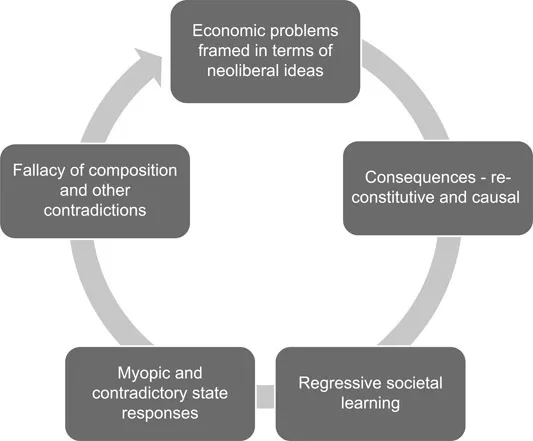
Fallacy of composition (see Elster 1978, 97–106) is a key concept in this book. What is possible for one actor at a given moment is not possible for all or many simultaneously. This has collective policy implications. For instance, any attempt to export a slump to other countries by reducing imports and increasing exports or by creating equivalent financial flows soon leads to a contradiction if everyone tries to do the same. The same applies to pursuing “competitiveness”, whether it refers to exports or investment. For example, if the aim is to attract a maximal share of investment to maintain economic growth via corporate tax competition, there is no aggregate level historical evidence that this increases the overall pool of investment. Rather, the opposite seems to be true: investment rates have declined in the OECD as tax rates have fallen. If corporate tax cuts have a positive effect on the level of real investments in one country, it will likely do so at the expense of other countries. Short-sighted and contradictory ways of responding to problems of the world economy are both the cause and effect of problems (Figure 1.1).
Figure 1.1 The self-reinforcing negative dynamics of the neoliberal world economy
The process tends to reinforce itself, partly because dynamics lead to political changes within and across states, often deepening and entrenching myopic self-regarding orientations. Many mechanisms can work toward this. For instance, volatile public opinion responds to changing conditions. Rising unemployment, widening social disparities and increasing uncertainty and dependence can generate existential insecurity among citizenry.7 Economic problems tend to threaten identity, as not only one’s earnings but also one’s social worth, rights and duties are tied to a position as an employee, entrepreneur or capitalist. Economic problems can endanger social integration (Habermas 1988, 20–31). Given characteristic difficulties and pathologies of socialization in a complex market society, and related crises of embodied personality, the blend of capitalist world markets and separate national states involve great potential for antagonistic social relations.
These and related processes largely explain why the world has been reverting to nationalist statism, militarized conflicts and arms races. The international political environment is becoming less benign. An arms race too can follow from (i) responses to economic problems and (ii) a related fallacy of composition. For instance, a state may decide to stimulate its economy by spending more on armaments (i.e. resort to military Keynesianism) or keep a “security margin” by trying to be better armed than its actual or potential military adversaries. If all relevant states – or even just two of them – try the same, the result can be an arms race, which may escalate to war.8
The result of these dynamics is a gradual and partial return of the past. Sometimes this return may be ideologically explicit. Neoliberalism tends to evoke nineteenth-century economic liberalism and its values (see e.g. Hayek 1944, 240). In international economic relations, the dominance of policies of free trade and free movement of capital signify a return to types of regime that existed before World War I. The re-emergence of power-balancing practices – following the brief post–Cold War period of globalism and the peace dividend – is another sign of a re-formation of a pre-WWI system type. The historical analogy to pre-WW...
Table of contents
Cover
Half Title
Series Page
Title
Copyright
Contents
List of figures
List of tables
Acknowledgements
1 Introduction: the world falling apart
2 Brexit and the causes of European disintegration
3 EU, Russia and the conflict in Ukraine
4 Trumponomics and the logic of global disintegration
5 Piketty’s inequality r > g: the key to understanding and overcoming the dynamics of disintegration
6 Conclusion: holoreflexivity and the shape of things to come
Index
Trusted by 375,005 students
Access to over 1.5 million titles for a fair monthly price.
Study more efficiently using our study tools.
Frequently asked questions
Yes, you can cancel anytime from the Subscription tab in your account settings on the Perlego website. Your subscription will stay active until the end of your current billing period. Learn how to cancel your subscription
No, books cannot be downloaded as external files, such as PDFs, for use outside of Perlego. However, you can download books within the Perlego app for offline reading on mobile or tablet. Learn how to download books offline
Perlego offers two plans: Essential and Complete
Essential is ideal for learners and professionals who enjoy exploring a wide range of subjects. Access the Essential Library with 800,000+ trusted titles and best-sellers across business, personal growth, and the humanities. Includes unlimited reading time and Standard Read Aloud voice.
Complete: Perfect for advanced learners and researchers needing full, unrestricted access. Unlock 1.5M+ books across hundreds of subjects, including academic and specialized titles. The Complete Plan also includes advanced features like Premium Read Aloud and Research Assistant.
Both plans are available with monthly, semester, or annual billing cycles.
We are an online textbook subscription service, where you can get access to an entire online library for less than the price of a single book per month. With over 1.5 million books across 990+ topics, we’ve got you covered! Learn about our mission
Look out for the read-aloud symbol on your next book to see if you can listen to it. The read-aloud tool reads text aloud for you, highlighting the text as it is being read. You can pause it, speed it up and slow it down. Learn more about Read Aloud
Yes! You can use the Perlego app on both iOS and Android devices to read anytime, anywhere — even offline. Perfect for commutes or when you’re on the go. Please note we cannot support devices running on iOS 13 and Android 7 or earlier. Learn more about using the app
Yes, you can access Disintegrative Tendencies in Global Political Economy by Heikki Patomaki in PDF and/or ePUB format, as well as other popular books in Politics & International Relations & Politics. We have over 1.5 million books available in our catalogue for you to explore.