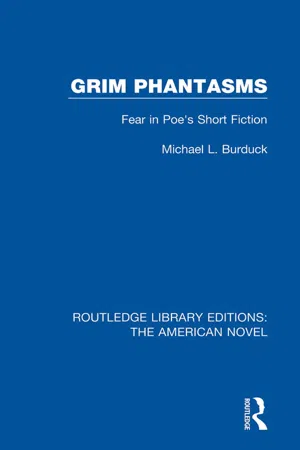
This title, originally published in 1992, presents an assessment of Poe's short stories that treat horror, and more specifically how he manipulated the conventions of that horror to register subtly on the fears and phobias of his reading audiences. Short-stories examined include The Black Cat, Hop-Frog and Morella. This title also explores the theories of Stephen King and Benjamin Rush on the horror genre. This title will be of great interest to students of American Literature.
- 170 pages
- English
- ePUB (mobile friendly)
- Available on iOS & Android
eBook - ePub
About this book
Information
Grim Phantasms
Chapter 1
Poe, Gothic Fiction, and Fear
POE AND THE NOTION OF FEAR
In “The Fall of the House of Usher,” the narrator attempts to discover the source of Roderick Usher’s unusual malady. Providing his friend with some pertinent details, Roderick reveals the true source of his illness:
I have, indeed, no abhorrence of danger, except in its absolute effect--in terror. In this unnerved--in this pitiable condition--I feel that the period will sooner or later arrive when I must abandon life and reason together, in some struggle with the grim phantasm, FEAR.1
Fear plays a key role in Poe’s tales. Most of the characters in the Gothic pieces find themselves slaves of this emotion. Skilled craftsman and artist as he is, Poe realizes that he must also lure his readers into a web of fear. His use of fear, then, must be directed at both artistically created figures and the readers who will either leave the book or remain spellbound by the story and follow it eagerly toward its conclusion. Poe relies on what Stephen King in Danse Macabre (1981) calls “phobic pressure points.” Common to all members of a particular society, such points make them react to the horrors presented in a tale or novel. The good horror writer will exploit these inner fears as he strives to terrorize his readers. Attempting to reach as large an audience as possible, Poe decided to use the fears present in the nineteenth-century mind as the means of luring his readers into his fictive world.
How well did Poe succeed in grasping his readers with the embrace of fear? Perhaps the words of his contemporary Philip Pendleton Cooke demonstrate the effectiveness of his fear-ridden narratives. In a letter dated 4 August 1846 Cooke describes his reaction to one of Poe’s tales, and he leaves little doubt as to its effect: “The ‘Valdemar Case’ I read … as I lay in a Turkey blind, muffled to the eyes in overcoats…. That story scared me in broad daylight, armed with a double-barrel Tryon Turkey gun. What would it have done at Midnight in some old ghostly countryhouse?”2 Cooke later comments on some of Poe’s other Gothic stories:
I have always found some one remarkable thing in your stories to haunt me long after reading them. The teeth in Berenice-the changing eyes of Morella-the red & glaring crack in the House of Usher … the visible drops falling into the goblet in Ligeia, & c. & c.--there is always something of this sort to stick by the mind….3
Although two years later Cooke would suggest that Poe’s appeal might increase if he wrote about subjects nearer ordinary life,4 his thoughts attest the power of fear present in Poe. No doubt other readers shared Cooke’s views and found themselves terrified in broad daylight as they read a Poe tale.
The psychological machinations of human beings fascinated Poe: “he was always eager to arrive at exact analyses of qualities of mind.”5 Attempting to chart the hidden mazes of thought became for him a lifelong artistic quest. Of all the emotions produced by and affecting the mind, fear most intrigued Poe. Influenced by Burke, Poe knew that no other passion so effectively prevents the mind from acting or reasoning.6 Like his narrator in “Usher,” Poe sought to discover the true sources and nature of fear. Throughout his fiction he probed the mind in order better to understand this grim phantasm, which at one time or another holds every man in its grasp.
The events in his tales serve to reflect and heighten the mental condition being probed. Such external devices as weather and setting provide an environmental basis for fear. Poe highlights his description of mental or physical situations or moods with a concentration similar to that which one in everyday life observes in tense moments.7 Understanding the mechanics of fear, Poe brings his knowledge of its characteristics to bear in the physical act of writing a tale.
Despite Poe’s use of fear as a force capable of producing deadly results, many critics question his seriousness regarding this emotion. Lewis posits that although Poe’s writings juxtapose terror and humor they rarely reject the power of fear.8 Other scholars appear more skeptical regarding Poe’s fiction of fear. In a famous essay T.S. Eliot questions Poe’s sincerity arguing that Poe appeared to entertain ideas rather than believe in them.9 To G.R. Thompson the irony used in the Gothic tales allows Poe to contemplate fear and yet detach himself from it as he spoofs fear literature.10 Such viewpoints minimize the possibility of Poe taking his Gothic tales with anything but a grain of salt.11
Other critics comment unfavorably regarding Poe’s fiction in general. Stoehr feels that “Poe’s tales are … completely out of phase with everyday life.”12 Expressing a similar notion, Pattee remarks “nowhere [in Poe] is there realism. The characters are not alive…. We never see such people in real life.”13 When they do perceive something genuine in one of Poe’s tales, certain readers immediately read the piece as a public confession of some sort of personal proclivity.14
Perhaps readers find Poe’s tales difficult to believe because they often contain unusual characters or improbable events. Do these superficial features rule out the possibility of certain truths existing below the surface in the depths of the story? To answer this question adequately, one must be aware of Poe’s ability to make the implausible or incredible appear realistic.15 To those who view only the surface of the tales, these stories become unbelievable farces demonstrating Poe’s ability to hoax or parody the excessive horrors used by other Gothic writers. Such an opinion fails to give Poe his due. Poe uses fear and other Gothic devices in virtually all of his stories. The tales of ratiocination, “The Gold-Bug,” “The Murders in the Rue Morgue,” “The Mystery of Marie Roget,” “The Purloined Letter,” and “Thou Art the Man!” contain numerous samples of Gothic horrors. In these tales, however, Poe focuses on the intuitive and analytical capabilities of the mind. He is concerned more with the mind’s strengths than with its weaknesses. Like the detective stories, his satirical pieces, including “Loss of Breath,” “How to Write a Blackwood Article,” “Four Beasts in One,” “The Man That Was Used Up,” and “Some Words with a Mummy,” feature elements indigenous to the Gothic tradition. Yet these tales do not attempt to terrify the reader. Poe intends to poke fun at currently popular phenomena or various political or literary figures. He uses not his ratiocinative or satirical tales but his horror fiction to explore the dark, ominous realm of fear. Horribly intense, the fear present in these sketches completely captures the reader’s consciousness. The stories of horror are realistic because fear, their key element, makes the creations real. Fear is an innate emotion rooted deep in the mind. Along with love, hate, anger, and joy, fear resides in the depths of our being and often plays a crucial role in determining our beliefs and actions. By denying the existence of fear or shunning it, a person refuses to acknowledge what helps make him human. If fear is real, then those Poe tales dealing with this basic emotion center upon an important reality of existence. Despite the incredible trappings of Gothic fiction, devices which he certainly does use in his works, Poe addresses the nature of fear, the terror not of “Germany” (i.e. sleazy horrifies) but of the “soul,” and its influence upon us. Poe’s fiction of fear examines acutely man’s mind and its manifestations.
Readers often categorize Poe’s fear sketches as morbid. His concentration on such matters as bizarre death and torture leads some to doubt his sanity. Others consider Poe a literary pioneer. Commenting on Poe’s stories, Foerster recognizes Poe’s use “of ugly and harrowing things from which men automatically avert their eyes, of the strange functioning of the senses, the nerves, the subconscious self.”16 Foerster views the bizarre characteristics of Poe’s stories as an artist’s attempt to treat all of man’s emotions. H.P. Lovecraft also praises Poe and his horror fiction:
He saw clearly that all phases of life and thought are equally eligible as subject matter for the artist … and decided to be the interpreter of those powerful feelings and frequent happenings which attend pain rather than pleasure, decay rather than growth, terror rather than tranquility…. 17
Realizing the power of pain, decay, and terror, Poe explored these feelings and attempted to enlighten the dark tunnels of human life. Like some of his contemporaries, Poe challenged the rather overly optimistic ideas formulated at the onset of the American Renaissance. Whereas certain of his literary colleagues would have shrunk back, Poe forged his way toward a better understanding of life and all of its aspects.18 He attempted to bring his literary light into the depths of psychic darkness: “the monstrous seems to have led more significantly to a fictional discovery of the true depths of human nature than to a mere exploitation of the sensational and the perverse.”19 The depths of fear were not the least of Poe’s concerns.
In the following pages I will investigate the fears present in some of Poe’s short stories. My central concern will be the particular fears possessed by the nineteenth-century reader who ventured into Poe’s world of Gothic horror. Through his acquaintance with such works as Benjamin Rush’s Medical Inquiries and Observations upon the Diseases of the Mind, published in 1812, Poe familiarized himself with the fears recorded by the pioneers of modern American psychology.20 Such early psychological treatises helped to shape Poe’s perspectives regarding fear and madness. He learned what scared the nineteenth-century reader, and he consciously strummed those inner chords buried deep in his readers’ minds.
SOME CHARACTERISTICS OF THE GOTHIC
Before examining Poe’s strategy of fear, we should study briefly some of the pervasive qualities in Gothic tales. Scholars have spilled a great deal of critical ink discussing the tale of terror. Since Poe decided to use this genre as his chief means of relaying his artistic vision, a few comments concerning this form of fiction may help to clarify the relationship between Poe and the tradition with which he worked.
Originating with the publication in 1864 of Horace Walpole’s The Castle of Otranto, Gothic fiction became a popular type of literature. Sinister castles, cruel villains, helpless victims, clanking chains, and supernatural visitors entranced the reading public. Writers of these tales were eager to explore new horizons in their works. Eighteenth-century literature had previously placed great emphasis on the mind’s rational power. Order and reason reigned supreme. Many writers, consequently, produced works that adhered to a carefully planned Neoclassical formula. The Castle of Otranto helped to produce a counterforce against rigid Neo-classicism. Rejecting art that called attention to its own...
Table of contents
- Cover
- Half Title
- Title Page
- Copyright Page
- Table of Contents
- Series Editors Preface
- Preface
- Acknowledgments
- 1 Poe, Gothic Fiction, and Fear
- 2 Aesthetic and Scientific Theories:
- 3 Poes Fiction of Fear
- 4 Poes Fiction of Fear in Retrospect
- Selected Bibliography
- Index
Trusted by 375,005 students
Access to over 1.5 million titles for a fair monthly price.
Study more efficiently using our study tools.
Frequently asked questions
Yes, you can cancel anytime from the Subscription tab in your account settings on the Perlego website. Your subscription will stay active until the end of your current billing period. Learn how to cancel your subscription
No, books cannot be downloaded as external files, such as PDFs, for use outside of Perlego. However, you can download books within the Perlego app for offline reading on mobile or tablet. Learn how to download books offline
Perlego offers two plans: Essential and Complete
- Essential is ideal for learners and professionals who enjoy exploring a wide range of subjects. Access the Essential Library with 800,000+ trusted titles and best-sellers across business, personal growth, and the humanities. Includes unlimited reading time and Standard Read Aloud voice.
- Complete: Perfect for advanced learners and researchers needing full, unrestricted access. Unlock 1.5M+ books across hundreds of subjects, including academic and specialized titles. The Complete Plan also includes advanced features like Premium Read Aloud and Research Assistant.
We are an online textbook subscription service, where you can get access to an entire online library for less than the price of a single book per month. With over 1.5 million books across 990+ topics, we’ve got you covered! Learn about our mission
Look out for the read-aloud symbol on your next book to see if you can listen to it. The read-aloud tool reads text aloud for you, highlighting the text as it is being read. You can pause it, speed it up and slow it down. Learn more about Read Aloud
Yes! You can use the Perlego app on both iOS and Android devices to read anytime, anywhere — even offline. Perfect for commutes or when you’re on the go.
Please note we cannot support devices running on iOS 13 and Android 7 or earlier. Learn more about using the app
Please note we cannot support devices running on iOS 13 and Android 7 or earlier. Learn more about using the app
Yes, you can access Grim Phantasms by Michael L. Burduck in PDF and/or ePUB format, as well as other popular books in Literature & Literary Criticism. We have over 1.5 million books available in our catalogue for you to explore.