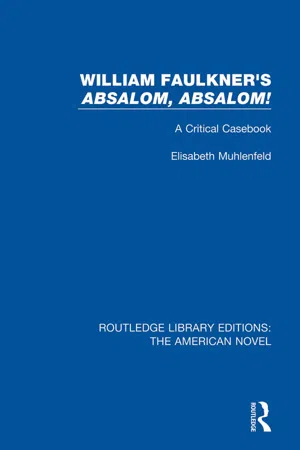
Originally published in 1984. William Faulkner is the most studied American author of our time. This volume presents a collection of some of the best critical essays on William Faulkner's ninth novel Absalom, Absalom!. Numerous approaches are represented; among them are theme studies, close readings, psychological studies, source studies, structural studies, and analyses of style and narrative technique.
- 284 pages
- English
- ePUB (mobile friendly)
- Available on iOS & Android
eBook - ePub
About this book
Information
BIBLIOGRAPHY
SELECTIVE BIBLIOGRAPHY: 1936–1973
The following is a highly selective list of those books and articles dealing with Absalom, Absalom! which were published through 1973, the cut-off date for Thomas L. McHaney, William Faulkner: A Reference Guide (Boston: G.K. Hall, 1976), the standard secondary bibliography of Faulkner’s works. All items in the list which follows, except those reprinted in this casebook, are annotated briefly. For convenience, items are listed alphabetically by author; readers wishing to review the scholarship chronologically may refer to the number preceding each entry, keyed to McHaney (i.e., 68/B47 indicates an article listed in McHaney under the year 1968, list B—shorter writings, item 47). The few items without such a number do not appear in McHaney.
| 72/B1 | Adamowski, T.H. “Dombey and Son and Sutpen and Son,”Studies in the Novel, North Texas State, IV (Fall, 1972), 378–389. Both Dombey and Sutpen are isolated, interested in dynasty, and view their wives similarly. |
| 68/A1 | Adams, Richard P. Faulkner: Myth and Motion. Princeton, N.J.: Princeton University Press, 1968, pp. 172–214. A thorough assessment of the novel, which emphasizes Rosa’s Gothic vision, Mr. Gompson’s classical vision, and Quentin’s biblical language and association with the creation myth and the Fall. Discusses Sutpen as a “representative man.” |
| 59/B6 | Arnavon, Cyrille. “Absalon! Absalon! at l’histoire,” Configuration Critique de William Faulkner II, La Revue des Lettres Modernes, V (Winter, 1959), 250–270. Racial problems are the root of the evil in the novel. Quentin and Shreve, who begin by conducting a “police inquest” into Sutpen’s life, enter upon a holy quest. Discusses twentieth-century techniques and themes in the novel as well as its tragic and deterministic tone. |
| 68/B4 | Aswell, Duncan. “The Puzzling Design of Absalom, Absalom!” Kenyon Review, XXX (Issue I, 1968), 67–84. Reprinted herein. |
| 64/B5 | Barth, J. Robert. “Faulkner and the Calvinist Tradition,”Thought, XXXIX (Spring, 1964), 100–120; reprinted in Religious Perspectives in Faulkner’s Fiction: Yoknapatawpha and Beyond (Notre Dame, Ind.: Notre Dame University Press, 1972), pp. 11–31. The curse on Sutpen, on a deeper level, is slavery—the curse on the South; on a deeper level still, it is the “curse over fallen mankind.” |
| 41/B4 | Beck, Warren. “William Faulkner’s Style,”American Prefaces, VI (Spring 1941), 195–211; frequently reprinted, included in Faulkner: Essays (Madison, Wisc.: University of Wisconsin Press, 1976), pp. 34–51. Uses numerous examples from Absalom to discuss appreciatively Faulkner’s elaborate “full style,” diction, and his “persistent lyrical embroidering and coloring,” which exists side by side with realistic colloquialism. |
| 63/B5 | Björk, Lennart. “Ancient Myths and the Moral Framework of Faulkner’s Absalom, Absalom!” American Literature, XXXV (May, 1963), 196–204. Overview of myths drawn on by Faulkner in the novel, with particular attention paid to the stories of Agamemnon and King David which provide the reader with a moral framework against which Sutpen can be understood. |
| 70/B11 | Bradford, Melvin E. “Brother, Son, and Heir: The Structural Focus of Faulkner’s Absalom, Absalom!” Sewanee Review, LXXVIII (Winter, 1970), 76–98. Bon is his father’s son, “single-minded and inflexible” and destructive of those he touches. Henry alone acts responsibly; he is the novel’s hero. The novel cannot be fully understood without reference to The Sound and the Fury; it is Quentin who is weak and not the South. |
| 51/B7 | Breit, Harvey. “Introduction,”Absalom, Absalom! New York: Modern Library, 1951, pp. v-xii. The novel has a personal quality, as though the father-son story is Faulkner’s “objective correlative of a vision of the South.” |
| 51/B10 | Brooks, Cleanth. “Absalom, Absalom!: The Definition of Innocence,”Sewanee Review, LIX (Autumn, 1951), 543–558. Discusses Sutpen’s innocence as tragic and Quentin’s obsession with the problem of tragedy. |
| 64/B11 | ______. “The American ‘Innocence’: in James, Fitzgerald, Faulkner.” Shenandoah, XVI (Autumn 1964), 21–37; reprinted in A Shaping Joy: Studies in the Writer’s Craft (N.Y.: Harcourt, Brace, Jovanovich, 1971). Sutpen resembles Newman in The Americans and Gatsby in The Great Gatsby; all are typical American innocents who create themselves from ambigious origins. Sutpen, oblivious to the concept of sin, fails to take into account the community of which he is a part. |
| 72/B13 | ______. “Faulkner and History.” Mississippi Quarterly, XXV (Spring 1972), supplement, pp. 3–14. Sutpen is a gnostic who finds history meaningless; he has confidence that he can change the present and create a future. Shreve dismisses the past; Quentin is defeated by it. |
| 63/A1 | _____. “History and the Sense of the Tragic: Absalom, Absalom!” In William Faulkner: The Yoknapatawpha Country (New Haven: Yale University Press, 1963). See “History, Tragedy and the Imagination in Absalom, Absalom!” |
| 63/B13 | ______. “History, Tragedy and the Imagination in Absalom, Absalom!” Yale Review, LII (March 1963), pp. 340–351; included in William Faulkner: The Yoknapatawpha Country (New Haven: Yale University Press, 1963), pp. 295–324, 424–443. Overall analysis of the novel, discussing its marriage of form (which utilizes the detective story), content, and theme. Absalom is a universal novel concerned with man’s relationship to his past and the way in which we apprehend meaning. Sutpen is a tragic figure; Judith, who uses her great strength and love in affirmation, is one of Faulkner’s noblest characters. |
| 73/B16 | ______. “On Absalom, Absalom!” Mosaic, VII (Fall 1973), 159–183. Summarizes and contributes to three critical debates: (1) the problem of fact vs.speculation in the novel, and in particular, the evidence that Bon is Sutpen’s son, (2) Sutpen as a “representative Southern man” and (3) the nature of Sutpen’s innocence. Sutpen has absolute faith in his own will to pursue the American dream. Revised version of section 2 of this article is included in William Faulkner: Toward Yoknapatawpha and Beyond (New Haven: Yale University Press, 1978). |
| 70/B13 | _____. “The Poetry of Miss Rosa Canfield [sic].” Shenandoah, XXI (Spring 1970), 199–206; included in William Faulkner: Toward Yoknapatwapha and Beyond. Rosa’s monologue shows her to be a geniune poet. |
| 72/B18 | Brumm, Ursula. “Forms and Functions of History in the Novels of William Faulkner.” Archiv, CCIX (August 1972), 43–56. In Absalom, Faulkner’s “fullest exploration of the working of a historic consciousness,” Quentin exemplifies that role. |
| 69/B11 | _____. “Thoughts on History and the Novel.” Comparative Literature Studies, VI (September 1969), 317–330. Absalom is an exploration of the epistemological problem of history, and marries “research” (truthful representation) and “fiction” to demonstrate that history is a product of the human mind. |
| 68/A2 | Brylowski, Walter. “Faulkner’s Mythology.” Faulkner’s Olympian Laugh: Myth in the Novels (Detroit: Wayne State University Press, 1968), pp. 17–42. Reprinted herein. |
| 58/B17 | Coanda, Richard. “Absalom, Absalom!: The Edge of Infinity.” Renascence, XI (Autumn, 1958), 3–9. Sympathetic effort to describe Faulkner’s style, especially in terms of its relationship to baroque and Jacobean models. |
| 63/B25 | Connolly, Thomas E. “A Skeletal Outline of Absalom, Absalom!” College English, XXV (November 1963), 110–114; reprinted in Arnold Goldman, ed., Twentieth Century Interpretations of Absalom, Absalom! (Englewood Cliffs, N.J.: Prentice-Hall, 1971). Title is explanatory. Does not differentiate between characters with objective fictional being and those invented by other characters in the novel. |
| 46/B2 | Cowley, Malcolm. “Introduction.” Viking Portable Faulkner (New York: Viking Press, 1946), i-xxiv; frequently reprinted. Cowley’s most influential statement of his thesis that Faulkner’s achievement is his construction of a saga of Yoknapatawpha County. Absalom, Absalom! is a metaphor for the decline of the Old South; Sutpen resembles Faust. |
| 70/B21 | Davenport, F. Garvin, Jr. “William Faulkner.” The Myth of Southern History: Historical Consciousness in Twentieth-Century Southern Literature (Nashville: Vanderbilt University Press, 1970), 82–130. Faulkner’s concern, best exemplified in Absalom, Absalom!, is with ideals and universal (not Southern or American) history. Sutpen’s flaw is his inability to live in history. Relates Thomas Dixon’s The Sins of the Father (1912) to Absalom. |
| 72/B39 | Garzilli, Enrico. “Myth and the Self: Absalom, Absalom!” Circles Without Center: Paths to the Discovery and Creation of Self in Modern Literature (Cambridge, Mass.: Harvard University Press, 1972), 52–60. Sutpen’s aspirations are larger than the American Dream; he seeks “openness to infinity.” Examines mythical analogues, mirrorings and parallels in the novel, particularly patterns of father/son and creator/creation. |
| 73/B44 | Gidley, Mark [Mick]. “Elements of the Detective Story in William Faulkner’s Fiction.” Journal of Popular Culture, VII (Summer 1973), 97–123; rpt. in Larry N. Landrum et al., eds., Dimensions of Detective Fiction (Bowling Green, Ohio: Popular Press, 1976). Absalom is only at its simplest level a detective story. The reader, who must weigh conjectures, becomes his own detective. |
| 67/B36 | Guetti, James. “Absalom, Absalom!: The Extended Simile.” The Limits of Metaphor: A Study of Melville, Conrad and Faulkner (Ithaca: Cornell University Press, 1967), 69–08. Reprinted herein. |
| 59/A1 | Gwynn, Frederick L., and Joseph L. Blotner, eds. Faulkner in the University: Class Conferences at the University of Virginia, 1957–1958 (Charlottesville, Va.: University of Virginia Press, 1959). Contains several statements about Absalom, Absalom!, usually made by Faulkner in response to questions concerning his characterization of Sutpen. Read... |
Table of contents
- Cover
- Half Title
- Title Page
- Copyright Page
- Table of Contents
- Preface
- Introduction
- Richard Poirier, “ Strange Gods’ in Jefferson, Mississippi: Analysis of Absalom, Absalom!”
- Arthur L. Scott, “The Myriad Perspectives of Absalom, Absalom!”
- James H. Justus, “The Epic Design of Absalom, Absalom!”
- Floyd C. Watkins, “What Happens in Absalom, Absalom!?”
- James Guetti, “Absalom, Absalom!: The Extended Simile”
- Duncan Aswell, “The Puzzling Design of Absalom, Absalom!”
- Walter Brylowski, “Faulkner’s ‘Mythology”
- John V. Hagopian, “The Biblical Background of Faulkner’s Absalom, Absalom!”
- T. H. Adamowski, “Children of the Idea: Heroes and Family Romances in Absalom, Absalom!”
- Carl E. Rollyson, Jr., “Absalom, Absalom!: The Novel as Historiography”
- Elisabeth Muhlenfeld, “‘We have waited long enough’: Judith Sutpen and Charles Bon”
- François Pitavy, “The Narrative Voice and Function of Shreve: Remarks on the Production of Meaning in Absalom, Absalom!”
- Bibliography
Trusted by 375,005 students
Access to over 1.5 million titles for a fair monthly price.
Study more efficiently using our study tools.
Frequently asked questions
Yes, you can cancel anytime from the Subscription tab in your account settings on the Perlego website. Your subscription will stay active until the end of your current billing period. Learn how to cancel your subscription
No, books cannot be downloaded as external files, such as PDFs, for use outside of Perlego. However, you can download books within the Perlego app for offline reading on mobile or tablet. Learn how to download books offline
Perlego offers two plans: Essential and Complete
- Essential is ideal for learners and professionals who enjoy exploring a wide range of subjects. Access the Essential Library with 800,000+ trusted titles and best-sellers across business, personal growth, and the humanities. Includes unlimited reading time and Standard Read Aloud voice.
- Complete: Perfect for advanced learners and researchers needing full, unrestricted access. Unlock 1.5M+ books across hundreds of subjects, including academic and specialized titles. The Complete Plan also includes advanced features like Premium Read Aloud and Research Assistant.
We are an online textbook subscription service, where you can get access to an entire online library for less than the price of a single book per month. With over 1.5 million books across 990+ topics, we’ve got you covered! Learn about our mission
Look out for the read-aloud symbol on your next book to see if you can listen to it. The read-aloud tool reads text aloud for you, highlighting the text as it is being read. You can pause it, speed it up and slow it down. Learn more about Read Aloud
Yes! You can use the Perlego app on both iOS and Android devices to read anytime, anywhere — even offline. Perfect for commutes or when you’re on the go.
Please note we cannot support devices running on iOS 13 and Android 7 or earlier. Learn more about using the app
Please note we cannot support devices running on iOS 13 and Android 7 or earlier. Learn more about using the app
Yes, you can access William Faulkner's 'Absalom, Absalom! by Elisabeth Muhlenfeld in PDF and/or ePUB format, as well as other popular books in Literature & Literary Criticism. We have over 1.5 million books available in our catalogue for you to explore.